
Strategy
Management Tools
Financial Institutions
December 08, 2023
Purpose-driven management in cooperative financial institutions
DOI: 10.22167/2675-6528-20230093
E&S 2023,4: e20230093
Edson Mangefesti Franco; Samira Furtado de Queiroz
This research presents a study on purpose-driven management in cooperative financial institutions, aiming to improve the sales process and achieve goals. Two surveys were conducted in credit cooperatives of the same cooperative system of different sizes, located in Nova Petrópolis (RS) and Lavras (MG). The results obtained provided insights to understand what motivates sales teams to achieve their goals and to discover the challenges and opportunities associated with purpose-driven management in sales.
The research sought to analyze the importance and effectiveness of purpose in companies as a driver of greater profitability, as well as the possible benefits of this management model for the organizations that adopt it. Humanized companies, which adhere to new positive approaches and prioritize the well-being of employees, customers, investors, partners, communities, and societies, gain recognition and appreciation from their “stakeholders”, contributing to a better world through their business practices[1].
Most companies do not understand what truly motivates their employees. Many organizations continue to rely on short-term incentive practices, such as cash for performance, despite evidence that such methods can be counterproductive[2]. Motivation, which is intrinsically linked to purpose, is identified as the main stimulus for employees and is essential to ensure individual satisfaction and creativity in their business or operational projects[2]. Therefore, it is fundamental to understand that true motivation lies in the connection with a greater purpose, the pursuit of learning, autonomy, and the positive impact that work can have on the world[2]. Since fair compensation and benefits are necessary to sustain life, balancing these elements with management that promotes a meaningful purpose is crucial[2].
The importance of empathetic leadership, which genuinely cares about the well-being of employees, promoting a friendlier and more productive work environment[3], is widely recognized. External rewards can sometimes have negative effects, and self-imposed goals are healthier than externally imposed goals[2]. Management by purpose plays a fundamental role in humanized companies, which seek a conscious approach to capitalism, integrating “stakeholders”, leadership, culture, and management to achieve sustainable success[1],[2],[4].
For this study, questionnaires were applied to the collaborators of two financial cooperatives of the same cooperative system, one small, in Lavras (MG), and another large, in Nova Petrópolis (RS) in the year 2022.
In the study, the economic-financial data of the credit cooperatives in question (Table 1), obtained from the public annual reports available on their websites, were compared. Table 1 highlights the large disparity in size between the cooperatives, with assets of R$ 4.4 billion for the large one and R$ 80 million for the small one.
Table 1. Economic-financial data
| Data | Cooperative A | Cooperative B |
| Large scale | Small scale | |
| Years of existence | 118 | 33 |
| Number of partners | 188.232 | 4.762 |
| Number of agencies | 46 | 3 |
| Share capital | BRL 216,661,000.00 | BRL 4,842,000.00 |
| Net worth | BRL 542,928,000.00 | BRL 10,212,000.00 |
| Total deposits | BRL 3,362,226,000.00 | BRL 54,852,000.00 |
| Credit operations | BRL 3,094,743,687.14 | BRL 53,203,000.00 |
| Result (leftovers) | BRL 87,397,368.00 | BRL 1,333,000.00 |
| Total assets | BRL 4,457,649,000.00 | BRL 80,685,000.00 |
The research involved two questionnaires applied via Microsoft Forms and informal online conversations with the institutions’ directors. In the small cooperative, 14 out of 30 employees were interviewed, while in the large one, 19 out of approximately 800 employees participated. The questions asked to directors and collaborators had a strategic purpose, allowing for a comparative analysis between the directors’ strategic vision and the sales team’s tactical and operational perspective.
In the questionnaires, the vision of the directors and collaborators of the cooperatives was considered regarding:
- impact of purpose-driven management on results.
- motivation, enthusiasm, and commitment of employees to objectives and goals.
- advantages and disadvantages of purpose-driven management.
- gains, losses, challenges, and opportunities of this model.
Considering the different sizes of cooperatives, variations in the perspectives of commercial teams regarding the purpose-driven management model were explored.
Additionally, focusing on cooperative financial institutions — given that this work focuses on purpose-driven management in cooperative financial institutions —, a survey was conducted to understand the differences between banks and credit unions. These institutions, despite offering essentially the same financial products and services, operate with distinct business models[5].
Table 2. Difference between banks and credit unions
| BANKS | CREDIT COOPERATIVES |
| They are capital companies | They are partnerships |
| Power is exercised in proportion to the number of shares | The vote has equal weight for everyone (one person, one vote) |
| The deliberations are concentrated | Decisions are shared among many |
| The administrator is a third party (market player) | The administrator is from the (cooperative) sector |
| The user of the operations is a mere client | The user is the owner himself (cooperative member) |
| The user does not exert influence on price definition | The operational policy is decided by the users themselves |
| Each user can be treated distinctly | They cannot distinguish, what applies to one applies to all |
| They prefer the big saver and the largest corporations | They do not discriminate and are more directed towards the less affluent |
| They prioritize large centers and bigger cities | They do not restrict, having a strong presence in the interior of the states |
| They have mercantilist purposes | The merchandise is not considered |
| The remuneration for operations and services has no limit | The price of operations and services aims to cover costs |
| They serve en masse, prioritizing self-service | The relationship is personalized, with the support of technology |
| They have no link with the community and the target audience | Are committed to the communities and to the users |
| Aim for profit through excellence | Profit is outside of its scope |
| The result is from few owners | The surpluses (leftovers) are distributed among the users |
| They are regulated by the Corporations Act | They are regulated by the Cooperativist Law |
Credit cooperativism covers half of Brazilian municipalities, with 11.9 million members as of December 2020, representing 4.9% of the population[6]. In December 2020, the assets of the (National System of Corporate Credit (SNCC) totaled R$ 371.8 billion, with credit operations of R$ 213.2 billion and fundraising of R$ 290.1 billion[6]. Credit cooperatives led credit expansion in the National Financial System (SFN) in 2020, with the net worth of singular cooperatives reaching R$ 57.4 billion in December of the aforementioned year. In Brazil, according to data from the Central Bank of Brazil, there were 847 credit cooperatives, 6,474 service points, and about 110,000 employees in 2020[6].
Table 3. Total of singular cooperatives by system
| System | Year 2020 |
| Sicoob | 371 |
| Sicredi | 108 |
| Cresol | 74 |
| Unicred | 35 |
| 2-level sys. | 37 |
| Independent | 222 |
| Aggregate | 847 |
As shown in Table 4, in December 2020, credit cooperativism was present in 50.1% of Brazilian cities, that is, in 2,788 municipalities.
Table 4. Percentage of municipalities with credit cooperative service units by region
| Region | Year 2020 |
| South | 94,20% |
| Midwest | 63,80% |
| Southeast | 61,90% |
| North | 27,60% |
| Northeast | 11,80% |
| Total average in the country | 50,10% |
Tables 5 and 6 are crucial for evaluating the adherence of cooperative financial institutions to purpose-driven management, emphasizing the importance of these actions in generating goals in companies[1],[2],[3], [4], [7], [8].
Table 5 presents the results of the survey with employees from the commercial area of the small cooperative. A reasonable adherence to the principles of purpose-driven management is noted, with the response “almost always” predominating over “always”, and with the term “sometimes” being relevant in some of the evaluated items. It is important to highlight that 23% of employees considered basic rewards, such as salaries and benefits, as “rarely fair”, while another 23% see them as “sometimes fair”. This is a critical point, as it emphasizes the importance of fair basic rewards as a starting point for work motivation[2].
Table 5. Assessment of the questions answered by the small cooperative’s collaborators
| Evaluated Item | Always | Almost always | Sometimes | Rarely | Never |
| Company identification with conscious capitalism | 23% | 62% | 15% | ||
| Purpose-driven management is a practice adopted and disseminated | 54% | 31% | 15% | ||
| Participation of the commercial team in the elaboration of objectives and goals | 38% | 54% | 8% | ||
| Financial incentive and external rewards for achieving goals | 8% | 54% | 38% | ||
| Environment is pleasant, there is trust, autonomy, innovation | 38% | 54% | 8% | ||
| The basic rewards, such as salaries and benefits, are fair | 8% | 46% | 23% | 23% | |
| Has knowledge of the company’s purpose and is committed | 38% | 54% | 8% | ||
| The company genuinely cares about the human side of the team | 23% | 62% | 15% | ||
| Acts guided by the company’s purpose, without short-term pressures | 54% | 46% |
Table 6 presents the results of the survey with collaborators from the commercial area in a large cooperative. A solid adherence to purpose-driven management is highlighted, with a predominance of “always” in the responses. The expression “sometimes” is rare, representing only 6% of the total. Notably, in the item addressing financial incentives and rewards for achieving goals, 56% of collaborators stated that this never occurred in the institution, while 33% said it was rare. It is crucial to emphasize that intrinsic motivation is the basis of the purpose-driven management model and that short-term financial incentives are not recommended to keep professionals committed to the organization’s objectives and goals[2].
Table 6. Assessment of questions answered by employees of the large cooperative
| Evaluated Item | Always | Almost always | Sometimes | Rarely | Never |
| Identification of the company with conscious capitalism | 44% | 50% | 6% | ||
| Purpose-driven management is a practice adopted and disseminated | 72% | 22% | 6% | ||
| Participation of the commercial team in the elaboration of objectives and goals | 83% | 17% | |||
| Financial incentives and external rewards to achieve goals | 11% | 33% | 56% | ||
| Environment is pleasant; there is trust, autonomy, innovation | 50% | 44% | 6% | ||
| The basic rewards, such as salaries and benefits, are fair | 22% | 72% | 6% | ||
| Has knowledge of the company’s purpose and is committed | 94% | 6% | |||
| The company genuinely cares about the human side of the team | 67% | 33% | |||
| Acts guided by the company’s purpose, without short-term pressures | 77% | 17% | 6% |
The concept of conscious capitalism involves the humanization of companies and values the emotional connection between stakeholders[1]. Both cooperatives demonstrated adherence to this concept; in the large cooperative, however, more collaborators stated that they always or almost always perceived this identity (Table 7).
The intrinsic motivation of collaborators was widely practiced in both cooperatives, with greater adherence in the large institution. This is fundamental, as management by purpose is based on intrinsic motivation, eliminating the need for short-term financial incentives to keep professionals committed to goals[2].
Credit cooperatives faced challenges regarding the use of these incentives, with the large one having a higher proportion of collaborators reporting that this practice was never or rarely used. Purpose-driven management requires trust, autonomy, and a pleasant work environment, elements that were practiced in both cooperatives.
Basic rewards, such as salaries and benefits, were considered fair in the large cooperative; in the small one, however, there was a considerable proportion of employees dissatisfied with these practices.
Both cooperatives demonstrated commitment to the company’s purpose and sought to create a human environment. However, the large cooperative stood out in some aspects, such as in the knowledge of the purpose and employee commitment, as well as in the perception that the company genuinely cared about the human side.
Finally, both cooperatives acted guided by the company’s purpose, without short-term pressures, although the large cooperative had a slightly higher proportion of collaborators indicating this (Table 7).
Table 7. Assessment of the questions answered by collaborators from large and small cooperatives
| Customer Evaluation | Scope | Always | Almost always | Sometimes | Rarely | Never |
| Identification of the company with conscious capitalism | Large | 44% | 50% | 6% | ||
| Small | 23% | 62% | 15% | |||
| Management by purpose is a practice adopted and disseminated | Large | 72% | 22% | 6% | ||
| Small | 54% | 31% | 15% | |||
| Commercial team participation in the development of objectives and goals | Large | 83% | 17% | |||
| Small | 38% | 54% | 8% | |||
| Financial incentives and external rewards for achieving goals | Large | 11% | 33% | 56% | ||
| Small | 8% | 54% | 38% | |||
| Environment is pleasant, there is trust, autonomy, innovation | Large | 50% | 44% | 6% | ||
| Small | 38% | 54% | 8% | |||
| The basic rewards, such as salaries and benefits, are fair | Large | 22% | 72% | 6% | ||
| Small | 8% | 46% | 23% | 23% | ||
| Has knowledge of the company’s purpose and is committed | Large | 94% | 6% | |||
| Small | 38% | 54% | 8% | |||
| The company genuinely cares about the human side of the team | Large | 67% | 33% | |||
| Small | 23% | 62% | 15% | |||
| Acts guided by the company’s purpose, without short-term pressures | Large | 77% | 17% | 6% | ||
| Small | 54% | 46% |
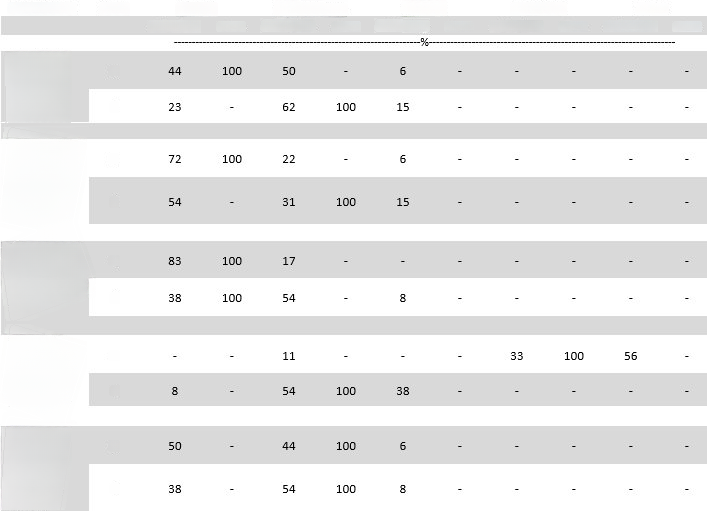
Comparing five strategic items evaluated from the perspective of directors and collaborators from both cooperatives, it is possible to observe significant differences in their perceptions (Table 8). For example, regarding the first item — the identification of the company in relation to conscious capitalism —, the management of the large cooperative had the perception of perfect adherence (100%), while 50% of the employees pointed out “almost always” perceiving this identity, compared to about 44% who stated they always identified it. In the small cooperative, the management’s perception was more aligned with that of the collaborators (Table 8).
The results highlighted the differences between the perceptions of collaborators and directors regarding items such as company identification with conscious capitalism and the use of financial incentives to achieve goals. However, in both cooperative sizes, perceptions of the work environment, trust, autonomy, and innovation were similar between collaborators and directors.
Table 8. Assessment of the questions answered by directors and collaborators of large and small cooperatives
Source: Original research results.
Note: P = Small / G = Large
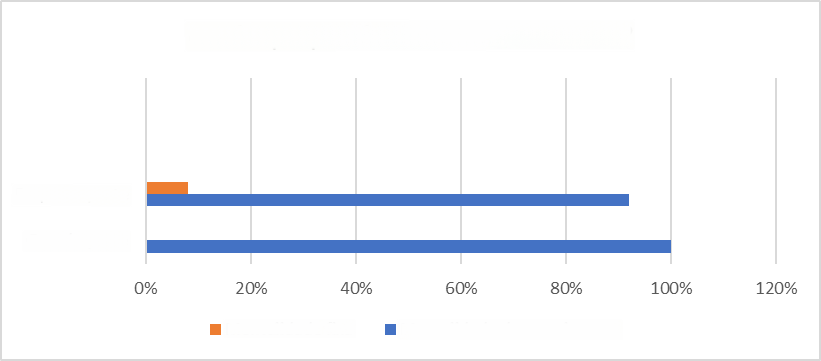
In organizations, two types of mindsets are found among employees: the growth mindset, which is open to learning and evolving, and the fixed mindset, which resists change[9]. In purpose management, which values proactive behavior, the aim is to understand which mindset prevails among employees. The results of this study revealed that the growth mindset was predominant, being more pronounced in large cooperatives compared to small ones (Figure 1).
Figure 1. Assessment of the question answered by cooperative employees
Source: Original research results.
Progress in purpose-driven management is noted in the sales of financial cooperatives, but challenges persist. The traditional model of goals and results is still dominant in cooperative financial institutions, even with efforts to promote the understanding of purpose-driven management among employees, including internal training programs and discussions in forums.
Many credit cooperatives seek to adopt the purpose-driven management model in their teams. It is even known that a large cooperative eliminated quantitative sales targets and achieved a “Net Promoter Score (NPS)” above 75, indicating excellence in recommendations. However, there is a lack of mobilization in the credit cooperative system as a whole. Individual cooperatives, despite promising to meet the needs of their members, often maintain a focus on sales targets, even with short-term financial incentives, contradicting the principles of conscious capitalism, with humanized companies[1].
Purpose-driven management in sales generates significant impacts, increasing team motivation and commitment. In the large cooperative, 72% of respondents considered it a common practice. Furthermore, 83% stated that the sales team participated in goal setting, and 50% said they always found a pleasant environment, with trust, autonomy, and innovation.
Positive aspects of the research include people’s intrinsic motivation, a sense of belonging in a participatory environment, and fair remuneration, without short-term pressures. In this way, the company is recognized and admired by its employees and other “stakeholders”. However, the Brazilian cooperative credit system needs to increase the visibility of this management model and promote it further to obtain sustainable benefits for all interested parties.
References
[1] Mackey J.; Sisodia, R. Capitalismo Consciente: como libertar o espírito heroico dos negócios. Rio de Janeiro (RJ): Editora Alta Books. 2018.
[2] Pink D.H. Motivação 3.0. Rio de Janeiro (RJ): Editora Sextante. 2019.
[3] Scott K. Empatia Assertiva: como ser um líder incisivo sem perder a humildade. Rio de Janeiro (RJ): Editora Alta Books. 2019.
[4] Sisodia R.; Wolfe D.B; Sheth J. Empresas Humanizadas: Pessoas, Propósito, Performance. Rio de Janeiro (RJ): Editora Alta Books. 2019.
[5] Souza J.B.L.; Meinen E. Cooperativas de crédito: Gestão eficaz, conceitos e práticas para uma administração de sucesso. Brasília (DF): Editora Confebras. 2010.
[6] Banco Central do Brasil (BACEN). 2020. Panorama do Sistema Nacional de Crédito Cooperativo. Disponível em: https://www.bcb.gov.br/estabilidadefinanceira/coopcredpanorama. Acesso em: 02 out. 2022.
[7] Covey S.M.R; Merril R.R. A Velocidade da Confiança: o elemento que faz toda diferença. Rio de Janeiro (RJ): Editora Alta Books. 2017.
[8] Magaldi S.; Neto J.S. Gestão do Amanhã: tudo o que você precisa saber sobre gestão, inovação e liderança para vencer a 4ª revolução industrial. São Paulo (SP): Editora Gente. 2018.
[9] Dweck C.S. Mindset: A nova psicologia do sucesso. São Paulo (SP): Editora Objetiva. 2017.
Como citar
Franco E. M.; Queiroz S. F. Gestão por propósito nas instituições financeiras cooperativas Revista E&S. 2023; 4: e20230093.
Sobre os autores
Edson Mangefesti Franco, Diretor Executivo no Sicoob União Central, Praça Cel. Caetano Mascarenhas, 230 – Centro – CEP 35774-000 – Paraopeba/MG, Brasil.
Samira Furtado de Queiroz, Advisor Professor, Pecege – Rua Cezira Giovanoni Moretti, 580 – Santa Rosa – Postal Code 13414-157 – Piracicaba/SP, Brazil.
Download link: PDF