
Strategy
People Management
Leadership
July 28, 2025
Between strategies and solutions: the role of middle management
With the growing adoption of AI tools by companies, the demand for more human leadership, capable of translating organizational culture

The moment a vision becomes routine marks the point at which a strategy proves its worth. Organizations’ ambitious goals need to reach operations whole, translated into priorities, viable processes, and metrics that make sense to those who execute them. When this transition fails — whether because the top doesn’t see the limits (and strengths) of operations, or because the message gets lost along the way — the cost appears. It is on this bridge that professionals with a vital role act: managers, coordinators, supervisors, and team leaders.
Regardless of the title, it is these leaders who translate the strategy, adjust the course in the face of urgencies, and keep the gear turning. In a scenario of accelerated changes, new generations, and technological dilemmas, it is necessary to recognize the leading role of this pressured, but essential, layer. Because, if we want to transform strategy into real solutions, perhaps it is time to look more closely at this bridge.
In a large part of organizations, it is in operations that the greatest costs of material, time, and resources are concentrated. Therefore, any misalignment at this level directly impacts margins, deadlines, and efficiency. It is clear that what each leadership needs to manage varies according to the organization’s segment or its position in the value chain, but the common denominator remains: ensuring that each step is delivered in harmony with the defined strategy.
These managers are also the image of the organization for their teams; they are the ones who, in practice, translate the company’s culture into attitudes, decisions, and examples. They are the ones who coordinate efforts, resolve conflicts, celebrate achievements, and keep the team’s morale high, also accumulating the responsibility of directly influencing motivation and engagement of people — two elements that trigger a series of effects on organizational performance.
Today, motivating teams is no longer just a desirable differentiator, but a strategic condition. A recent McKinsey survey estimates that disengagement, added to talent attrition, can generate losses between US$228 and US$355 million per year for an average S&P 500 company — exceeding US$1 billion in just five years.
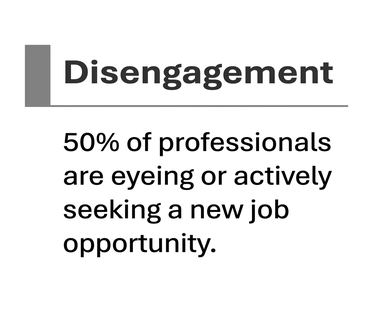
Employee disengagement costs the global economy about US$8.8 trillion per year, equivalent to approximately 9% of global GDP, according to Gallup. According to the “State of the Global Workplace 2025” report, only 21% of professionals feel engaged, while 50% are eyeing or actively seeking a new job opportunity. In other words: how average management mobilizes — or wastes — energy and talent has become a decisive issue of competitiveness.
Movements like quiet quitting, job hopping, and grumpy staying deepen this scenario, revealing the challenges of coordinating efforts in an increasingly complex environment. The “Dream Career 2024” survey by Cia de Talentos reinforces this diagnosis by identifying, among the new generations, a growing feeling of “no future possibility” — fueled by political crises, climate instability, and the fear that artificial intelligence will replace entire functions. Faced with these “drivers of change,” new leaders must also assume the role of translators of context: informing, preparing, clarifying, and, when necessary, retraining. Offering clarity about the organization’s direction and pointing out possible paths for development have become attitudes as important as distributing daily tasks.
The complexity in these translations increases with the generational factor. There has never been so much age diversity in teams. What for some is “resilience,” for others may seem like “stubbornness.” The way work—and the world—is perceived varies from generation to generation. It is up to middle management to adjust the language, balance expectations and find forms of recognition that promote real collaboration.
Lack of preparation
Faced with all these challenges, there is a critical point: a large part of the people who become leaders — or are about to assume this role — are still not prepared to face them, or do not even receive the necessary preparation. This is warned by Eugenio Stipp, a consultant and mentor for professionals at the beginning of their leadership journey, who shared the story of Pedro — an example that illustrates in practice the dilemmas faced by those who have just taken on their first management position. Although set in an industrial plant, Pedro’s experience resonates across various segments and stages of the value chain.
Pedro was one of the best technicians on the team. He knew the process in depth, mastered the machine’s operation, knew how to solve problems with agility, and still had the willingness to teach his colleagues. Whenever a doubt or need for improvement arose, he was the one everyone turned to. Due to his competence and proactivity, he was promoted to supervisor — which, in the leadership’s view, was a natural step.
On the night he received the news, he barely slept. He was excited, but also anxious. He thought a lot and decided that the best way to lead would be to teach the team to do exactly as he did. The next day, he gathered the team, told them about the promotion, and shared “his way” of doing things. But the reaction was not as he expected: some understood, others didn’t, some didn’t want to change, others interpreted everything differently. Over time, the results did not appear.
Pedro tried to get closer, be more understanding, make friends. Then he hardened, tried to demand more. Nothing seemed to work. He started arriving earlier than everyone else and leaving last, putting out fires and getting directly involved in tasks — which further distanced him from management. The routine became a cycle: he overloaded himself, but the goals remained distant. With stagnant indicators, difficult conversations with leadership began. He tried harder and harder, but without preparation, without support, and without guidance, he couldn’t get the team to deliver as expected. In the end, the company lost an excellent technician and gained an unprepared leader. And, after months of frustration and pressure, Pedro was eventually let go — who left exhausted, feeling that he had given his best, but that it wasn’t enough.
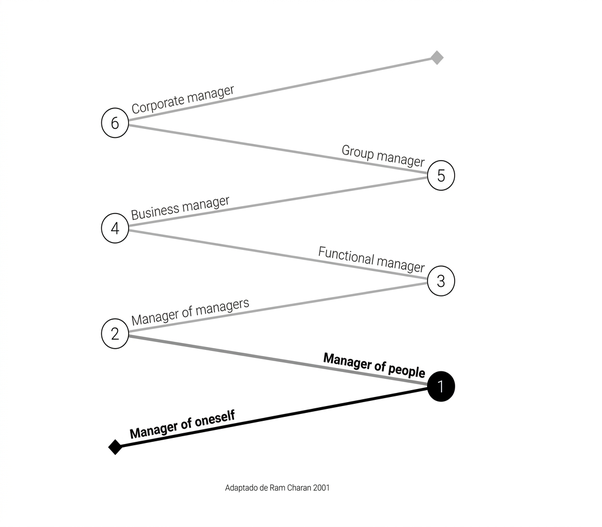
This moment of transition presented in the story is described by Ram Charan in the leadership pipeline — a scale that represents the main points in the management trajectory. At each step, new challenges, responsibilities, and skills emerge that need to be developed. The first of these levels — where Pedro was — is perhaps the most demanding, precisely because it requires the person to stop being an excellent individual performer and become someone capable of coordinating, guiding, and mobilizing the performance of others. As Eugenio Stipp warns, this is often the most critical transition of the entire leadership journey , as it marks the break between doing and coordinating.
Each new stage of the pipeline demands transformations in the way of thinking, acting, and perceiving one’s own role. When this adaptation does not occur — whether due to lack of preparation or support — goals are no longer met, the organizational climate weakens, and often the company ends up losing professionals who were previously seen as great talents. Pedro, like so many others, stopped being evaluated solely by what he directly delivered and began to be held accountable for what he could generate through the team. This shift requires skills that were not always developed up to that point and for which, in general, specific training is not offered.
Pressure
Annie Dymetman, coordinator of the House of Mediation, highlights that the pressure and the sense of crisis are almost constant in the lives of those who lead, as the leader occupies a unique position: they need to emotionally sustain the team while responding to higher or external instances. “All the time they are sandwiched,” she summarizes. Without support, structure, or preparation, this reality becomes suffocation, and crisis becomes routine. Nevertheless, Annie reinforces that the leader cannot show they are terrified, as it is precisely they who need to maintain the emotional stability of the team. Leading, in these contexts, means sustaining a constant tension between what is felt internally and what needs to be shown externally — a dissonance between fear and responsibility that, as Annie points out, is not a mistake, but part of the function. For this pressure not to become a permanent state of wear and tear and loneliness, it is essential that the challenges are aligned with preparation and that adequate support resources are available for leadership.
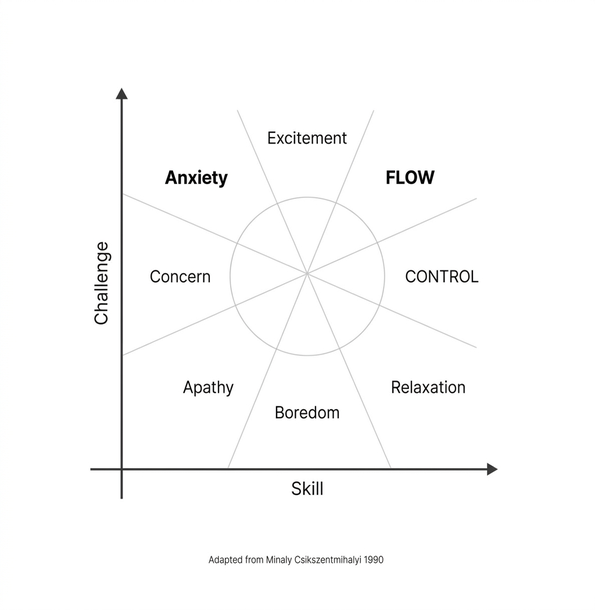
The Flow Model, developed by Mihaly Csikszentmihalyi, helps illustrate this point. Typically used to describe states of high performance and engagement, the model also allows us to see the opposite: what happens when the level of challenge exceeds the skill or readiness. It is in this mismatch that states of anxiety, worry, and frustration arise.
It is natural for leaders to face unexpected situations for which they are not fully prepared — that is part of the role. But it is not feasible to live in a permanent state of anxiety and overload. The challenge is that this preparation takes time. The curve can be long — and, when the need for a new leader arises, it is possible that they are not yet ready. Or worse: that they don’t even want the position.
This is what the phenomenon of quiet ambition shows, identified by consultancies and research. A silent but growing movement, in which professionals choose not to seek leadership positions — not due to a lack of competence, but by their own decision. Without intentional preparation, we run the risk of repeating the cycle: promoting good technicians without offering the necessary support — or, worse, simply not having people willing to assume leadership positions.
According to Runn (2023), 63% of millennials believe their organizations are not developing enough leaders. This warning is not new. In 2018, a survey by Fórum CEO Brasil already indicated that 76% of CEOs of large companies were concerned about the shortage of leadership. Since then, the issue has only gained momentum: in the most recent editions of the Great Place to Work survey, leadership development remains at the top of priorities in people management . Furthermore, the survey highlights the urgency of actions focused on mental health — an issue also present in studies such as Gartner’s (2024) and the World Economic Forum’s 2025 report, which points to well-being as the main factor for talent attraction.
AI
With generative artificial intelligences increasingly taking over tasks and processes, it is natural for companies to seek to adopt them for greater efficiency. This also increases the demand for a more human leadership, one that is close, capable of translating organizational culture, guiding changes, and sustaining relationships.
It is this layer that drives and makes innovation possible. It is these leaders who cushion the impacts of vertical decisions, help redefine priorities amidst chaos, and preserve the integrity of the organizational culture. But when they stop supporting innovation and AI implementation — by centralizing decisions and blocking processes — they end up being discarded.
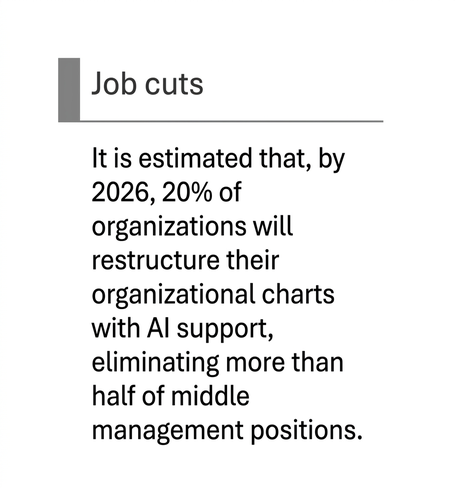
According to a recent article from the “Harvard Business Review”, facing a shortage of prepared leaders, technological advancement and the prospect of a lack of successors, many companies have adopted delayering: a process of eliminating intermediate positions to reduce costs and increase agility. It is estimated that, by 2026, 20% of organizations will restructure their organizational charts with the support of AI, eliminating more than half of middle management positions.
In a scenario of successive crises, accelerated changes, and constant technological advancement, leadership has ceased to be mere command: it has become a construction of trust. Middle management gains prominence by translating strategies into action, sustaining relationships, cushioning impacts on teams — and still dealing with the implementation of new tools, meeting the growing expectations of teams, and keeping up with the evolution of work. Organizations that understand this will be better prepared to face unpredictability, care for people, and build sustainable futures.
| To access the references of this text click here. |
Who wrote this column
Lucas Tangi