
September 15, 2026
Decision Making and Data Quality: Perceptions on Accuracy, Completeness, Consistency, and Availability.
Lucas Rodrigues Banhete Moreno; Adriano Matos de Oliveira
DOI: 10.22167/2675-6528-202602262
Article derived from a Final Course Work (TCC), with content based on the student’s original work and adapted to the editorial format of the E&S Magazine with the support of the ResumeAI tool, an artificial intelligence solution developed by the Pecege Institute for textual synthesis and organization.
Abstract
The exponential growth in the volume of data generated and consumed globally has transformed how organizations conduct their decision-making processes, making information quality a determining factor for the effectiveness of these decisions. This study analyzed the perception of professionals who use data in their daily functions regarding data quality in organizational decision-making processes. A quantitative descriptive methodology was adopted, with data collection carried out through a structured five-point Likert scale survey. The sample was non-probabilistic by convenience, composed of professionals from different hierarchical levels and company sizes. For the analysis of the results, descriptive statistical techniques and Spearman’s correlation were employed. The analyses revealed that the use of data was widely incorporated into the participants’ decision-making routine and that the evaluated quality dimensions were predominantly perceived positively, with the exception of consistency, which showed the lowest performance and the highest dispersion. Correlations between quality dimensions and decision-making confidence were positive and statistically significant, with accuracy standing out as the dimension with the greatest influence on decision-making security. It was concluded that, although organizations show progress in adopting data-driven practices, structural challenges related to information consistency persist, indicating the importance of improving data integration and governance practices.
Keywords: Decision-making confidence; Data governance; Organizational perception; Data quality; Decision-making.
1. Introduction
The global technology market has registered significant growth in recent decades (Yalli et al., 2024). Considering Brazil alone, the value moved in this market in 2024 was estimated at around R$ 762 billion, which corresponds to 6.5% of the national Gross Domestic Product (Brasscom, 2025). This technological advancement, combined with business expansion, imposes on companies the constant need to improve their internal processes, especially those related to decision-making (Rajagopal et al., 2022). In this scenario, the great challenge for organizations is to respond to internal and external demands with agility and effectiveness, always remaining aligned with the company’s strategy (Avancha et al., 2024).
In this context, to achieve business success, organizations need to have resources that support their decision-making processes, as these processes represent critical points for good management (Salehzadeh and Ziaeian, 2024; Kozioł-Nadolna and Beyer, 2021). Among an infinity of resource classes, data gains prominence, assuming an increasingly strategic role in companies, where it is already considered a fundamental asset for innovation processes and is constantly compared to oil in terms of value and relevance (Sacramento, 2024). The relevance of the topic intensifies with the exponential growth in demand, as well as the volume of data generated, consumed, and shared on a global scale (Castro et al., 2024; Arinze, 2024). As a result of this scenario and the advancement of generative artificial intelligence models, it is estimated that by the end of 2025, this volume will reach 81 zettabytes, representing an almost threefold increase compared to 2020 (World Economic Forum, 2024). This data growth highlights the need for efficient data storage, analysis, and usage strategies (Alsalim and Javed, 2024), reinforcing the importance of studies that address the challenges and opportunities related to the management and application of emerging technologies (Adewusi et al., 2024).
Despite its importance on the global stage, the use of data in decision-making processes still faces significant challenges (Fanelli et al., 2023). In this context, many professionals, when making relevant decisions, rely on intuition and previous experiences (Vergara, 1993; Savioni et al., 2023), which can become a problem, as it may generate inferior results when compared to actions based on data. Wand and Wang (1996) and Nilashi et al. (2023) argue that the large volume of data, by itself, does not guarantee value generation, as the central issue lies in the quality of the data.
Although the concept of data quality is not unanimous in various publications, characteristics such as accuracy, completeness, consistency, and availability are frequently recognized as fundamental (Cai and Zhu, 2015; Fox et al., 1994). However, the evaluation of data can be relative, varying according to different business contexts and decision-making levels in which they are applied; for example, datasets used in daily operations may not meet objectives when applied to strategic issues (Lacagnina et al., 2023). Thus, a reliable and effective decision-making process depends on the availability of quality data, aligned with organizational purposes, in various business contexts (Alabduljabbar and Alshammari, 2024).
Given this scenario, the present work is justified by the need to understand market professionals’ perception of the quality of data used at various decision-making levels, contributing to the improvement of data management and governance practices. Therefore, this study has the general objective of analyzing the perception of professionals who use data daily in their roles regarding data quality in organizational decision-making processes. Furthermore, it has the following objectives: (I) Identify whether data are used in decision-making processes; (II) Evaluate respondents’ perception regarding data quality dimensions (accuracy, completeness, consistency, and availability); (III) Analyze the correlation between data quality and the reliability of decisions made.
2. Material and Methods
The present study was characterized as a descriptive research, with a quantitative approach, aiming to understand professionals’ perception of the quality of data used in business decision-making processes. This type of research allows for the description of phenomena and correlation analyses between variables (Gil, 2022). As a foundation for the work, a literature review was conducted in academic articles, scientific journals, and books to contextualize the topic and outline the research objectives (Gil, 2022).
Data collection was carried out through a field survey, using a structured questionnaire (Appendix A) divided into four sessions: characterization of participant profiles, identification of the intensity and means of interaction with data, assessment of perception regarding data quality dimensions, and understanding of impacts on decision-making confidence. The questionnaire, consisting of fourteen closed-ended questions, mostly formulated based on a five-point Likert scale, was developed on the “Google Forms” platform and shared through digital platforms such as “WhatsApp”, “LinkedIn”, and “e-mail” (Malhotra, 2019; Meireles, 2024). Before the final application, a pre-test was conducted with a group of five respondents, comprising three data professionals and two data users, to evaluate the clarity of the questions, the suitability of the response scales, and the average completion time (Gil, 2022).
The sampling adopted was non-probabilistic, by convenience, defined based on participant accessibility. This approach, although it does not allow the generalization of results to the entire population, allows for the gathering of individuals with characteristics relevant to the phenomenon studied, in this case, professionals who use data in their decision-making processes, which makes it possible to obtain qualified insights on the subject (Malhotra, 2019). The sample comprised professionals from different hierarchical levels (operational, tactical, and strategic) and from different areas of activity, aiming to broaden the diversity of perspectives.
For the data analysis, descriptive statistics techniques were employed, with the calculation of measures of central tendency (mean and median) and dispersion (standard deviation) of the main items of the survey. The responses were tabulated and normalized in spreadsheets, which allowed for visualization in tables and graphs (Artes, 2023). Subsequently, correlation analyses were performed using Spearman’s coefficient, utilizing the Jamovi statistical software, to examine the association between data quality variables and confidence perception in decision-making processes (Siegel and Junior Castellan, 2006).
Regarding the ethical aspects, the research was based on the anonymous collection of participant perceptions, without any direct identification or intervention, framing it as public opinion research. Thus, the study was considered exempt from the registration process for submission and analysis by the Research Ethics Committee [CEP] with Human Beings and by the National Research Ethics Commission [CONEP].
3. Results and Discussion
Sample Characterization
176 respondents who interact with data in their decision-making processes were identified. The sample was predominantly composed of professionals from large companies (66.5%), with a balanced distribution among analytical roles (35.2%), coordinators (19.9%), managers (34.1%), and directors (10.8%). Heterogeneity was observed in organizational tenure, with 35.8% of participants having more than 7 years with the company and 33.5% between 1 and 3 years. The distribution across operational (34.7%), tactical (33%), and strategic (32.4%) decision-making levels was homogeneous, allowing for a comprehensive view of organizational perceptions.
Table 1. Sample characterization
| Variable | Category | Quantity | % |
|---|---|---|---|
| Company Size | Minute | 17 | 9,7% |
| Company Size | Small | 13 | 7,4% |
| Company Size | Average | 29 | 16,5% |
| Company Size | Large | 117 | 66,5% |
| Function | Analyst | 62 | 35,2% |
| Function | Coordinator | 35 | 19,9% |
| Function | Manager | 60 | 34,1% |
| Function | Director | 19 | 10,8% |
| Company tenure | <1 ano | 25 | 14,2% |
| Company tenure | 1-3 years | 59 | 33,5% |
| Company tenure | 4-7 years | 29 | 16,5% |
| Company tenure | >7 years | 63 | 35,8% |
| Decision-making level | Operational | 61 | 34,7% |
| Decision-making level | Tactical | 58 | 33% |
| Decision-making level | Strategic | 57 | 32,4% |
Source: Original research results
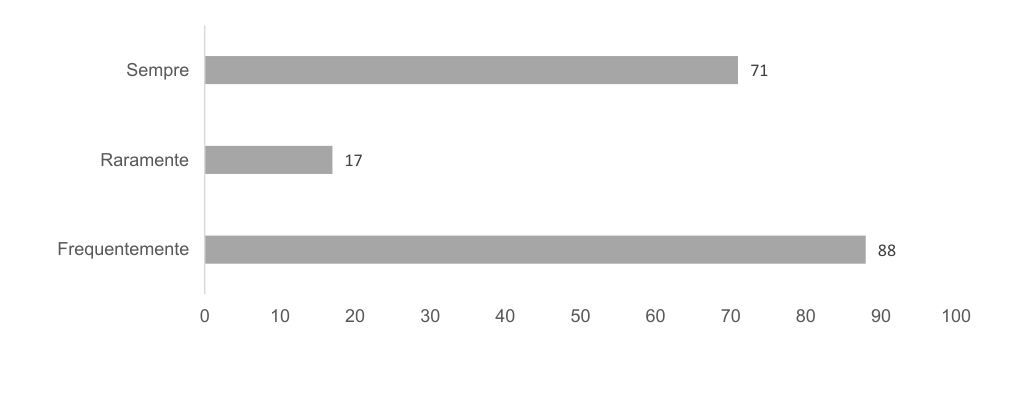
The results indicated that the use of data is strongly consolidated in the professional routine of the participants, with 98.3% of the sample declaring the need for data to support decisions, regardless of hierarchical level. This finding reinforces the central role of data in contemporary management models (Avancha et al., 2024). The high frequency of use, as detailed in Figure 1, indicated a continuous consumption of data, characterizing data-driven organizational environments and consolidating data as a strategic resource (Sacramento, 2024).
Figure 1. Frequency of data consultation in decision-making.
Source: Original research results
Analysis of perceptions on data quality and confidence in decision-making
The analysis of participants’ perceptions of the data quality dimensions revealed predominantly positive evaluations. Table 2 presents the means and standard deviations for each dimension. Completeness (mean of 3.94), availability (mean of 3.78), and accuracy (mean of 3.72) were the best-performing dimensions, suggesting that the data are perceived as sufficient, accessible, and faithful to the operational reality. This configuration indicated a certain degree of organizational maturity in data provision and use.
Table 2. Perceptions of data quality dimensions
| Dimension | Question | Average | Median | Standard deviation |
|---|---|---|---|---|
| Accuracy | Q8 | 3,72 | 4 | ± 0,85 |
| Completeness | Q9 | 3,94 | 4 | ± 0,78 |
| Consistency | Q10 | 3,36 | 4 | ± 1,05 |
| Availability | Q11 | 3,78 | 4 | ± 0,96 |
Source: Original research results
In contrast, the consistency dimension showed the lowest performance (average of 3.36) and the highest dispersion (standard deviation of ± 1.05) among the evaluated dimensions. This result indicated that, although the data could be reliable in isolated sources, its coherence across different sources or systems still represents a challenge, pointing to limitations in information integration and standardization (Cai and Zhu, 2015; Fanelli et al., 2023).
The analysis also addressed confidence in data-driven decisions, the use of intuition, and the impact of data quality issues. Table 3 summarizes these results. Confidence in data-driven decisions was predominantly positive (average of 3.66), recognizing data as a relevant element in the decision-making process. The use of intuition and professional experience over data was recurrently observed (average of 3.15), acting complementarily to data-driven approaches (Mi et al., 2025). The impact of data quality issues on decision effectiveness was perceived as moderate (average of 3.50), indicating that data quality failures can influence strategic and operational processes (Khong et al., 2023).
Table 3. Perceived confidence, insights, and impacts
| Variable | Question | Average | Median | Standard deviation |
|---|---|---|---|---|
| Confidence in data-driven decisions | Q12 | 3,66 | 4 | ± 0,75 |
| Use of intuition over data | Q13 | 3,15 | 3 | ± 0,77 |
| Impact of data quality problems | Q14 | 3,50 | 3 | ± 0,96 |
Source: Original research results
Correlations between quality dimensions and decision-making confidence
Spearman correlation analyses revealed positive and statistically significant associations between all data quality dimensions and the perceived level of confidence in decision-making processes. This suggests that a greater perception of data quality tends to increase professionals’ confidence and security in their decisions. Table 4 presents the correlation coefficients.
Table 4. Correlation between quality dimensions x confidence in data-driven decision-making processes
| Variable | Spearman | p Value |
|---|---|---|
| Accuracy | 0,510 | <0,001 |
| Completeness | 0,475 | <0,001 |
| Consistency | 0,365 | <0,001 |
| Availability | 0,451 | <0,001 |
Source: Original research results
The accuracy dimension presented the highest correlation coefficient (0.510), classified as a strong correlation according to Cohen (1988). This indicates that the perception that the data faithfully reflects the operational reality is the most influential factor in building decision-making confidence. The completeness (0.475) and availability (0.451) dimensions showed moderate correlations, suggesting that the existence and accessibility of information complement decision-making confidence (Mi et al., 2025). Consistency, although with the lowest coefficient (0.365), still demonstrated a moderate and statistically significant correlation, indicating that standardization between sources influences confidence, albeit less intensely than the other dimensions. Standardization issues may not be immediately perceived or may have an indirect impact.
In summary, the study demonstrated that data are widely incorporated into professionals’ decision-making routines, being perceived predominantly positively in terms of completeness, availability, and accuracy. The consistency dimension, however, revealed structural fragilities related to data standardization and integration. Accuracy was identified as the dimension with the greatest influence on decision-making confidence, while intuition and professional experience act complementarily to data use, and data quality problems can impact decision effectiveness.
4. Conclusion
The study analyzed the perception of professionals who use data in their daily functions regarding data quality in decision-making processes within organizations. It was found that the use of data was widely incorporated into the participants’ decision-making routine, being a consolidated practice at different hierarchical levels. The data quality dimensions, such as completeness, availability, and accuracy, were predominantly perceived positively by professionals. However, data consistency showed the lowest performance and the greatest dispersion, indicating structural weaknesses related to the standardization and integration of information across different sources and systems. It was observed that confidence in data-driven decisions was positive, and accuracy emerged as the dimension with the greatest influence on building this decision-making confidence, suggesting that the fidelity of data to operational reality is crucial.
The main contribution of this study lies in the explicit statement of persistent challenges in data quality management, especially regarding consistency, despite organizational advances in adopting data-driven practices. This reinforces the importance of improving data integration and governance practices to ensure greater reliability and effectiveness in decision-making processes. However, the study has limitations due to the use of a non-probabilistic convenience sample, which restricts the generalization of findings, and the use of self-reported data, which may be subject to biases. The cross-sectional nature of the research also limits the analysis of causal relationships over time. For future studies, it is suggested to conduct research with larger and probabilistic samples, adopt longitudinal approaches to investigate the evolution of variables, and deepen the investigation into data governance and management practices, focusing on information integration and consistency.
Bibliographic References
Associação das Empresas de Tecnologia da Informação e Comunicação e de Tecnologias Digitais [Brasscom]. 2025. Relatório Setorial 2024 do Macrossetor de TIC. Disponível em: . Acesso em: 11 out. 2025.
Avancha, S.; Aggarwal, A.; Goel, P. 2024. Data-Driven Decision Making in IT Service Enhancement. Journal of Quantum Science and Technology 1(3):10-24.
Rajagopal, N.K.; Qureshi, N.I.; Durga, S.; Asis, E.H.R.; Soto, R.M.H.; Gupta, S.K.; Deepak, S. 2022. Future of business culture: An artificial intelligence-driven digital framework for the organization’s decision-making process. Complexity 2022(1): 01-14.
Salehzadeh, R.; Ziaeian, M. 2024. Decision making in human resource management: a systematic review of the
Yalli, J.S.; Hasan, M.H.; Badawi, A.A. 2024. Internet of Things (IoT): origins, embedded technologies, smart applications, and its growth in the last decade. IEEE 12(): 91357-91382.
Article originating from the Course Conclusion Work of the Specialization in Business Management of the MBA USP/Esalq
To learn more about the course, click here and access the MBX Academy platform