
Design Thinking
Education
Project Management
User Experience (Ux)
December 26, 2022
UX Design and Design Sprint in the conceptualization of an educational platform for Basic Education
DOI: 10.22167/2675-6528-20220037
E&S 2022,3: e20220037
Ana Luiza Gasparette dos Santos Cecconi e Alexandre Barreto de Almeida
Since 2012, data show that Brazil still presents a large margin for improvement in the education sector. In 2018, the survey Portraits of Brazilian Society – Basic Education, from the National Confederation of Industry (CNI)[1] showed an increase in public dissatisfaction with the country’s education. In the survey, 26% of respondents considered high school in public schools to be poor or terrible, an increase of 11% compared to 2013. The data also showed a drop in the number of respondents who consider high school in public schools to be excellent or good: from 48% to 31% between 2013 and 2018. Regarding private schools, the number of respondents who consider the same school level to be excellent or good also decreased, in the same period, from 76% to 64%. In 2018, only 12% of respondents believed that a public high school student would be prepared for the professional market
A scenario of dissatisfaction and criticism of the Brazilian educational system was widely observed throughout the 2010s and, recently, with the context of the COVID-19 pandemic, some fragilities of education have become more evident. A survey by Unesco[2] showed that Brazilian schools were without in-person classes for approximately two-thirds of the 2020 school year, totaling a period of forty weeks. This period boosted structural problems, such as access, dropout rates, and the low quality of the system, to a proportion that cannot yet be measured. Unicef[3] predicts the risk of Brazil regressing two decades in access to education. C6 Bank[4] showed that about 4 million Brazilian students dropped out of their studies, representing a dropout rate of 8.4%.
Given this scenario, in recent years and during the COVID-19 pandemic, several companies offering solutions to basic education, for both private and public institutions, have been investing more and more in innovation and technology, in order to meet the various needs of the Brazilian educational system, which presents a large margin for improvement.
The development of a new product or service requires the organization to gather information and conduct a rigorous evaluation, which allows inferring about: i. the target audience’s demand; ii. sales potential; iii. competitor positioning; and iv. the initiative’s viability, considering the investments and costs associated with its realization[5]. In this sense, UX Design and its tools, as well as Design Sprint, are fundamental for understanding the target audience and their real needs, and can be seen as effective means in the search for solutions to the current demands of the Brazilian educational system.
Design Sprint and UX Design are approaches that have gained popularity in recent years, mainly among information and communication technology companies, with their foundations in the so-called Design Thinking. It is an approach that uses design methods and tools for the development of products and services that meet people’s needs, according to the economic and technological resources available for the project, being able to convert ideas into value for the client[6].
By proposing the involvement of various “stakeholders” during the process, Design Thinking can be used to deal with complex situations, with problems that are not clearly defined, in addition to supporting ideas that are still under construction. This approach also has the intuition process for pattern recognition in the mental construction of ideas and forms of expression[5], through strategies that allow each collaborator to contribute to the creation of innovative solutions for complex problems.
As Design Thinking is a human-centered approach, the adopted mindset is from the learning culture, focusing on interactive processes, prototyping, and radical collaboration, promoting unrestricted imagination[7]. With the popularization of Design Thinking, other approaches have been developed and deepened, as happened with UX Design and Design Sprint. To ensure the success of any strategy designed by UX Design, it would be necessary to include users in the solution creation process, to seek understanding of how they relate to any product.
The focus on the user, more than simply discussing how the developed components would look, would also allow for an examination of how efficient a product is in achieving the purpose for which it was conceived. The intent of UX Design, then, would be to ensure focus on the main needs of users, to obtain solid information during the development process, guaranteeing the prevention of errors and bad choices that, in turn, could cost the company dearly[8].
The study was conducted in a company based in São Paulo that operates in the education sector, developing technology and didactic content for formal education schools from the Final Years of Elementary School to High School. The technology developed by the company has already been used by twelve million students in Brazil, with the only official study platform for the Enem, certified by the Ministry of Education. With the COVID-19 pandemic scenario, new schools sought the solution offered by the company as an ally in conducting remote classes. In order to reach new age groups as a target audience and expand the solutions offered, the company decided, at the end of 2020, to develop a new education platform aimed at the segment of the Initial Years of Elementary School, which comprises the teaching-learning of children between 6 and 10 years of age. The survey conducted on the market potential of this new solution showed a reach of 14,449 private schools, totaling more than five million potential students. Observing the schools belonging to the company’s base, half of them expressed interest in expanding the already contracted solution to the Initial Years of Elementary School as well.
The creation of the educational platform aimed at Early Elementary Education was a project still under development, hence it was considered a “startup”. As a startup, the project was developed to quickly discover the right product to create: what will be desired and subsequently purchased by the customer[9]. The construction of the new product occurred in sprints, focusing on an innovative product, and a process with rapid user interactions and insights, in a feedback cycle called build-measure-learn[9].
The work was carried out based on the observation of the ideation process of the multidisciplinary team responsible for developing the minimum viable product to be sold in schools that would adopt the platform for Elementary School – Early Years in 2022. This team was composed of designers, UX designers, product managers, pedagogical designers, and editors specialized in the different curricular components of the school curriculum.
Development stages
Design Thinking is the basis of UX Design’s operation, and to systematize product development, the stages of the “Double Diamond” model, mapped by the Design Council UK in 2005[10], were considered. It is worth noting that the process is not necessarily linear, so the stages can be revisited at different times in a modular fashion (Figure 1).

Figure 1. Representation of the “Double Diamond” in Design Thinking
Source: Ágil Além da TI[11].
The first stage is called Understand, in which the team conducts research to obtain information about the proposed challenge, seeking to understand it and leveling the knowledge of all team members[10]. For this, theoretical research on education was carried out, search for important demographic and regional data, qualitative interviews with some important “stakeholders” for product development, external qualitative interviews with school agents and potential users, in addition to benchmarking, that is, a strategic analysis of the best practices used by companies in the same sector[12].
Theoretical research on education, based on work carried out in schools considered benchmarks in Brazil, worldwide, and within the company’s client base, led to pedagogical deepening. Consequently, the search focused on pedagogical benchmarks linked to active methodologies and teaching for innovation, as they are commonly mentioned among reference schools in the market. During the research, the following key points were considered: i. thinking routines; ii. National Common Curricular Base (BNCC); iii. “backward design”; iv. reading and interpretation of images and texts; v. psychomotricity; vi. constructivism; vii. socio-interactionism; and viii. use of digital in learning. This research was documented internally as a means of consultation during subsequent stages.
The qualitative interviews involved the directors of Customer Service, Editorial, the Commercial team, the Pedagogical and Product teams, along with the company’s CEO and the director of the main investor institution of the project. Some key questions were replicated in all interviews, involving issues related to market and growth, risks and constraints, competition, pedagogical vision, research and deepening suggestions, as well as more subjective questions to understand the expectations and values of the interviewees. This first round of interviews aided the team’s understanding of the product’s internal expectations and demands, as well as the business alignments established for the project to be initiated.
Qualitative interviews were also conducted with directors, coordinators, teachers, parents, and students from some client schools of the company already interested in acquiring the platform for Early Elementary Education, in addition to interviews with teachers and coordinators from some private schools that stand out in the Brazilian educational system.
With the group of directors and coordinators, the interviews sought to map the school’s social and cultural context, the adopted teaching materials, the challenges faced by the institution, and the school’s expectations regarding the company’s project with Elementary School Years. With the group of parents and students, in turn, the interviews sought to understand the reasons that led parents to enroll their children in a particular school, how the family routine and study incentives worked, as well as how parents perceived their children’s relationship with the school, seeking to understand the children’s motivations and blocks, and how parents followed their children’s learning process.
The interviews with the teachers in the segment sought to understand their motivations and weariness, their relationship with students and parents, the areas in which they would like to develop, the extra teaching materials and digital resources they like to use daily, what the ideal teaching material would be, their knowledge of active methodologies, as well as their way of putting them into practice, and the main challenges they face when working with the BNCC. In all the interviewed groups, some questions were asked in order to understand how the school routine was adapting to the remote environment and the COVID-19 pandemic scenario.
In this first moment (Understand), the benchmarking was comprehensive, gathering information from didactic materials used in the classroom to digital platforms used as complementary to teaching. This was also documented internally as a means of consultation during subsequent stages.
The second stage, Observe, is when field trips are made to talk to potential users and target audience, in an exercise of listening and observation, seeking to understand their real needs. At this moment, it is important to analyze the user’s context more broadly, considering physical, cultural, sociological, psychological, and behavioral aspects from different perspectives[10]. Therefore, all members of the multidisciplinary team followed a schedule of observing regular classes from three schools – already clients – that expressed interest in being platform pilots (pilot schools). In addition, planning meetings for teachers of Early Childhood Education were also attended. Due to the context of the COVID-19 pandemic, the observation practice was carried out online.
During the observations, some points were systematized in spreadsheets: i. school, teacher, school year, and curricular component; ii. link of the planning document used by the teacher; iii. which resources were used and if there was a need to adapt any resource; iv. how communication between teacher and student was, that is, what agreements were made in the classroom; v. didactic material used; vi. which skills required by the BNCC were worked on; what activities were proposed and how each one was delivered; vii. what were the moments of greatest and least student engagement; how the content was worked on; viii. what were the difficulties of students and teachers; ix. examples of striking student phrases and positive reinforcement from teachers.
Both the Understand and Observe stages showed that, for the team to be attentive and empathetic to users’ needs, it is necessary to invest time in being with them. To this end, it is important to constructively guide users so that they provide the essential information for product creation, regardless of whether they perceive the guidance or not[8].
The third stage, named Point of View, can be one of the most difficult in the process. After researching and collecting data, new “insights” and understandings are generated and, with this, it is necessary to reach a new understanding of the problem[10], bringing the guiding questions to the product design. For this, some common UX Design tools were used, such as storytelling, personas, and the empathy map.
A product narrative is a continuous story of how the product would shape users’ lives, which can be enriched with detailed scenarios about how the product will be used[8]. The creation of personas is one of the ways to expand a product’s narrative.
The persona is important in situations where there is a distance between the product/solution developer and the user, serving as an instrument intended to provide deep reflection by considering objective and subjective aspects of the user, analyzing their psyche to imagine what motivates them. The use of personas can produce quite tangible effects in the ideation of a solution, especially when the persona is validated by the user[8].
The empathy map is a tool that helps researchers empathize with and understand users and their needs, as well as systematize research observations[13]. It can be used to assist and reinforce the construction of personas, capturing behaviors and allowing the construction of user stories. The empathy map is used with the intention of preparing the team’s knowledge about the product’s customer segment, helping the team to empathize with the user[13].
For this stage, the data from the interviews and the survey were compiled and systematized into empathy maps and personas, thus mapping the main user needs, also called user requirements. The process of systematizing these requirements demands that the abstract requests of the target audience be converted into meaningful needs. After listing these needs, the result was shown to the potential users interviewed, in order to validate the systematization of the data and ensure that the team correctly understands the demand, as well as to verify if the product vision is compatible with that of the target audience[8]. This list also underwent internal validation by the “stakeholders” involved in the project, and, after verification, the following priority needs were reached in the project (Figure 2).

Figure 2. Systematization of the priority requirements of the stakeholders of a platform project for Elementary School Initial Years
Source: Elaborated by the author
Collecting user requirements is the most important part of a UX Design strategy, as it helps establish the foundation for the subsequent steps of the product development process. The prioritized user needs were considered guiding principles in the following stages, helping to establish the product’s technical requirements, that is, what the platform needs to have to meet the main user requirements[8]. The discussion about technical requirements is part of the process of starting to think about the solution, which is deepened in the Ideation, Prototyping, Testing, and Iteration stages. In the design of the education platform, these stages were developed with the Design Sprint.
The stages of Ideation, Prototyping, and Testing, from the “Double Diamond” model, were carried out through sprints, which decided the characteristics, functionalities, and usability of the minimum viable product to be launched for the pilot schools. The Design Sprint method is characterized by the union of some good practices in strategic management, innovation, behavioral sciences, design, among others, focusing on testing the effectiveness of an idea through a realistic prototype. The Sprint forces the team to concentrate on the most urgent issues, allowing learning to occur from the surface of what the product would be. The surface of a product is considered important because it is what the customer sees at first instance. By getting the surface right, the team can take the reverse path, in order to reach the underlying systems and technology. Focusing on the surface can allow the team to move fast and arrive at important answers before committing to execution[14].
Before the solution began to be discussed, the entire team participated in a new benchmarking immersion, in order to delve deeper into the most common practices in the educational materials market for organizing content by curricular component. For this moment, some questions were raised and guided the analysis, such as: how are printed materials and books organized? What devices are used for digital resources? What methodologies and pedagogical approaches are used? How do textbooks address emotional intelligence throughout the school year? What are the editing parameters for printed textbooks? How do other educational materials handle interdisciplinary projects and elective subjects?
In the systematization of benchmarking and to start the sprints, each team member formulated a list of questions in the format “How might we…?” to facilitate problem mapping at the beginning of each Sprint. For product ideation, more than one Sprint was carried out, as the project presented complex demands with multiple users involved. Therefore, for the solution design, three important sprints were carried out: content, design, and monitoring.
The content sprint was the moment to ideate, prototype, and test how school content would be presented to students and teachers throughout the school year, both in the printed book and on the digital platform. The objective set for the work week was “the company is bringing more up-to-date teaching material that will work with my class, that will give me practical resources and with interesting activities to keep in the student’s portfolio,” and the dynamic sought to meet the users’ requirements listed in Figure 1.
The content sprint prototype consisted of one chapter from each discipline, featuring printed material and a digital platform “wireframe” that interacted with each other, as the project envisioned the development of a hybrid education platform. During the usability tests, the prototype had to be redone twice until it reached a level of unanimous satisfaction among teachers, coordinators, and students from the pilot schools.
The project sprint aimed to achieve the objective of “creating a space for students and professors to develop 21st-century skills beyond traditional components,” considering the following user requirements (Figure 3).
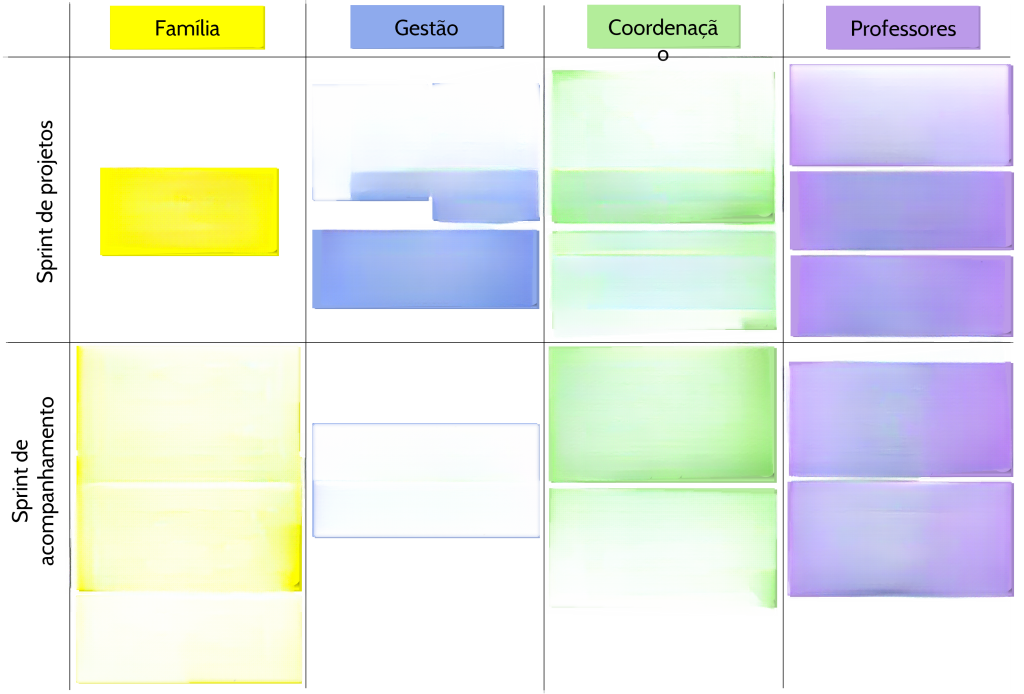
Figure 3. Requirements used in the project sprint and the monitoring sprint of a platform for Elementary School – Initial Years
Source: Elaborated by the author
The prototype of the project sprint consisted of the formation of an interdisciplinary project with interaction in the “wireframe” of the digital platform. In the tests, it was presented as a complementary resource to the didactic material offered by the platform, being well-accepted among teachers, coordinators, and students from the pilot schools.
The follow-up sprint aimed to design how the digital platform will provide visibility into student progress in a practical and intuitive way, responding to the following objective: “the school can monitor and act on each child’s development with pedagogical intentionality and then communicate it to the family in a simple and emotional way”.
The developed prototype was a “wireframe” of the performance data visualization for the class and each student, and after some tests, another sprint was necessary to achieve good satisfaction from potential users. The scenario in which the company operates is complex and involves many elements, so launching a new educational platform that meets the target audience in a practical and intuitive way becomes a great challenge, involving many “stakeholders” and the analysis of the real needs of multiple users.
References
[1] Confederação Nacional da Indústria (CNI). Retratos da Sociedade Brasileira – Educação Básica. Brasília: CNI; 2018. Ano 7, n. 42.
[2] Organização das Nações Unidas para a Educação, a Ciência e a Cultura (UNESCO). UNESCO: dois terços do ano acadêmico foram perdidos com o fechamento das escolas devido à COVID-19. Nações Unidas; 2021. Disponível em: <https://brasil.un.org/pt-br/109412-unesco-dois-tercos-do-ano-academico-foram-perdidos-com-o-fechamento-das-escolas-devido-covid>.
[3] Fundo das Nações Unidas para a Infância (UNICEF). UNICEF: Brasil corre o risco de regredir duas décadas no acesso à educação. Nações Unidas; 2021. Disponível em: <https://brasil.un.org/index.php/pt-br/126053-unicef-brasil-corre-o-risco-de-regredir-duas-decadas-no-acesso-educacao>.
[4] C6Bank. C6 Bank/Datafolha: 4 milhões de estudantes abandonaram a escola durante a pandemia. C6Bank; 2021. Disponível em: <https://blog.c6bank.com.br/c6-bank-datafolha-4-milhoes-de-estudantes-abandonaram-a-escola-durante-a-pandemia>.
[5] Amstel F.M.C.V. Expansive Design: designing with contradictions [Dissertação]. Enschede (Holanda): University of Twente; 2015.
[6] Brown T Design Thinking – Uma Metodologia Poderosa Para Decretar o Fim Das Velhas Ideias. 2009. Alta Books, Rio de Janeiro, RJ, Brasil.
[7] Carroll M.; Goldman S.; Britos L.; Koh J; Royalty A.; Hornstein M. Destination, Imagination and the Fires Within: Design Thinking in a Middle School Classroom. Int. J. Art Des. Educ. 2010; 29(1): 37-53. doi: 10.1111/j.1476-8070.2010.01632.x.
[8] Lowdermilk T. Design Centrado no Usuário. 2013. Novatec, São Paulo, SP, Brasil.
[9] Ries E. A Startup Enxuta. 2011 Editora Sextante, Rio de Janeiro, RJ, Brasil.
[10] Telles T.F. Design Thinking na Gestão de Projetos de Serviços [Monografia]. Rio de Janeiro: Fundação Getúlio Vargas; 2018.
[11] Ágil Além da TI. Plano de Trabalho colaborativo sobre Design Thinking e Agilidade: uma avaliação da situação atual e planejamento de melhorias. 2019. Disponível em: <https://agilalemdati.home.blog/2019/04/17/plano-de-trabalho-colaborativo-sobre-design-thinking-e-agilidade-uma-avaliacao-da-situacao-atual-e-planejamento-de-melhorias/>.
[12] Castro I.N. O que é Benchmarking e qual a sua importância para o Marketing Digital. RockContent; 2020. Disponível em: <https://rockcontent.com/br/blog/benchmarking/>.
[13] Dutra R. Desginer: Como Criar Personas Usando Mapas de Empatia. Designer; 2018. Disponível em: <http://designr.com.br/como-criar-personas-usando-mapas-de-empatia/>.
[14] Knapp J. Sprint: O método usado no Google para testar e aplicar novas ideias em apenas cinco dias. 2016. Intríseca, Rio de Janeiro, Rio de Janeiro, RJ, Brasil.
Como citar
Cecconi A.L.G.S; Almeida A.B. UX Design e Design Sprint na idealização de uma plataforma educacional para o Ensino Básico. Revista E&S. 2022; 3: e20220037.
Sobre os autores
Ana Luiza Gasparette dos Santos Cecconi, Bacharela em Geografia, Especialista em Gestão de Projetos, São Paulo, SP, Brasil
Alexandre Barreto de Almeida, Harfsen Research, Departamento de gestão de projetos de inovação, Piracicaba, SP, Brasil.
Link para download: https://cms.revistaes.com.br/wp-content/uploads/2023/01/ES_37.pdf