
Education
People Management
January 23, 2026
Perception of teachers from a technical school about the need for training in Special Education
Authors: André Luís Fernandes dos Santos and Antonio César Amaru Maximiano
DOI: 10.22167/2675-6528-2025049
E&S 2026, 7: e2025049
The interest of students from Special Education (SE) in technical secondary courses increased with Law No. 13,409, of December 28, 2016, which determined the reservation of vacancies for people with disabilities in technical education[1].
Law No. 13.409[2] has proven efficient in the inclusion in technical education. Data from the National Health Survey (PNS) of 2019 and the National Household Sample Survey (PNAD) of 2022 revealed an increase of 1.3 million people with disabilities between 2019 and 2022[3]. However, many educators question whether it is possible to adapt the curriculum to ensure the development of the foreseen competencies[1].
Part of the answer is given by Pletsch et al.[4], who highlight Universal Design for Learning (UDL) as the basis of EE. UDL uses technologies and methodologies that guarantee accessibility and autonomy, ensuring inclusive policies from their conception[5].
Specialized Educational Support (AEE) is a strategy to enable the principles of UDL in daily school life. Provided for by Law nº 13.146/15, AEE enables the principles of UDL in daily school life and offers supplementary support that eliminates barriers to inclusion[6].
Despite the advances provided by UDL and AEI, there is still the judgment of people with disabilities as “abnormal”, supported by the medical model of disability[7]. According to Camargo[8], many education professionals still focus on diagnosis, not on potential, considering that students with disabilities would not keep up with the content of so-called “normal” students[8].
Educators are considered the main agents of change and, in this context, the construction of a plural school requires the improvement of their training[9]. Pedroso et al.[10], after analyzing the curricula of undergraduate courses at three public universities in São Paulo, found that there were no Special Education contents in the syllabi. Graf et al.[11] reinforce that the lack of specific training compromises inclusion, highlighting the scarcity of internships in assistive technologies and a practical and interdisciplinary approach.
A relevant issue is the conceptual confusion between Special Education and Inclusive Education. Special Education offers specialized support for the student’s integration, while Inclusive Education guarantees access for students with disabilities to regular schools at all levels[12].
The construction of an inclusive school must follow the main educational regulations. The Law of Directives and Bases of National Education[2] determines, in its article 59, that schools guarantee adapted curricula and specific resources for students with disabilities. The National Guidelines for Special Education in Basic Education highlight the importance of teacher training and the use of assistive technologies[13]. The National Policy for Special Education in the Perspective of Inclusive Education (2008) proposes accessible and participatory schools[14].
Given this context, the objective of this study was to analyze the perception of teachers from a technical high school regarding the relevance of continuing education in the EE area, considering aspects related to the responsibility for offering the courses, the teaching modality (face-to-face or distance learning), the most appropriate period for their completion, and the deficiencies that should be addressed.
The research has a qualitative approach, with exploratory and descriptive objectives, and adopts procedures characteristic of a case study. This methodological choice is justified by the need to understand teachers’ perceptions of EE training in the specific context of the educational institution where they work.
The adoption of a qualitative approach is suitable for the research objectives, as it allows for the understanding of social phenomena and the meanings attributed by the subjects. Exploratory and descriptive objectives enable both initial approximation of little-known problems and detailed description of a phenomenon, group, or situation. The choice of a case study offers an in-depth investigation of a specific unit, seeking to understand its complexity within the real context in which it develops. These methodological elements, articulated with each other, favor a consistent and contextualized analysis of the observed perceptions and practices[15].
Considering this perspective, the field research was carried out in a school, because school spaces are considered privileged environments for investigations in the area of education[16]. Conducting it in the school environment represents an advantage, as the results tend to more faithfully reflect educational daily life[15]. The application of an anonymous questionnaire proved to be adequate, as it simulates an interview and favors spontaneous responses[16].
The chosen institution is a municipal autarchy, with no tuition fees for students, offering technical high school courses in integrated, concurrent, and subsequent modalities. It serves students in all three shifts and offers courses in Nursing, Clinical Analysis, Pharmacy, and Chemistry. The school has 16 classrooms and 10 specialized laboratories, including those for Computer Science, Chemistry, Microbiology, Microscopy, Common Core, and Nursing, in addition to a library, an auditorium, two tutoring rooms, a cafeteria, a multi-sport court, and a multipurpose room, ensuring adequate spaces for teaching activities. After authorization from the pedagogical management, a questionnaire was made available to approximately 80 teachers on an institutional platform from March 6 to April 6, 2023, with the aim of improving pedagogical management and the quality of the courses offered.
The link to the questionnaire was sent via institutional email, and only educators from the institution could answer it, voluntarily and anonymously. In total, 40 professors responded (n = 40). It is worth noting that this work did not go through an Ethics Committee, as its data originated from a final course project (TCC) and, according to the norms of the institution where the specialization course was carried out, it was not required for the study to be submitted to the aforementioned committee.
The questionnaire of this study had, in six out of the seven questions, the characteristics described by Nogueira[17]: being direct, closed, unassisted, and using the Likert scale with five variables (strongly disagree; disagree; neither agree nor disagree; agree; and strongly agree, respectively). The seventh question differed, as it did not use the Likert scale.
The institution for this study uses the Microsoft Teams platform, and for this reason, it was chosen to make the research questionnaire available. The questionnaire was developed based on the study’s objectives. Although it did not use previously validated instruments or specific theory as a reference, its questions were structured to directly reflect the research objectives. The proposed questions were:
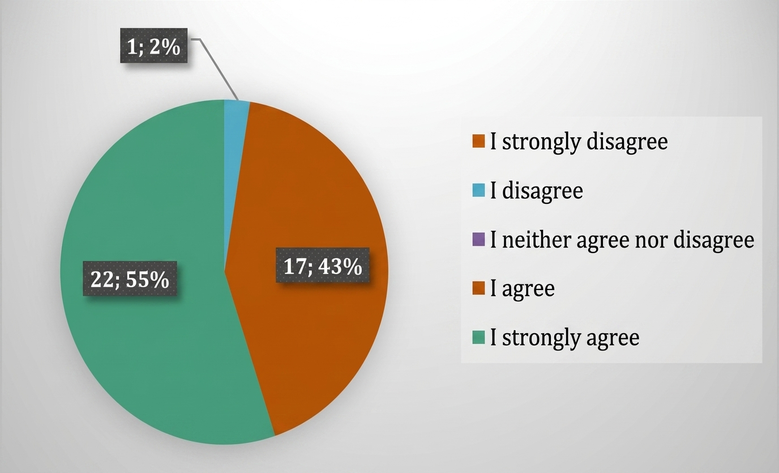
Question 1: Courses in the field of Special Education (EE) are fundamental for Technical High School teachers. This question aimed to verify if teachers recognize the training in Special Education (EE) as relevant in their professional practice;
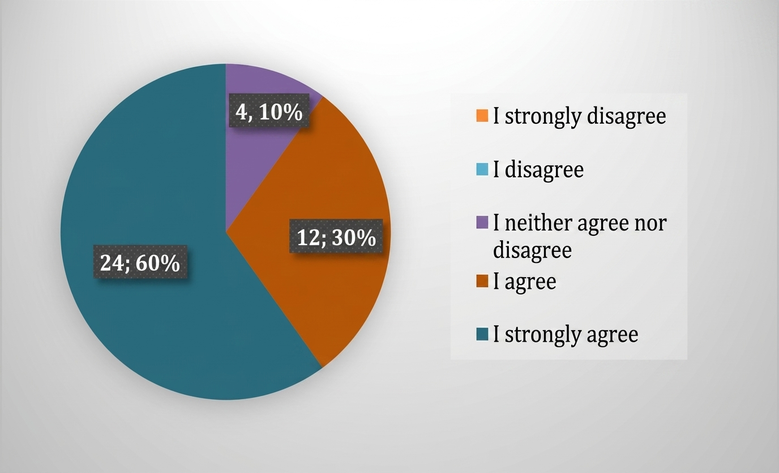
Question 2: Courses in the EE area should be offered by the institution where the professor works. The question intended to assess whether professors consider that continuing education in EE should also be an institutional responsibility and not just an individual one;
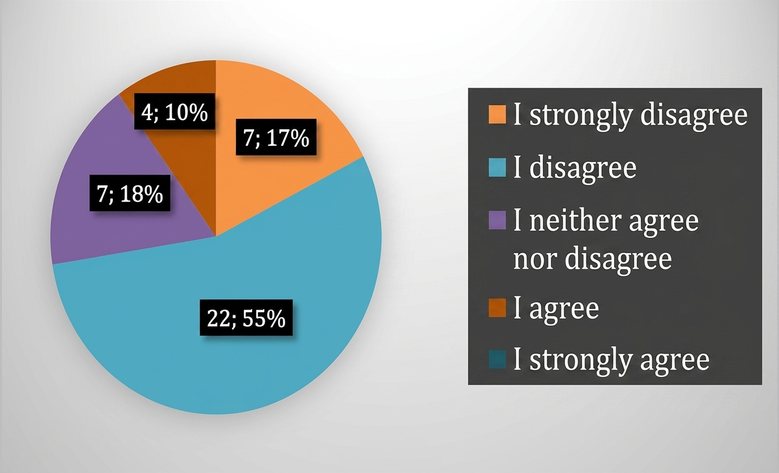
Question 3: Courses in the EE area should be offered only at the beginning of the academic year, before classes start, in a distance learning (EaD) format. The intention of the question was to investigate whether educators consider a one-off training in this format to be sufficient;
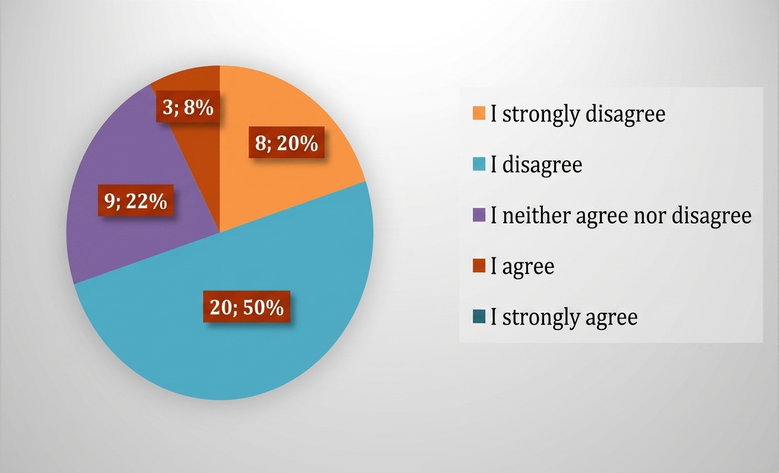
Question 4: Courses in the EE area should be offered only at the beginning of the academic year, before classes start, in the in-person modality. This question had the same purpose as the previous one, and sought to understand the preference of teachers between the in-person and distance modalities;
Question 5: Courses in the EE area should be offered throughout the academic year, in person. The question analyzes whether professors consider it relevant to participate in in-person continuing education throughout the academic period;
Question 6: Courses in the EE area should be offered throughout the academic year, in the EaD (distance learning) modality. This question sought to assess whether faculty members consider continuing education in the EaD modality a viable and effective alternative;
Question 7: Of the EE areas, which would you choose to carry out initial training? This last question aimed to identify which specific areas of Special Education are perceived as priorities by teachers.
After the closing of the response period, the collected data were organized in Microsoft Excel, which allowed for the descriptive statistical analysis of the obtained responses. The analysis focused on identifying patterns of agreement, indecision, or disagreement regarding faculty perceptions of Special Education training. To facilitate the visualization and interpretation of the results, pie charts were constructed, suitable for presenting the percentage of responses in each category of the Likert scale. This type of chart was chosen because it clearly and intuitively highlights the relative participation of each alternative within the total number of responses. Based on these procedures, it was possible to conduct an analysis capable of revealing general trends, training preferences, and possible divergences among faculty regarding the importance, frequency, and modality of Special Education training.
Figure 1 presents the results of the first question, which investigated the perception of Technical High School teachers regarding the importance of EE training for their professional practice. It is observed that 98% of participants agree that courses in the EE area are fundamental for their training, with 55% expressing total agreement.
Source: Original research results.
This institutional faculty stance aligns with Pires and Mendes[18], who highlight curriculum adaptation as essential in meeting the needs of Special Education students, emphasizing the importance of knowing the students and making pedagogical adjustments to promote effective learning. In other words, it is up to educators to have the disposition, time, and willingness to create integrated teaching methodologies. Fonseca[19] argues that, for the inclusion of students with disabilities and their adequate schooling, it is important to progressively integrate them into the school environment, as well as to offer training courses to educators, so they can acquire new professional skills.
In Figure 2, it is observed that 90% of educators agreed (with 60% strongly agreeing) that the institution where they work should offer EE training. However, 10% do not have a clear opinion on the matter (Figure 2).
Source: Original research results.
The agreement of the faculty regarding who should teach the courses in the Special Education area is supported by the National Education Council/Higher Education Chamber (CNE/CES), according to Resolutions nº 2, of June 18, 2007, and nº 4, of April 6, 2009, which determine that the continuing education of faculty should be carried out in collaboration between the federal, state, and municipal governments, within their respective education systems, and developed by accredited institutions[20],[21].
According to Coimbra[22], teacher training in Brazil presents three models. The content-based model (1939 – 2025) is the oldest and still quite ingrained in teacher training, having been challenged only in 2002 with the emergence of the so-called transition model, which questions the supremacy of content and incorporates practices as curricular components. The most recent model is the resistance model, which integrates practices as curricular components from the transition model, but more strongly values teacher training and demands the valorization of education professionals.
The consulted individuals (consciously or not) had a reference to the resistance model, as they demonstrated concern with training and, furthermore, with the inclusion of students who were until then invisible, as shown by the work carried out by Raiol et al.[23], who found little information relating Covid-19 to people with disabilities, compared to other social groups.
In Figure 3, it is observed that 72% of teachers did not agree that training in EE is sufficient only at the beginning of the school year, in the distance learning modality. In fact, 17% of them strongly disagreed. However, 10% of the professionals believed that a single distance learning training at the beginning of the school year would be sufficient. The other teachers did not have a clear opinion on the matter.
Source: Original research results.
Figure 4 presents very similar results to those of Figure 3, with the difference that the teaching modality, in this case, is in-person. However, the training remains punctual, occurring only at the beginning of the academic year. In this scenario, 70% of teachers disagreed with holding in-person training at a single moment (with 20% strongly disagreeing), while 8% believe that only one in-person training would be sufficient. Furthermore, 22% of respondents did not have a clear opinion on the matter.
Source: Original research results.
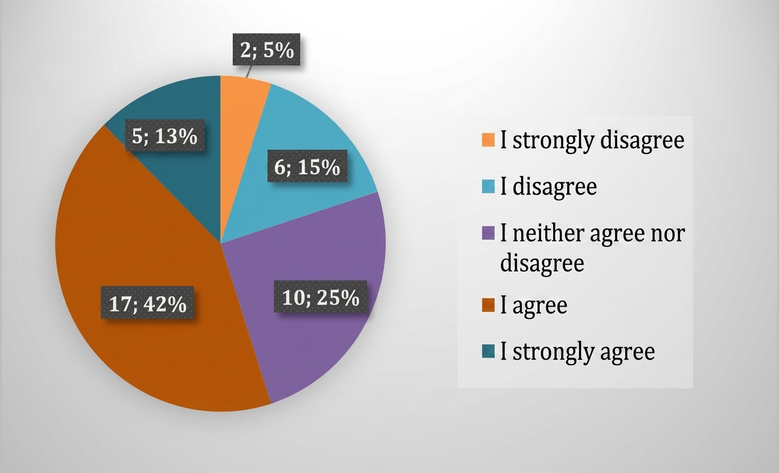
In Figure 5, we have the responses to the proposal of an in-person course throughout the year, i.e., continuing education. Only 20% of the faculty disagreed with continuing in-person training (5% strongly disagreed), while 55% of them (with 13% strongly agreeing) believed that continuing in-person training would be ideal. On the other hand, 25% of those consulted did not have a clear opinion.
Source: Original research results.
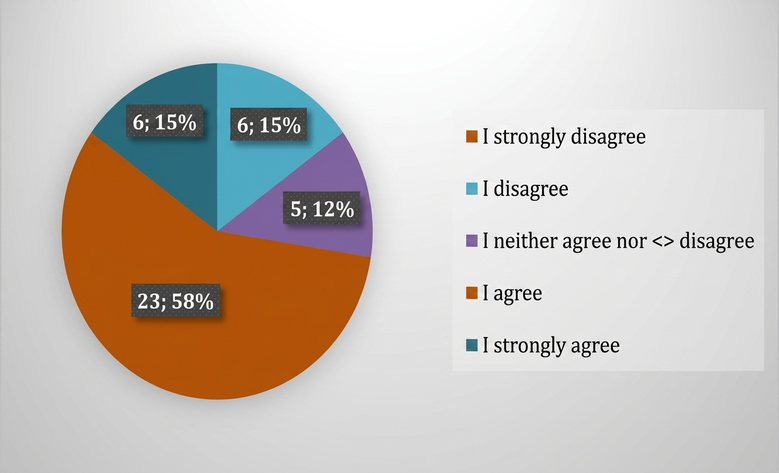
In Figure 6, we have the proposal for a year-round distance learning course, i.e., continuing education. Only 15% of the teachers disagreed with continuing distance education, while 73% of them believed that continuing distance education would be ideal. Another 12% of those consulted did not have a clear opinion.
Source: Original research results.
Therefore, the data from Figures 3 to 6 indicate that the institution’s faculty aim for continuing education in Special Education and Distance Learning (EaD). Studies show that continuing education is fundamental for the professional development of teachers, although there are still obstacles in the offering and diversification of specialization courses in Special Education[24].
A distance learning course for teachers, held in the United States, applied an anonymous evaluation with its participants and observed that all would recommend this teaching modality to other educators, with 81% preferring exclusively distance learning courses. The reason for this result was that participants felt connected to their instructor (equally or more connected than in face-to-face courses). However, 19% of respondents would like to participate in hybrid courses, i.e., distance learning and face-to-face[25].
The study shows that 73% of teachers would like continuing education exclusively in distance learning, while 55% prefer face-to-face modality only, showing a similarity with the results of Kubala[25]. However, the possibility of a hybrid course was not contemplated in the questionnaire applied to the teachers in this work.
Similar results to those of this study were observed by Aragón, Menezes and Charczuk[26], who investigated the learning of 26 teachers distributed across two hubs of a distance learning course. In the last semester, 315 posts were analyzed in the participants’ webfolios, in which they reflected on their training process. It was observed that educators value the relationship between theory and practice and recognize the importance of teachers and tutors in mediating learning.
Giolo[27] considers that disregarding school as part of teacher training is a great mistake. For the author, the virtual exchanges that occur between students are important, as is distance learning; the problem would lie in praxis, when the teacher, in person, will face real students, and their purely bookish knowledge will not be sufficient, requiring emotional balance, leadership, patience, among other skills learned from coexistence.
Martins et al.[28] created a project titled “Conversation Circles” to improve the understanding of undergraduate students and basic education teachers about inclusive education. It was a project with four in-person meetings, whose objective was to reframe the concept of school inclusion; these meetings were mediated by a professor with experience in the subject, and participants were given a voice, that is, educators could share their experiences with students with special needs. From these “circles” an extension course was created. The institution studied can follow this model, providing some in-person meetings for discussion among teachers, followed by a subsequent distance learning training.
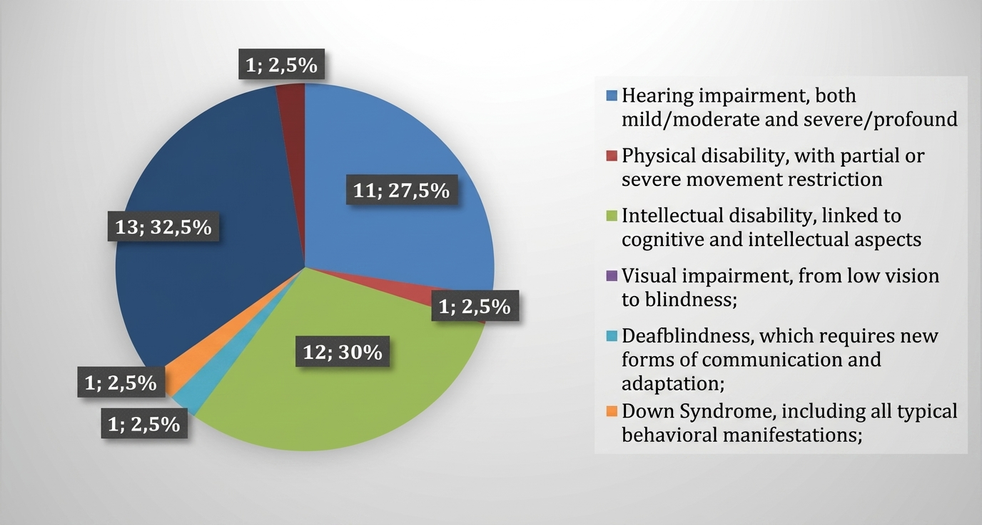
The study shows that 32.5% of teachers would like to have initial training in multiple disabilities, while 27.5% and 30.0% wished to undergo this initial training in hearing impairment and, respectively. These teachers account for 90% of respondents. The remaining 10% are equally divided (2.5% each) among those who wish for training in visual impairment, physical impairment, Down Syndrome, and giftedness/high abilities. No educator expressed the desire to have their initial training in deafblindness (Figure 7).
Source: Original research results.
In the educational institution of this research, there are students with deafness, cerebral palsy, and autism spectrum disorder (ASD). Therefore, some teachers work directly with these students, which may explain why they desire initial training to learn how to deal with these disabilities. There are no students with visual impairments, Down syndrome, giftedness, or significant mobility restrictions (e.g., wheelchair users), which could justify the teachers’ low interest in training in these areas. What is noteworthy is that no teacher showed interest in deafblindness.
However, deafblindness (total or partial loss of vision) is a disability that requires a lot of attention from teachers, according to Lupetina and Walter[29]. The authors interviewed some deafblind students to comment on their school trajectory: one student, 53 years old, reported that, in the mid-80s, her Chemistry teacher “suggested” that she look for a special school to attend her; this generated enormous frustration in the student and resulted in her dropping out in the first year of high school.
The research achieved its purpose by analyzing teachers’ perception of continuing education in Special Education, showing that they consider this training relevant and understand that its offering should be the institution’s responsibility. The results point to the need for training proposals that address the disability areas most present in daily school life and that reconcile the flexibility of distance learning (EaD) with moments of interaction among participants.
As limitations, the absence of the hybrid modality among the options presented in the questionnaire stands out, which restricted the identification of preferences for formats that integrate in-person and distance moments. Furthermore, the exclusive use of quantitative data limited the understanding of deeper perceptions about inclusive teaching practice. Future studies may include qualitative methodologies and cover hybrid training models, broadening the understanding of teachers’ needs and expectations.
REFERENCES
[1] Diogo, M.A.; Geller, M. 2022. A Educação Especial e os cursos técnicos: A visão dos docentes sobre os processos de adaptação curricular. Revista Brasileira de Educação Especial 28: 561-578.
[2] Brasil. 1996. Lei nº 9.394, de 20 de dezembro de 1996. Estabelece as diretrizes e bases da educação nacional. Disponível em: https://www.planalto.gov.br/ccivil_03/leis/l9394.htm. Acesso em: 17 out. 2025.
[3] Botelho, A.; Lenzi, F.C. 2024. Trajetória da identificação das pessoas com deficiência no Brasil: uma análise das pesquisas domiciliares do IBGE. Ciência & Saúde Coletiva 29(11): 1-12.
[4] Pletsch, M.D.; Souza, F.F.; Orleans, L.F. 2017. A diferenciação curricular e o desenho universal na aprendizagem como princípios para a inclusão escolar. Revista Educação e Cultura Contemporânea 14(35): 264-281.
[5] Pieczarka, T.; Valdivieso, T.V. 2023. Desenho Universal para Aprendizagem e a inclusão de estudantes com deficiência intelectual: uma revisão sistemática. Revista Educação Especial 36: e67.
[6] Sotero, M.C.; Cunha, E.B.J.; Garcia, V.A. 2019. Educação integral e atendimento educacional especializado: como essas políticas são implementadas ao mesmo tempo? Cadernos CEDES 39(108): 237–250.
[7] Lima, A.L.S. 2021. Capacitismo e eugenia na educação brasileira: uma reflexão a partir de aproximações epistemológicas. Revista PHILIA | Filosofia, Literatura & Arte 3(1): 2-20.
[8] Camargo, F.P. 2020. O capacitismo e a expectativa docente em relação a alunos com deficiência. [SYN]THESIS 13(1): 87-96. https://doi.org/10.12957/synthesis.2020.61451
[9] Nozi, G.S.; Vitaliano, C.R. 2017. Saberes de professores propícios à inclusão dos alunos com necessidades educacionais especiais: condições para sua construção. Revista Educação Especial 30(59): 589-602.
[10] Pedroso, C.C.A.; Campos, J.A.P.P.; Duarte, M. 2013. Formação de professores e educação inclusiva: análise das matrizes curriculares dos cursos de licenciatura. Revista Unisinos 17(1): 40-47.
[11] Graf, L.; Lôbo, Í. M.; Marvila, L. S. P.; Gomes, C. P. 2025. Formação docente na educação especial: desafios e possibilidades para a inclusão. Revista Acadêmica Online 11(55): 1-14.
[12] Neto, A.; Ávila, É.; Sales, T.; Amorim, S.; Nunes, A. F.; Santos, V. 2017. Educação inclusiva: uma escola para todos. Revista Educação Especial 31: 1–14. https://doi.org/10.5902/1984686X24091
[13] Brasil. 2001. Diretrizes Nacionais para a Educação Especial na Educação Básica. Ministério da Educação, Secretaria de Educação Especial. Disponível em: https://www.gov.br/mec/pt-br/media/diretrizes_ed_esp_2001.pdf. Acesso em: 17 out. 2025.
[14] Brasil. 2008. Política Nacional de Educação Especial na Perspectiva da Educação Inclusiva. Ministério da Educação, Secretaria de Educação Especial. Disponível em https://www.gov.br/mec/pt-br/assuntos/educacao-especial/politica-nacional. Acesso em: 17 out. 2025.
[15] Gil, A.C. 2002. Como elaborar projetos de pesquisa. 4. ed. Editora Atlas, São Paulo, SP, Brasil.
[16] Tozoni-Reis, M.F.C. 2009. Metodologia da Pesquisa. 2. ed. IESDE Brasil S.A., Curitiba, PR, Brasil.
[17] Nogueira, R. 2002. Elaboração e análise de questionários: uma revisão da literatura básica e a aplicação dos conceitos a um caso real. UFRJ/COPPEAD, Rio de Janeiro, RJ, Brasil.
[18] Pires, Y.R.; Mendes, G.M.L. 2019. Adaptar, adequar, diferenciar: reflexões a partir das políticas curriculares para o público-alvo da Educação Especial. Revista Espaço do Currículo 12(3): 390–403.
[19] Fonseca, V. 1987. Educação Especial. Artes Médicas, Porto Alegre, RS, Brasil.
[20] Brasil. 2007. Resolução CNE/CES nº 2, de 18 de junho de 2007. Dispõe sobre carga horária mínima e procedimentos relativos à integralização e duração dos cursos de graduação, bacharelados, na modalidade presencial. Disponível em: https://normativasconselhos.mec.gov.br/normativa/view/CNE_RES_CNECESN22007.pdf?query=covid%2019. Acesso em: 17 jun. 2023.
[21] Brasil. 2009. Resolução CNE/CES nº 4, de 6 de abril de 2009. Dispõe sobre carga horária mínima e procedimentos relativos à integralização e duração dos cursos de graduação em Biomedicina, Ciências Biológicas, Educação Física, Enfermagem, Farmácia, Fisioterapia, Fonoaudiologia, Nutrição e Terapia Ocupacional, bacharelados, na modalidade presencial. Disponível em: https://portal.mec.gov.br/cne/arquivos/pdf/2009/rces002_09.pdf. Acesso em: 07 jul. 2025.
[22]Coimbra, C.L. 2020. Os Modelos de Formação de Professores/as da Educação Básica: quem formamos? Educação & Realidade 45(1): 1-22.
[23] Raiol, J.J.M.; Orlando, R.M.; Thomazini, E. 2020. COVID-19 e a invisibilização da pessoa com deficiência: as formas de divulgação de informação em site oficial. Comunicações 28(2): 1-14.
[24] Carmo, B. C. M. do; Ferreira, A. R.; Fumes, N. de L. F.; Sarmento, V. N.; Tavares, R. V. da S. 2024. Formação continuada em educação especial: análise da oferta de cursos de especialização na região Nordeste do Brasil. Revista Educação Especial 37(1): e60/1–25.
[25] Kubala, T. 1998. Addressing Students Needs: Teaching on the Internet. Technological Horizons in Education 25(8): 71-74.
[26] Aragón, R.; Menezes, C.S.; Charczuk, S.B. 2015. Trajetórias de aprendizagens em uma formação de professores na modalidade EAD. Revista Iberoamericana de Educación 69(2): 131-146.
[27] Giolo, J. 2008. A Educação a Distância e a Formação de Professores. Educação e Sociedade 29(5): 1211-1234.
[28] Martins, E.B.A.; Antunes, K.C.V.; Monteiro, S.S. 2019. Formação docente e inclusão escolar. Revista on line de Política e Gestão Educacional 23(1): 877-896.
[29] Lupetina, R.; Walter, C.C.F. 2021. Trajetórias Educacionais de pessoas com surdocegueira adquirida. Revista Brasileira de Educação Especial 27: 1021-1036.
COMO CITAR
Santos, A.L.F.; Maximiano, A.C.A. Percepção dos docentes de uma escola técnica sobre a necessidade de formação em Educação Especial. Revista E&S. 2026; 7: e2025049.
ABOUT THE AUTHORS
 André Luís Fernandes dos Santos – Professor of the Technical Course in Clinical Analysis. Barueri Education Institute Foundation (FIEB). Rua do ITB do Engenho Novo, 238, Vila Engenho Novo, 06415-070, Barueri, SP, Brazil.
Antonio César Amaru Maximiano – Faculty Member. Department of Administration of the School of Economics, Administration and Accounting of the University of São Paulo. Av. Prof. Luciano Gualberto, 908, University City, 05508-010, São Paulo, SP, Brazil.