
Project Management
November 06, 2026
Proposal for the Implementation of a PMO for Project Control in a Software Development Company
Alexandre dos Santos Batista; Carlos Augusto Serna Giraldo
DOI: 10.22167/2675-6528-202603639
Article derived from a Final Course Work (TCC), with content based on the student’s original work and adapted to the editorial format of the E&S Magazine with the support of the ResumeAI tool, an artificial intelligence solution developed by Instituto Pecege for textual synthesis and organization.
Summary
The implementation of a Project Management Office (PMO) was proposed in a medium-sized software development company. The initiative arose from the need to improve control, deadline management, and communication between teams, motivated by recurring delivery delays, priority changes, and the absence of standardized processes, even with agile practices. The research was conducted as an applied case study, using documentary analysis, participant observation, alignment meetings with managers and collaborators, and a structured questionnaire for organizational diagnosis. The results highlighted opportunities for improvement in planning, schedule monitoring, definition of responsibilities, and project information visibility. Based on this diagnosis, a Control PMO proposal was developed, focusing on standardization, monitoring, and delivery control, including the modeling of a project management process in BPMN. It was concluded that the proposed structure has the potential to increase project predictability, improve interdepartmental communication, and establish a foundation for the evolution of the organization’s project management maturity.
Keywords: Organizational communication; Management; Standardization; Processes.
1. Introduction
Project management has been consolidated as an essential practice for organizations seeking greater efficiency in the execution of their strategies, especially in dynamic and innovation-oriented environments. The application of knowledge, skills, tools, and techniques is fundamental to meeting the proposed objectives and generating value for organizations and their stakeholders (PMI, 2021).
In the software development sector, the adoption of agile methodologies, such as Scrum, has become a widespread practice. This is due to the need to respond quickly to market changes and customer demands (Carneiro et al., 2022). Scrum structures work into short development cycles, focusing on continuous value delivery and constant adaptation to changes. Its principles are based on customer involvement, incremental software delivery, acceptance of changes, and continuous communication among project participants (Carneiro et al., 2022).
Despite the benefits provided by agile approaches, the use of Scrum does not eliminate the need for structured project management practices. Organizations experienced in agile methods still face challenges related to organizational alignment, results tracking, and the integration of management practices with strategic objectives (Perrella, 2024). In organizations that execute several projects simultaneously, challenges related to demand prioritization, schedule control, interdepartmental communication, and delivery tracking can compromise the expected results.
In this context, the Project Management Office (PMO) emerges as a structure capable of supporting the standardization of management practices, promoting greater visibility of ongoing projects, and contributing to the alignment between the organization’s needs and the expected results. The PMO performs different functions within organizations, acting in support, control, and monitoring of projects, according to the maturity level and the needs of the organizational environment (Lescowicz and Penteado Neto, 2019). Studies show that the implementation of a PMO can contribute to the improvement of internal processes, the strengthening of communication between teams, and the increase in the capacity to monitor organizational initiatives (Mello et al., 2020), in addition to generating gains in organization, standardization, and decision-making (Pinheiro and Costa, 2021).
The organization analyzed in this study operates in the development of software solutions and has several projects executed simultaneously for distinct clients. Although it uses agile development practices, the absence of a formal structure responsible for the integrated monitoring of projects was observed. As a consequence, difficulties were found related to schedule control, priority management, communication between the involved areas, and monitoring of deliveries made to clients. These challenges, which include the lack of structured processes and communication difficulties, are frequently encountered in organizations that do not yet have a formally established project management office (Tavares, 2022).
The preliminary diagnosis carried out in the organization indicated opportunities for improvement related to process standardization, deadline management, inter-team communication, and decision-making support. The need for this research, therefore, arose from the identification of difficulties in meeting deadlines, managing priorities, and communication, even with the use of agile development practices based on the Scrum framework. Thus, the present work aims to propose the implementation of a Project Management Office in a software development company, through the analysis of the current scenario and the elaboration of a standardized process for managing initiatives, seeking to increase the predictability of deliveries, improve communication between teams, and strengthen project control.
2. Material and Methods
This work is characterized as an applied research, of an exploratory and descriptive nature, developed through a case study in a medium-sized Brazilian company operating in the software development sector. The research strategy adopted was the case study, which enabled an in-depth investigation of contemporary phenomena in their real context to understand organizational processes and analyze the challenges faced in existing projects. The analyzed organization uses agile practices based on the Scrum framework for conducting its development activities.
Data collection occurred through multiple sources of evidence: participant observation, document analysis, alignment meetings with managers and collaborators, and application of a structured questionnaire. Participant observation allowed us to follow the flow of demands, communication between teams, project planning and monitoring processes, and challenges related to meeting deadlines. Internal documents, schedules, monitoring records, and the organization’s project management artifacts were analyzed. The structured questionnaire was developed based on aspects of project management maturity, encompassing dimensions such as communication, planning, control, definition of responsibilities, and process standardization, and was used to support the organizational diagnosis.
After the diagnosis, a proposal was developed for the implementation of a Project Management Office (PMO), focusing on process standardization, schedule monitoring, and communication improvement. As part of the proposal, the project management process was modeled using the “Business Process Model and Notation” (BPMN) notation. According to Vieira (2022), BPMN is a notation used for modeling business processes, allowing for the graphical representation of activities, events, responsibilities, and workflows in a standardized way. The modeling aimed to represent the proposed flow for managing the organization’s projects, from demand intake to initiative closure.
3. Results and Discussion
The organization studied is a medium-sized Brazilian company, with over three decades of experience in developing software solutions for public agencies and private institutions. With approximately 300 employees distributed across various areas, the company faced increasing challenges in tracking deliveries, managing deadlines, and inter-team communication due to the growing volume of simultaneous projects. Although it used agile practices based on the Scrum framework, the absence of a formal structure for integrated project tracking, process standardization, and results monitoring was observed.
Diagnosis of the current scenario
The analysis of the organizational context, carried out through participant observation, documentary analysis, alignment meetings, and the application of a structured questionnaire, revealed factors that contributed to project delays. The development teams, although using iterative cycles inspired by Scrum, frequently received emergency demands, resulting in constant priority changes that impacted planning and deadlines.
The absence of standardized processes for project monitoring was identified. Although control mechanisms existed for development activities, a centralized structure for integrated monitoring of ongoing initiatives was lacking. This situation hindered the acquisition of a consolidated view of projects and the early identification of risks and bottlenecks. These findings align with the challenges pointed out by Tavares (2022), which include the lack of structured processes, communication difficulties, and the absence of standardization in organizations without a formal project management office.
Communication between areas occurred in a decentralized manner, which prevented the uniform sharing of relevant information. Carneiro et al. (2022) highlight that communication failures can compromise the understanding of customer needs and project performance. In the organization studied, this decentralization contributed to rework and frequent redefinitions of priorities.
Organizational diagnosis results
The structured questionnaire, designed to identify perceptions of project management maturity, included dimensions such as organizational structure, processes, tools, people, results, and organizational culture. Initially, the research planned for a broader data collection, but low participant adherence, motivated by concerns about exposing perceptions of internal processes, limited the use of quantitative data. Thus, the questionnaire served as an exploratory instrument, complemented by participant observation, document analysis, and alignment meetings.
Despite the limitation in adherence, the questionnaire results converged with other sources of evidence, indicating opportunities for improvement in the formalization of management processes, deadline monitoring, definition of responsibilities, and results monitoring. It was found that the organization has a favorable environment for adopting improvements, but presents weaknesses in coordinating initiatives, performance monitoring, and consolidating managerial information, as summarized in Table 1.
Table 1. Synthesis of organizational diagnosis results
| Assessed Dimension | Observed Level | Key Evidence |
| Organizational Structure and Governance | Low | Absence of a formal structure for integrated project monitoring and centralized definition of responsibilities. |
| Processes and Standardization | Intermediate | Existence of established work practices, but with low standardization of project management processes. |
| Tools and Technology | Intermediate | Use of support tools for development, but with limitations in the consolidation and managerial follow-up of information. |
| People and Empowerment | Low | Need for strengthening project management skills and greater formalization of the roles involved. |
| Results and Performance | Low | Difficulties in keeping up with schedules, meeting deadlines, and monitoring project indicators. |
| Organizational Culture | High | Receptive environment for continuous improvement and adoption of new management practices. |
Source: Original research results
Table 1 shows that, although organizational culture is receptive to improvements (Observed Level: High), the dimensions of Organizational Structure and Governance, People and Capacity Building, and Results and Performance were classified as Low. Processes and Standardization, and Tools and Technology were considered Intermediate, indicating the need for standardization and better use of existing tools.
Proposal for the implementation of the PMO
Based on the diagnosis, a proposal was developed for the implementation of a Project Management Office (PMO) focused on process standardization, delivery tracking, and communication improvement. The proposal aims to establish formal planning and control mechanisms to increase delivery predictability and reduce the impacts of priority changes.
The proposed PMO assumes characteristics of a Controlling PMO, according to the model by Lescowicz and Penteado Neto (2019), acting in process standardization, monitoring of schedules and indicators, and communication support. This approach is aligned with studies by Pinheiro and Costa (2021) and Passos et al. (2020), which point to benefits in project organization, information visibility, and strengthening of controls.
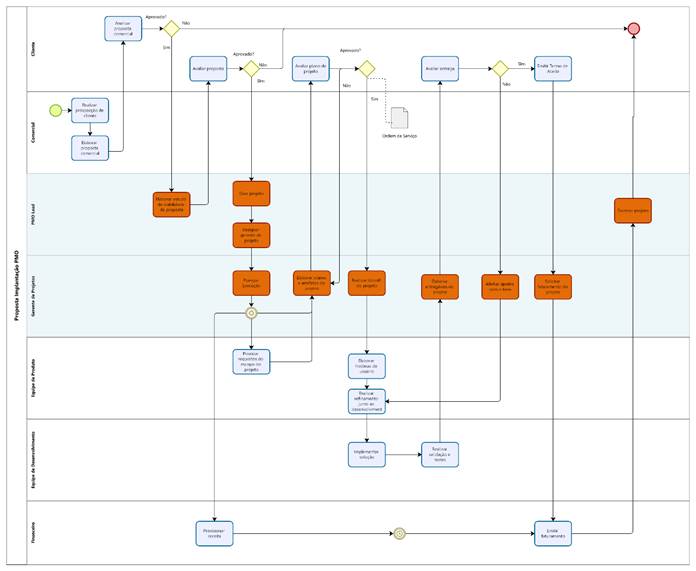
As part of the proposal, a project management process was modeled using the Business Process Model and Notation (BPMN) notation, which, according to Vieira (2022), facilitates the standardized representation of workflows. Figure 1 illustrates the proposed process, which ranges from the input of demands to the closing of projects.
Figure 1. Proposed process for project management through the Project Management Office (PMO)
Source: Original research results
The flow modeled in Figure 1 establishes formal control points throughout the project lifecycle, aiming to reduce reliance on informal decisions and increase information visibility. To mitigate the continuous entry of demands without evaluation, the model includes stages for business analysis, feasibility assessment, and formal approval before project creation. To address the difficulty in tracking schedules and responsibilities, the process foresees formal activities for planning, project manager assignment, artifact elaboration, and kick-off execution, seeking to align expectations and define responsibilities.
During the project execution, the workflow establishes continuous monitoring mechanisms between the product, development, and management teams, promoting alignment and reducing communication issues, an essential aspect for agile projects (Carneiro et al., 2022). The proposal also formalizes the project validation, acceptance, and closing stages, requiring formal evaluation of deliverables by the client and issuance of an acceptance form for greater control of the results.
The modeled process complements existing agile practices, providing planning, tracking, and control mechanisms to increase predictability and reduce risks associated with priority changes. The model foresees the joint action of the PMO Lead, focused on process standardization, indicator monitoring, and support for management practices, and the Project Manager, responsible for operational conduct, activity planning, and team monitoring.
Table 2 details the proposed responsibilities for the PMO Lead and the Project Manager, seeking to avoid overlap and strengthen monitoring and control mechanisms.
Table 2. Main responsibilities proposed for the PMO Lead and Project Manager roles
| PMO Lead | Project Manager |
| Standardize project management processes. | Plan and control project schedules. |
| Define and maintain document models and artifacts. | Develop and maintain project management artifacts. |
| Monitor project performance indicators. | Conduct follow-up meetings with teams and stakeholders. |
| Track strategic milestones and deliverables. | Coordinate multidisciplinary teams involved in the project. |
| Support the prioritization and organization of demands. | Manage risks, issues, and change requests. |
| Consolidate information from ongoing projects. | Monitor the execution of planned activities. |
| Support the management of critical risks and issues. | Monitor compliance with defined deadlines and milestones. |
| Promote continuous improvements in management processes. | Facilitate communication between clients, business areas, and technical teams. |
| Register and disseminate lessons learned. | Ensure alignment between scope, deadline, cost, and quality. |
| Support senior management in decision-making related to projects. | Conduct the formal closure of projects and record the results achieved. |
Source: Original research results
The responsibilities of the PMO Lead, according to Table 2, adhere to the functions of project offices synthesized by Lescowicz and Penteado Neto (2019), emphasizing methodological standardization, performance monitoring, management support, and dissemination of lessons learned. These functions reinforce the PMO’s role as an integration and control element, contributing to consistency in project management.
The proposal seeks to preserve the benefits of the Scrum framework, incorporating management practices for greater control over deadlines, scope, and communication, which is corroborated by Carneiro et al. (2022) on the importance of coordination and communication in agile environments. Expected benefits include improved predictability of deliveries, reduction of delays, increased project visibility, strengthened communication, and greater managerial tracking capacity, serving as a basis for future evolutions of project management maturity in the organization.
4. Conclusion
The present study aimed to propose the implementation of a Project Management Office (PMO) in a software development company, seeking to improve control, deadline management, and communication among teams. It was found that, despite the use of agile practices, the organization faced challenges such as recurring delays, frequent priority changes, and the absence of standardized processes for integrated project monitoring. The organizational diagnosis revealed weaknesses in initiative coordination, performance monitoring, and the consolidation of managerial information, indicating opportunities for improvement in process formalization, schedule tracking, and responsibility definition. Based on these findings, a Control PMO proposal was developed, focused on process standardization, delivery tracking, and improved communication, including the modeling of a project management process in BPMN. The proposed structure seeks to complement existing agile practices by providing formal mechanisms for planning, monitoring, and control, with the potential to increase delivery predictability, reduce delays, and strengthen interdepartmental communication.
As a limitation of the study, the low adherence of collaborators to the applied questionnaire stands out, which restricted the use of quantitative data and required the complementation of the analysis with other sources of evidence. Additionally, the proposal had not been fully implemented at the time of the completion of this work, making it impossible to measure the effective results of its application. For future studies, it is recommended to monitor the implementation of the PMO and evaluate its impacts on project performance indicators, as well as the evolution of organizational maturity in project management. It is also suggested to analyze the transition of the proposed structure to a PMO model with a more strategic role and greater participation in the management of the organization’s project portfolio, in more advanced stages of maturity.
Bibliographic References
Carneiro, R. A.; Martens, M. L.; Garcia, V. M. B.; Gonzales, E. D. S. 2022. O valor percebido pelo cliente na gestão de projetos de software, utilizando o framework Scrum. Revista de Gestão e Projetos (GeP) 13(3): 149-176.
Lescowicz, A.; Neto, R. 2019. PMO–Project Management Office: Uma Revisão de Literatura. In: IX Congresso Brasileiro de Engenharia de Produção, 2019, Ponta Grossa, Paraná, Brasil. Anais… p. 1-12.
Mello, F. M. C. de; Machado, R. H. C.; Campos, N. A.; Suzuki, J. A.; Santos, A. A. 2020. A contribuição do Escritório de Gestão de Projetos para a evolução de indicadores de risco e comunicação de uma organização. Revista Brasileira de Gestão e Engenharia 11(2): 1-22.
Passos, L. da S.; Campos, C. R.; Fortes, M. Z. 2020. Desafios e benefícios da implementação de um escritório de gerenciamento de projetos. Revista Gestão em Foco 1(12): 48-72.
Perrella, F. R. 2024. Gestão ágil de projetos: um estudo exploratório dos resultados em organizações experientes em métodos de gestão de projetos. Dissertação de Mestrado em Administração. Universidade Municipal de São Caetano do Sul, São Caetano do Sul, SP, Brasil.
Pinheiro, V. F.; Costa, D. de M. 2021. A percepção de valor na implantação de PMOs em pequenas e médias empresas. Revista Inovação, Projetos e Tecnologias 9(1): 124-142.
Project Management Institute [PMI]. 2021. Padrão de gerenciamento de projetos e Guia do conhecimento em gerenciamento de projetos (Guia PMBOK). 7ed. Project Management Institute, Newtown Square, Pennsylvania, Estados Unidos da América.
Tavares, O. B. M. 2022. Proposta de implantação de um escritório de gerenciamento de projetos no setor de prestação de serviços em uma empresa de telecomunicações brasileira. Monografia de Graduação em Engenharia de Produção. Universidade Federal Rural do Semi-Árido, Mossoró, RN, Brasil.
Vieira, G. C. Modelagem de processos de negócio usando BPMN. 2022. Monografia de Graduação em Sistemas de Informação. Universidade Estadual de Goiás, Itaberaí, GO, Brasil.
Article originating from the Final Course Work of the Specialization in Project Management at POLI USP PRO
To learn more about the course, click here