
September 15, 2026
Artificial Intelligence and Leadership: Developing Communication Skills Through an AI Tool
João Augusto Rodrigues Cortial Chagas; Allan Tadeu Pugliese
DOI: 10.22167/2675-6528-202602234
Article derived from a Final Course Work (TCC), with content based on the student’s original work and adapted to the editorial format of the E&S Magazine with the support of the ResumeAI tool, an artificial intelligence solution developed by the Pecege Institute for textual synthesis and organization.
Abstract
Artificial intelligence has impacted how leaders communicate and develop their teams, and the use of AI tools for interpersonal skills training has emerged as a relevant alternative. This study evaluated an AI tool for developing communication skills in leaders, seeking to understand the perceptions of organizational actors regarding its use. The research involved sixty employees from a multinational company, who participated in leadership training sessions between late 2025 and early 2026. Data were collected through an online questionnaire administered immediately after using the tool. The results indicated high acceptance of the tool, especially in terms of usability and learning support, and a positive contribution to the development of communication skills. However, limitations were identified regarding the realism of interactions and the quality of AI-generated feedback. It was concluded that artificial intelligence can act as an effective complementary tool in leadership development, provided it evolves in aspects of personalization and authenticity.
Keywords: Learning; Development; Simulation; Soft skills; Technology.
1. Introduction
Artificial intelligence (AI) has been consolidating itself as one of the most transformative technologies of the modern era. It is defined as the capacity of computational systems to simulate human intelligence to perform tasks that require learning, perception, and decision-making (Corrêa, n.d.). Its applications encompass process automation, predictive analysis, customer service through chatbots, and personalization of user experiences, standing out for efficiency, cost reduction, and innovative solutions for complex challenges (Corrêa, n.d.).
Although its origins date back to the 1950s, with the studies of John McCarthy and Alan Turing (Gunkel, 2017), the Covid-19 pandemic boosted its use on an even larger scale, making it a revolutionary factor in the business world (Meirelles, 2021; Garcia, 2024). The advancement of AI goes beyond basic chatbot interactions, evolving into high-level language processing tools and increasingly natural interactions (Meirelles, 2021; Altomare, 2025; Castello, 2025). It is estimated that, by 2030, the impact of AI could raise the Brazilian GDP by four percentage points (Meirelles, 2021). Although human feedback is crucial for the improvement of algorithms like ChatGPT (Rosado, 2023), challenges remain regarding the artificiality of interactions and the adequacy of responses to real-world contexts.
In the organizational environment, interpersonal communication is a fundamental pillar for the functioning and success of companies, being even more relevant for those who occupy leadership positions (Gerolamo, 2025). Leading involves influencing people towards a common vision and objectives, requiring essential communication skills, such as conducting difficult conversations and delivering feedback (Brown, 2016; Stone & Heen, 2016). The quality of these interactions directly impacts organizational productivity and well-being.
In this scenario, AI tools emerge designed to simulate interpersonal interactions, such as feedback sessions and sales negotiations. Companies developing such applications aim to enhance their employees’ communication skills, often using AI models as a basis. This innovation opens new possibilities for corporate training, but also raises questions about its influence on human dynamics, interpersonal trust, and the authenticity of interactions.
Given the growing relevance of artificial intelligence in skill development and the critical importance of communication for leadership, it becomes essential to investigate how AI tools can effectively contribute to the enhancement of soft skills. The central problem of this study questions: using an AI tool focused on soft skills training, how can Artificial Intelligence (AI) develop communication skills in organizational leaders? Thus, this study aims to understand the perceptions of organizational actors on the use of Artificial Intelligence (AI) tools to understand how they assist in the development of leaders in an organization.
2. Material and Methods
The study was conducted in a multinational technology and communication company, with collaborators based in the Americas, ranging from potential leaders to senior leadership. The research, exploratory in nature and qualitative in approach, adopted a pre-experimental design, in which the AI tool was applied to a predetermined group. The limitation of the absence of a control group for comparison is acknowledged, due to the homogeneity of the sample universe, composed of collaborators from the same organization. The period of interaction with the AI tool occurred between the last quarter of 2025 and the first quarter of 2026, during leadership and communication training.
The data collection instruments included bibliographic and documentary research, interviews with managers and specialists, evaluation of the AI tool by the researcher, and questionnaires. The research included a literature review and a detailed examination of the AI tool in question, aiming for greater familiarity with the object of study and the development of hypotheses (Turrioni & Mello, 2012; Prodanov & Freitas, 2013). The initial qualitative phase was conducted through interviews with managers and specialists in the field to validate hypotheses and raise new questions. Subsequently, the AI tool was evaluated by the researcher, who mapped its functionalities, interactions, and proposed uses. Organization collaborators interacted with the AI tool and evaluated their experience through an online questionnaire, administered via MS Forms in English, immediately after using the tool during training sessions. Four training sessions were conducted with distinct collaborator profiles, where 22 non-managers participated in conflict resolution and feedback scenarios, and 38 managers participated in objective-building and leadership influence scenarios. Participants were informed about the research objectives and voluntarily agreed to participate.
The Artificial Intelligence (AI) tool evaluated, provided by a third-party company, aims to simulate organizational situations to develop skills. It offers scenarios such as feedback, conflict resolution, coaching, and negotiations, in which the participant receives a problem situation and an objective. The interaction with the tool, which simulates an employee, can occur via voice, chat, or both, and in multiple languages.
The tool operates in different modes. In “guided” mode, teachings and tips are provided during the interaction, and at the end, feedback based on four areas (scenario objective, professionalism, coherence, and efficiency), highlighting positive points. The “model” mode inverts the roles, with the participant acting as a collaborator and the tool as a manager, offering a final report with positive points. The “practice” mode, considered the main one, allows for interaction without interference, like a real conversation, and provides more complete feedback at the end, including good evaluations, areas for improvement, and a score from zero to one hundred, based on the same four criteria. The tool also allows parameterizing the simulation’s behavior, such as assertiveness or reactivity, in the “guided” and “practice” modes.
The work was exempted from evaluation by the Ethics Committee, according to the sole paragraph of Article 1 of CNS Resolution No. 510/2016, as it falls under public opinion research with unidentified participants, scientific literature review, and theoretical deepening of situations emerging from professional practice without revealing identifiable data.
3. Results and Discussion
The market for Artificial Intelligence (AI) tools
The conversational AI market has shown significant growth, reaching approximately 7 billion web visits per month in 2025, representing a 76% increase compared to 2024. During the same period, downloads of AI applications more than tripled, reaching 1.9 billion. ChatGPT (OpenAI) dominates this market, being the fifth most visited website globally, although its share has decreased from 87% in 2024 to 64.5% in 2025 (Naspe and Sheridan, 2026; Sordilli, 2026). Gemini (Google) has emerged as a strong second, driven by its integration with other company tools, such as Gmail and Android, which include generative AI functionalities for everyday tasks. The observed trend is that AI tools are becoming part of the digital infrastructure, not just isolated products.
The use of ChatGPT by users aged 45 and over has grown, representing 30% of the total, although the majority of users are still composed of individuals under 34 years old. In terms of purpose, one-third of the use is for creation and writing, such as text and image generation, and 24% for practical learning, including studies and simulations (Naspe and Sheridan, 2026).
Foundations and Challenges of Artificial Intelligence (AI)
AIs operate without an internal database for information storage, focusing on predicting the most probable next word for a response (Altomare, 2025). Castello (2025) distinguishes between Machine Learning, which uses existing references and materials to provide answers, and Generative Artificial Intelligence (GenAI), which is capable of creating its own content, such as texts, images, and videos. In Machine Learning, learning can be classified as trainable, with human supervision, or non-trainable, where the tool optimizes its responses autonomously (Altomare, 2025).
The creation of customizable environments in market AI tools is feasible, enabling the development of communication skills in leaders, including advanced audio and video resources for reading body language and tone of voice (Altomare, 2025; Castello, 2025). However, the use of AI presents challenges, such as the potential decrease in human interactions, as AI tends to be more “courteous”, not simulating real emotions and conflicts. Another concern is the disinterest in learning and developing human skills, given that AI can replace many activities. Functions that require creativity and emotional intelligence, such as leadership, remain distant from automation (Altomare, 2025; Castello, 2025).
Features of the evaluated Artificial Intelligence (AI) tool
The AI tool evaluated, provided by a third-party company, aims to provide safe and realistic simulations of organizational situations for the development of new skills. The available scenarios include feedback, conflict resolution, coaching, and negotiations with stakeholders, always with a defined problem situation and objective. Interaction with the tool can occur via voice, chat, or both. It was observed that the generation of new responses by the tool, after evaluating a specific message, resulted in very similar texts, with few spelling variations.
The tool offers multiple interaction modes. In “guided” mode, tips and teachings are provided during the interaction. At the end, feedback is generated based on four areas (scenario objective, professionalism, coherence, and efficiency), highlighting only the positive points. In tests, the useful teaching was limited to a single opportunity. The “model” mode inverts the roles, with the participant acting as a collaborator and the tool as a manager, aiming for learning through practice. Interactions in this mode were perceived as artificial, with long and standardized responses, and the feedback was also limited to positive points. The “practice” mode is the main one, allowing for an interference-free conversation. The final feedback is more complete, including positive evaluations and areas for improvement, as well as a performance score. However, the standardization of positive feedback texts persisted.
The tool allows parameterizing the simulation behavior in “guided” and “practice” modes, choosing more assertive, reactive, dismissive, critical, or random interactions. In tests, performance evaluation was negatively impacted by delays or hesitations in purely oral interactions, while written interaction, which allows for revision, did not suffer the same penalty.
User Perception of the AI Tool
Four training sessions were conducted with collaborators of distinct profiles, using the AI tool in “practice” mode for specific scenarios. A questionnaire was applied after the interaction. 22 non-managers (conflict resolution and feedback scenarios) and 38 managers (objective building and leadership influence scenarios) participated.
The majority of participants, almost three in four, chose to interact with the tool exclusively in writing, regardless of their profile. Few ventured to interact only by speaking, although a hybrid approach was used by approximately a quarter of the managers, according to Table 1.
Table 1. How to use the AI tool during the practical part of the course.
| Public | Writing and listening | Speaking only | Writing only |
|---|---|---|---|
| Managers | 23,7% | 2,6% | 73,7% |
| Non-Managers | 9,1% | 18,2% | 72,7% |
Source: Original research results
The prior use of the tool outside the evaluated courses was low, according to Table 2, indicating that few participants had explored it on their own or in other contexts.
Table 2. Use of the tool outside the course
| Public | No use outside of the course | Yes, in other courses. | Yes, for personal learning | Yes, both in other courses and for personal learning |
|---|---|---|---|---|
| Managers | 33 | 3 | 1 | 1 |
| Non-Managers | 20 | 0 | 2 | 0 |
Source: Original research results
The tool’s usability was the best-rated aspect, with an overall average of 4.45 across all profiles. Participants also recognized the tool as significant support for learning, especially among non-managers, where the perception was unanimous, according to Table 3.
Table 3. AI tool evaluation
| Public | Ease of use | Assistance in understanding the course |
|---|---|---|
| Managers | 4,45 | 4,16 |
| Non-Managers | 4,45 | 4,50 |
| General Average | 4,45 | 4,28 |
Source: Original research results
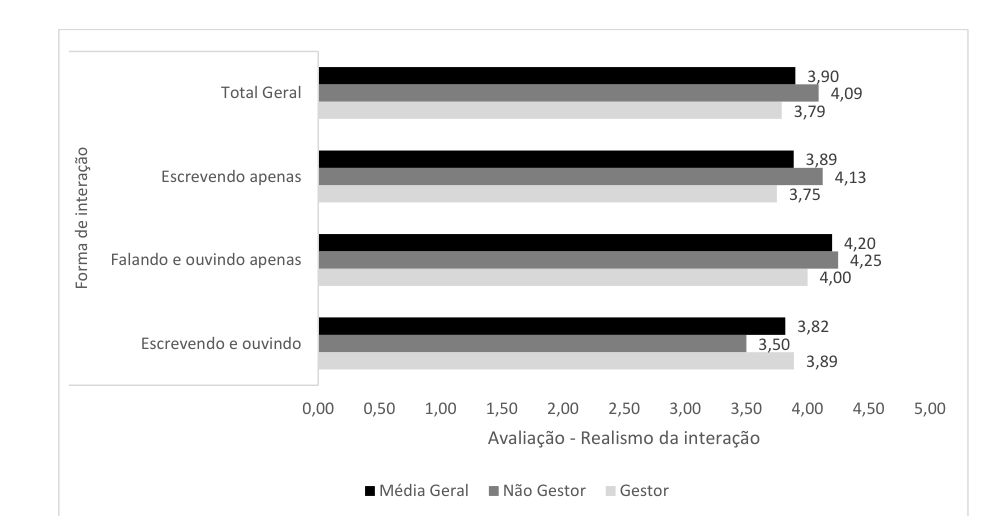
Despite positive evaluations in usability and learning assistance, the realism of the interaction was the aspect with the worst rating. Analyzing the perception of realism in relation to the type of interaction (Figure 1), it was observed that spoken interaction received the worst rating, while hybrid interaction tended to be perceived as more realistic. User comments indicated a perception of extreme simulation profiles, without transitions or nuances, such as interactions that were excessively stubborn or pleasant, depending on the parameterization.
Figure 1. AI tool evaluation: interaction realism vs. interaction form
Source: Original research results
The intention to use the tool in future courses of the organization was high, with an overall average of 4.33. For personal learning, the intention was slightly lower, with an average of 4.00, but still relatively high. Non-managers showed greater interest in both cases, according to Table 4.
Table 4. Intention to use the AI tool
| Public | In future courses | In personal learning. |
|---|---|---|
| Managers | 4,24 | 3,89 |
| Non-Managers | 4,50 | 4,18 |
| General Average | 4,33 | 4,00 |
Source: Original research results
This study allowed mapping the functionalities of the AI tool and identifying its strengths, such as the diversity of scenarios and customization, as well as opportunities for improvement, notably in feedback and interaction realism. The practical application of the tool in leadership training demonstrated added value to employee development, with generally positive perceptions. Methodological limitations, such as resistance to using sensitive data and difficulty in obtaining a homogeneous sample for quantitative study, directed the research towards a more qualitative and practical approach. It is suggested that future studies validate the learnings in other scenarios and explore other tools and proposals to broaden the knowledge on leadership development through AI.
4. Conclusion
This study sought to understand the perceptions of organizational actors on the use of an Artificial Intelligence (AI) tool in developing communication skills in leaders. High acceptance of the tool was verified, especially in terms of usability and learning support, indicating a positive contribution to the enhancement of communication skills. Most participants opted for written interaction, although the hybrid modality was perceived as more realistic. The intention to use the tool in future organizational courses was high, evidencing its perceived value. Thus, artificial intelligence emerges as an effective complementary instrument for leader development, offering a safe environment for practicing soft skills.
However, notable limitations were identified related to the realism of simulated interactions and the standardized quality of AI-generated feedbacks, which often were restricted to positive points or showed little variation. The qualitative approach adopted, although practical, was influenced by challenges in obtaining sensitive data and in forming a homogeneous sample, which limited the statistical generalization of the results. To maximize the potential of AI, it is suggested that future studies explore the evolution of the tool in aspects of personalization and authenticity of interactions. It is also recommended to validate the learnings in other scenarios and investigate different modalities and proposals for AI tools, focusing on more homogeneous populations to deepen the statistical relevance of the perceptions.
Bibliographic References
Altomare, R. 2025. Inteligência Artificial: fundamentos e desafios. Entrevista realizada em 29/06/2025. São Paulo, SP, Brasil.
Brown, B. 2016. A Coragem de ser imperfeito. Sextante. Rio de Janeiro, RJ
Castello, F. 2025. Big Data e Inteligência na Gestão de Dados I e II. Apresentado no MBA de Gestão de negócios em 2024. Universidade de São Paulo. Piracicaba, SP.
Corrêa, D. n.d. Inteligência Artificial na Comunicação Interna – 7 ferramentas para otimizar o dia a dia. Progic. Disponível em . Acesso em 02/04/2025.
Garcia, F. 2024. IA, Ética e Carreira: O Que Ninguém Te Contou Sobre o Futuro do Trabalho. Apresentado na Conferência Nacional Toastmasters Brasil em 24/05/2024. Brasília, DF, Brasil.
Gerolamo, M. C. 2025. Liderança e Professional Skills. Apresentado no MBA de Gestão de negócios em 2024. Universidade de São Paulo. Piracicaba, SP.
Gunkel, D. 2017. Comunicação e inteligência artificial: novos desafios e oportunidades para a pesquisa em comunicação. SciElo Brasil. Disponível em: . Acesso em 01 de abril de 2025.
Meirelles, G. 2021. Pandemia acelera processos na revolução da inteligência artificial. Febraban Tech. Disponível em: < https://febrabantech.febrabanco.org.br/temas/inteligencia-artificial/pandemia-acelera-processos-na-revolucao-da-inteligencia-artificial>. Acesso em 02 de abril de 2025
Naspe, L.; Sheridan, S. 2026. 2025 Generative AI Landscape: The State Of Gen AI. Similarweb. disponível em: . Acesso em 02 de fevereiro de 2026.
Prodanov, C. C.; Freitas, E. C. de. 2013. Metodologia do trabalho científico: métodos e técnicas da pesquisa e do trabalho acadêmico. 2ed. Feevale, Novo Hamburgo, RS, Brasil.
Resolução CNS (2016) [Referência completa não encontrada no documento original]
Rosado, A.C. 2023. Inteligência Artificial e o Futuro da Comunicação. Facha Editora, Rio de Janeiro, RJ. Disponível em: Acesso em 03/04/2025.
Sordilli, Aline. 2026. Gemini cresce, ChatGPT perde terreno e ambos formam duopólio mundial da IA. UOL. Disponível em: https://economia.uol.com.br/colunas/aline-sordili/2026/02/02/gemini-cresce-chatgpt-perde-terreno-e-ambos-formam-duopolio-mundial-da-ia.htm. Acesso em 02 de fevereiro de 2026.
Stone, D.; Heen, S. 2016. Obrigado pelo feedback: a ciência e a arte de receber bem o retorno de chefes, colegas, familiares e amigos. 1ed. Portfolio-Penguin, São Paulo, SP, Brasil.
Turrioni, J.; Mello, C.H. 2012. Metodologia de pesquisa em engenharia de produção estratégias, métodos e técnicas para condução de pesquisas quantitativas e qualitativas. Universidade Federal de Itajubá, Itajubá, MG, Brasil.
Article originating from the Final Course Work of the Specialization in Business Management of the MBA USP/Esalq
To learn more about the course, click here and access the MBX Academy platform