
September 15, 2026
Application of the Eisenhower Matrix in Deadline Management in Infrastructure Works
José Antonio Nabero Neto; Samira Sestari do Nascimento
DOI: 10.22167/2675-6528-202602241
Article derived from a Final Course Work (TCC), with content based on the student’s original work and adapted to the editorial format of the Revista E&S with the support of the ResumeAI tool, an artificial intelligence solution developed by the Pecege Institute for textual synthesis and organization.
Abstract
This work addressed the management of a public contract for the implementation of a Substation (SE) in a metropolitan railway system for passengers in the Metropolitan Region of São Paulo. The initial schedule predicted 36 months for the energization of two lines (A and B), but a strategic decision imposed the anticipation of the energization of Line A. The objective was to evaluate the effectiveness of the Eisenhower Matrix as a real-time schedule restructuring tool to meet this goal. The research was characterized as applied, with a qualiquantitative approach, developed through a single case study. The methodology focused on identifying crucial activities from the Project Breakdown Structure (EAP), classifying the tasks for Line A energization as “important and urgent” and those for Line B as “important, but not urgent”. Complementarily, schedule compression techniques such as “fast tracking” and “crashing” were applied. The partial delivery of the substation, with the anticipation of Line A energization by approximately three months, demonstrated the matrix’s effectiveness. It was concluded that the Eisenhower Matrix proved to be an effective decision-making support tool in complex projects, contributing to greater efficiency in contract management and goal achievement in deadline-constrained scenarios. The method proved to be practical and replicable for schedule management in public works for metropolitan railway energy systems.
Keywords: Project management; Time management; Eisenhower Matrix; Activity prioritization; Energy substation.
1. Introduction
Contract management in public works is a field that demands rigorous alignment between schedule, budget forecast, and strategic goals. The inherent complexity of these projects requires great responsibility, as the resources employed come from the collective collection of taxes and fees, as highlighted by Mendonça (2025).
In the context of the Metropolitan Region of São Paulo, the metro-rail sector represents one of the main transport modes, crucial for the mobility of hundreds of thousands of passengers. In this scenario, transport demand and energy availability are determining factors for the strategic planning of operating companies. Energy substations (SEs) play a vital role in the operationality of trains, as a greater capacity for energy supply to the system allows for an increase in the number of trains in circulation, a reduction in the interval between trips, and, consequently, an improvement in operational efficiency and user comfort, according to data from the Companhia Paulista de Trens Metropolitanos (2026).
This work analyzes a real-life situation of public contract management that involved the elaboration of an executive project, supply, and implementation of traction energy supply systems for the metro-railway system. The schedule, defined by the Project Management Institute (2021) as the representation of project activities over time, including their durations, sequencing, and dependencies, is a central tool in this type of undertaking.
The initial scope of the contract provided for the re-adaptation of the existing infrastructure, with the modernization and increased capacity of the energy system to meet the growing demand of passengers. The works were planned for 36 months, including the implementation of a new Substation (SE) and the energization of two operational lines, named Lines “A” and “B”, each with two circulation lanes. The original forecast was to energize both lines simultaneously.
However, during the project execution, a strategic decision by the contracting company imposed a new goal: to anticipate the energization of Line “A” due to its expansion and the need for a new operational section. This change generated a central problem: how to restructure an already established and rigid schedule to anticipate partial deliveries without compromising the overall project performance?
Faced with the need to restructure the construction plan in real time and anticipate part of the delivery, the Eisenhower Matrix, also known as the Time Management Matrix, emerged as an approach to realign planning and restructure the schedule. This management tool, as described by Covey (2015) and Tronier (2025), organizes and prioritizes activities based on two factors: urgency and importance, aiming to increase productivity and ensure that simultaneously urgent and important tasks receive priority attention.
The application of the Eisenhower Matrix, combined with schedule compression methods addressed by the PMI (2021), allowed for the classification of activities. Crucial tasks for the energization of Line “A” were designated as “important and urgent”, while activities for the energization of Line “B” were treated as “important, but not urgent”. This classification was carried out by the supervision and contract management teams, following the logic of the Eisenhower Matrix (Covey, 2015).
This work is justified by the need to develop a practical method for prioritizing activities that enables inspection and contract management to redefine the schedule in real time, ensuring the fulfillment of the company’s strategic goal. The Eisenhower Matrix, in this context, is configured as a widely used approach, as evidenced by Silva (2020) in a case study of a multinational company. The objective of this work is to evaluate the application of the Eisenhower Matrix as a tool for restructuring schedules, concentrating resources on priority tasks for the fulfillment of the goal established by the company.
2. Material and Methods
This is an applied research, with a quali-quantitative approach, developed through a single case study focused on the practical application of project management concepts. The work analyzed a real situation of managing a public contract, allowing for the evaluation of decisions made during the execution of the work. The approach combined qualitative analyses, related to the decision-making process, and quantitative analyses, focused on the evaluation of deadlines and schedule performance. The unit of analysis for this study corresponded to the schedule of the public contract for the implementation of an energy substation (SE) intended for the reinforcement of the electrical system of two operational lines, identified as Lines “A” and “B”.
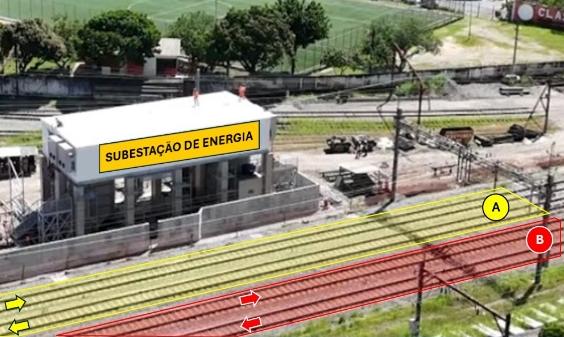
Figure 1 shows the Substation during the construction period and a representative diagram of the project area, highlighting Lines “A” and “B”.
Figure 1. On the left, the photo shows the Substation and Lines “A” and “B” through which passenger trains circulate; on the right, a representative diagram of the Substation region
Source: original research data
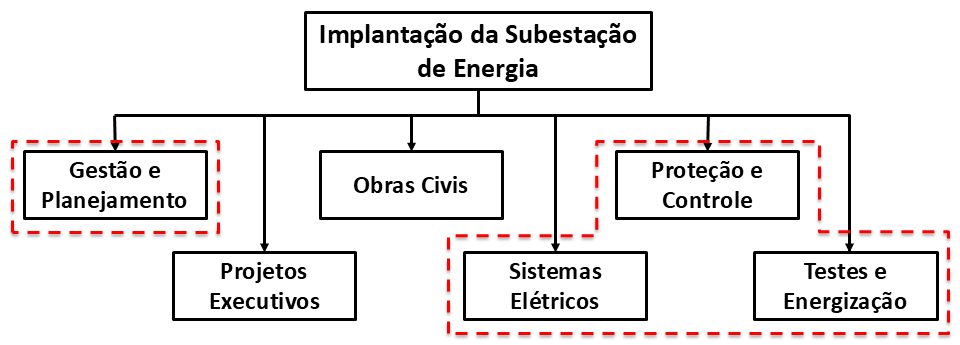
The information and data that structured the schedule were obtained through documents and records related to the contract. Data from the Work Breakdown Structure (WBS), Microsoft Project schedules, executive projects, technical and administrative documents, and records of technical meetings for monitoring, alignment, and decision-making between management, contract supervision, and the technical teams of engineers and managers of the contracted company were used. The WBS was used to break down the project into smaller parts, aiding in the understanding of the scope and the phases associated with the substation’s implementation.
Figure 2 illustrates the Substation Energy Implementation WBS, and Table 1 details the WBS decomposition.
Figure 2. Energy Substation Implementation WBS
Source: original research data
Table 1. WBS decomposition of SE implementation
| Category | Activities |
|---|---|
| Management and Planning | Team mobilization and organization; Schedule planning and control; Contracts and interfaces, risks and changes; Reporting and follow-up meetings |
| Electrical Systems | Equipment supply; Electromechanical assembly; Busbars, cables and connections; Integration with “A” and “B” Lines |
| Protection and Control | Electrical protection systems; Supervision and remote control systems; Integration with CCO (Operational Control Center); Functional tests |
| Tests and Energization | Isolated tests; Tests integrated into operating systems; SE Commissioning; Energization of Lines “A” and “B” |
Source: original research data
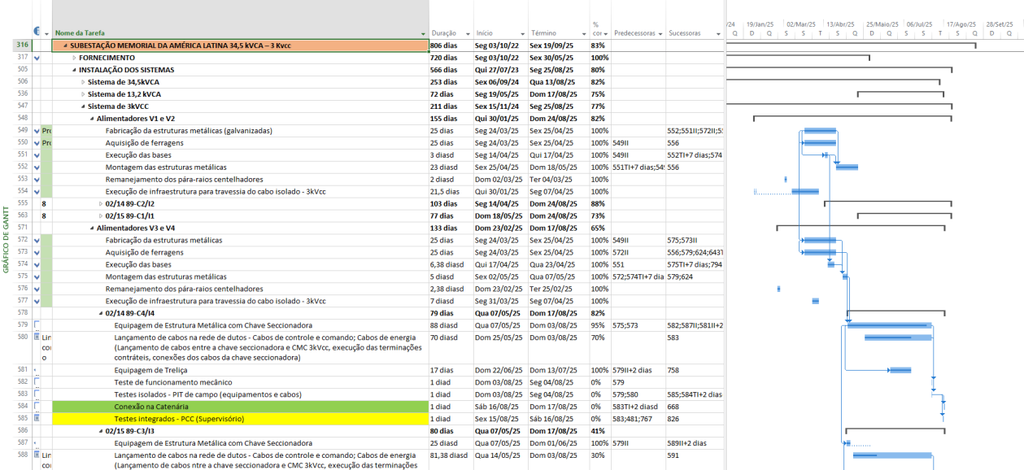
The original contract schedule, which provided for 36 months for the total implementation and energization of the substation, was developed with MS Project software, using a Gantt Chart for visualizing activities, durations, milestones, and precedence relationships. Figure 3 shows a recorte of the original project schedule.
Figure 3. Snippet of the original project schedule created in MS Project
Source: original research data
During the works, a strategic decision by the company required the early energization of Line “A”, demanding a restructuring of the schedule. The technical teams analyzed the original schedule, verifying that it did not foresee intermediate deliveries and had a strong dependency between the activities of the two lines, which made partial energization impossible. To realign the planning and restructure the schedule in real time, the Eisenhower Matrix was selected as an analysis tool, complemented by prioritization and schedule compression techniques.
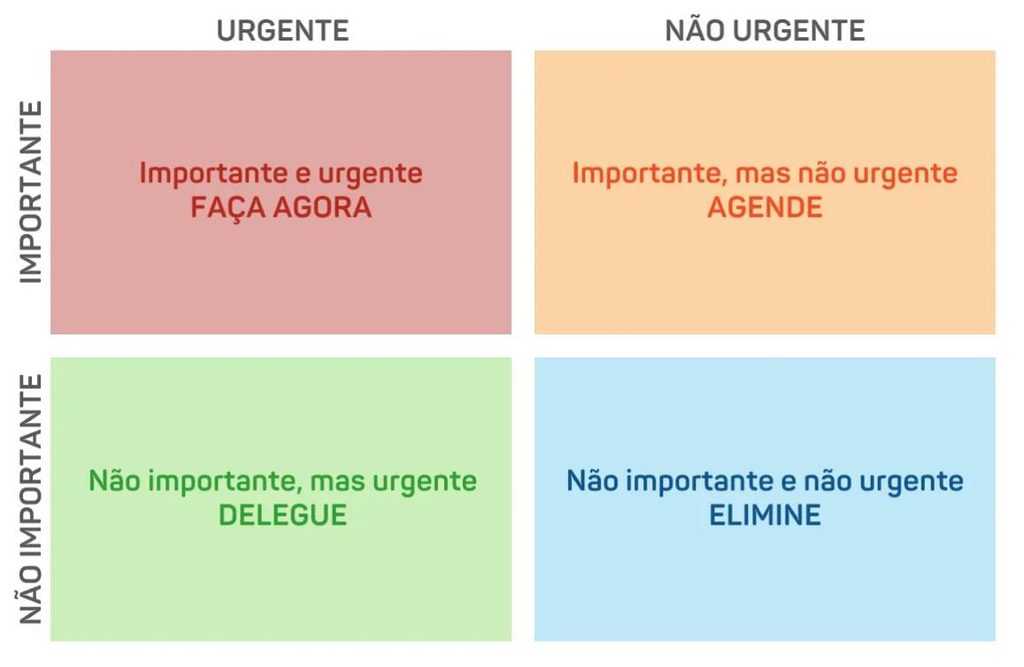
All activities directly related to the energization of Line “A” were identified in the base schedule. These activities were classified based on urgency and importance criteria, according to a joint analysis by the teams, using structured technical judgment in meetings with the coordination, supervision, and engineering teams of the contracted company. Activities classified as “important and urgent” were prioritized, concentrating resource allocation, while those “important, but not urgent” were rescheduled for later stages of the contract. Figure 4 presents the Eisenhower Matrix, and Table 2 shows its application to the project.
Figure 4. Eisenhower Matrix
Source: IBS (2025)
Table 2. Eisenhower Matrix applied to the project
| URGENT | NOT URGENT | |
|---|---|---|
| IMPORTANT | LINE “A” Finalize installations Tests Definitive energization | LINE “B” Finalize execution Tests Definitive energization |
| NOT IMPORTANT | Auxiliary systems Protection/interlocking systems Remote control | Monitoring system [CFTV] Training Spare equipment delivery |
Source: adapted from Covey (2017)
To complement the Eisenhower Matrix and enable early delivery, schedule reduction techniques such as “fast tracking” (parallelism) and “crashing” (compression) were applied, according to the guidelines of the PMBOK® Guide (PMI, 2021). “Fast tracking” was characterized by the parallel execution of originally sequential activities, such as the overlap between installation and testing phases, allowing parts of the substation to be energized and tests on equipment related to Line “A” to begin while other parts of the work were still underway. “Crashing” consisted of reducing the duration of activities by allocating additional resources, such as hiring extra teams and increasing working hours. This technique was mainly applied to critical path activities for energizing Line “A”, including the assembly of equipment related to the protection and energization of Line “A”, cable laying and connection, and equipment testing, mobilizing additional teams and specialists for simultaneous testing.
3. Results and Discussion
Initially, it was diagnosed that the original project schedule was structurally rigid, a common characteristic in infrastructure projects with strong interdependencies between activities (Limmer, 1996). This schedule did not foresee intermediate stages and established a direct dependency between the deliveries of Lines “A” and “B”, which resulted in a plan focused on the complete scope completion and without flexibility for partial deliveries. Such a model proved incompatible with modern project management approaches that value flexibility and adaptation to uncertainties and changes (PMI, 2021).
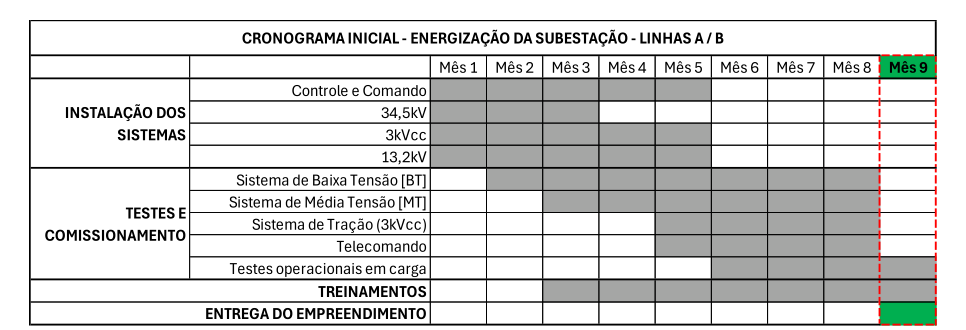
Figure 5 illustrates the excerpt of the original construction schedule, covering the development period of this work.
Figure 5. Spreadsheet (Excel) format schedule
Source: original research data
Given the need to restructure the original schedule, driven by a strategic change that aimed to anticipate the energization of Line “A”, an alignment of essential activities was sought to meet this goal. Technical discussions focused on the sequencing of energization activities for Line “A” allowed for the adjustment of a new critical path, which operated independently of Line “B”.
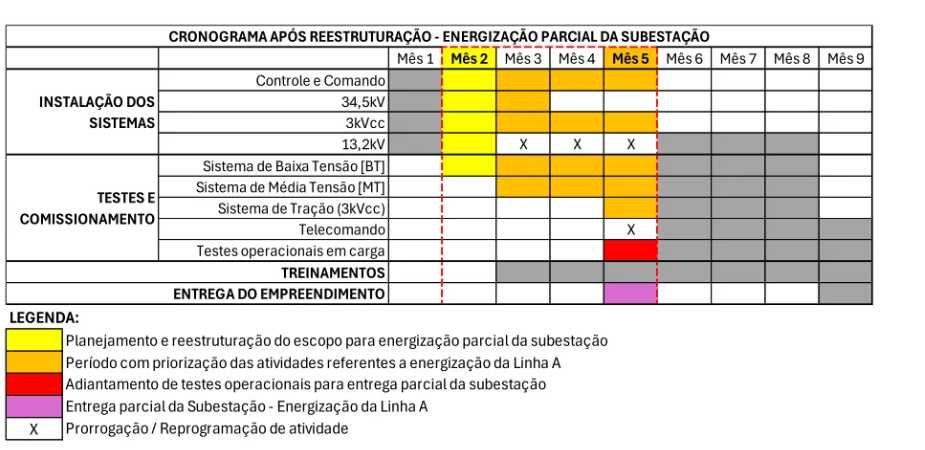
In this process, the Eisenhower Matrix was used to qualitatively identify priority activities. This methodology, recognized as one of the main tools for prioritizing activities (Silva, 2020), guides that tasks considered important and urgent receive greater attention and resources. Its practical application contributed to the elimination of unnecessary dependencies and to a more efficient execution of the project. Figure 6 below illustrates the schedule after restructuring activities based on the prioritization of the Eisenhower Matrix.
Figure 6. Restructured schedule in spreadsheet format (Excel)
Source: original research data
With the company’s strategic change, the energization of Line “A” was brought forward to the end of Month 5. This represented an anticipation of approximately 3 months compared to the original forecast of 7 months for the joint energization of Lines “A” and “B”, resulting in a reduction of about 50% in the critical activity timeframe. The data were analyzed through a before/after comparison, measuring the impact on the final deadline from the moment of the decision to anticipate the partial delivery of the substation.
The application of the Eisenhower Matrix as a tool to support the redistribution of activities proved to be a challenging task, largely due to the absence of a culture of using management tools in the company and in construction contracts. The literature, as Junkes (2022) points out, suggests that the adoption of methodologies and best practices for planning, monitoring, and controlling construction works can improve performance and expected results.
The anticipation of the energization of Line “A” by approximately 3 months, as evidenced in the schedule of Figure 6, demonstrated the effectiveness of the adopted methodology and the concept of strategic prioritization (Covey, 2015). Project management studies, such as Moreira et al. (2010), also observed similar results, indicating that the reassessment of dependencies and the reorganization of activity sequencing can generate significant time gains, without necessarily increasing costs proportionally. Additionally, the combination of fast tracking and crashing techniques, according to PMI (2021) recommendations, proved to be adequate for the analyzed context.
The application of these techniques required caution, as it implied an increase in operational risks, especially related to quality and safety (PMI, 2021). Strict control was necessary, maintained in the present study by the technical validation of prioritized activities. Crashing demanded greater team control and a slight increase in costs, while fast tracking introduced risks of rework and potential conflicts between teams, especially in a critical environment such as high-voltage electrical installations.
The combined use of these techniques, aligned with the prioritization of critical activities through the Eisenhower Matrix, was fundamental for the restructuring of the schedule and for meeting the strategic goal of anticipating the substation’s energization.
From a methodological point of view, the Eisenhower Matrix proved to be a simple yet highly effective tool for supporting decision-making in complex environments. Studies by Silva (2020) and Ribeiro (2022) corroborate that prioritization tools contribute significantly to improving project performance, especially when rapid responses to strategic changes are necessary.
However, the study presents some limitations. Firstly, being a single case study, the generalization of results to other contexts or sectors is restricted. According to Yin (2015), case studies have strong internal validity but limited external validity. Furthermore, part of the decisions analyzed was based on the practical experience of the teams, which may introduce a degree of subjectivity into the prioritization process.
Another relevant limitation is the absence of a more in-depth quantitative analysis of the impacts on costs and risks. Although the main focus was on the schedule, the project management literature highlights the interdependence between schedule, cost, and scope (PMI, 2021). Future research could explore these aspects in an integrated manner to broaden the robustness of the conclusions.
As a positive point, the practical applicability of the proposed methodology stands out. The Eisenhower Matrix, combined with PMBOK best practices, proved to be a viable and replicable approach for real-time replanning situations. The clarity in defining priorities and the objectivity in decision-making contributed to greater alignment between technical teams and contract management.
Additionally, the study highlights the importance of integrating classic planning tools, such as the Gantt Chart, with strategic prioritization methods. This combination allows not only for visualizing the schedule but also for dynamically acting upon it, increasing the project’s responsiveness to changes.
In summary, the results obtained confirm that the structured prioritization of activities, when applied consistently and aligned with the strategic objectives of the project, can generate significant performance gains, especially in terms of schedule. The adopted approach proved effective in reorienting planning, reducing unnecessary dependencies, and enabling partial deliveries.
4. Conclusion
This study evaluated the application of the Eisenhower Matrix as a tool for schedule restructuring, aiming to concentrate resources on priority tasks for the fulfillment of a strategic goal in a public contract for the implementation of a metro-rail substation. It was found that the original schedule presented structural rigidity and direct dependency between the deliveries of Lines A and B, which made the early energization of Line A unfeasible. The application of the Eisenhower Matrix allowed for the identification and qualitative prioritization of crucial activities for Line A as “important and urgent”, while those of Line B were classified as “important, but not urgent”. This approach, combined with schedule compression techniques such as fast tracking and crashing, enabled the restructuring of the planning, eliminating unnecessary dependencies and adjusting a new critical path. Consequently, the early energization of Line A was observed to be approximately three months ahead of schedule, demonstrating the methodology’s effectiveness in deadline management in complex projects. The main contribution of this work lies in presenting a practical and replicable method for schedule management in public works for metro-rail energy systems, promoting greater efficiency in contract management and in meeting deadlines under time constraints.
However, the study has limitations inherent to its single case study nature, which restricts the generalization of results to other contexts. Additionally, part of the decisions analyzed was based on the teams’ practical experience, introducing a degree of subjectivity into the prioritization process. A relevant limitation was the absence of an in-depth quantitative analysis of cost and risk impacts, although the focus was on the deadline. For future studies, it is suggested to apply the methodology to other ventures for additional validation of the results and to conduct research that explores the aspects of deadline, cost, and risk in an integrated manner, in order to broaden the robustness of the conclusions.
Bibliographic References
Companhia Paulista de Trens Metropolitanos [CPTM]. 2025. Embarcados acumulados do mês. Disponível em: . Acesso em: 17 jan. 2026.
Covey, S.R. 2015. Os 7 hábitos das pessoas altamente eficazes. 52ªed. Best Seller, Rio de Janeiro, RJ, Brasil.
Covey, S.R. 2017. Primeiro o mais importante. Sextante, Rio de Janeiro, RJ, Brasil.
IBS Sistemas. 2025. Matriz de Eisenhower: Organize sua vida e aumente sua produtividade. Disponível em: . Acesso em 12 dez. 2025
Junkes, 2022 [Referência completa não encontrada no documento original]
Limmer, C.V. 1996. Planejamento, Orçamentação e Controle de Projetos e Obras. Editora JC, Rio de Janeiro, Brasil.
Mendonça, J.C.S. 2025. A importância da gestão de processos em obras públicas: Apontamentos decorrentes de repercussão financeira originada de alterações de custo e prazo de execução. Revista FT. 29: 144. Disponível em: . Acesso em: 23 jan. 2026.
Moreira, A.M.; Palma, M.A.M; Silva, R.S. 2010. Análise de Gerenciamento de Tempo Aplicado a um Projeto de Petróleo. Revista de Gestão e Projetos – GeP. 01: 128-146.
Project Management Institute [PMI]. 2021. Um Guia do Conhecimento em Gerenciamento de Projetos (Guia PMBOK®). 7ed. Project Management Institute, Newtown Square, PA, EUA.
Ribeiro, G.M. 2022. Desenvolvimento de um plano de ação e intervenção para as manifestações patológicas identificadas na edificação pública do município de Patos-PB. Monografia – Bacharelado em Engenharia Civil. Universidade Federal Rural do Semi-Árido, Caraúbas, RN, Brasil.
Silva, H.T.M. 2020. A importância de metodologias de priorização no processo de gestão de portfólio de projetos: um estudo de caso. Monografia – Bacharelado em Administração. Universidade Federal do Maranhão, São Luís, MA, Brasil.
Tronier, R. 2025. Matriz de Eisenhower: como priorizar os seus afazeres. Disponível em: . Acesso em: 23 jan. 2026.
Yin, R.K. 2015. Estudo de Caso: Planejamento e Métodos. 2ªed. Bookman, Porto Alegre, RS, Brasil.
Article originating from the Final Course Work of the Specialization in Project Management of the MBA USP/Esalq
To learn more about the course, click here and access the MBX Academy platform