Education
Innovation
Technology
April 09, 2024
Why won’t AI replace my job as a proofreader?
Translators have been using CAT Tools for many years, and their role has always been complementary
One of the things I’ve heard most since I chose the profession of translator and reviewer was the question of whether I was worried about the possibility of AI (Artificial Intelligence) tools taking my space in the job market.
The truth is that if this type of technology really threatened my job, Word’s spell checker would have already stopped me from getting this far. After all, if it can correct all the errors in a text, why would human quality control be necessary?
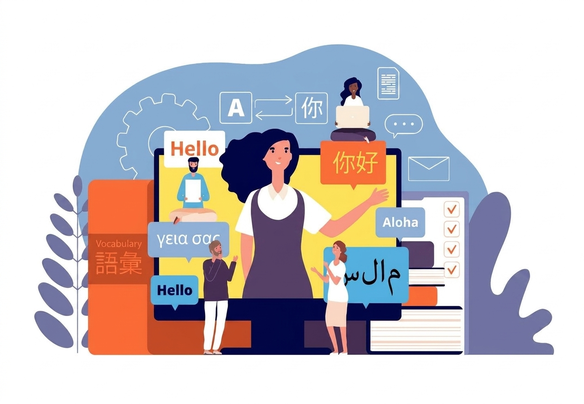
Carefully analyzing the trajectory of the review and translation sector, it is possible to perceive that AIs bring nothing new to this area. Translators have been using CAT Tools (Computer-Assisted Translation tools) for many years, and their role has always been complementary.
According to Nino Vukalović (2021), we can divide the evolution of CAT Tools into two main periods: the classic phase (1995 – 2005), when these tools began to become more accessible for commercial use, and the modern phase (2005 – present), characterized by the increase in the amount of data feeding these tools and the simplification of user interfaces.
In today’s job market, it is practically impossible for a reviewer not to use these tools, which serve to facilitate work and provide precision and agility to the revision and translation process. Imagine a client requesting copywriting work with a 24-hour deadline, and a professional offering a five-day deadline because they consider AI a mortal enemy. Unacceptable!
Considering contemporary automation and the evolution of technologies in all areas, it would not make sense to label AI as a villain. On the contrary, I imagine my professional routine would be much more difficult without its help. It is perfectly possible to see AI as a work colleague, even. A recurring mistake is thinking that technology can handle the entire process alone, alongside all its other advantages, such as precision and speed, since it does not get tired, does not sleep, and does not eat.
The problem is that AI fails precisely at the foundation of the fundamentalist theory of translation, which emphasizes the importance of attention to “when”, “where”, “how”, “why”, “for whom”, and “by whom”. In other words, the literature in the field postulates that good translation should be guided by the understanding of a context, which includes the purpose to be fulfilled and the uses and codes of the target audience’s culture. It also depends on the bridge between cultural nuances that, until now, only human intelligence has proposed with excellence.
As in all situations, there are (several) advantages and (some) disadvantages in using AI in the world of translation and revision. Firstly, the advantages: 1) more speed in the translation process; 2) increasingly accurate results; 3) ability to self-correct; and 4) lower cost; the latter, due to the fact that artificial intelligence does not require rest, leisure, or food and mobility assistance, among others. This makes the cost-benefit associated with long-term delivery more economical in some cases (which, let’s face it, is more than a little help in anyone’s life).
In terms of disadvantages, it is necessary to mention that AI still falls short in the three “Ws” of translation: When, Where (where), and Who (who), in a very summarized way. When performing any type of translation or revision, it is necessary to analyze aspects that go beyond linguistic factors (the so-called extralinguistic factors), such as cultural codes, how that text fits into the timeline, and what the target audience is. For this reason, for example, it is very common for the voice actor to have to alter what the translator chose to put in the script, since the latter only has access to the text, while the voice actor has a broader and more detailed view of the situation.
In an interview with CNN, NYU Stern School of Business professor Scott Galloway stated that the algorithms of translation tools simply rearrange information eloquently, as they do not possess the capacity to be creative – in addition to still being subject to a certain margin of error in the information they compress.
Tiny errors, whatever they may be, in areas such as medicine and law are fatal, and can even lead to judicial consequences in certain cases. No manager, regardless of the area, can afford to rely solely on artificial intelligence to perform their functions. Why would it be different for a proofreader and translator?
Beginnings
The first signs of the emergence of artificial intelligence appeared in the mid-1950s, albeit in a very limited way. The process became much more interesting and productive around the 1980s, with the improvement of studies (and the return of scholars’ attention to this research area) in Artificial Neural Network(ANN) and Natural Language Processing (NLP), which had a substantial advance. Leandro Silva (1998) states that the event that highlighted the ANN field was “the development of a method for adjusting parameters of multilayered non-recurrent networks” (Silva, p.14), based on an algorithm called backpropagation, and the release, in 1986, of the book “Parallel Distributed Processing”.
The progress of the internet in recent years has enabled access to a large (if not enormous) amount of data, and this has also impacted the field of translation. The purpose of AI algorithms in reproducing behaviors similar to those originated by the human brain has been gradually achieved, but there is still a reason why not even Microsoft allows its contracts to be translated directly by ChatGPT without the participation of a reviewer.
Current AI models still fail at the same point as old ones: they make mistakes in the semantic ambiguity test, a topic that is – and will be for a long time – the responsibility of the human reviewer. The ideal ends up being a hybrid situation: neural translation/review with human post-editing. It is flesh-and-blood translators who perform the cultural adaptation, compare languages with different particularities, and perform the adaptation of linguistic codes and cultures for the reader.
A simple way to view the problem in question is by applying the same sentence, without prior context, in two different communication channels. A few days ago I came across a text that said the phrase “the bank went bankrupt” can have different interpretations depending on the context. In fact, reading the sentence “the bank went bankrupt” in the international trends on X (formerly Twitter) would allow us to conclude that there was some problem related to a financial institution, most likely.
On the other hand, if someone receives this same message from their grandfather, they will likely imagine it to be a broken seat. AI does not yet have the ability to interpret an ambiguous phrase and translate it faithfully, as the only way to understand the context in this case is by knowing the sender.
AI is the talk of the town, isn’t it?
It depends. As mentioned above, AI is still flawed from the perspective of cultural aspects derived from lesser-known regions or linguistic factors. Like any algorithm, it depends on prior data from models and training – which, voilà, depend on the quality of human eye control. The recognition of patterns, linguistic and cultural nuances and complexities of a certain regionality is still necessary, especially with those more devoid of popularity – the Maori language (spoken by the Maori people, native to New Zealand), for example.
I did some tests on my own with ChatGPT and Bard regarding the idiomatic expressions from the Southeast and Northeast of Brazil, specifically. With this, I obtained three different types of results: the correct answer, the wrong answer, and “giving up”, that is, the AI admitting that there was no concrete answer to the question.
The first expression chosen was “capotar o Corsa” (to lose control of something; to fall asleep), widely used in the Southeast of Brazil. ChatGPT indicated to me that “it is a colloquial expression used to refer to a car accident”, which in English could be placed as “to flip the Corsa” (to flip the Corsa in Portuguese). Bard, on the other hand, indicated that the expression “to go up in flames” (to turn to smoke), which means to be completely destroyed (literally or colloquially), would be a fitting equivalent. Well, putting myself in the shoes of a foreigner who just wanted to understand what their Brazilian friend was saying, I would certainly be confused. Or worse, worried about a possible car accident.
The second example applied was the Bahian expression “lá ele”, also widely used and popularized online. The first platform (ChatGPT) indicated that there is no direct equivalent in English and that, if it is “being used casually”, it can be translated as “there he goes” (lá vai ele, in Portuguese). Bard ended up indicating a similar, but still incorrect, result: “sure thing” (with certainty). The expression, in fact, is used in an informal context of negation, usually to contest a phrase with a double meaning directed at someone. In summary, it would be an “I don’t!” or the famous “leave me alone” from the Southeast.
Finally, I used another expression from the Bahia region, which originated the subtitle of this section: “boca de 09”. At first, it strongly resembles the expression “X9”, which indicates a person who cannot keep a secret. I believe the AI algorithm ended up following the same line of thought, as Bard delivered “chatterbox” as a direct equivalent of the expression. ChatGPT merely indicated that there were no equivalents in English and that more context would be needed to deliver a concrete answer. “Boca de 09” (read as boca de zero nove) actually refers to something of extreme quality or efficiency.
AI, the villain of new times
Of course, there is still a long way to go until AIs replace contextual understanding, creativity and modifications that are not based on pattern repetition or logic, but rather on circumstances that demand creativity and freer interpretations, exclusively belonging to human knowledge until now. It is the partnership between the human and AI that can lead to more precise and efficient results regarding the deadline versus quality relationship.
While artificial intelligences are still in their infancy, reviewers’ positions are likely more than secure. The phase of seeing AI as the villain of the century has passed; even though there is a possibility of it being used for “not-so-legal” purposes, this technology is nothing more than a complementary tool in almost all areas. In the case of translation, besides joining words, the touch of emotion and sincerity of the human gaze, irony, satire – and all in a cohesive manner – is necessary.
Although AI still has a long way to go before reaching the “know-it-all” level that many believe it already possesses, the value this technology adds to our daily lives is undeniable. The partnership between humans and AI emerges as a promising approach, capable of uniting the best of both worlds. Thus, as AIs continue to evolve, it is evident that the role of the reviewer remains fundamental, as the complementarity between technology and human talent is essential to achieve quality and relevant results. This symbiosis between man and machine promises not only to optimize processes but also to enrich and enhance the human experience in various fields, opening doors to new possibilities and discoveries.
It is important to remember that relying solely on artificial knowledge is, in fact, generating only more artificial knowledge.
This content was produced by:

Isabela Talita Segredo
Project manager and translator at Skylar, where she performs her role in demands related to the Skylar Business front. She worked as an English language teacher for four years before migrating to the field of translation and subtitling. Her research focus and interest lie in Audiovisual Translation, with special emphasis on dubbing and cultural transposition in extralinguistic aspects.
Who wrote this column
Skylar