Digital
March 12, 2026
How captions are reshaping the brain
The simple act of reading what is heard brings about transformations in how the brain processing of learning occurs
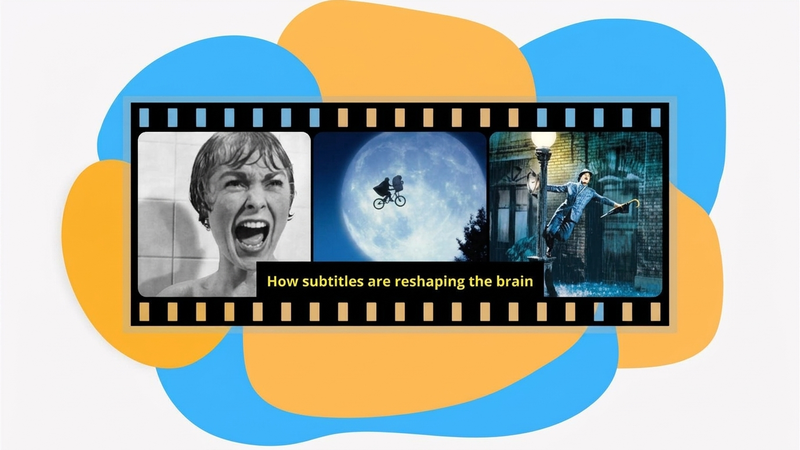
In the streaming era, besides accessibility and translation, another characteristic of subtitling — omnipresence — is bringing to light a fascinating side effect of audiovisual subtitling: the improvement of the learning process.
The circulation of information and cultural products has reached unprecedented levels in the contemporary world. Access to audiovisual content from different parts of the world is now an everyday reality, driven by the expansion of the internet, the proliferation of smart devices, and the emergence of streaming platforms.
This scenario created new demands and challenges, both for the productive and service sectors as well as for the entertainment industry and the audiovisual market. Accessibility emerges as a fundamental principle, requiring content to be understandable and useful for different audiences, regardless of language or sensory ability.
In this context, subtitling has been consolidated as an essential bridge between different forms of communication, by making the verbal channel accessible through visualization. Traditionally, in audiovisual products, this channel manifested itself mainly through sound — as in dialogues, narrations, music, and vocal effects. Subtitling, however, allows this oral content to be converted into on-screen texts, promoting the visual translation of orality.
This transposition not only breaks down linguistic barriers but also increases accessibility for people with hearing impairments and for those who, for various reasons, prefer or need to read rather than listen. Less evident, but increasingly studied, is the fact that this simple act of “reading what you hear” entails transformations in how the brain processes, retains, and learns information (Vanderplank, 2016).
Cognitive science and subtitling
To understand why captions are so effective, it is necessary to look at cognitive neuroscience. The main explanation lies in Dual Coding Theory, proposed by psychologist Allan Paivio, who postulates that the human brain processes and stores information through two different but interconnected channels: a verbal channel (for language, both spoken and written) and a non-verbal channel (for images and objects).
When we watch a movie or documentary without subtitles, auditory information (dialogues) and visual information (scenes) are processed simultaneously. However, when subtitles are activated, we introduce an additional stimulus that reinforces the verbal channel. The brain receives the same message through two different modalities: it listens (auditory) and simultaneously reads the message (visual-textual).
This dual processing creates a much more robust and redundant memory trace. Additionally, if a part of the auditory stimulus is lost, whether due to an unfamiliar accent, a very fast dialogue, background noise, or simply a momentary distraction, the on-screen text acts as a cognitive anchor, ensuring that the message is not only received but also understood and retained.
Still according to Paivio’s theory, this phenomenon is also related to the reduction of cognitive load required when watching a video in a language other than one’s native tongue. The brain has a limited processing capacity. Trying to decipher complex audio — for example, a lecture with technical terminology or a movie with specific language — consumes a significant amount of mental resources.
Subtitles have the ability to alleviate this burden: by providing a clear and direct transcription, they free the brain from the task of decoding sound, allowing the organ to dedicate more resources to higher-level tasks, such as understanding meaning, analyzing context, and connecting new ideas with prior knowledge. Essentially, subtitles allow us to work smarter and with less effort.
Besides the general improvement in information retention, captioning has proven to be a very effective learning tool in various areas (Vanderplank, 2016).
- Second language acquisition:
It is perhaps the most applied and studied benefit. For language students, subtitled audiovisual content is an unparalleled immersion resource.
a) Caption in the native language: helps beginners associate the sound and intonation of the new language with its direct meaning, building a bridge of initial understanding.
b) Foreign language caption: it is an even more powerful tool, as it allows the person to see the exact spelling of the words they are hearing. This enables the connection of phonetics with spelling, the identification of words in fast speech, vocabulary acquisition, and familiarization with the grammatical structures of the language in a natural and interesting context.
A 2016 study from the University of Barcelona published in 2016 demonstrated that students who watched videos in a foreign language with subtitles in the same language showed a significantly greater improvement in listening comprehension and vocabulary recognition than those who watched without subtitles or with subtitles in their native language (Birulés-Muntané; Soto-Faraco, 2016).
- Improved literacy and reading comprehension:
For native speakers, especially children and developing readers, same-language captions (e.g., Portuguese captions for a Portuguese program) are very beneficial. This practice, commonly called SLS (same-language subtitling), has been the subject of massive literacy campaigns in countries like India. By seeing text synchronized with speech, children and adults with reading difficulties improve fluency, reading speed, and word recognition. The brain automatically and fluidly learns to associate the spoken word with its written form, a fundamental pillar in literacy.
- Understanding of complex and technical content:
Thinking, for example, about a medical series full of technical terms, a dense political analysis, or a documentary about quantum physics, subtitles act as a real-time glossary. They allow you to see the spelling of proper names, scientific terms, or abstract concepts, facilitating assimilation and eventual further search for more information. The simple fact of reading the terms “Higgs Boson” while the explanation is being heard helps to anchor the concept in the mind in a way that audio alone cannot always achieve.
Commoditization
The phenomenon of subtitling has acquired a global dimension in recent years, largely as a result of the boom of streaming platforms such as Netflix, Prime Video, and Disney+, among others. What began as an accessibility feature has transformed into a global commercial strategy. Jorge Díaz-Cintas, a reference in audiovisual translation studies, coined the term “commodification of subtitling” to describe this shift. Subtitling has become a standardized, mass-produced service, often at a low cost, in order to satisfy the insatiable demand for globalized content.
The dynamism of digital communities, manifested in phenomena such as fansubbing (subtitling done by fans of series that have not yet been officially distributed), TED translators (volunteers who subtitle and translate TED Talks lectures into dozens of languages), or speedsubs (subtitles made by fans more quickly, for premieres), reveal a cultural demand that anticipates the industry. These practices reflect a global desire for immediate access to knowledge and entertainment, and subtitles are the main vehicle to satisfy it.
This market logic, which prioritizes speed and quantity, implies serious challenges. Quality can be affected, with very literal translations, synchronization errors, or lack of cultural nuances, which, at the same time, affects the viewer’s experience and devalues the work of professional translators. However, this explosion of subtitling is also a direct response to the consumption habits of the modern audience: people not only watch content in the comfort of their homes, but also on public transport, in noisy environments, or at night while others sleep. In this context, subtitles cease to be a simple aid and become a necessity.
AI and the human touch
The future of subtitling is currently at a crossroads. On one hand, Artificial Intelligence (AI) and Machine Learning are revolutionizing caption creation. Tools like YouTube’s automatic subtitling generate instant transcripts, increasing accessibility on a massive scale. However, anyone who has used these automatic captions knows their limitations, as errors such as lack of punctuation, inability to identify irony, wordplay, or cultural references, among others, are always present.
On the other side of the coin is the human subtitling professional, who remains irreplaceable. A good professional not only transcribes but also adapts. They condense long dialogues to fit reading speed, find cultural equivalents for jokes and idioms, and ensure the speaker’s intent and tone are faithfully conveyed. As AI takes on the heavy lifting of initial transcription, the professional’s role will evolve to post-editing, quality supervision, and cultural mediation—tasks that require judgment and sensitivity that machines are still far from possessing.
Subtitles have undergone an extraordinary journey: from mere footnotes for specific audiences, they have transformed into central elements of the global media ecosystem. Far from being mere aids to comprehension, they have consolidated as cognitive tools capable of enhancing memory, accelerating learning, and deepening the user’s connection with the content.
By providing a dual channel of information, captions allow for the reduction of mental load, freeing the user to embark on a deeper engagement with the content they consume. They function as catalysts for language learning, reinforce literacy processes, and become indispensable allies for navigating the complexities of modern knowledge. In a world saturated with information, captions offer something precious: a clearer and more effective way to transform noise into signal, and signal into lasting knowledge. By activating these texts at the bottom of the screen, we are not just transcribing or translating words, but actively stimulating our brain’s learning capacity.
| To access the references of this text click here |