Agenda 2030
November 11, 2026
The two essential links of education
Infrastructure and literacy need to go hand in hand to ensure quality education

Education of quality demands infrastructure and literacy. This relationship appears in the environments where we learn. A library needs to be available, have conditions to receive its audience, and offer materials that can be understood. In the digital environment, we also need to be able to access a platform, interpret its interface, and understand the offered content.
In both cases, learning depends on the conditions of participation and the ability to construct meaning from experience. Thinking about the quality of education requires looking at these conditions together.
In 2020, I participated in an initiative related to International Youth Day, dedicated to sharing the United Nations’ (UN) Sustainable Development Goals (SDGs), especially with young people. I was responsible for presenting SDG 4, focused on quality education. As I delved deeper into my studies, I realized that behind seemingly simple objectives lies a global agenda far more complex than a first reading might suggest.
For those who live a comfortable reality, quality may mean discussing methods, curriculum, or new resources. In other contexts, the conversation still begins with basic conditions for getting to school, staying in it, and learning.
SDG 4 proposes inclusive, equitable and quality education, with lifelong learning opportunities. Its goals make this commitment concrete: adequate facilities and safe and inclusive environments; literacy and basic mathematical knowledge; relevant skills, including in information and communication technologies; and qualified teachers.
The indicators also consider water, sanitation, electricity, accessibility, and digital resources for pedagogical purposes. When addressing equity, the agenda demands a focused look at those who face more barriers to participation. Infrastructure and literacy appear as conditions that need to reach people in different realities.
Therefore, I consider it important to know the SDGs and relate them to one’s own reality. The Agenda 2030 offers common references to discuss priorities and monitor results. The UN’s 2026 report shows that only 36% of the 139 targets were on track or showed moderate progress. The assessment considers targets distributed across the 17 SDGs. The proximity of this deadline reinforces the responsibility for current choices. Education participates in this agenda both through its own challenges and by training people who will act on the others.
When I talk about infrastructure, I think of rooms, water, energy, sanitation, accessibility, libraries, and working conditions. I also think about digital environments: equipment, connectivity, accessible interfaces, maintenance, and support.
This structure needs to be monitored and updated according to the activities and needs of those who use it. A resource may be available and functioning, but still require adaptations to fulfill its educational function. After all, ensuring the functioning of a structure does not necessarily mean that it is adequate for the needs of all audiences. These are related aspects, but they need to be evaluated separately.
The Brazilian scenario shows a wide presence of basic infrastructure in schools. According to the 2025 School Census, from Inep, 97.5% of basic education schools had bathrooms and 96.5% had access to drinking water. These results help to recognize an already available physical base for learning, which needs to be maintained and improved according to students’ needs.
In the energy sector, the panel of the National Connected Schools Strategy (ENEC), from the Ministry of Education (MEC, 2026b), registers adequate conditions in 98.9% of the monitored public schools. Recognizing this structure allows us to plan how to expand educational experiences based on existing conditions.
In the digital field, there is a national strategy to expand these conditions. Established in 2023, the ENEC coordinates initiatives to universalize quality connectivity in public basic education schools. Technical note no. 182/2025 from the MEC explains that the Connected Schools Indicator combines energy, connection speed, and internal distribution via Wi-Fi. The August snapshot showed 79.1% of the 138,086 monitored schools meeting the adequate parameters. Therefore, there is an organized effort and a broad base for progress, with schools still to be reached.
TIC Educação 2025 complements this panorama from another perspective. Released in August 2026 by the Information and Coordination Center of the .br Registry (NIC.br), the survey with managers of public and private Elementary and Middle Schools reports that 84% have internet for students’ educational activities. The joint presence of internet and computers for student use was at 62%: 73% in urban schools and 41% in rural ones. This data shows why we need to consider both connectivity and the conditions of access to equipment in each context.
These results help to recognize advances and plan activities based on available resources. Reading, research, and collaboration experiences can be carried out directly in browsers, including through cloud services, which allow part of the processing to be done on remote servers and the use of simpler devices. However, the quality of the connection and the condition of the equipment remain fundamental. An activity that works well individually may present limitations when carried out simultaneously by an entire class, due to the higher demand on the network.
Cell phones are part of this access base. According to the PNAD Contínua TIC 2025, from the Brazilian Institute of Geography and Statistics (IBGE), 89.8% of the population aged ten years or older had a cell phone for personal use. The proportion was 55.2% among 10 to 13 year olds and 88.5% among 14 to 19 year olds. Many applications can run on these devices, including those designed primarily for mobile use, known as mobile-first. The pedagogical decision must consider the school stage, the conditions of use, and an equivalent alternative for those who do not have the necessary resource.
The other side of this relationship lies in literacy, which begins with basic education. The 2025 Literate Child Indicator (Inep, 2026) indicates that 66% of public school students were literate by the end of the second year of Elementary School, surpassing the national target of 64%. This is an important advance, accompanied by the challenge of reaching those who have not yet achieved this standard. Learning to read and write expands the conditions for participating in other educational experiences. This foundation needs to continue to be strengthened as other languages begin to be part of learning.
As discussed in another column (we don’t just read words), interpreting the world involves images, interfaces, data, and forms of interaction. In addition to accessing information, we need to understand how it was produced and relate it to what we already know. Mathematical and scientific reasoning, as well as digital and data literacy, help in this process. Media and information literacy also contributes: according to Unesco, it involves seeking information, evaluating it critically, and producing content responsibly. Growing up surrounded by devices, by itself, does not guarantee this understanding.
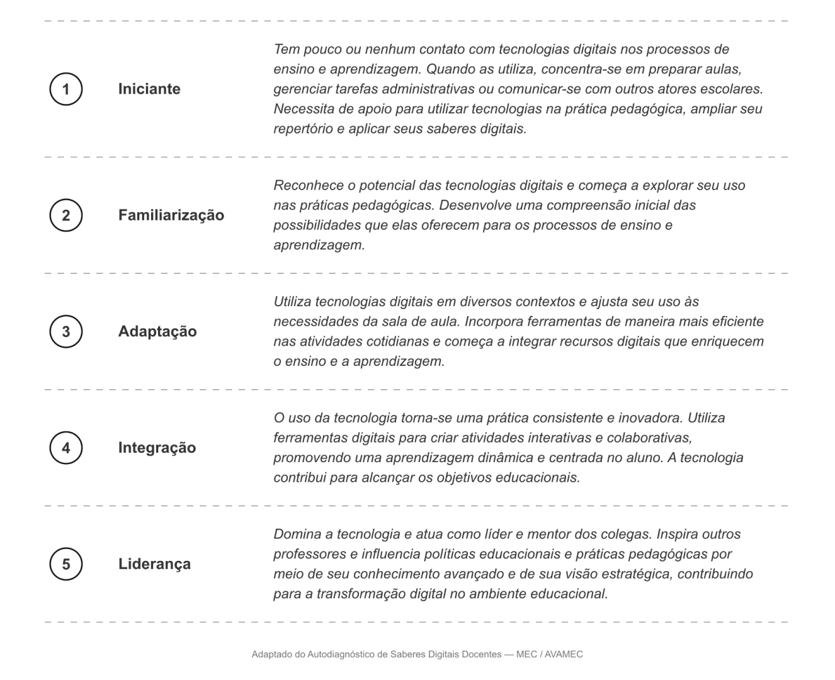
To guide this learning, educators also need to develop their literacies. The MEC Self-Diagnosis offers an overview: among the 64,137 responses from basic education teachers in 2026, the average level was Familiarization. It is the second of five levels, on a scale that starts at Beginner and continues through Familiarization, Adaptation, Integration, and Leadership. The result suggests a development path still to be advanced.
Knowing the technologies also expands the possibilities that an educator can imagine. Technologies enable futures: new capabilities open paths to different scenarios. In education, it is worth asking what experiences we want to make possible and what capabilities we wish to develop with them. Teachers participate in this construction by bringing available resources closer to the knowledge they teach and the students’ needs. Preparing them helps transform possibilities into pedagogical choices that contribute to desirable futures.
Artificial intelligence broadens this discussion. It can support the production of materials, offer explanations, and present avenues for investigating a topic. Its use also demands new reading skills. A convincing answer may contain errors or non-existent references. To evaluate it, we need to know the subject, verify information, and understand the system’s limitations. AI literacy relates to other literacies and gains importance as these tools become part of study, work, and communication practices.
Teaching about AI is also possible without screens. The publication “Artificial Intelligence in Basic Education: guiding document on curricular paths and ethical practices for the use of AI in schools”, from the MEC, presents unplugged AI education, also called AI unplugged. Games, cards, and simulations allow for the construction of classification criteria, testing of results, and discussion of errors.
The professor can teach these concepts without AI tools, but needs to understand the topic to guide the activity. These practices have their own pedagogical value and can occur with limited infrastructure, while other experiences depend on the expansion of digital access.
Students are already using these tools. At TIC Educação 2024, 70% of high school students who sought information for school research turned to generative AI. In the same edition, 43% of elementary and high school teachers reported using it in the preparation of didactic content.
In the text Why study if AI exists?, I discuss how obtaining an answer and learning are different experiences. Even when the student masters the operations of a tool, the educator needs to accompany them in building reasoning. This role involves helping them formulate questions, recognize limits, confront sources, and explain their choices. The teacher needs to identify difficulties and evaluate the learning that the activity intends to develop. Their mediation depends on understanding how the resources used participate in the production of knowledge in the discipline and in the stage in which they act.
The 2024 UNESCO AI teacher competency framework offers guidance for this process. It organizes 15 competencies into five dimensions: human-centered perspective, AI ethics, foundations and applications, pedagogy with AI, and AI for professional learning. This organization brings together technical understanding, responsibility, and pedagogical decision-making. Developing such competencies helps teachers evaluate what they use, preserve people’s autonomy, and decide how technology can contribute to their work.
Tools change rapidly. Therefore, training needs to develop criteria that remain useful when products are updated. Just as reading and writing help in learning new content, digital, informational, and data literacy provide a foundation for understanding new technologies. Verifying content, recognizing biases, and considering data treatment are responsibilities related to pedagogical practice.
Teachers need infrastructure and, above all, literacy. They need to learn not only about artificial intelligence, but also about how to explore learning with AI and how to prepare students for a world in which it will be present. Their participation in the construction and adaptation of education is fundamental. To contribute to these decisions, educators need preparation to understand and evaluate new technologies. Continuing to learn is part of education, especially for those who teach.
This commitment also appears in the regulations. Resolution CNE/CEB No. 2/2025 addresses both the use of digital devices in schools and the integration of digital and media education into curricula. Its Article 36 establishes the mandatory implementation of the new curricula starting in 2026. In my reading, however, the restrictions on the use of devices have received more attention in public debate than the responsibility to teach how to understand these technologies. We need to discuss the conditions of use and the training necessary for students to use them critically and responsibly.
A school can restrict the use of certain devices and, at the same time, teach how to understand the technologies that are part of students’ lives. Discussing data protection, analyzing content, and investigating recommendation criteria are part of this learning, with practices suitable for each stage. To guide these experiences, educators need to understand the available resources and relate them to the knowledge they teach.
The data presented show that we already have an important infrastructure base in Brazilian schools, although there are still differences in access and adequacy that need to be addressed. This base opens up possibilities for quality education, and taking advantage of them depends on prepared and digitally literate educators.
Therefore, the training of educators needs to keep pace with infrastructure investments, offering conditions to learn about technologies, evaluate their uses, and participate in decisions about the education we want to build. We have resources and paths to move forward. We need to strengthen the knowledge of those who transform these possibilities into learning experiences every day. If technology transforms the way we learn and produce knowledge, to what extent do we understand education without understanding technology?
| To access the references of this text click here |
Who wrote this column
Lucas Tangi