
People Management
January 07, 2026
Perception of employees and managers on the knowledge management practices of organizations
Authors: Flavia Souza da Silva and Ana Paula Pereira dos Passos
DOI: 10.22167/2675-6528-2025027
E&S 2026, 7: e2025027
Knowledge management is recognized as a fundamental pillar for organizational sustainability, as it enables effective knowledge sharing and drives organizational performance. However, its implementation faces considerable challenges, especially due to people’s reluctance to share their knowledge[1].
The difficulties related to knowledge management are becoming increasingly evident in contemporary organizations, a result of the growing complexity of the business environment, rapid technological evolution, employee turnover, and the absence of an organizational culture focused on knowledge sharing[2].
Knowledge management is a dynamic field that encompasses diverse concepts, models, and practices aimed at maximizing the value of knowledge in organizations[3]. However, the effective implementation of these tools and practices frequently faces considerable challenges, especially due to cultural and individual resistance to knowledge sharing[4].
These challenges highlight the need for more effective approaches to knowledge management, which include the development of appropriate processes, tools, and policies, in addition to fostering collaboration and continuous learning within organizations[2].
The importance of understanding individual perceptions and organizational factors that influence knowledge sharing readiness[5] is highlighted, among them organizational culture, which plays a fundamental role in facilitating or inhibiting this sharing[6].
The absence of an organizational culture that values knowledge sharing and employee turnover can constitute significant obstacles to the effectiveness of knowledge management initiatives[8].
As organizations face the increasing complexity of the business environment and the rapid technological evolution, effective knowledge management becomes essential to ensure competitiveness and organizational sustainability[9].
Knowledge management enables the capture, sharing, and effective application of knowledge, which results in more efficient processes and more informed decisions[10]. Therefore, understanding the practical challenges of knowledge management in contemporary organizations is fundamental to developing recommendations and strategies capable of improving this practice.
Knowledge management is not limited to technology and organizational structure, as it also depends on collaboration between individuals and groups within the company[11]. The ability to create effective knowledge-sharing networks contributes to the holistic integration of knowledge management practices in organizations. This integrated approach strengthens organizational resilience and promotes a culture of continuous learning and adaptation to environmental and technological changes.
Furthermore, knowledge management is increasingly recognized as a dynamic and adaptive process that requires not only the capture and sharing of existing knowledge, but also the generation of new knowledge and the facilitation of innovation[12]. The ability to transform information into knowledge and to apply it agilely is essential for facing emerging challenges and seizing growth opportunities in today’s globalized market.
Another critical aspect involves the impacts of knowledge management on operational efficiency and strategic decision-making. Recent research indicates that organizations implementing advanced knowledge management practices not only expand their responsiveness to market demands but also strengthen their capacity for sustainable innovation[11].
By better understanding how knowledge is created, shared, and applied in organizations, managers can optimize processes and resources to achieve better financial and strategic results.
The objective of this study was to examine the perception of employees and managers regarding knowledge management practices in organizations. The research adopted a descriptive quantitative approach, which seeks to produce numerical data about a phenomenon, favoring objectivity and statistical measurement[13]. This approach makes it possible to characterize and describe the properties of a group, situation, or phenomenon, allowing for the understanding of its main characteristics without researcher interference[14].
A structured questionnaire composed of two parts was applied. The first gathered sociodemographic data, such as gender, color/race, age group, education level, work sector, leadership position, and length of time in the role. The second part presented questions based on Dawes[15], organized into four factors: (1) knowledge management practices in the organization; (2) impact and perception of knowledge management in the organization; (3) organizational culture and recognition in the company; and (4) efficiency and integration of knowledge management in the organization.
The issues were evaluated using a four-point Likert scale: 1 (totally disagree), 2 (partially disagree), 3 (partially agree), and 4 (totally agree).
Before the collection, a pre-test was conducted with five individuals, in which there was no difficulty in understanding and answering the questions, which dispensed with any adjustments. Filling out the questionnaire took between five and ten minutes. Data collection occurred online through Google Forms, and the link was disseminated on social media during May and June 2024.
An open post was published on social media, inviting professionals from different sectors, including employees and managers, to participate in the survey. The inclusion criteria were to be active in the job market and be 18 years of age or older. A non-probabilistic convenience sampling technique was used[16], resulting in 110 responses. To broaden the survey’s reach, successive posts with an inviting tone were made, in order to reinforce the call to professionals active in the job market.
To ensure the integrity and reliability of the results, all responses were collected anonymously, in accordance with ethical research principles. Furthermore, measures were taken to protect participants’ privacy and obtain their informed consent with the Free and Informed Consent Form (FICF) before participating in the study.
The data collected through the questionnaires were organized, processed, and analyzed using Microsoft Excel software. Descriptive statistical analyses, such as frequency, mean, and standard deviation, were performed, as detailed in the subsequent section of the work[17].
Sociodemographic profile of respondents
Table 1 presents the profile of the respondents. A predominance of the female gender (68.2%) was observed, followed by the male gender (30.9%), while a reduced proportion preferred not to answer or identified as non-binary (0.9%). Regarding the age group, a higher concentration (53.6%) was found between 26 and 35 years old, followed by the 36 to 45 years old group (32.7%).
Regarding color/race, the majority of participants identify as white (62.7%), followed by brown color/race (22.7%). With regard to the level of education, most have postgraduate lato sensu (55.5%), followed by complete higher education (36.4%).
Table 1. Sociodemographic profile of respondents
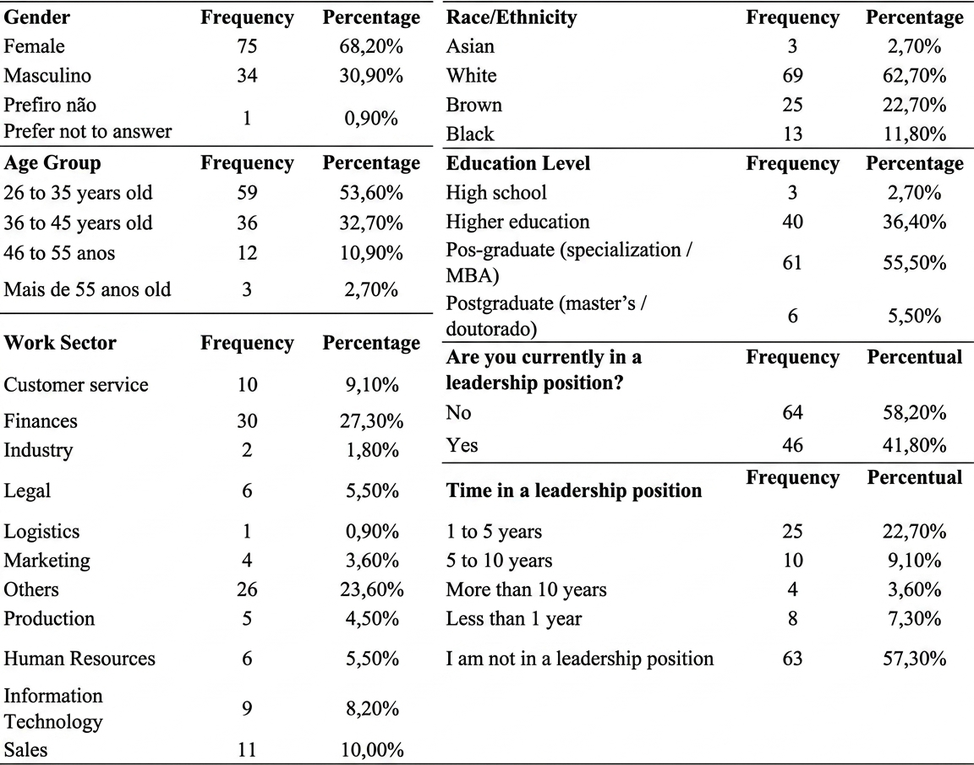
Regarding the leadership position, 41.8% of participants hold this role, while 58.2% do not. Among those in leadership positions, the largest proportion is in the 1 to 5 year range (22.7%). Participants are distributed across various work sectors, with higher representation in finance (27.3%) and sales (10.0%).
Knowledge management practices in the organization
The results from Table 2 indicate that existing practices are evaluated as moderately effective, with a mean of 2.78 and a standard deviation of 0.81 (item 8). However, the frequency of application of these practices shows a mean of 2.69 and a standard deviation of 0.85, which highlights greater variability in opinions and suggests still limited use (item 9). Organizational culture is perceived as moderately favorable to knowledge management, with a mean of 2.72 and a standard deviation of 0.89 (item 10).
Table 2. Knowledge management practices in the organization
| Entry | Average | Standard deviation |
| 8. Does my organization have effective knowledge management practices? | 2,78 | 0,81 |
| 9. Are knowledge management practices frequently used in my organization? | 2,69 | 0,85 |
| 10. Does my company’s organizational culture facilitate knowledge management? | 2,72 | 0,89 |
| 11. Does my organization’s leadership support knowledge management? | 2,97 | 0,85 |
| 12. Does my organization have adequate technological tools for knowledge management? | 2,85 | 0,92 |
| 13. Are the collaborators regularly trained in knowledge management? | 2,45 | 0,92 |
| 14. Do I feel I have enough time to participate in knowledge management practices? | 2,40 | 0,82 |
A panoramic view of the participants’ perceptions of aspects related to knowledge management practices was observed. Leadership receives a positive evaluation regarding support for knowledge management, with a mean of 2.97 and a standard deviation of 0.85, indicating a good perception and relative agreement among respondents (item 11). The available technological tools show a mean of 2.85 and a standard deviation of 0.92, reflecting varied opinions on their adequacy (item 12).
While regular training registers an average of 2.45, with the same standard deviation (0.92), which reveals a less favorable perception (item 13). Regarding the availability of time to participate in knowledge management practices, the average is 2.40, with a standard deviation of 0.82, which points to a perceived challenge in time management for these activities. (item 14).
In general, although there is recognition of leadership support and moderate effectiveness in existing practices, aspects such as frequency of use, adequacy of tools, quality of training, and time management remain critical points that require attention.
The variability of perceptions indicates that employee experience can diverge significantly, reinforcing the need for personalized strategies. Addressing these challenges can improve efficiency and strengthen a collaborative and innovative organizational culture, as advocated by Al-Laham et al. [6] and Wang and Noe[5], who highlight the importance of knowledge sharing for organizational performance.
Impact and perception of knowledge management
In Table 3, participants perceive resistance to change as a moderate obstacle to knowledge management, with a mean of 2.59 and a standard deviation of 0.93 (item 15). Knowledge management is not widely considered a priority by leadership, with a mean of 2.47 and a standard deviation of 0.92 (item 16). Internal communication focused on knowledge management is rated as moderately effective, with a mean of 2.63 and a standard deviation of 0.92 (item 17).
Table 3. Impact and perception of knowledge management
| Entry | Average | Standard deviation |
| 15. Resistance to change is a significant obstacle to knowledge management in my organization? | 2,59 | 0,93 |
| 16. Is knowledge management considered a priority by the leadership of my organization? | 2,47 | 0,92 |
| 17. Is internal communication in my organization effective for knowledge management? | 2,63 | 0,92 |
| 18. Do I have easy access to the information and documents necessary for my work? | 3,10 | 0,75 |
| 19. Do you regularly participate in knowledge management training programs or workshops? | 2,25 | 1,04 |
| 20. Does knowledge management increase work efficiency in my organization? | 3,12 | 0,97 |
| 21. Does my organization invest enough in knowledge management practices? | 2,43 | 0,95 |
| 22. Does my organization have a digital platform for knowledge management? | 2,74 | 1,14 |
The ease of access to the necessary information is positively evaluated, with an average of 3.10 and a standard deviation of 0.75 (item 18). Regular participation in knowledge management training programs is low, with an average of 2.25 and a standard deviation of 1.04, revealing a perceived need for greater involvement in this type of activity (item 19). Furthermore, knowledge management is seen as a factor that increases work efficiency in the organization, with an average of 3.12 and a standard deviation of 0.97 (item 20).
The perceived investment in knowledge management practices is considered insufficient, with a mean of 2.43 and a standard deviation of 0.95, suggesting a need for greater resource allocation in this area. (item 21). The presence of a digital platform for knowledge management is moderately perceived, with a mean of 2.74 and a standard deviation of 1.14, indicating variation in respondents’ perceptions. (item 22).
Although access to information and the positive impact of knowledge management on efficiency are well evaluated, challenges persist related to low investment, limited training offerings, and the consolidation of digital platforms. These findings converge with Davenport and Prusak (2000), who identify barriers such as resistance to change and lack of leadership priority.
Complementarily, Jashapara[18] and Alavi and Leidner[19] emphasize that the effectiveness of knowledge management depends on the integration between technology, culture, and empowerment. Thus, the results reinforce the need for structured actions to overcome these barriers and elevate the maturity of knowledge management practices in organizations.
Organizational culture and recognition
In Table 4, participants indicate an average of 2.90, which shows that they feel moderately encouraged to share knowledge, with a standard deviation of 0.91 (item 23). The average of 2.62 points to a moderate perception of recognition and reward for knowledge sharing, with a standard deviation of 0.90 (item 24). With an average of 2.95 and a standard deviation of 0.97, knowledge management is seen as a factor that has a moderately positive impact on organizational innovation (item 25).
Table 4. Organizational culture and recognition
| Entry | Average | Standard deviation |
| 23. I feel encouraged to share my knowledge and experiences in my organization? | 2,90 | 0,91 |
| 24. Does my organization recognize and reward knowledge sharing? | 2,62 | 0,90 |
| 25. Does knowledge management have a positive impact on my organization’s innovation? | 2,95 | 0,97 |
| 26. Does my organization’s culture promote knowledge sharing? | 2,65 | 0,95 |
| 27. Does my organization regularly assess the effectiveness of knowledge management practices? | 2,23 | 0,92 |
| 28. Does knowledge management contribute to the professional development of employees? | 3,45 | 0,82 |
Organizational culture is perceived as moderately favorable to knowledge sharing, with a mean of 2.65 and a standard deviation of 0.95 (item 26), while regular assessments of knowledge management practices show a mean of 2.23 and a standard deviation of 0.92, indicating limited implementation of these actions (item 27). The contribution of knowledge management to professional development receives a high rating, with a mean of 3.45 and a standard deviation of 0.82 (item 28).
Despite these positive points, especially regarding the impact on innovation (item 25) and professional development (item 28), relevant weaknesses persist, such as insufficient recognition of knowledge sharing (item 24) and the absence of systematic evaluations of knowledge management practices (item 27), which are configured as priority areas for improvement.
In general, these findings dialogue with the literature. Nonaka and Takeuchi[20] demonstrate that environments that favor knowledge sharing tend to develop innovative capabilities and competitive advantage. Davenport and Prusak[11] reinforce that active sharing among collaborators significantly improves organizational efficiency and decision quality. Jashapara[18] highlights that solid sharing cultures result in greater collaboration and better practices, while Alavi and Leidner[19] emphasize that effective knowledge management systems expand information circulation and foster more innovative environments.
This body of evidence indicates that, to maximize the benefits of knowledge management, organizations should align their practices with employee needs and invest in continuous evaluation and recognition processes, which strengthens a collaborative and learning-oriented culture.
Efficiency and integration of knowledge management
The results from Table 5 offer an insight into the efficiency and integration of knowledge management. Access to information necessary for decision-making presents a neutral perception, with a mean of 2.74 and a standard deviation of 0.89 (item 29). Overall satisfaction with knowledge management practices is low, demonstrated by a mean of 2.44 and a standard deviation of 0.94 (item 30). The incentive for continuous learning receives a moderate evaluation, with a mean of 2.78 and a standard deviation of 0.93 (item 31).
Table 5. Efficiency and integration of knowledge management
| Entry | Average | Standard deviation |
| 29. Do I have easy access to the information needed for decision-making in my organization? | 2,74 | 0,89 |
| 30. Am I satisfied with the knowledge management practices in my organization? | 2,44 | 0,94 |
| 31. Does my organization promote a culture of continuous learning? | 2,78 | 0,93 |
| 32. Do I have the opportunity to participate in innovation initiatives in my organization? | 2,71 | 0,95 |
| 33. Is the exchange of knowledge between departments efficient in my organization? | 2,40 | 0,92 |
| 34. Are best practices and lessons learned regularly shared within my organization? | 2,56 | 0,91 |
| 35. Is knowledge management integrated into the daily work processes in my organization? | 2,45 | 0,83 |
| 36. Does my organization have a mentorship system for knowledge sharing? | 2,35 | 1,09 |
| 37. Do new employees receive adequate training on the organization’s knowledge management practices? | 2,53 | 0,99 |
The opportunity to participate in innovation initiatives is viewed neutrally to negatively, with a mean of 2.71 and a standard deviation of 0.95 (item 32). Knowledge exchange between departments is perceived as inefficient, which is reflected in the mean of 2.40 and a standard deviation of 0.92 (item 33). The regular sharing of best practices has a mean of 2.56 and a standard deviation of 0.91, indicating only a moderate perception (item 34).
The integration of knowledge management into daily processes also receives a negative evaluation, with a mean of 2.45 and a standard deviation of 0.83 (item 35). Furthermore, the absence or low effectiveness of mentoring systems is evidenced by a mean of 2.35 and a standard deviation of 1.09 (item 36). Finally, the training offered to new employees is perceived as insufficient, with a mean of 2.53 and a standard deviation of 0.99 (item 37).
In general, the results point to challenges in the efficiency and integration of knowledge management practices. These findings converge with Nonaka and Takeuchi[20] and Alavi and Leidner[19], who highlight interdepartmental communication and the continuous flow of knowledge as essential elements for sustaining innovation and organizational learning.
Jashapara[18] argues that mentoring programs and continuous training strengthen knowledge exchange and broaden the maturity of practices. Similarly, Davenport and Prusak[11] demonstrate that organizations that promote knowledge sharing among collaborators achieve greater efficiency and competitive advantage.
Thus, the implementation of effective mentoring, integrated communication platforms, and systematic training can enhance employee perception and strengthen collaboration, innovation, and professional development within organizations.
This study examined the perception of employees and managers regarding knowledge management practices in organizations. The results indicate that, although these practices are recognized as moderately effective, challenges persist related to the frequency of use and the adequacy of available technological tools. Leadership is perceived as a positive factor, but the data points to the need for greater investment in training and in strengthening a more collaborative organizational culture.
Furthermore, the analysis revealed that perceptions of knowledge management vary according to sociodemographic characteristics, highlighting the importance of adapting strategies to the specific needs of different groups within the organization. The implementation of continuous training programs and the strengthening of leadership support emerge as crucial strategies for enhancing the effectiveness of knowledge management practices.
This research presents some limitations. The use of a non-probabilistic convenience sampling reduces the possibility of generalizing the results to other organizational contexts, while the cross-sectional nature of the research and the use of self-reported data may amplify the influence of individual biases.
For future research, the development of longitudinal studies is recommended to allow tracking the evolution of knowledge management practices over time. Qualitative approaches, such as interviews and focus groups, are also suggested to deepen subjective aspects related to organizational culture and knowledge sharing, in addition to comparative investigations between sectors and organizations that enable the identification of relevant patterns, particularities, and moderating factors.
Finally, it is emphasized that this study seeks to contribute to the maximization of the benefits of knowledge management in organizations. To achieve this purpose, it is essential to invest not only in tools and processes, but also in a culture that values knowledge sharing and continuous learning. The success of these initiatives depends on the organization’s ability to align its knowledge management practices with the needs and expectations of employees, which ensures greater competitiveness and long-term sustainability.
REFERENCES
[1] Ferreira, A.C.F.; Cunha, P.H.B. 2024. Compartilhamento do conhecimento nas organizações: contribuições e desafios. Boletim do Gerenciamento, 40(40). Disponível em: https://nppg.org.br/revistas/boletimdogerenciamento/article/view/1098. Acesso em: 04 mar. 2024.
[2] Siqueira, M.M.M. (Ed.). 2014. Novas Medidas do Comportamento Organizacional: Ferramentas de Diagnóstico e Gestão. Artmed, SP, Brasil.
[3] Dalkir, K. 2013. Knowledge Management in Theory and Practice. MIT Press, Cambridge, MA, USA.
[4] Ardichvili, A.; Page, V.; Wentling, T. 2019. Motivation and barriers to participation in virtual knowledge-sharing communities of practice. Journal of Knowledge Management, 23(7): p. 1339-1364.
[5 ]Wang, Y.; Noe, R.A. 2017. Knowledge sharing: A review and directions for future research. Human Resource Management Review, 27(4): p. 673-683.
[6] Al-Laham, A.; Alaboudi, A.; Zairi, M. 2020. Knowledge sharing culture and its relationship with organizational performance: Empirical evidence from Saudi Arabia. Journal of Knowledge Management, 24(2): p. 233-256.
[7] Gupta, B.; Iyer, L.S.; Aronson, J.E. 2018. Knowledge management tools and techniques: improvement dimensions and performance outcomes. Industrial Management & Data Systems, 118(2): p. 515-545.
[9] Tseng, J.F.; Lee, Y.C.; Chuang, H.M. 2021. The impacts of knowledge management on organizational competitiveness. Journal of Business Research, 124: p. 445-451.
[10] Santos, N.; Lima, G.J.V. 2020. Fundamentos Teóricos de Gestão do Conhecimento. Pandion Acadêmica, Florianópolis, SC, Brasil. Disponível em: https://ppgegc.paginas.ufsc.br/files/2023/06/Gestao_do_Conhecimento_1-3.pdf. Acesso em: 04 mar. 2024.
[11] Davenport, T.H., Prusak, L. 2020. Working knowledge: How organizations manage what they know. Harvard Business Press.
[12] Nonaka, I.; Takeuchi, H. 1995. Criação de conhecimento na empresa: como as empresas japonesas geram a dinâmica da inovação. Rio de Janeiro: Campus.
[13] Minayo, M.C.S. 2010. O desafio do conhecimento: pesquisa qualitativa em saúde. 12ed. São Paulo: Hucitec.
[14] Gil, A.C. 2007. Métodos e técnicas de pesquisa social. 6ed. São Paulo: Atlas.
[15] Dawes, J. 2008. Do Data Characteristics Change According to the Number of Scale Points? A Comparison of Likert and Kansei Scales. International Journal of Market Research 50(1), 61-104. https://doi.org/10.1177/147078530805000106
[16] Lima, A.S.; Souza, R.M. 2022. Amostragem não probabilística por conveniência em pesquisas de mercado. Estudos de Mercado, 55(1): p. 45-58.
[17] Rodrigues, M. A.; Almeida, P.R. 2020. Métodos quantitativos aplicados à análise de dados. In: Guimarães, A. (Ed.). Análise Quantitativa de Dados. Editora Científica, São Paulo, SP, Brasil.
[18] Jashapara, A. 2011. Gestão do conhecimento: uma abordagem integrada. São Paulo: Saraiva.
[19] Alavi, M.; Leidner, D.E. 2001, Review: Knowledge management and knowledge management systems: conceptual foundations and research issues. MIS Quarterly, 25(1): p. 107-136.
[20] Nonaka, I.; Toyama, R. 2021. The theory of the knowledge-creating firm: subjectivity, objectivity and synthesis. In: Nonaka, I.; Toyama, R. (Eds.). A Dynamic Theory of Organizational Knowledge Creation. Palgrave Macmillan, London, UK.
COMO CITAR
Silva, F.S.; Passos, A.P.P. Percepção dos funcionários e gestores sobre as práticas de gestão do conhecimento das organizações. Revista E&S. 2026; 7: e2025027.
ABOUT THE AUTHORS
Flavia Souza da Silva – Specialist in People Management. Operations Specialist. Via Transversal Sul, 169, Novo Osasco, 06045-420, Osasco, São Paulo, Brazil.
 Ana Paula Pereira dos Passos – PhD in Administration. Supervising Professor. Rua João Pereira dos Santos, 99, Ponte do Imaruim, 88130-475, Palhoça, Santa Catarina, Brazil.