
Embrapa
Innovation
Partnerships
March 25, 2022
Open innovation: user experiences and Embrapa in establishing partnerships
DOI: 10.22167/2675-6528-20220022
E&S 2022,3: e20220022
Anderson Ferreira; Alexandre Barreto de Almeida
Embrapa was created in the 70s, a time when agriculture was intensifying in Brazil and the demand for food and fiber accompanied population growth[1]. Since then, Embrapa has been conducting research, developing and transferring technologies for the Brazilian Agro sector, always in line with the needs of the productive sector, with the aim of generating technologies and information that meet the demand of its clients.
Over the years and with the reduction of funding from the National Treasury for the development of new technologies, the company began to establish public-private partnerships, being considered a precursor in this type of interaction[2]. These partnership interactions began with assets related, mainly, to seeds.
Currently, Embrapa is focused on intensifying its partnership actions for open innovation, co-development, and the use of the most diverse assets, in what is called the macroprocess of innovation. In 2019, the company published its Innovation Policy and, at the same time, has been promoting structural change in the company, strengthening and encouraging partnerships for open innovation with the productive sector in the most diverse segments of its operations[3]. Furthermore, it is attentive to its constitutional responsibility regarding the efficient use of federal public resources, as provided for in Article 37 of the Federal Constitution[4].
One of these structural changes was the creation of a specific project type for open innovation, which decentralizes resources to the units, and managers can negotiate open innovation actions and co-development of technologies in partnership with private companies. This greater autonomy for managers, in their units, presents itself as a great opportunity to seek and put into practice this negotiation and intensification in interaction for open innovation. Currently, there are 43 decentralized units of Embrapa and, in general, different levels of organization and strategy are observed in each unit when it comes to prospecting and negotiating opportunities for co-development of technologies. In this sense, there is a knowledge gap regarding the main processes that lead to successful prospecting, negotiation, and partnership between Embrapa and the partner company (User).
Seemingly simple questions were applied to users and adapted from Teixeira[5]: What makes a user seek Embrapa for open innovation partnership? What needs or desires does the user have that Embrapa can solve? These and other questions, if answered and organized, can become a guiding tool for leveling information between units and increasing Embrapa’s success rate in this segment. The realization and improvement of this practice can contribute strongly to increasing Embrapa’s management efficiency and the better use of public resources, as defined by Article 37 of the Federal Constitution[4].
There are different ways to understand how the user interacts with or perceives a brand or product[5]. Among them, “Ux Design” and user experience metrics, such as “User Experience,” have been widely used in recent years. “Ux Design” can be defined as the level of satisfaction people have when using a product or service, whether physical or digital, which can also be didactically divided into four major skills: strategic vision, user research, information architecture, and interface design[6].
The application of questionnaires (whether via survey or interview) aims to obtain quantitative and qualitative information that can lead to better interaction between the company and users. Many studies have made use of this tool in different fields of knowledge[7], [8], [9]. In this sense, the objective was to understand the decisive processes in establishing partnerships between users and Embrapa in open innovation partnership processes.
Nine success cases were selected, originating from five Embrapa units, located in different regions of Brazil, with a history of open innovation and the launch of co-developed products in the last 10 years. The success cases were chosen given the recent negotiation, or the recent launch by Embrapa, or the prominence of the co-developed technology in public-private partnership. Embrapa was considered user 1, and the partner company with the possibility of interaction with Embrapa was considered user 2.
Information gathering from the user and Embrapa was carried out through the User Experience Understanding tool[5], interviews were conducted with users via e-mail, always with a focus on qualitative responses. The questions answered by Embrapa (user 1) were: i) What is the name of the technology?; ii) What year did the negotiation begin?; iii) What year was the technology launched? Or is it still ongoing?; iv) How/Who approached the Company? The researcher? Management? Project office? Headquarters? Other?; v) Is the partner from the same segment as Embrapa regarding target audience/clients?; vi) Was there anything that led them to choose this Company over another? Brand? Customer segment? Reliability? Presence in state or city or region? Other?; vii) Were other companies contacted or given the opportunity to participate in the selection?; viii) What was the Technology Readiness Levels (TRL) of the negotiated asset?; ix) What led to choosing the Company for partnership/co-development?; x) What was the decisive factor in the realization of the partnership/contract signing?; xi) What could be improved?
The questions answered by the company (user 2) were: i) How was the approach with Embrapa? Directly with the researcher? Directly with management? At the headquarters? Any specific secretariat? ii) Is the partner from the same segment as Embrapa regarding target audience/clients?; iii) Was there anything that led him to choose one unit of the Company or another? Brand? Name of renowned experienced researcher? What area of knowledge? Location, example state or city or producing region?; iv) What led to choosing Embrapa for partnership/co-development?; v) What was the decisive factor in the realization of the partnership/signing of the contract?; vi) What could be improved?
For the analysis of the obtained data, descriptive statistical analysis was used to summarize and describe the dataset[10]. Furthermore, a similarity analysis was performed to determine word occurrences and connectivity between them. For this purpose, the “Interface de R pour les Analyses Multimensionnelles de Textes et de Questionnaires” (IRAMUTEQ) was used to generate word clouds to graphically organize and group words based on frequency[11]. After receiving and analyzing the data, it was possible to observe that the average time between the start of negotiations and the launch of the technologies analyzed in this study was two years and seven months. Even considering that the technologies in progress had a completion date of 2021, this average time would remain practically the same (Figure 1).
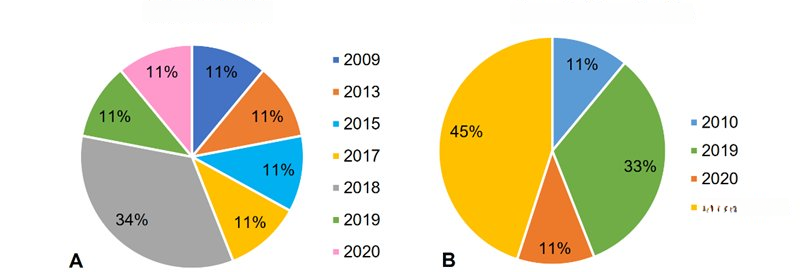
Figure 1. Graphs showing the years of negotiation start and year of conclusion and launch of co-developed technologies between Embrapa and partner companies. 1A: shows the years of negotiation start and the frequency in each year; 1B: shows the years of conclusion of co-developed technologies and the frequency in each year
Source: Prepared by the author
The first contact between Embrapa and the partner regarding the technology to be negotiated was handled by the Researcher responsible for the topic at the Embrapa unit. The second form of access, with 33% of the responses, was cited in open call events, such as calls for proposals and/or “open innovation events”, as the way for private sector partners to be approached. There were also cases where the technology transfer sector itself sought out potential partners.
In 67% of negotiations, the process was conducted giving more than one company the opportunity to participate/compete. In 33% of cases, only one company participated in the negotiation process. Upon closer examination of cases where only one company participated in the process, they refer to technologies where the company sought out Embrapa or was approached to discuss a peculiar technology and, to some extent, a specificity of the subject. The technologies negotiated by Embrapa with its partners were at a measured degree of maturity (TRL), between TRLs 4 and 8. The TRL scale ranges from 1 to 9, and the higher the degree of maturity, the more finalized the technology is for the market. TRL4 was observed most frequently, reaching 45%, followed by TRL8 with 22% (Figure 2). These numbers demonstrate the preference of Embrapa’s partner companies for negotiating their technological assets at more advanced TRLs. This characteristic ends up increasing the technological development risk for Embrapa, as the phases of greatest risk in the development of any technological asset have already been overcome in the TRL1 to TRL4 phases.
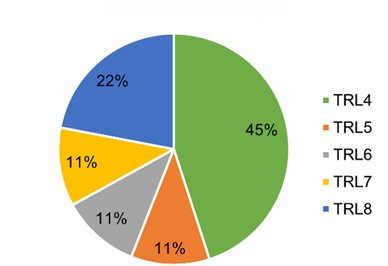
Figure 2. Graph showing the degree of maturity of technologies in Technology Readiness Levels (TRLs). This scale used by Embrapa and other global institutions ranges from TRL1 to TRL9, where TRL1 signifies the lowest degree of maturity and TRL9 signifies the technology ready for the market
Source: Prepared by the author
User 1 (Embrapa) Perceptions on the negotiation process
Embrapa, when choosing a partner company, prioritizes the capacity for product development for the market and knowledge of that market to be explored, represented here by the words “product” and its ramifications “market”, “development”, “production”, and “final” (Figure 3). Another aspect present in the discourse and considered is that this company has market innovation experience and resources to invest in co-developing the technology, represented by the word “resource” and “innovation”.
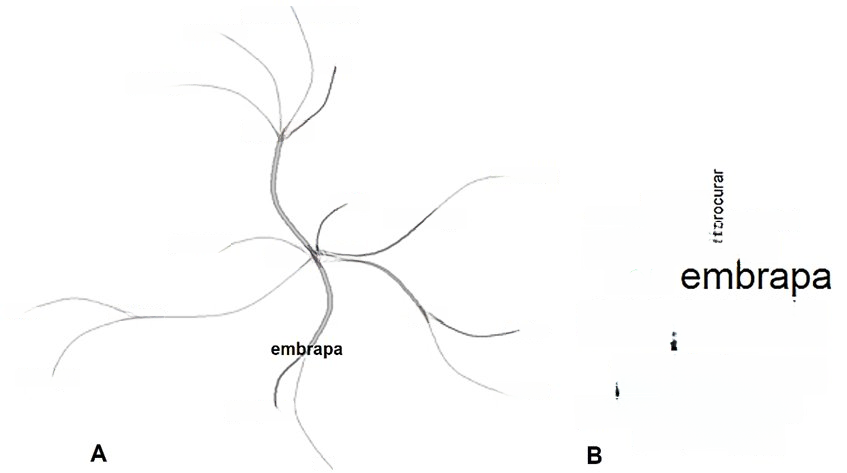
Figure 3. Similarity graphs and word cloud regarding the question: “What are the reasons that led Embrapa to choose a certain company for a technology co-development partnership? 3A. Graph showing the similarity analysis of the set of texts taken from interviews with participants; 3B. Graph showing the word cloud of the set of texts taken from interviews with participants
Source: Elaborated by the author
Furthermore, the technology and capacity to produce the product on an industrial scale are other relevant points in the choice made by Embrapa and are represented by the words “technology” and “industrial”. Below, some excerpts from the original texts written by the interviewees in the forms can be observed.
The reason why the “company” was chosen was the infrastructure, availability of resources for annual investments in joint development, industrial plant to start large-scale production, in addition to product distribution points. Furthermore, there is the degree of use of technological resources and experience in agricultural innovation, and the fact that the company is established in the market and demonstrates the capacity to produce with quality and volume (industrial park).
As for the company, by choosing Embrapa, it highly values the “Embrapa” brand in the agricultural sector and the reliability associated with the co-developed product, represented here by the word “Embrapa”, in evidence. Another important point is Embrapa’s capacity to collaborate for the company to meet the market with a new technology or process improvement originating from the co-developed technology, represented by the words “market”, “production”, “product”, “process”, “new”, and “technology”. Furthermore, decentralized units play an important role in this choice, as proximity, prior relationship with researchers, and negotiation capacity strongly contribute to choosing Embrapa for establishing a partnership, represented here by the word “unit”. The possibilities of choosing by coincidence/opportunity were also mentioned, where the company observed research results or part of the technology presented at scientific events or “open innovation” type events. The decisive factors for closing and signing contracts are more related to the research and technology capacity of Embrapa and the partner company, represented by the words “company”, “Embrapa”, “technology”, and “research” (Figure 4).
Figure 4. Similarity graphs and word cloud regarding the question: “What is the decisive factor for closing and signing a contract for co-development partnership with Embrapa? (from the perspective of Embrapa employees). 4A. Graph showing the similarity analysis of the set of texts extracted from the interviews with the participants; 4B. Graph showing the word cloud of the set of texts extracted from the interviews with the participants
Source: Prepared by the author
The negotiation capacity and the presence of a professional business area in the unit are represented here by the words “unit” and “partnership”. Another aspect mentioned was the mutual interest between Embrapa and the partner in launching a product to the market, represented by the words “product”, “interest”, and “partner”. The aspects that can be improved in the negotiation process are related to improvements in processes, documents, and legislation within Embrapa.
User Perceptions 2 (Company) on the negotiation process
The main reason for the company to choose Embrapa for a partnership in technology co-development is the trust in the name/brand “Embrapa” (Figure 5). Scientific credibility and impartiality were also cited as important factors in the choice, represented here by the word “Embrapa” in evidence. The companies consider Embrapa a reference in research and respect its trajectory and importance for the sustainable development of Brazilian agriculture, evidenced here by the word “research” in highlight. Another fact considered by the companies in their choice is that Embrapa is a Brazilian company that works on the development of innovative technologies for Brazil, evidenced by the word “Brazilian”.
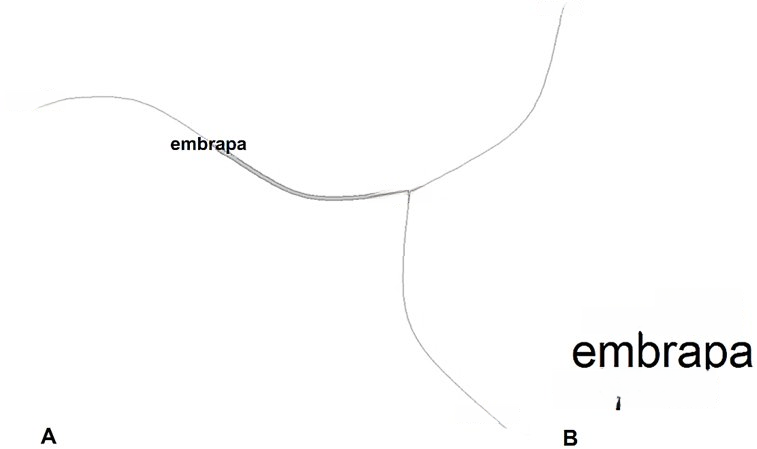
Figure 5. Similarity graphs and word cloud regarding the question: “What was the reason for choosing Embrapa for contract negotiation for co-development partnership”? (from the companies’ perspective). 5A. Graph showing the similarity analysis of the set of texts extracted from the interviews with the participants; 5B. Graph showing the word cloud of the set of texts extracted from the interviews with the participants
Source: Prepared by the author
When choosing an Embrapa unit over others, the main reason highlighted by companies was the “name” and the work developed by the researcher involved in the technology development, as evidenced by the words “researcher” and “work”. The theme on which the Embrapa unit works or the relevance of the research work on the target theme of the partnership/project are also factors considered in the choice, evidenced here by the words “unit”, “Embrapa” and “project”. Other points were also cited in smaller proportions, such as the geographical proximity between the company and the unit; the existence of a prior partnership relationship with the unit on other themes; research support and infrastructure; and the technology transfer team are also factors considered in choosing the Embrapa unit to establish an open innovation partnership.
The decisive factors for closing and signing contracts are more related to the company’s confidence in the results, the quality of work, and Embrapa’s research data, represented by the words “confidence” and “company”. Other aspects mentioned by the interviewees were the researcher’s credibility and market-consistent “royalty” values.
Among the aspects that can be improved in the negotiation and co-development process, companies highlighted the need for improvement of financial resources for the units to continue producing good research results, represented by the word “result”, in evidence (Figure 6). Companies understand that Embrapa has many technologies in its research centers and needs to present these assets more to potential interested parties, through events or specific business rounds, represented by the word “technology”. Type_3 projects (open innovation) are considered a great opportunity, but they need to be better internalized among collaborators and Embrapa must adjust its internal flowchart to this project format, evidenced by the words “type_3” and “project” and “need”. Type_3 projects are pointed out as a great evolution for generating solutions for Brazilian farmers, evidenced here by the branch with the word “solution”. It was also mentioned that concepts from private research, such as the Minimum Viable Product concept, could be an accelerator for launching technologies in type_3 projects, represented here by the word “research”. Furthermore, one of the companies stated it was totally satisfied with the negotiation and co-development format established with Embrapa.
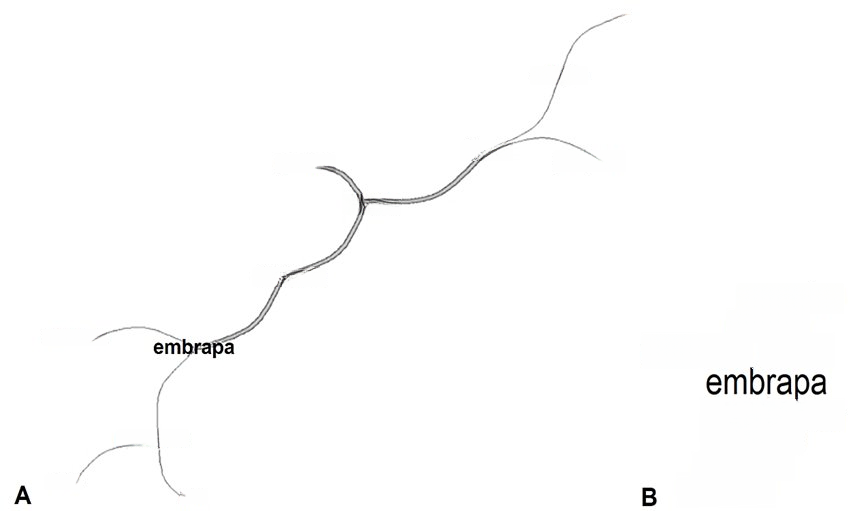
Figure 6. Similarity graphs and word cloud regarding the question: “What can be improved in the negotiation and co-development process with Embrapa? (from the companies’ perspective). 6A. Graph showing the similarity analysis of the set of texts taken from the interviews with the participants; 6B. Graph showing the word cloud of the set of texts taken from the interviews with the participants
Source: Elaborated by the author
The decisive processes in establishing partnerships between users and Embrapa in open innovation partnership processes are: the researcher’s “name” and work allied with pre-existing relationships with Embrapa; market innovation experience, resources, and industrial scale; the Embrapa “brand”; and Embrapa’s agile negotiation capacity allied with the joint perspective of a new product for the market. In this sense, Embrapa must study the partner company well and verify the key points above, in order to increase the success rate in partnerships and co-development; prioritize promoting more events where its technologies are showcased and where partners can equally present new ideas; work on the negotiation aspect within the company and adjust this strategy and agility in documentation among the different units. Maintain investments in basic research and “royalty” prices consistent with the market, which were aspects listed as key to maintaining the open innovation process at Embrapa.
References
[1] Empresa Brasileira de Pesquisa Agropecuária (EMBRAPA). Memória da Embrapa. 2020. Disponível em: <https://www.embrapa.br/memoria-embrapa/inicial>.
[2] De Carli C.R. Embrapa: Percursora da parceria Público-Privada no Brasil. (Dissertação). 2005. Universidade de Brasília, Brasília, DF, Brasil.
[3] Empresa Brasileira de Pesquisa Agropecuária (EMBRAPA). Política de Inovação da Embrapa. 2019. Disponível em: <https://www.embrapa.br/documents/10180/1600893/Pol%C3%ADtica+de+Inova%C3%A7%C3%A3o+da+Embrapa/80fba384-b495-9ab1-69c3-f879c2f1eb3a>.
[4] Constituição Federal. Constituição Federal. 2019. Disponível em: <https://www.senado.leg.br/atividade/const/con1988/con1988_26.06.2019/ind.asp>.
[5] Teixeira F. Introdução e boas práticas em UX design. 2017. Editora Casa do Código, São Paulo, SP, Brasil.
[6] Pereira R. User experience design: como criar produtos digitais com foco nas pessoas. 2018. Editora Casa do Código, São Paulo, SP, Brasil.
[7] Law E.; Vermeeren A.; Hassenzahl M.; Blythe M. Towards a UX Manifesto, 3ed. 2007. Lancaster, United Kingdom.
[8] Park J.; Han S.H.; Kim H.K.; Cho Y.; Park W. Developing elements of user experience for mobile phones and services: survey, interview, and observation approaches. Hum Factors Ergon Manuf. 2013; 23:279–293.
[9] Luther L.; Tiberius V.; Brem A. User experience (UX) in business, management, and psychology: a bibliometric mapping of the current state of research. Multimodal Technol. Interact. 2020; 4(2): 18.
[10] Pimentel-Gomes F. Curso de estatística experimental, 14ed. 2020. Editora Livroceres, Piracicaba, SP, Brasil. [11] Camargo B.V.; Justo A.M. IRAMUTEQ: um software gratuito para análise de dados textuais. Temas em Psicol. 2013; 21(2): 513-518.
Como citar
Ferreira, A.; Almeida, B.A. Inovação aberta: experiências do usuário e da Embrapa no estabelecimento de parcerias. Revista E&S. 2022; 3: e20220022.
Sobre os autores
Anderson Ferreira, Empresa Brasileira de Pesquisa Agropecuária (Embrapa Trigo), Departamento de Pesquisa e Desenvolvimento, Passo Fundo, RS, Brasil.
Alexandre Barreto de Almeida, Harfsen Research, Departamento de gestão de projetos de inovação, Piracicaba, SP, Brasil.
Editorado por: Edson Mota
Link para download: https://35.221.10.74/wp-content/uploads/2022/04/25.pdf