
Cryptocurrencies
Financial Management
Innovation
September 08, 2020
Bitcoin Allocation in a Diversified Portfolio
DOI: 10.22167/2675-6528-20200002
E&S 2020, 1: e.20200002
Roberta Bertagnoli Gasparo e Haroldo José Torres da Silva
Innovation is a key concept for economic development: it brings solutions to the market and stimulates debate in the face of the “new”. It was from the advancement of the global use of the internet that electronic markets leveraged information technology to combine buyers and sellers effectively (Nian and Chuen, 2015).
Digital solutions for financial transactions eliminate geographical barriers, stimulate technological development, and reduce state bureaucracy on commercial transactions, alleviating the tax burden. In this scenario, digital currencies stand out as agents of structural change in the financial system. Digital currencies are part of new information systems and technological solutions that allow for decentralized organization, operational security, and unrestricted transparency in commercial and monetary transactions (Nakamoto, 2008).
The most successful example of digital currency, also called encrypted, is Bitcoin – an open-source digital currency model, meaning it can be downloaded by anyone. Structured in a database system (“blockchain”), Bitcoin allows strict secrecy and confirmation of transactions between users. The encryption process defines who the “owner” of the coins is and the quantity in which they can be generated or mined. Each Bitcoin transaction is checked and validated in the databases by miners who, in turn, are rewarded with fees and “remuneration” in new coins (Nian and Chuen, 2015).
Globally, there is still no full agreement on the regulation of Bitcoin and no government or central authority manipulates its supply, despite its growing acceptance. On the subject, there is still much controversy and discussion: after all, is Bitcoin primarily an alternative currency or a speculative asset (European Central Bank [ECB], 2012)?
Nian and Chuen (2015) reports that the pros and cons of encrypted currency must be carefully analyzed. In its favor are the freedom of payments, speed, and low costs – due to the absence of an intermediary for transaction registration. There are also no location or time limiters, which leads to a second point: market benefits. Bitcoin stands as a light alternative compared to the costs of current payment methods, as there are no large structures that need to be maintained. The system is also safe from fraud attacks, and usage is controlled through the personal key generated by cryptography. This, however, is registered on a physical computer, therefore, susceptible to damage to the hardware or malicious software (Doherty, 2011).
According to the authors, another positive point is that its platform, which is open to innovation, is also not restricted to monetary transactions, which can be useful for other types of information.
On the other hand, the currency is subject to speculative bubbles due to high demand, as it is a reliable backing. Another critical element is the facilitation of criminal activities, where secrecy has its ambiguous side in the relationship when it comes to illicit activities that do not want to be identified. There are also controversial points related to the legal regulatory attitude and economic risk – if the structural change is abrupt, there will be destabilization of the financial and payment market and, consequently, prices as a whole (Nian and Chuem, 2015).
Despite the duality, the demand for Bitcoin is growing and, as the user network increases, more companies foster the universe of the encrypted currency (Bartos, 2015). In October 2017, for example, the Chicago Mercantile Exchange (CME Group) announced futures contracts using Bitcoin, confirming the trend that encrypted currencies will be increasingly constant in the near future.
Numerous studies already analyze the use of digital currency in the economic sphere and, from this perspective, it is important to note that there is a lack of rigorous theoretical grounding; inadequacy of some econometric models used; rise in the use of encrypted currency as a form of payment in the electronic world; and, advancement and space for innovation in the technological environment. Academic research is, therefore, crucial for reaching a general understanding (Bonneau et al., 2015).
The price of Bitcoin fluctuates according to public information and follows the hypothesis of efficient markets. Specifically, it was found that the price of Bitcoin is higher during days of positive events, for example, in relation to days without events (Bartos, 2015).
Placing digital currencies in an investment position, however, requires study of risk and return. Therefore, for this analysis, Markowitz’s optimization model is applied, which is fundamental for observing Bitcoin’s behavior within the construction of Portfolio Theory or Mean-Variance Theory (Markowitz, 1952; Markowitz, 1956; Markowitz, 1959).
To understand if Bitcoin is a favorable instrument for investors aiming to diversify their portfolios, a study was conducted in which Bitcoin price data were analyzed from July 2010 to June 2017 (Central Bank of Brazil [BACEN]; CoinDesk), and compared with stock values, represented by Ibovespa and fixed-income securities, considering the CDB/RDB rate, Selic, and gold.
For the calculation of the monthly rate of return, the conversion of the dollar adjustment price to the real was considered using the average PTAX buy and sell rate of the day; the basic interest rate, determined in the Special System for Settlement and Custody (Selic), based on the weighted average of repurchase agreements with federal public bonds; stocks represented by Ibovespa; the spot price of gold obtained on B3; the CDB/CDR rate represents fixed-income securities and corresponds to an average of the rates weighted by the amount raised; taxes and brokerage costs were disregarded; annual values were weighted using 252 business days.
Calculated risk and return, individual performance is calculated using the Sharpe ratio, in which the higher the ratio between the risk-free interest rate of each asset and the coefficient of variation, the better the performance of the security or portfolio will be when comparing two assets versus a common benchmark, the one with a higher Sharpe ratio provides a better return for the same risk or the same return for lower risk (Assaf Neto, 2015).
Portfolio Analysis
From the average of expected returns of the n assets within the investment, weighted by the participation of each of the securities in the portfolio, portfolio analysis was performed, in which the choice of the best portfolio is determined, based on the risk/return relationship present in the investment evaluation. Thus, the efficient frontier is capable of maximizing return for a given level of risk (Markowitz, 1952; Markowitz, 1991).
Return and Risk Index (or Efficient Frontier?)
From the 1,761 observations, the chosen assets were related to what is normally traded in national territory, unlike other portfolio studies with Bitcoin, which are normally based on Chinese and American currencies.
Low correlation, or negative correlation, is the best scenario for investors interested in changing the variance of their portfolio by adding another asset to it.
Low correlation, or negative correlation, is the best scenario for investors to be interested in changing the variance of their portfolio by adding another asset to it (Markowitz, 1952; Markowitz, 1956; Markowitz, 1959) (Table 1).
Table 1. Pearson Matrix
| Correlation | Selic | Ibovespa | Gold | Pre-DI Rate* | Bitcoin |
| Selic | 1,000 | ||||
| Ibovespa | -0,015 | 1,000 | |||
| Gold | 0,004 | -0,059 | 1,000 | ||
| Pre-DI Rate | 0,002 | 0,038 | -0,017 | 1,000 | |
| Bitcoin | -0,018 | 0,001 | -0,015 | -0,001 | 1,000 |
Assets related to Bitcoin follow negative correlations, except for Ibovespa. Although negative correlations are desired, they are unlikely to occur in the financial market. Brealey et al. (2001) cite that good diversification will result in a portfolio whose risk will depend on the market risk of the securities included in the portfolio.
This is an indication that, according to Markowitz’s model, the use of Bitcoin can add value and outperform individual assets and/or equally weighted portfolios from a risk-adjusted perspective. Before portfolio analysis, a simple analysis of the expected return and risk characteristics of each asset and the portfolio with the Sharpe ratio must be presented. It can be observed that Bitcoin is more profitable, but also riskier, as shown in Table 2.
Table 2. Risk, Return, and Sharpe Ratios
| Entry | Unit | Selic | Ibovespa | Gold | Pre-DI Rate | Bitcoin |
| Average return | % a.a. | -0,01 | -0,09 | 7,92 | -2,60 | 154,62 |
| Risk | % a.a. | 11,19 | 23,03 | 21,79 | 103,47 | 635,76 |
| Coefficient of Variation | % | -834,0 | -257,0 | 3,0 | -40,0 | 4,0 |
| Sharpe | % | 0,000 | -0,003 | 0,364 | -0,025 | 0,243 |
It is possible to calculate the expected return and risk of any probable portfolio based on the characteristics of each individual asset and the correlations between them. However, to limit the results of viable portfolios, the restrictions were non-negative weights and the sum of total weights equal to 100%. 50 random portfolios were generated and their return and risk profiles were computed. Portfolios with maximum expected return for each risk level generate what is known as the Efficient Frontier. Within it, there is a portfolio that has the maximum expected return per unit of risk.
Figure 1 presents the study results, where one of the differentiated points is the return and risk ratio, which shows the highest Sharpe ratio result, consequently, where the best risk x return relationship is, taking into account a risk-free interest rate. However, the further away from this point, the lower the Sharpe ratio. The return at this location is 10.84%, while the risk is 24.6% and the Sharpe Ratio is 44.12%. The portfolio with the lowest variance, however, is the most efficient par excellence, with a return of 1.46% and risk of 8.98%. The growth in portfolio risk is progressively high, meaning that risk increases progressively as the proportion of Bitcoin allocated to the portfolio increases. In darker blue are the assets with the highest individual Sharpe ratios. The lighter ones, with negative or lower Sharpe ratios, are expected to be avoided.
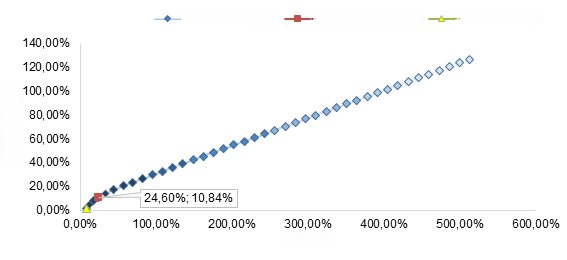
Figure 1. Efficient frontier
Portfolios with a higher percentage of Bitcoin within the wallet are positioned in an upward trend within the frontier. They carry high risks, but are compensated with high returns – as demonstrated by an annual return of 154.62%, with a standard deviation of 635.76%, which represents a Sharpe Ratio of 24.32%. This Sharpe ratio relative to the main asset classes is high, but did not surpass gold (Table 2).
In a scenario where there are more blog posts, news, and website articles about Bitcoin than scientific papers, there are controversial opinions regarding Bitcoin’s security and stability, as well as whether the currency is considered a financial instrument or an experiment. And the lack of awareness is one of the main reasons for risk-averse investors to hesitate (Kiran and Stannett, 2014). Statistical results from Krause and Pham (2017) have already shown that Bitcoin can effectively reduce portfolio risk or increase returns without altering its volatility, considering a study based on American, Chinese, European, and Japanese indices. This risk created by volatility is not constantly at a very high level, just as its decrease is not significant.
Bitcoin trading does not follow financial patterns, which means that rates change at any moment, while stock exchanges have specific trading times. Therefore, the analysis with Bitcoin excluded lines in the cryptocurrency data and converted it into a time series with only 252 trading days.
Some investors also identify Bitcoin as a commodity, and in recent years, several foreign Bitcoin derivatives exchanges have opened, albeit with much lower offerings and volume than other commodities. In 2015, the Commodity Futures Trading Commission (CFTC) considered the cryptocurrency a commodity and made the commodity trading standard rules effective (Sheppard, 2015).
The expansion of encrypted currency is inevitable, and gradually, mechanisms to protect against its volatility will also develop. The CME, the world’s largest derivatives trading exchange, recently decided to introduce Bitcoin futures contracts into the market, which should bring more transparency and confidence to cryptocurrency operators (Rocha, 2017). The results of this study can have high value for investors who are constantly seeking opportunities to diversify their portfolios and are not entirely risk-averse.
Final Considerations
The encrypted currency is still a financial novelty and, therefore, has many inconclusive aspects. Investors in the Brazilian market have not yet realized all the opportunities of Bitcoin, which causes negative asset correlations and makes the currency, therefore, a very good instrument for diversifying the portfolio. It is, however, a favorable instrument only for those with a high propensity for risk.
References
Assaf Neto, A. 2015. Mercado Financeiro. 13 ed. Atlas, São Paulo, SP, Brasil.
Banco Central do Brasil [BACEN]. 2017. SGS – Sistema Gerenciador de Séries Temporais – v 2.1. Disponível em: https://www3.bcb.gov.br/sgspub/localizarseries/localizarSeries.do?method=prepararTelaLocalizarSeries. Acesso em: 02 set. 2017.
Bartos, J. 2015. Does Bitcoin follow the hypothesis of efficient market?. International Journal of Economic Sciences 4(2): 10-23.
Bonneau, J.; Miller, A. ; Clark, J.; Naraynan, A.; Kroll, J.A.; Felten, E.W. 2015. SoK: Research Perspectives and Challenges for Bitcoin and Cryptocurrencies. In: IEEE Computer Society Symposium on Security and Privacy, 2015, San Jose, CA, USA. Anais…104-121
Brealey, R.A. ; Myers, S.C. ; Allen, F. 2011. Principles of Corporate Finance. 10 ed. McGraw-Hill Education, New York, NY, USA.
Chicago Mercantile Exchange Group [CME]. 2017. CME Group Announces Launch of Bitcoin Futures. Disponível em: http://www.cmegroup.com/media-room/press-releases/2017/10/31/cme_group_announceslaunchofbitcoinfutures.html/. Acesso em: 06 nov. 2017.
Coindesk. 2017. CoinDesk BPI. Disponível em: <https://www.coindesk.com/>. Acesso em: 02 set. 2017.
Doherty, S. 2011. All your bitcoins are ours…. Disponível em: https://www.symantec.com/connect/blogs/all-your-bitcoins-are-ours. Acesso em: 09 set. 2017.
European Central Bank [ECB]. 2012. Virtual Currency Schemes. Disponível em: http://www.ecb.europa.eu/pub/pdf/other/virtualcurrencyschemes201210en.pdf. Acesso em: 01 set. 2017.
Kiran, M.; Stannett, M. 2014. Bitcoin Risk Analysis. Nemode, Guildford. UK. Disponível em: http://www.nemode.ac.uk/wp-content/uploads/2015/02/2015-Bit-Coin-risk-analysis.pdf. Acesso em: 10 out. 2017.
Krause, D.; Pham, N. 2017. Bitcoin – a favourable instrument for diversification? A quantitative study on the relations between Bitcoin and global stock markets. Tese Mestrado. Umeå School of Business and Economics, Umeå University, Umeå, Suécia.
Markowitz, H.M. 1952. Portfolio selection. Journal of Finance 7: 77-91.
Markowitz, H.M. 1956. The optimization of a quadratic function subject to linear constraints. Naval Research Logistics Quarterly 3: 111-133.
Markowitz, H.M. 1959. Portfolio selection: efficient diversification of investments. John Wiley & Sons, New York, NY, USA.
Nakamoto, S. 2008. Bitcoin: A peer-to-peer electronic cash system. Disponível em: https://bitcoin.org/bitcoin.pdf. Acesso em: 02 set. 2017.
Nian, L.P.; Chuen D.L.K. 2015. Introduction to Bitcoin. p.5-30. In: _____. Handbook of Digital Currency: Bitcoin, Innovation, Financial Instruments, and Big Data. Academic Press, London, UK.
Rocha, L. 2017. Maior bolsa de derivativos do mundo anuncia índice de bitcoin e o preço dispara. Disponível em: https://www.criptomoedasfacil.com/maior-bolsa-de-derivativos-do-mundo-anuncia-indice-de-bitcoin-e-o-preco-dispara/. Acesso em: 01 nov. 2017.
Sheppard, D. 2015. US regulator halts bitcoin derivatives. Disponível em: https://www.ft.com/content/420d597e-5df8-11e5-9846-de406ccb37f2. Acesso em: 10 out. 2017.
Como citar
Gasparo, R.B; Silva, H.J.T. 2020. Alocação de Bitcoin em portfólio diversificado. Estratégias e Soluções, 1: e.20200002.
Sobre os autores
Roberta Bertagnoli Gasparo, Me. Pecege, MBA em Gestão de Negócios – Escola Superior de Agricultura “Luiz de Queiroz”, Universidade de São Paulo, Piracicaba, SP
Haroldo José Torres da Silva, Doutorando em Economia Aplicada, Escola Superior de Agricultura “Luiz de Queiroz”, Universidade de São Paulo, Piracicaba, SP
Editorado por: Edson Pereira da Mota
Link para download: https://cms.revistaes.com.br/wp-content/uploads/2020/11/2.pdf