
How trends are constructed

Column

Innovation

January 14, 2026

How trends are constructed

Behind the reports that shape decisions lies a complex process, requiring rigorous observation, analytical responsibility, and care in communication

The reports of trends have been gaining momentum each year. In January, it is common to see social networks, newsletters, and different media, digital or traditional, flooded with publications that promise to “reveal” the main trends for markets, sectors, consumer behaviors, or social dynamics. The search for anticipating what is to come, however, is not a recent phenomenon. It has accompanied humanity since its beginnings and, over time, has given rise to entire disciplines dedicated to the analysis of the future, as I comment on in the column about foresight, as well as increasingly structured methods of observation, interpretation, and organization of signals.

In contexts marked by sociopolitical instabilities, climate anxiety, and a growing sense of unpredictability, it is natural for many people to find a kind of cognitive shortcut in these reports. A ready-made scenario analysis, a future presented in an organized way, which reduces the effort of exploring deeper and often more distressing layers of reality. Thus, materials produced by large consultancies, institutes, or organizations often end up shaping our view of what the future will be and influencing how we think about possibilities, risks, and opportunities.

According to the dictionary, the word “tendency” can be defined as “a force or action that determines the movement of a body”. From this perspective, trend reports seek to identify which social, technological, economic, cultural, or environmental forces are acting on certain systems and what kind of changes these forces tend to provoke. More than predictions, these studies aim to map vectors of change, offering possible interpretations of ongoing transformations.

In this text, I propose to explore the importance of understanding how trends are formed, opening space for a more critical debate about their interpretation and encouraging a more pragmatic view on the subject.

Superficial reading

In practice, it is common for readers to jump directly to the report pages where trends appear in a synthesized and visually appealing way. Sections explaining methodology, approach, analytical cuts, or observed spectra are usually ignored. The result is a superficial reading, which accepts the findings without understanding or questioning the paths that led to them.

As already discussed in another text, by synthesizing behavioral patterns and market projections, these reports exert strong influence on tactical and strategic decisions. When they gain wide visibility, they can generate what we call self-fulfilling prophecies. Scenarios that, by being disclosed as probable, start to guide investments, strategies, and behaviors, increasing the chances of them materializing not due to their inevitability, but due to the collective adherence they provoke. This cycle tends to reinforce trends without their assumptions being duly questioned. Therefore, regardless of the approach adopted, it is fundamental to remember that no scenario is deterministic.

Understanding how a trend is identified, constructed, and validated therefore becomes essential. Otherwise, we run the risk of having our vision of the future and our present decisions defined by reports consumed without knowledge of their foundations, limitations, and intentions. Curiously, many people who disseminate trends tend to highlight predictions that have come true, but few revisit or critically analyze those that have not materialized.

Therefore, it is relevant to observe methodologies and layers analyzed before assuming trends as absolute truths, even when presented by consolidated organizations. This text does not aim to criticize specific reports or institutions. On the contrary, as an enthusiast of the subject, I recognize its relevance. However, as in any serious study, it is necessary to critically analyze methods, scopes, and objects of observation. Reports dealing with social, technological, environmental, and economic layers should not be consumed with the same logic as ephemeral content, such as popular short videos from various social networks. This is, above all, an invitation to critical reading.

Identification methods

There are different methods for identifying trends. Some are more empirical, such as coolhunting, which is based on active observation of emerging signs and movements, especially in culture and consumption. This approach usually analyzes layers such as pop culture, fashion, and behavior, often from observations or research with younger audiences, seeking to identify what is perceived as new or desirable and that can gain scale. It is a method used by marketing agencies, also known as trend spotting.

On the other hand, there are approaches with more structured processes and well-defined methods. This is the case of WGSN, one of the largest trend forecasting organizations in the fields of fashion, consumption, and lifestyle, which adopts its own method, STEPIC, combining signal observation, data analysis, and cultural interpretation. Other organizations with consolidated methodologies, such as Gartner and the Institute for the Future, also transparently maintain materials that explain their processes, approaches, and analytical premises for those who wish to delve deeper into the subject.

Trends observe multiple layers of reality, and each organization adopts distinct ways of analyzing them to arrive at trends or macro-trends. Regardless of the method, it is important to recognize that no trend is neutral. All carry the lenses of those who formulate them, reflecting geographical cuts, cultural perspectives, interests, theoretical premises, and implicit values.

Another fundamental point is the temporal localization of trends. Are we talking about the next semester, the next year, a two-year period, or a decade? In studies of possible futures, the separation by temporal horizons is essential to make sense of the analyses and avoid misinterpretations.

Regardless of the sources, perhaps the most important aspect when dealing with trends is to remain open to multiple perspectives, treating these materials as interpretive signals and not as closed truths, always considering the context in which they will be applied.

The context or scenario is a central element that rarely appears faithfully portrayed in trend reports. This limitation becomes even more evident when we consider geographical, economic, and cultural particularities, from micro to macro, both of the Global South and of the specific reality of each organization. Therefore, interpreting and translating how these trends manifest in a given context is fundamental. Not every signal indicates causality; many only point to correlations.

Understanding the perspective adopted by these reports also helps to reveal the worldview that underpins them and the vectors that guide their reading of the scenario. In this sense, it is worth recalling the contribution of Raymond Williams, one of the most influential thinkers in 20th-century cultural studies. When analyzing processes of cultural change, Williams proposed the organization of signs into three major categories: residual, dominant, and emergent. Although originally focused on cultural analysis, this lens offers valuable contributions to the reading of trends.
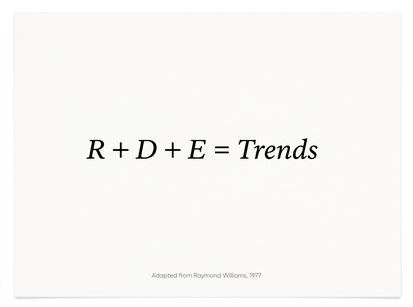
The term “residual” refers to elements formed in the past that remain active or influential in the present. “Dominant” relates to that which possesses strength and hegemony in the now, the mainstream that guides consumption, discourse, and practices. “Emergent” involves new practices, meanings, and values in formation, that which begins to gain space and visibility.

A superficial reading of trends, without considering scenarios, temporalities, and influences, can lead to the mistaken interpretation that only the emergent constitutes a trend. The triad proposed by Williams helps precisely not to reduce the analysis to what is evident at the moment, while also allowing the identification of long-term forces and future transformation vectors. A consistent trend usually articulates residual, dominant, and emergent elements.
Although formulated for cultural analysis, this approach can be extrapolated to understand behaviors and how they influence technological, social, and consumption trends. The identification of trends is a complex process that requires rigorous observation, analytical responsibility, and care in communication. Nevertheless, we see a growing volume of publications that ignore this rigor, which ends up discrediting serious and well-founded work.

Similarly, interpreting ready-made signals or reports requires preparation and critical thinking, especially when these readings begin to support strategic decisions in organizations. This phenomenon is common in the influencer economy, where opinions are often justified by supposed studies with low scientific rigor. Being aware of the trends that influence a market is fundamental, regardless of the source, but pursuing all of them reactively can become an exhausting exercise. As Tiago Mattos provocatively states, the adaptable is an attentive latecomer. More than reacting, it is necessary to act proactively, observing signals, interpreting trends, and promoting transformations in the sector itself.

Understanding trends, therefore, is not about seeking certainties about the future, but about expanding our capacity to read the present. The future is neither linear nor deterministic. It is from this multiplicity that more responsible, adaptive, and conscious strategies can be built.

To access the references of this text click here.

Who wrote this column

Lucas Tangi

Lucas é Design Manager no Pecege, formado em tecnologia e especialista em gestão de equipes criativas. Com ampla experiência liderando equipes de design, é também palestrante, professor e consultor. Já participou de projetos em consultorias de tecnologia, venture builders, ODS e na amazônia brasileira. Entusiasta e pesquisador de futuros, dedica-se à inovação e à criação de soluções com alto impacto social e econômico.

You may also like

October 02, 2026

Determinants of supermarket location in São Paulo

A study investigated the determining factors for supermarket location in the state of São Paulo, with the objective of investigating the factors that explain the presence and expansion of these establishments, considering socioeconomic, demographic, and market dimensions. Data from the 2010 and 2022 Demographic Censuses of IBGE and information from the National Registry of Legal Entities of the Federal Revenue of Brazil were used to build a georeferenced database. A Random Forest classification model was applied, adjusted by grid search with cross-validation, prioritizing the recall-macro metric due to the imbalance of the dependent variable, which represented the presence or absence of supermarkets within a 50-meter buffer. The results indicated that supermarket location is strongly associated with demographic, income, and population characteristics in the surrounding area. The analysis of variable importance showed that sociodemographic factors, such as elderly literacy, household income, and the presence of other food establishments, exerted significant influence, especially in the immediate vicinity. The findings reinforced the hypothesis that the spatial distribution of supermarkets is not random, being conditioned by socioeconomic characteristics and the commercial structure of the territory, offering subsidies for business decisions and urban planning.

Keywords: Spatial Analysis; Machine learning; Expansion; Commercial location; Supermarkets.

Neuroscience And Learning In Education

October 02, 2026

Anti-Racist Education: Inclusive Educational Practices and Social Development

Antiracist education, understood as a structuring axis of inclusive education and social development, was investigated in the Brazilian context. The study aimed to identify and analyze, based on legal documents and teachers’ perceptions, educational practices capable of promoting antiracism in school and society, and how the implementation of Laws nº 10.639/03 and nº 11.645/08 contributed to social justice. A qualitative and documentary approach was adopted, with analysis of educational legislation, curricular guidelines, institutional reports, and academic literature. Complementarily, a semi-structured questionnaire was applied to 295 Basic Education teachers. The data were evaluated quantitatively and qualitatively, through thematic content analysis, and validated with bibliographic studies. The results revealed a paradox: despite a robust legal framework, the implementation of antiracist policies proved fragile and sporadic, with a lack of teacher training, adequate teaching materials, and monitoring. Significant educational inequalities between white and black students were found to persist, and most teachers acknowledged the occurrence of racism in schools, but without clear institutional protocols. Neuroscientific analysis showed that racism negatively impacts students’ cognitive and emotional development. It was concluded that antiracist education is central to quality education, requiring political commitment, public investment, and intersectoral articulation. The integration of Neuroscience in teacher training and the production of qualified materials are crucial to strengthen the school’s role in building a more just and inclusive society.

Keywords: Social Development; Antiracist Education; Social Justice; Law 10.639/03; Inclusive Educational Practices.

Neuroscience And Learning In Education

October 02, 2026

Paths of Inclusion: Perceptions of Parents and Teachers on the Schooling of Students with Dual Exceptionality in the Brazilian Context

Dual Exceptionality, characterized by the coexistence of High Abilities/Giftedness and neurodevelopmental disorders, represents a complex phenomenon that challenges traditional identification and schooling models. The study aimed to understand the perceptions of parents or guardians, teachers, and other education professionals regarding the schooling of students with Dual Exceptionality in the Brazilian context, investigating challenges, pedagogical strategies, and possibilities for inclusion based on equity. The research adopted a qualitative, exploratory, and descriptive approach, and collected data through an online, voluntary, and anonymous questionnaire answered by 25 participants. Discursive data were analyzed using thematic content analysis. The results indicated that knowledge about the topic is often built from personal and professional experiences, revealing gaps in systematic training. Difficulties were identified in identifying these students, in teacher training, and in implementing individualized educational plans, pedagogical flexibility, and curriculum enrichment. Socio-emotional repercussions, such as frustration and low self-esteem, were reported. However, some schools demonstrated inclusive practices based on equity, articulating specific needs and potentialities. Although the results do not allow for generalizations, they highlighted the need to strengthen professional training and the articulation between school, family, and specialized services. It was concluded that the inclusion of students with Dual Exceptionality requires practices that simultaneously recognize their difficulties and potentialities, ensuring equitable conditions for participation, learning, and development.

Keywords: Human development; Teacher training; School inclusion; Neurodivergence; Pedagogical practices.

October 02, 2026

Data Transformation into Strategy: Applied Research for Ecotourism Operation Optimization

The growing demand in ecotourism in Minas Gerais has driven the search for business intelligence to transform customer data into strategic information. The study aimed to structure a data science pipeline to collect, segment, and classify the customer base of an ecotourism operation, in order to optimize marketing actions and anticipate market movements. An exploratory, quali-quantitative research was conducted through a case study. 2,777 transactional records from an ecotourism company, referring to January 2024 to December 2025, were used. The methodological process involved automated data collection (Google Sheets API), processing and enrichment (ETL), validation, and creation of RFM (Recency, Frequency, and Monetary Value) attributes. Dimensionality reduction via PCA and K-Means clustering was applied, with the number of clusters defined by the Elbow method and Silhouette Score. The results were validated with DBSCAN and K-Medoids. The results revealed the identification of three behavioral customer segments: “Loyal”, “Low Value”, and “Potential”. The “Loyal” segment represented the highest accumulated economic value, while the “Potential” segment stood out for its high average ticket and potential for conversion into recurrence. The integration of data analysis techniques proved to be a robust and replicable method for generating intelligence in ecotourism. It was concluded that the structured data science pipeline enabled the behavioral segmentation of the customer base, the statistical validation of the groups, and the creation of a predictive system for new buyers, providing subsidies for data-driven strategic decisions and future analyses.

Keywords: Clustering; Business intelligence; Machine Learning; Customer segmentation; Decision making.

October 02, 2026

Classification of defaulting customers using supervised machine learning techniques

The risk of default in credit operations demanded analytical approaches to anticipate losses. This study comparatively evaluated the performance of supervised machine learning models in classifying defaulting customers in credit card operations. The public dataset “Default of Credit Card Clients” from the University of California Irvine was used, with 30,000 observations and class imbalance. The algorithms Logistic Regression, Random Forest, and Extreme Gradient Boosting were employed. The imbalance was addressed by assigning weights to the classes, and model optimization occurred with the RandomizedSearchCV method, prioritizing sensitivity. Cross-validation results indicated that the Extreme Gradient Boosting model showed a higher capacity for identifying the defaulting class and better discriminatory performance, followed by Random Forest and Logistic Regression, with a sensitivity of 0.8250 and an AUC-ROC of 0.7844 for XGBoost. Interpretability analysis, conducted by the Shapley Additive Explanations (SHAP) technique, highlighted the predominance of variables associated with payment behavior, especially the history of delays. It was concluded that tree-based models, particularly boosting techniques, proved to be more suitable for capturing complex patterns in the data, configuring themselves as consistent alternatives for credit risk management.

Keywords: Machine Learning; Credit Card; Classification; Extreme Gradient Boosting; Credit Risk.

October 02, 2026

Sentiment Analysis on Brazilian Banks on Twitter/X: Comparison between Traditional and Digital Institutions

A study analyzed public perception of Brazilian financial institutions on the Twitter/X platform, highlighting the importance of sentiment monitoring on social networks for understanding reputation and customer experience in the banking sector. The objective was to compare user perception of the image and reputation of traditional and digital banks, based on the sentiment patterns identified in the analyzed manifestations, seeking to identify structural differences between these groups. The methodology was based on the analysis of 1,096 tweets collected between November 2022 and June 2023. Two complementary sentiment analysis approaches were used, the sum and the average of labels, to capture the majority sentiment and nuances of perception. Additionally, the Market Profile Model, with indicators of emotional reputation, reputational risk, neutrality, and polarization, and the Banking Clustering Model, which allowed grouping institutions according to perception patterns, were developed. The results indicated a predominance of neutral and negative sentiments, a higher volume of interactions in digital banks, and structural differences in the emotional intensity of perceptions, with greater stability in digital banks and greater polarization in traditional ones. It was concluded that the combination of analytical and statistical techniques contributed to an in-depth understanding of institutional image in the digital environment, demonstrating the importance of data-driven reputation management strategies.

Keywords: Digital banks; Traditional banks; Data modeling; Opinion mining; Social Networks.

October 02, 2026

Optimization of annual budget planning through project management methodologies

The Annual Budget Planning (POA) is a crucial process for translating organizational strategy into operational and financial goals, but it frequently faces deadline pressures, interdepartmental dependencies, and the repetition of habitual expenses. The study aimed to analyze how the combined application of project management practices and Zero-Based Budgeting (OBZ) can optimize the POA. To this end, a case study was developed in the Brazilian operation of a publicly traded company in the beverage sector, using documentary research of its 2023 results report and an anonymous questionnaire applied to 47 respondents. Documentary analysis indicated growth in net revenue, expansion of gross profit and adjusted EBITDA, and contained advancement of selling, general, and administrative expenses, suggesting cost discipline and operational leverage. The complementary survey revealed a high perception of cascading effect on the schedule, strong support for defining cost package owners, and a preference for technical justification of expenses, in addition to demand for controlled flexibility after the baseline definition. It was concluded that structuring the POA as a project, associated with the rigor of OBZ, increased the process predictability, reinforced accountability for expenses, and broadened the coherence between budgetary execution and economic-financial performance.

Keywords: Cost Control; Operational Efficiency; Zero-Based Budgeting; PMBOK; Beverage Sector.