
September 16, 2026
Improvement and Standardization of Process in an Industrial Laundry
Pedro Cabegi de Barros; Vagner Ferreira
DOI: 10.22167/2675-6528-202602306
Article derived from a Final Course Work (TCC), with content based on the student’s original work and adapted to the editorial format of the E&S Magazine with the support of the ResumeAI tool, an artificial intelligence solution developed by the Pecege Institute for textual synthesis and organization.
Abstract
Operational efficiency in industrial environments depends on process standardization and clarity of instructions. In this context, the objective was to develop a proposal for improvement actions to standardize and reduce failures in the washing process of an industrial laundry. A qualitative case study was conducted in an industrial laundry located in the interior of São Paulo. Data collection involved direct observation at the company, interviews with the production manager and operators, and bibliographic research on routine management, Lean tools, and process standardization. The management tools PDCA cycle, 5W2H, and the 5S program were used for analysis and structuring of solutions. The results pointed to the absence of accessible Standard Operating Procedures (SOPs), lack of a checklist, and inefficient organization of the input warehouse as the main causes of failures, in addition to informal order control and bottlenecks in manual processes. Based on this diagnosis, the implementation of visual SOPs, the 5S program, and operator training were proposed, as well as the digitalization of order control and the creation of verification routines. The developed proposal contributed to the management of industrial processes, offering an integrated methodological structure adapted to contexts with low-skilled teams and high staff turnover, with the expectation of greater operational reliability and reduction of rework.
Keywords: Company; Routine management; Laundry; Lean; Industrial processes.
1. Introduction
The contemporary business environment demands that companies implement effective process management, oriented towards results and the maintenance of operational stability. In the industrial sector, particularly in the textile segment, where uniformity and the quality of the final product are crucial, the application of methods that guarantee the correct and consistent execution of routines is indispensable. Routine management serves as the foundation for organizations to preserve operational stability, ensuring adherence to established standards and the achievement of expected results (Campos, 2013).
However, the mere definition of standards is not enough; the challenge lies in ensuring their uniform application in various situations within the company. In organizations with many employees, additional difficulties arise, such as understanding complex instructions, unfamiliarity with management tools, and the need for more accessible forms of communication, including non-verbal resources (Borges and Pinheiro, 2002). Such factors demand that knowledge be transmitted through other methods, such as oral communication, to ensure process standardization (Carmo, 2017).
Operational efficiency directly depends on the clarity of processes, employee training, and the implementation of a system that promotes continuous improvement (Slack and Brandon-Jones, 2018). In this sense, measuring performance and using well-defined indicators allows managers to strategically direct efforts, ensuring that the most important processes receive the necessary attention (Kaplan and Norton, 1997). The integration of these ideas with the practice of daily routine management, as valued by Campos (2013), points to the need for adapted models of standardization and monitoring, which are easy for operators to understand and apply, regardless of their educational level.
Recent studies demonstrate the effectiveness of applying Lean methodologies in laundries for process standardization and the reduction of operational failures. Cunha et al. (2011) highlight that the adoption of Lean principles in a hospital laundry resulted in the creation of a continuous flow, standardization of activities, and waste reduction, with significant productivity gains and greater reliability. Complementarily, Silva and Pulquerio (2024) emphasize that the implementation of tools such as 5S and Kaizen in industrial laundries, focusing on environmental organization and operator involvement, is fundamental for improving activity execution and reducing operational errors, especially in contexts with teams of different educational levels. These works reinforce the relevance of using Lean methodologies to support standardization and continuous improvement in industrial laundry processes.
In this context, the present research analyzed the clothes washing process in an industrial laundry located in the rural area of Cerquilho, São Paulo. The central problem that guided the study was: what improvement actions can be implemented to standardize and reduce failures in the washing process of an industrial laundry?
This study is justified by its importance in suggesting approaches that consider the particularities of businesses facing issues related to their team composition, while simultaneously enriching theoretical knowledge about the management of factory procedures in the aforementioned company. The objective of the study was to develop a proposal for improvement actions to standardize and reduce failures in the washing process of an industrial laundry.
2. Material and Methods
The research has an applied character, a qualitative approach, and a descriptive type. The case study object was the washing process in an industrial laundry, located in Cerquilho-SP. The term of assent for data collection and analysis was signed by the company owner and is in the researcher’s possession (Yin, 2018; Severino, 2017).
To obtain data, a bibliographic search was conducted on routine and process management, focusing on approaches for people with little schooling, with Vicente Falconi de Campos as the main author of the theoretical framework. Complementarily, the “Lean” methodology applied to industrial laundries was studied (Cunha et al., 2011; Silva and Pulquerio, 2024).
The collection of empirical data included direct observation at the production site and exploratory interviews with open-ended questions, conducted with the production manager, employees, and outsourced personnel responsible for washing and manual processes. The interviews took place on September 06, 2026, and January 17, 2026, lasting approximately one hour each. The interview scripts are listed in Appendix 1 (Bogner et al., 2009; Döringer, 2021).
Regarding the ethical aspects, no participant was identified and no personal approach questions were asked that could pose risks. According to Article 1 of CNS resolution no. 510 of April 2016, this research was not submitted for evaluation by the CEP/PECEGE, as it does not reveal data that could identify the participating subjects, aims at theoretical deepening of situations related to professional practice, and/or involves research with databases containing aggregated information without individual identification.
The management tools applied in the research included the PDCA cycle for analysis and problem-solving and the development of Standard Operating Procedures [SOPs] (Campos, 2009; 2013). The “Lean” methodology was used to support the standardization, control, and continuous improvement of the washing process, focusing on waste elimination (Womack and Jones, 1997). The 5S program (Seiri, Seiton, Seiso, Seiketsu, Shitsuke) was employed for workplace organization (Silva and Pulquerio, 2024). The 5W2H action plan was used to support the planning stage of PDCA to structure improvement actions (Silva and Casagrande, 2022; Neves et al., 2018).
The qualitative data collected (interviews, observations, and reports) were analyzed descriptively and subjected to comparative discussion with the bibliography.
3. Results and Discussion
The company studied is an industrial laundry founded in 2014, with 57 employees and an operational capacity to wash approximately 300,000 pieces of clothing per month. Additionally, it has the capacity to finish about 40,000 pieces monthly through manual services, serving four major clients in the Cerquilho-SP region. The services are provided on a outsourced basis, integrating into the clients’ production chain.
Among the main problems identified, the insufficient training of collaborators and the high staff turnover rate, which hinder continuous training, stood out. The main washing process, known as “bottom removal”, presents a high risk of damage to the parts, as it is executed in a batch production system. Another critical point is the bottleneck in manual services, which limits the company’s ability to fully meet customer demand.
During the technical visit and conversations with the production manager, it was confirmed that the washing stage is the most critical, requiring the precise use of recipes with specific combinations of chemicals. Errors in this phase can lead to the loss of entire batches, generating high costs and wasted time. The operation process begins with the receipt of raw parts and their washing recipes, which specify chemicals and washing time. A sample of already washed fabric is used as a quality reference.
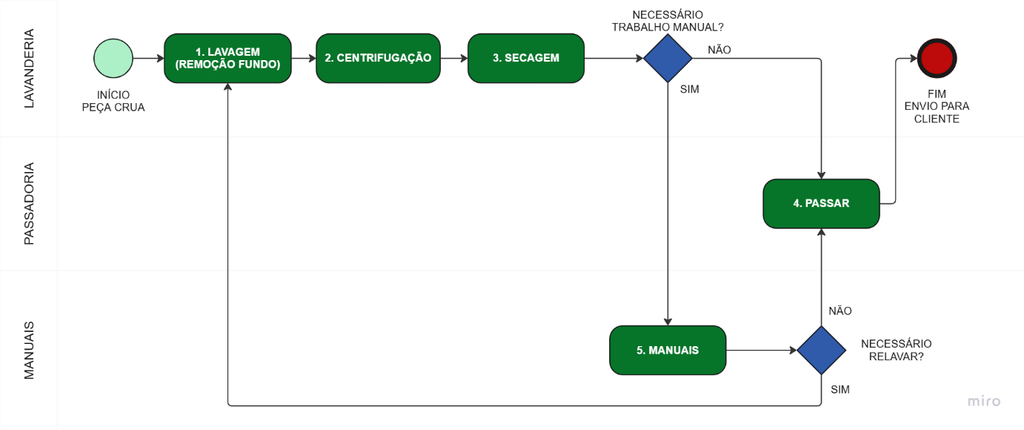
The company’s production flow comprises five main stages. In Stage 1 (Washing – bottom removal), baskets are transported to machines, where clothes are loaded, chemicals added, and time and temperature parameters configured. The supervisor can interrupt the cycle for comparison with the reference sample. After the cycle, the garments are unloaded and sent for centrifugation. In Stage 2 (Centrifugation), the washed garments are loaded into equipment for excess water removal. In Stage 3 (Drying), the garments are transported to drying machines, where constant heat is applied. In Stage 4 (Ironing), the dried garments are sent for finishing with irons. Stage 5 (Manuals) consists of outsourced manual activities, such as ozone application, permanganate blasting (“reveal”), manual or “differentiated” finishing, “tank” or “mustache” process, and “used” process. For finalization, the garments are separated into baskets on “pallets” and prepared for return to the customer.
The company’s productive flow is illustrated in the following flowchart.
Figure 1. Flowchart of the washing process
Source: Original research results
The production manager indicated that the company acts as outsourced labor, performing industrial washing and manual work on jeans. He confirmed that the greatest production risks are concentrated in the bottom removal process, with the potential to ruin many pieces simultaneously, while manual processes generate isolated losses. The main bottleneck pointed out was the manual processes stage, due to the insufficient capacity of the outsourced company to meet demand.
The control of incoming orders was informal, done through a corkboard with manual notes and communication via WhatsApp groups. The monthly production capacity for washing is 300,000 pieces, with delivery of 40,000 finished pieces through manual processes.
The employee in the washing process explained that their responsibilities include following the service order (“recipe”), searching for and mixing dosed chemical inputs. Production control is done through a registration form, where name, batch weight, number of pieces, type of process, and machine entry and exit times are recorded. Parameters such as water temperature and washing time can be adjusted.
The owner of the outsourced manual process company confirmed the productive bottleneck, stating that his company cannot fully meet the volume of washed parts that demand these processes. He attributed the low productivity to the high employee turnover, which hinders training and standardization. The manual “mustache” process was pointed out as the most time-consuming. The monthly delivery capacity of finished parts is approximately 40,000, confirming the production manager’s data.
Consolidated diagnosis of the identified problems
Direct observation and interviews allowed for the identification of three main groups of problems affecting the operational stability of the industrial laundry. The first is the washing process (bottom removal), which represents the stage with the highest operational risk. An error in the formulation or dosage of chemical products can result in the loss of an entire batch of items, generating high costs and compromising the delivery deadline to the client. The second problem is the informal control of orders, carried out through a corkboard with manual notes, which increases the risk of information errors regarding washing type, deadline, and quantity of items. Finally, the third problem is the bottleneck in manual processes, performed by a third-party company with high staff turnover, which hinders the standardization of activities and limits the capacity to meet demand.
These problems are consistent with conditions that weaken routine management, such as the absence of clear standards, lack of operator training, and the non-existence of systematic control and verification mechanisms (Campos, 2013). High staff turnover worsens the scenario, hindering continuous training and the consolidation of correct practices (Silva and Pulquerio, 2024).
Improvement proposal based on the PDCA cycle
The improvement proposal was structured according to the four phases of the PDCA cycle (Campos, 2013), applied in contexts of continuous improvement in productive environments (Silva and Casagrande, 2022). Table 1 summarizes the phases and the proposed actions.
Table 1. Synthesis of the PDCA cycle phases and proposed actions for the industrial laundry
| Phase | Step | Proposed actions (synthesis) |
|---|---|---|
| “Plan” [P] | Problem identification and planning | Diagnosis of failures in the washing process; development of the 5W2H action plan for standardization and reduction of operational errors |
| “Do” [D] | Execution of planned actions | Application of 5S in the productive environment; elaboration and implementation of visual SOPs; operator training |
| “Verification” [C] | Results Verification | Monitoring of batch rejection indicators, rework, and recipe execution; comparison with the client’s standard sample |
| “Act” [A] | Standardization or correction | Incorporation of improvements to SOPs; corrective actions for deviations; periodic review of standards based on achieved results |
Source: Original research results.
“Plan” [P] – Planning
The planning phase consisted of identifying the problem, analyzing its causes, and establishing improvement actions, with defined goals and responsibilities. The main problem to be addressed is the occurrence of failures in the washing process (bottom removal), which exposes the company to the risk of losing complete batches of parts. The identified causes include: absence of formalized and accessible SOPs at the workstation; absence of a checklist before the start of each batch; inadequate organization of the chemical input warehouse; and manual and informal control of received orders.
To operationalize the planning, the 5W2H tool was used, which allows for detailing improvement actions clearly and objectively (Silva and Casagrande, 2022). Table 2 presents the action plan developed based on this tool.
Table 2. 5W2H action plan for improving the industrial laundry washing process
| What? | Why? | Where? | When? | Who? | How? | How much does it cost? |
|---|---|---|---|---|---|---|
| Develop visual SOPs for the washing process (background removal) | Reduce errors in the addition of chemicals and parameter configuration, avoiding batch loss | Wash area | 1st month | Production Manager | Creation of work instruction with images and simple language; placement near the machines | Low cost (printing and lamination of posters) |
| Implement 5S program in the washing area and chemical input stock | Organize the productive environment, facilitate the location of inputs, and reduce the risk of using the wrong product | Wash area and chemical storage | 1st and 2nd month | Production manager and operators | Organization drive; visual identification of shelves and containers; disposal of unused materials | Low cost (labels, identification inks) |
| Train washing process operators based on the created SOPs | Ensure that all operators know and correctly apply the washing recipe, reducing errors due to lack of knowledge | Wash area | 2nd month | Production Manager | On-the-job practical training, with in-person demonstration and use of visual SOPs as reference | Man-hour [MH] cost for training (without additional investment) |
| Create a routine for revenue reconciliation of washing before the start of each lot | Ensure the conformity of inputs and parameters before the start of the cycle, preventing batch losses due to setup failure | Wash area | From the 2nd month | Washing operator and production supervisors | Simple physical checklist (can be visual/pictographic) to be filled out and signed before starting each batch | Printing cost of forms |
| Digitize and centralize order control (replace the manual corkboard) | Reduce risk of information errors regarding washing type, deadline, and quantity of items per order | Administrative area / production management | 3rd to 4th month | Production Manager | Deployment of a simple spreadsheet (e.g., Google Sheets or Excel) for order control, with easy access and standardized fields | No additional cost (use of free tools) |
| Establish performance indicator for batch losses and rework in washing | Allow systematic monitoring of operational failures and support corrective actions ( “Check” phase of PDCA) | Wash area | From the 2nd month | Production Manager | Daily log of the number of problematic batches; weekly compilation; monthly data analysis by the manager | Cost of printing control sheets |
Source: Original research results.
The proposed actions were prioritized based on their impact on the critical background removal process, which concentrates the company’s greatest operational risk. Directing improvement efforts towards the most relevant processes is fundamental to achieving the desired results efficiently (Kaplan and Norton, 1997).
“Do” [D] – Execution
The execution phase corresponds to the implementation of the planned actions, following the sequence defined in the 5W2H action plan, with attention to the communication of changes to the operators and the involvement of the production manager. A central action is the elaboration and posting of visual SOPs in the washing area, written in simple language and accompanied by images, posted in a visible location near the washing machines, as recommended by Borges and Pinheiro (2002) for teams with different educational levels. Additionally, practical training should be carried out at the workstation, with in-person demonstration of the washing process steps, using the SOPs as reference material.
The implementation of 5S should occur gradually and participatively, involving the operators themselves in the reorganization of the work environment. The involvement of collaborators in the stages of organization and standardization of the environment was a determining factor for the success of the 5S implementation in an industrial laundry, resulting in greater adherence to new practices and reduction of operational errors (Silva and Pulquerio, 2024). Table 3 presents the application of the five senses of 5S to the context of the laundry studied.
Table 3. Application of the 5S program in the context of the industrial laundry
| Sense | Principle | Application in the industrial laundry |
|---|---|---|
| “Seiri” (Sense of Use) | Separate the necessary from the unnecessary | Identify and remove expired chemical inputs, unlabeled containers, and disused equipment from the washing area; keep only the products necessary for the batches in progress |
| “Seiton” (Sense of Organization) | Assign a place for everything | Organize and visually identify chemical warehouse shelves by type and frequency of use; define fixed positions for parts transport baskets and measurement equipment |
| “Seiso” (Sense of Cleanliness) | Keep the environment clean | Establish a daily cleaning routine for washing machines, centrifuges, and dryers; include cleaning as part of the shift closing SOPs |
| “Seiketsu” (Sense of Standardization) | Maintain the first three senses in a standardized way | Fix posters and visual signage (with images) indicating the correct organization of workstations; periodically review compliance with defined standards |
| “Shitsuke” (Sense of Discipline) | Maintain the habits and standards achieved | Incorporate the 5S senses into daily routines through SOPs; involve the production manager in promoting the culture of organization; perform simple periodic checks of workstations |
Source: Original research results.
Within the scope of Lean Thinking, the execution phase should include the elimination of the main identified wastes, such as rework generated by washing failures and waiting time due to chemical warehouse disorganization. Previous studies have shown that the adoption of Lean principles in hospital laundries has enabled the creation of continuous flow, standardization of activities, and waste reduction, resulting in productivity gains and greater process reliability (Cunha et al., 2011).
“Check” [C] – Verification
The verification phase consists of monitoring the results of the actions performed. Systematic monitoring of results is essential to identify and correct deviations in a timely manner (Campos, 2013). For this stage, it is proposed to establish simple performance indicators for the washing process, focusing on: (i) number of batches with rejection or rework per period; (ii) percentage of batches started with the checklist completed; and (iii) frequency of non-conformities related to incorrect chemical product dosage. These indicators should be recorded daily by the washing operator and compiled weekly by the production manager, allowing for trend analysis and identification of improvement opportunities.
“Act” [A] – Corrective action or standardization
The final phase of the PDCA cycle consists of acting based on the verification results. When the results are satisfactory, the practices must be standardized and definitively incorporated into the company’s procedures; when unsatisfactory, corrective actions must be identified and a new cycle initiated. In the context of the industrial laundry studied, this phase involves reviewing and updating the SOPs based on the identified improvements, incorporating the revenue verification checklist as a permanent practice, and adjusting the 5S program based on the audits performed. The standardization of positive results is the mechanism that allows the company to consolidate improvements and progressively move towards operational stability (Campos, 2013).
The results indicated that the general objective of this work was achieved, with the development of a structured proposal of improvement actions to standardize and reduce failures in the industrial laundry washing process. The management tools applied (PDCA cycle, 5S program, 5W2H action plan) proved to be complementary and adequate to the analyzed context, contributing to the problem diagnosis and to the structuring of practical, viable, and low-cost solutions. It is expected that the implementation of the proposed actions will result in greater operational reliability, reduction of rework, and strengthening of the continuous improvement culture in the organization.
4. Conclusion
The present study sought to develop a proposal for improvement actions to standardize and reduce failures in the washing process of an industrial laundry. It was found that the main causes of operational failures resided in the absence of accessible Standard Operating Procedures (SOPs), the lack of a checklist, and the inefficient organization of the chemical input storeroom. Additionally, informal order control and a bottleneck in manual processes, executed by a third-party company with high staff turnover, were identified. Given this diagnosis, an improvement framework based on the PDCA cycle was proposed, which included the development of visual SOPs and the implementation of the 5S program for organizing the work environment. Operator training, digitalization of order control, and the creation of verification routines were also suggested, aiming for greater operational reliability and reduction of rework.
The main contribution of this work lies in the adaptation of consolidated quality management tools, such as the PDCA cycle, 5W2H, and the 5S program, to an industrial context with teams of low schooling and high staff turnover. It was demonstrated that such methodologies can be applied in an accessible and low-cost manner, maintaining their effectiveness in process standardization and control. However, the proposal was not implemented during the study period, which made it impossible to quantitatively measure the results and empirically verify its effectiveness. Future research may follow the execution of the action plan and evaluate the gains obtained, serving as a reference for organizations with analogous challenges and contributing to the advancement of knowledge on continuous improvement in industrial laundries.
Bibliographic References
Bogner, A., Littig, B. and Menz, W. eds., 2009. Interviewing experts. Springer.
Borges, L.D.O. and Pinheiro, J.Q., 2002. Estratégias de coleta de dados com trabalhadores de baixa escolaridade. Estudos de Psicologia (Natal), 7, pp.53-63.
Campos, V.F., 2009. O verdadeiro poder. Falconi Editora.
Carmo, A.V.F., 2017. Competência informacional desenvolvida em analfabetos e semi-analfabetos do conjunto Bárbara de Alencar II-Curió-Messejana. Revista Brasileira de Biblioteconomia e Documentação, 13, pp.1836-1849.
Cunha, A.M.C.A., Campos, C.E. and Rifarachi, H.H.C., 2011. Aplicabilidade da metodologia Lean em uma lavanderia hospitalar. O Mundo da Saúde, 35(3), pp.311-318.
Döringer, S., 2021. ‘The problem-centred expert interview’. Combining qualitative interviewing approaches for investigating implicit expert knowledge. International journal of social research methodology, 24(3), pp.265-278.
Kaplan, R.S. and Norton, D.P., 1997. A estratégia em ação: balanced scorecard. Gulf Professional Publishing.
Neves, P., Silva, F.J.G., Ferreira, L.P., Pereira, T., Gouveia, A. and Pimentel, C., 2018. Implementing lean tools in the manufacturing process of trimmings products. Procedia Manufacturing, 17, pp.696-704.
Severino, A.J., 2017. Metodologia do trabalho científico. Cortez editora.
Silva, C.M. and Casagrande, D.J., 2022. QUALIDADE NO PROCESSO PRODUTIVO DA CERVEJA: uma análise a partir das ferramentas Ciclo PDCA e 5W2H. Revista Interface Tecnológica, 19(1), pp.378-388.
Silva, G.K.D. and Pulquerio, S.R., 2024. Implementação de 5s e kaizen, ferramentas do lean manufacturing, em uma lavanderia industrial.
Slack, N. and Brandon-Jones, A., 2018. Operations and process management: principles and practice for strategic impact. Pearson UK.
Womack, J.P. and Jones, D.T., 1997. Lean thinking—banish waste and create wealth in your corporation. Journal of the operational research society, 48(11), pp.1148-1148.
Yin, R.K., 2018. Case study research and applications (Vol. 6). Thousand Oaks, CA: Sage.
Article originating from the Course Conclusion Work of the Specialization in Business Management of the MBA USP/Esalq
To learn more about the course, click here and access the MBX Academy platform