
Education
Ideb
May 11, 2023
The ICMS apportionment law in Ceará and its impacts on education indices
DOI: 10.22167/2675-6528-20230027
E&S 2023, 4: e20230027
Larissa de Oliveira Peruzo; Lucas Nobrega Augusto; Maria Cecília Perantoni Fuchs Ferraz
Basic public education in Brazil is linked to government revenues and regulated by the Fund for the Maintenance and Development of Basic Education and the Valorization of Education Professionals [Fundeb][1]. It is possible to highlight several improvements and positive results from this public policy, as well as its effectiveness as an instrument for improving the quantitative and qualitative indicators of education in the country[1]. Thus, the significance of variables such as teacher and director remuneration, and investment in infrastructure, directly influence the improvement of student grades, and this is due to financial investments in public education in Brazil[2].
Ceará is historically a relatively poor state in the northeast region of Brazil, its GDP corresponds to one third of the per capita GDP of the richest states, with a population of approximately 9 million inhabitants. However, Ceará has become a model in education in terms of quality and efficiency, as it has the largest increase in the result of the Basic Education Development Index [Ideb] in the last 12 years, created by the National Institute for Educational Studies and Research Anísio Teixeira [Inep] to measure the quality of national learning and establish goals for improving teaching. This is the result of excellent allocation of funds for education[3].
The results obtained for the evaluation with such scope represented a very important achievement for the State. It should be noted that at no previous time in educational policy was it possible to obtain such a faithful portrait of student performance, in the content areas and grades evaluated[4].
In 2007, the state of Ceará enacted Law nº14.023/07[5] and, subsequently, Decree nº 29.306/08[6] with new rules for the distribution of the Tax on Operations related to the Circulation of Goods and on Interstate and Intermunicipal Transportation and Communication Services [ICMS] to be transferred to municipalities. The proposal to revise the ICMS distribution rules arose so that the distribution of resources to municipalities would be defined based on results in the areas of education, health, and environment, thus encouraging municipal managers to effectively invest in these three spheres to improve results[5].
According to the Federal Constitution [CF] of 1988[7], part of the ICMS revenue collected by the states must be transferred to the municipalities. Article 158 of the CF establishes that 25% of the ICMS collected by the states shall be distributed to the municipalities according to the following criteria: 1) at least three-quarters, in proportion to the value added in operations related to the circulation of goods and the provision of services carried out in their territories; 2) up to one-quarter, according to state law or, in the case of Territories, federal law[7].
Before Law No. 14.023/07, the distribution of the municipalities’ share in Ceará was carried out as follows: 75% according to the added value, as determined by the federal government, and of the remaining 25%, 5% proportional to the number of inhabitants in the municipality, 12.5% related to the proportionality of education spending on municipal revenue, and 7.5% distributed equally among all municipalities[5]. With the implementation of the new law, the 25% became: 18% based on education results, with 6% based on the educational quality index of 5th-grade elementary school students; 12% based on the literacy assessment of 3rd-grade elementary school students. The remaining 5% are composed based on health results and 2% on the environment[5]. This change in law aimed to generate healthy competition among municipal managers and thus raise the indicators related to the development of the municipalities and, consequently, of the state[8].
Given the importance of investments and financing in education and the influence they have on improving the quality in this sector, the objective of this work was to verify the impact of the legislative change in ICMS distribution on the educational performance of the state of Ceará, more specifically, on the Mathematics and Portuguese Language scores of the Basic Education Evaluation System [Saeb] for the initial years of elementary school.
For the research, data on the results of the Mathematics and Portuguese Language assessments for the second and fifth grades of Elementary School from 1995 to 2019 from Saeb were first collected, made available by Inep on the federal government website. In this study, only data from public schools in the early years of elementary school were used[9].
Conducted since 1990, Saeb is a set of large-scale external assessments that allows for a diagnosis of Brazilian basic education and of factors that may interfere with students’ academic performance. These questionnaires are applied every two years in public schools and a sample of private ones. Saeb can be considered a good indicator for evaluating education because through it it is possible to understand and thus improve the pedagogical processes of educational institutions, and it has been receiving various technical and methodological improvements over 30 years to monitor Brazilian educational policies and also point out the deficiencies in teaching[10]. Therefore, the diagnosis can serve as a guide to monitor and improve education based on evidence and thus guarantee the universalization of access to education.
After data collection, an initial evaluation was carried out on the evolution of the State of Ceará’s scores in Mathematics and Portuguese Language tests for the early years of elementary school between 1995 and 2019. In this way, it was possible to assess whether there is any indication of improvement from 2007 onwards, the year in which the legislative change was implemented.
In a second moment, the grades of the state of Ceará were compared with the other 25 states of Brazil and the Federal District. However, since each state has different socioeconomic characteristics that influence the students’ grade level, it was established that each state’s grade in 2007 would be assigned a value of 100. Thus, it was possible to verify which states had made the most progress since 2007 (the moment when the state of Ceará altered its legislation).
In addition to the direct comparison with the results from other states, a synthetic control was created with the aim of obtaining a counterfactual, that is, a scenario in which the state of Ceará itself had not implemented the aforementioned law. The synthetic control consisted of a fictitious state composed by the weighting of other Brazilian states so as to have a synthetic state similar to the original state of Ceará according to the variables included in the model. For the creation of the synthetic state, the statistical software Stata was used, which establishes weights for the other states in such a way that the variables determined by the model most closely resemble the respective variables of Ceará.
In the main specification of this work, two synthetic controls were defined. The first obtained from the Mathematics notes of Saeb between 1995 and 2007 and the second from the Portuguese Language notes between 1995 and 2007. Only the period before the legislative change was used, as the objective was to compare what Ceará would be without the new law, which came into effect in 2007.
Although it does not include any socioeconomic variables in the main specifications, the study assumes that states with similar scores tend to have similar characteristics. Since the factors that influence the scores and are omitted in this model are expected to be similar to other states, for example, states with very similar scores, the determinants of educational quality, such as school management, teacher appreciation, and family income, are expected to be similar. Therefore, a qualitative analysis of the composition of the synthetic states is essential to ascertain whether the greater weight of the states that make up the control corresponds to states similar to Ceará.
To evaluate whether the estimated model of representation of what the state of Ceará would be if there had been no legislative change was indeed effective, a synthetic placebo state was created for each of the other 25 states of the Brazilian federation and the Federal District. The expectation is that the difference between the scores of the other states and the synthetic placebos will be equal to zero, meaning that the placebo scores will be very similar to the original, given that in the other states there was possibly no relevant legislative change for education during the period. If the expectation is confirmed, it is an important indication that the synthetic state of Ceará was well constructed and thus it is possible to measure whether there was a growth in scores above what would be observed if there had been no change in the law.
The analysis of Saeb performance indicators in the state of Ceará (Figure 1) showed a drop in assessment results between 1997 and 2001 in both mathematics and Portuguese language. Between 2003 and 2007, there was a significant recovery, returning to levels close to those observed in 1997. From 2007 onwards, an acceleration in performance improvement and a relatively constant growth trajectory are noted. In this assessment, it is possible to identify strong evidence that the legislative change in Ceará in 2007 positively influenced the state’s Saeb scores.
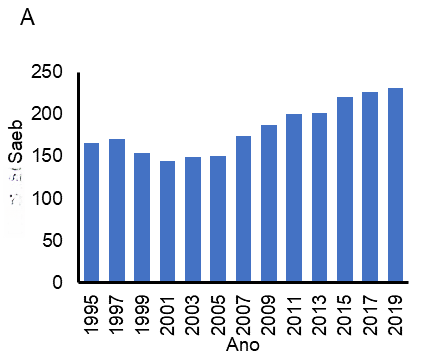
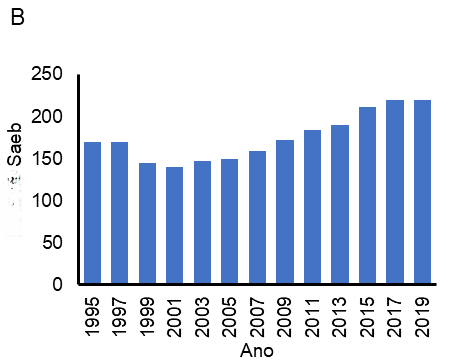
Figure 1. Saeb performance of the state of Ceará in mathematics (A) and in Portuguese language (B)
Source: Elaborated by the authors based on INEP[9].
When comparing Ceará’s scores with other states (Figure 2), it is observed that the state registered one of the largest evolutions until 2013 and since then it is the state with the largest proportional growth in its scores between 2007 and 2019. Such results infer that there was an impact from the legislative change, but that it was not immediate but rather gradual. This phenomenon is explained by the fact that the fruits of investments in education take time. Similar results were found in the study by Pereira[11], which shows a strong correlation between the increase in investment in education and student performance in Saeb, but it is not an isolated factor.
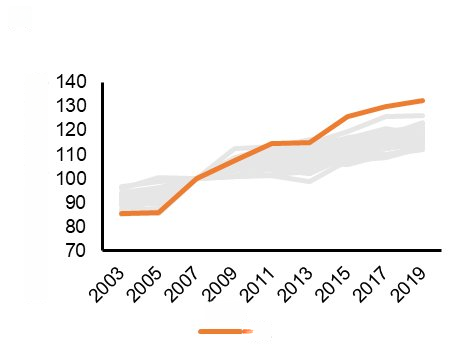
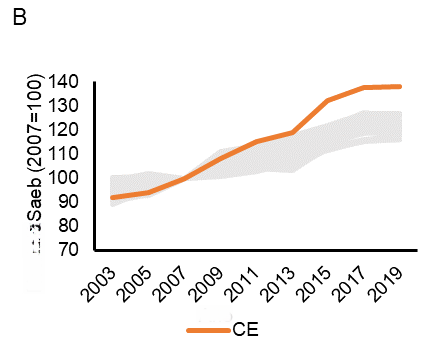
Figure 2. Comparison of Saeb performance in Ceará with other states in mathematics (A) and Portuguese language (B)
Source: Elaborated by the authors based on INEP[9].
Note: In this graph, each state’s 2007 score was set to 100 for comparison purposes
In the deepening of the assessment of the impact of legislative change in the state of Ceará on Saeb scores, synthetic control was adopted. Table 1 shows the composition (percentages) of the synthetic controls created for mathematics scores and for Portuguese language scores. It is noted that the synthetic states in the two disciplines are composed of states similar to Ceará, both geographically (North and Northeast regions), and in socioeconomic and demographic aspects[12]. These are indicators that the synthetic controls were well constructed.
Table 1. Composition of the synthetic State of Ceará
| State | Mathematics | Portuguese Language |
| —————————————%———————– | ||
| AC | 3.3 | – |
| TO | – | 22.3 |
| MA | 62.4 | 18.1 |
| RN | 31.6 | 32.2 |
| MBA | 2.7 | 27.5 |
When comparing the performance of the state of Ceará with the synthetic state, further evidence was obtained that the new ICMS distribution law in the state of Ceará had a positive impact on Saeb scores in both disciplines. Figure 3 shows that in the hypothetical scenario where this change had not occurred, Ceará’s scores would have continued to evolve, however, at a pace below what was observed. For Portuguese Language scores, Ceará registered 15.8 points above its synthetic comparative, equivalent to a 9.1% higher score. This same measure reaches 26.1 points in 2019, which is equivalent to a 13.5% higher score.
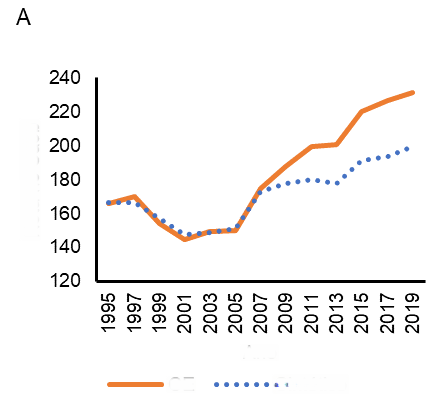
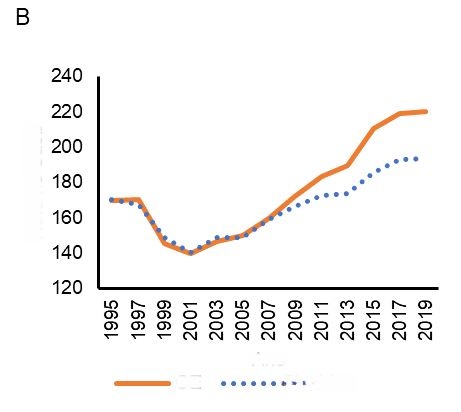
Figure 3. Evolution of the performance in Saeb of Ceara and synthetic Ceara in mathematics (A) and Portuguese language (B)
Source: Elaborated by the authors.
For Mathematics grades, Ceará obtained 23 points above its synthetic comparative, corresponding to a 12.9% higher grade. This same measure reaches 31.8 points in 2019, which represents a 15.9% higher grade. It is worth noting that these differences are significant. In the last available data, Ceará’s grades were at a similar level to the states in the Southeast, which present socioeconomic indicators superior to the state of Ceará. On the other hand, the synthetic state would have results closer to its peers in the Northeast. Such results infer once again that the change in the ICMS apportionment law has raised the level of education in the state.
Furthermore, it was necessary to verify if the construction of the synthetic control occurred adequately. For this reason, the performance of the placebos in the other states was evaluated. In the analysis, the mean difference between the original data and the synthetic placebos was very close to zero (Figure 4), indicating that the construction of the synthetic states was appropriate.
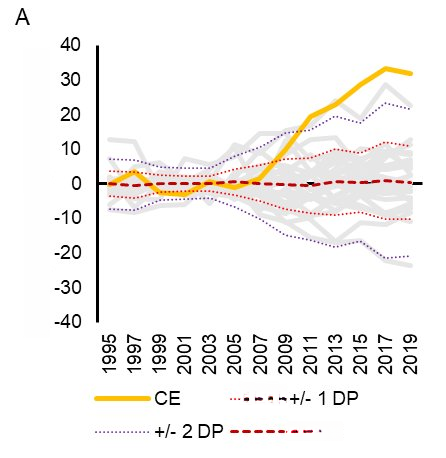
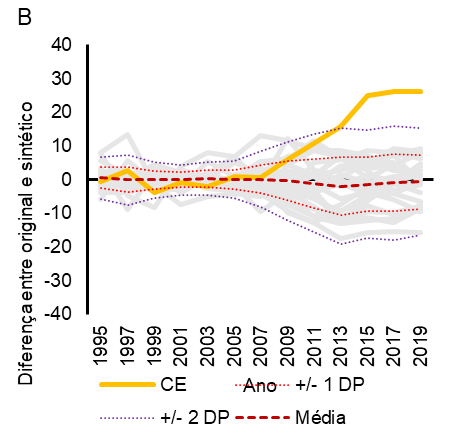
Figure 4. Difference between effective performance and synthetic control performance for each Brazilian state as well as the Federal District in the initial years of elementary school in mathematics (A) and Portuguese language (B)
Source: Prepared by the authors.
It is noteworthy that the difference between the scores of the state of Ceará and its synthetic equivalent is the largest among all states. Furthermore, inherent in any statistical modeling is an error component. Therefore, to ascertain whether the observed effect was statistically significant, one can compare it with the standard deviation, i.e., the margin of error, recorded in the difference between the scores of the original states and their synthetic equivalents across all states. In this case, the positive effect on Ceará’s scores was more than twice the standard deviation observed in the sample (Figure 4). Thus, it was concluded that, in fact, there was a positive effect of the policy for the state of Ceará, both for Portuguese Language and for Mathematics.
Brazilian states have autonomy to administer their municipalities, and this means they can apply their own policies to manage all sectors, as long as they do not diverge from national regulations. The new ICMS distribution rule in the State of Ceará[5] encourages municipalities to invest more in education, beyond politics. This reform required transparent dialogue with the parties involved in the process and convincing these groups that the common goal is to provide quality education, thus benefiting all parties[13].
This public policy generates incentives for municipalities to improve their performance in tests, which can be seen and compared with Brazilian states that do not have it. Municipalities receive more funds according to their performance and there is a penalty for those that increase inequality in schools, or even for those that try to circumvent the system by reducing the participation of low-performing students in standardized assessments[5].
The positive impact of the legislative change shows that city halls react positively to financial incentives, thus resulting in improved educational quality, and consequently receiving more budgetary funds to be allocated to their interests and policy agendas. Furthermore, it is pointed out that the focus should then be on the public manager, i.e., the mayor, instead of the school or student. This generates mobilization in other agents, such as principals, teachers, and the school community. In addition to the new public policy, all improvements in education in Ceará originated from dialogue, partnership, and transparency between political power, local authorities, and educational managers, meaning it is not just about injecting financial resources resulting in quality education, but rather a set of activities, proposals, and programs for quality and democratic education to be achieved, with the participation of the entire school community[4].
The results obtained indicated that the premise of how managers respond to incentives is satisfactory, as the education indices in the state of Ceará were high when compared to similar states that do not have the new ICMS distribution law. All these arguments and results show how beneficial it can be for the country’s education as a whole, new public policies that reinvent the mechanism for transferring public funds to raise education indices throughout the country and so that, thus, the State can reap the benefits of a society that has had access to quality education.
References
[1] Sobreira R.; Campos B.C. Investimento público em educação fundamental e a qualidade do ensino: uma avaliação regional dos resultados do Fundef. Revista de administração pública. 2008; 42(2): 327-346.
[2] Peres A.P.F. Gestão democrática e conselhos de escola no município de Araraquara/SP [Tese de doutorado]. Araraquara (SP); Universidade Estadual Paulista Júlio de Mesquita Filho; 2016.
[3] Loureiro A.; Cruz L.; Lautharte I. The State of Ceará in Brazil is a Role Model for Reducing Learning Poverty. Washington (DC): World Bank; 2020.
[4] Abrucio F.L.; Seggatto C.I.; Pereira M.C.G. Regime de Colaboração no Ceará: funcionamento, causas do sucesso e alternativas de disseminação do modelo. São Paulo (SP): Instituto Natura; 2016.
[5] Ceará. Lei nº 14.023, de 17 de dezembro de 2007. Modifica dispositivos da Lei nº12.612, de 7 de agosto de 1996, que define critérios para distribuição da parcela de receita do produto e arrecadação do imposto sobre operações relativas à circulação de mercadorias e sobre prestações de serviços de transporte interestadual e intermunicipal e de comunicação – ICMS, pertencente aos municípios e dá outras providências. Fortaleza, CE. Disponível em: <https://www.ipece.ce.gov.br/wp-content/uploads/sites/45/2020/09/Lei-Estadual_14.023_17.12.07_Modifica-Cota-Parte.pdf>.
[6] Ceará. Decreto nº 29.306, de 05 de junho de 2008. Dispõe sobre os critérios de apuração dos índices percentuais destinados à entrega de 25% (vinte e cinco por cento) do ICMS pertencente aos municípios, na forma da Lei nº 12.612, de 7 de agosto de 1996, alterada pela Lei nº 14.023, de 17 de dezembro de 2007, e dá outras providências. Fortaleza, CE. Disponível em: < https://www.ipece.ce.gov.br/wp-content/uploads/sites/45/2016/06/Decreto29306_05_07_2008.pdf>.
[7] Brasil. Constituição da República Federativa do Brasil de 1988. Brasília, DF: 1988. Disponível em: <https://www.planalto.gov.br/ccivil_03/constituicao/constituicao.htm>.
[8] Holanda M.C.; Barbosa M.P.; Costa L.O.; Nogueira C.A. Proposta de mudança no rateio da cota parte do ICMS entre os municípios cearenses. Fortaleza (CE): Instituto de Pesquisa e Estratégia Econômica do Ceará (Ipece). 2007; Texto para Discussão, n. 51.
[9] Instituto Nacional de Estudos e Pesquisas Educacionais Anísio Teixeira (INEP). Resultados do SAEB. Brasília, DF. Disponível em: <https://www.gov.br/inep/pt-br/areas-de-atuacao/avaliacao-e-exames-educacionais/saeb/resultados>.
[10] Instituto Nacional de Estudos e Pesquisas Educacionais Anísio Teixeira (INEP). Sistema de Avaliação da Educação Básica (Saeb). Brasília, DF. Disponível em: <https://www.gov.br/inep/pt-br/areas-de-atuacao/avaliacao-e-exames-educacionais/saeb>.
[11] Pereira V.M.; Oliveira J.J.D. Análise do investimento público na educação básica e o desempenho dos alunos em avaliações nacionais no estado de Goiás durante o período de 2012 a 2019 [Trabalho de Conclusão de Curso]. Goiânia (GO); Universidade Federal de Goiás; 2022.
[12] Instituto Brasileiro de Geografia e Estatística (IBGE). Síntese de Indicadores Sociais: uma análise das condições de vida da população brasileira: 2022. Rio de Janeiro (RJ): IBGE. 2022.
[13] Brandão J.B. O Rateio de ICMS por Desempenho de Municípios no Ceará e seu Impacto em Indicadores do Sistema de Avaliação da Educação [Dissertação de mestrado]. Rio de Janeiro (RJ); Fundação Getúlio Vargas; 2014.
Como citar
Peruzo L.O.; Augusto L.N.; Ferraz M.C.P.F. A lei de rateio do ICMS no Ceará e os impactos nos índices de educação. Revista E&S. 2023; 4: e20230027
Sobre os autores
Larissa de Oliveira Peruzo, Pedagoga e Psicopedagoga Clínica e Institucional, Especialista em Gestão Escolar, Chicago, IL, Estados Unidos
Lucas Nobrega Augusto, Mestre em economia, Master of Arts in Public Policy, Chicago, IL, Estados Unidos.
Maria Cecília Perantoni Fuchs Ferraz, Pesquisadora Associada, Assistente de Coordenação do curso de MBA em Gestão Escolar, Piracicaba, SP, Brasil.
Link para download: https://cms.revistaes.com.br/wp-content/uploads/2023/05/23027.pdf