May 29, 2024
AI in scientific writing: advances and ethical implications
The technological advancement and the tools originating from artificial intelligence (AI) have fundamentally transformed the landscape of scientific research. Used from project conception to data analysis, new software emerges almost daily as an ally of scientific practice, redesigning the boundaries of research methodology. However, it is also important to highlight the challenges and noise that the use of these tools can cause in the research construction process.
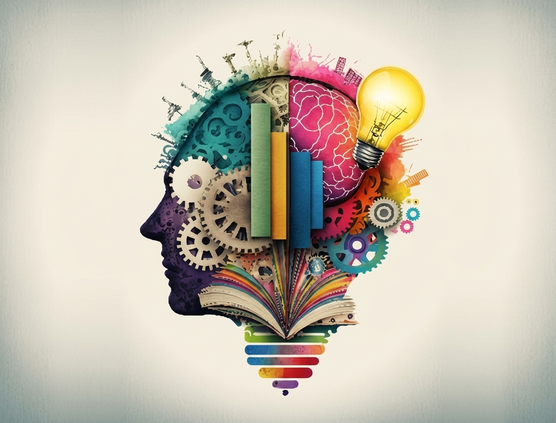
The dependence that the careless use of these tools can cause in researchers serves as a warning that technology should be used with caution (Rolim et al. 2023). Research assistance mechanisms should be treated as tools, in the sense found in dictionaries: “any instrument necessary for professional practice” (Houaiss, 2024). This means that the researcher should use AI and the many opportunities that arise from it as support – an instrument to assist in the development of research that can serve as a guide.
To support this discussion, it is worth analyzing Michel Foucault’s book “Discipline and Punish”, from 1998. In one of his most emblematic works, the author reveals the intricate webs of power and social control that permeate institutional structures and shows how society is shaped by the advances achieved. In this context of social evolution, the rise of artificial intelligence in scientific research sheds light on new forms of epistemic surveillance, where algorithms and software not only facilitate data analysis, but also subtly influence the paths of knowledge.
In a report released in the last quarter of 2023 by the Brazilian Academy of Sciences (ABC), a committee of several scientists stated that the delay of the Brazilian scientific scenario in relation to AI, both in terms of incorporation and investments, is worrying and fuels the “brain drain” to other countries, which does not contribute to the development of innovation and science in Brazil. This scenario can perpetuate the country’s lack of competitiveness in the future.
Curiosity and ethics
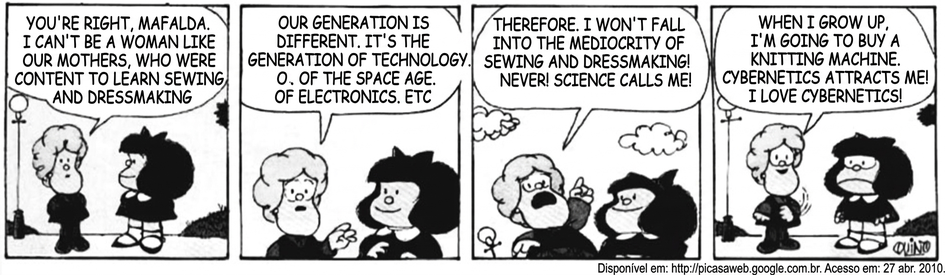
The Mafalda comic strip, reproduced in 2013 in one of the National High School Exam (ENEM) tests, about the modernization process and the life prospects of women in the professional context, illustrates the transition of values and interests that mirrors the evolution of science and technology in society itself.
Just as the character sees in cybernetics a field full of promises, artificial intelligence represents a horizon to be explored for scientific writing. By embracing these tools with curiosity and ethics, it is possible to continue expanding the frontiers of human knowledge and improving scientific communication, thus contributing to the advancement in various social spheres.
Alongside the fear that new technologies impose on some professionals and, mainly, on the autonomy and veracity of research in science, it is essential to address the practical utility of these tools and their intersection with scientific knowledge, beyond the paradigms that shape our understanding of the world (Rolim et al. 2023).
Recently, a report published in The Guardian showed that, in 2023, more than ten thousand articles in journals worldwide were subject to retractions (the English term for the act of “unpublishing” a work) due to improper and/or inadequate use of AI, linked to reasons ranging from the authorship of information to the treatment of the data presented.
Another recent fact that drew attention and caused concern in the global scientific community was mentioned by Jornal da USP, which, in February 2024, reported that an international impact journal had published an article containing incorrect information and images with errors in proportion. The journal had to retract it three days later.
The case drew attention due to the gross and elementary errors in the images, opening a discussion about the ethical and editorial aspects of the case, since, to be approved, the article went through a series of evaluative stages. After all, what is the responsibility that editors have over publications? Monitor and parameterize the way AI is used or punish, portraying the published articles?
Recent cases such as those reported by The Guardian and Jornal da USP highlight the urgency of discussing the establishment of rigorous criteria for the use of AI in scientific production. Accountability from both editors and authors is crucial, not only in validating and verifying AI-generated content but also in maintaining the integrity and quality of publications.
The choice of these tools should not be merely technical; it must be based on theories that can contribute to the production of knowledge in an ethical manner and respecting the guidelines of each journal (Rolim et al. 2023). The breaks in paradigms epistemological from the questions that human beings build are positive and even assist in the composition of scientific revolutions, guiding the way studies are conceived (Kuhn, 1998). But the transformation can and should be gradual, so as not to cause damage to the balance of an entire system. The figure below shows tips on the thoughtful use of artificial intelligence, as a tool to aid research.
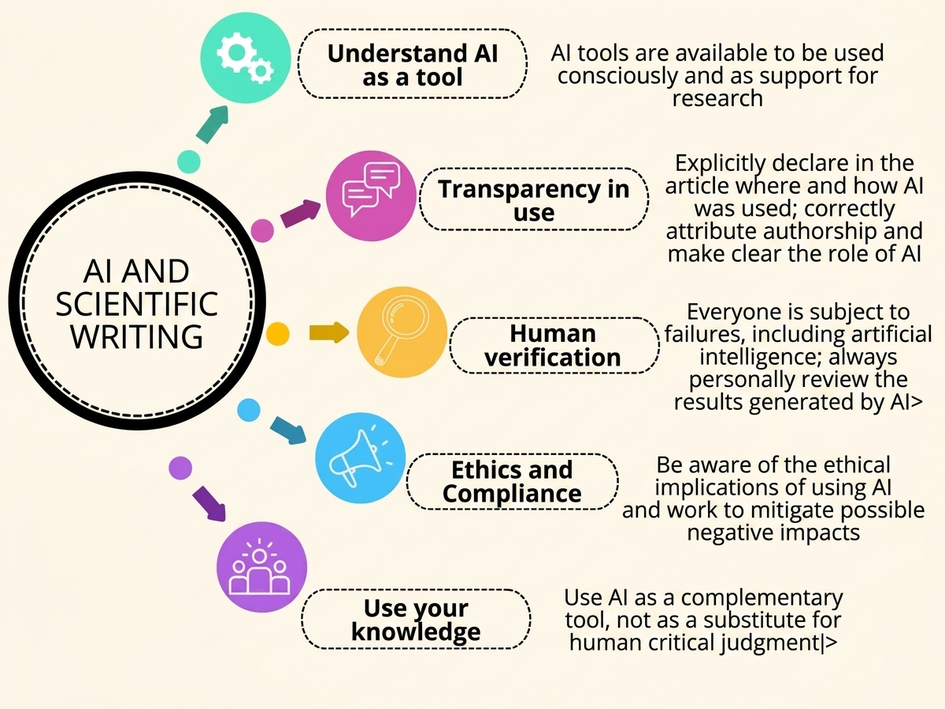
The table above is an example of using artificial intelligence as a tool. The figure was created with the help of software for layout development and for the elaboration of the points mentioned, and its content was adapted by the author based on prior knowledge. The intention here in presenting AI as an aid for the development of a study was to try to elucidate the practical functionalities of these tools and to problematize the broader ramifications of their use for the production and dissemination of scientific knowledge.
Just as Foucault outlined the mechanisms of power that shape social institutions, contemporary researchers face the challenge of understanding how research software and AI tools adapt not only to scientific practice but also to the very structures of knowledge and coexistence, as mentioned in the Mafalda comic strip. After all, knowledge and the use of AI must be collaborative, following ethical and normative patterns of science and aiming for quality scientific production.
| To access the references of this text click here |
This content was produced by:

Luiz Eduardo Giovanelli
Assistant Editor of the Strategies and Solutions Journal. Master’s student in Administration from the University of São Paulo. Specialist in Public Management from the State University of Ponta Grossa and graduate in Administration from the State University of Northern Paraná.
Who wrote this column
Editora Pecege