April 23, 2024
Paths of knowledge: the importance of organization in scientific research
A clear project with the entire process detailed avoids possible distortions and detours

“What is not certain, nor ever will be / What cannot be fixed, nor ever will be”. This excerpt from the song “Que Será (À Flor da Terra)”, from 1976, composed by Chico Buarque, invites reflection on the journey of life and refers to the importance of experiencing it with wisdom and flexibility. The uncertainties, inherent in the paths that personal choices trace, advance to the various areas of knowledge construction.
These reflections on existence, time, the past, and the future are also important when exploring new possibilities in science. As in verses that question the uncertainties of the journey, there are few certainties for those who begin a research.
The research process is a construction. The structured development of the study is the foundation that guarantees the reproduction of reliable and significant data, which, in turn, aids the reader’s understanding. The quality of any study, whether scientific, academic, or market research, depends largely on how the work is presented.
By precisely and organizedly outlining a research, researchers not only ensure the credibility of their results, but also facilitate the understanding and interpretation of the findings by the target audience. Clarity at this point is of utmost importance so that the author does not get lost in the adversities of the path, just as it echoes the song that is the premise of this text (read more about clarity in the last column of Editora Pecege, via the link (https://cms.revistaes.com.br/colunas/onde-esta-a-clareza/).
Cooper and Schindler (2003) emphasize, in their book on administration methods and research, that this path must be based on a clear project with the entire detailed process, with the main intention of avoiding possible distortions and deviations from the route.
In this sense, the authors also address that the strategies must be based on the basic stages of research formulation; therefore, it is important to have a timeline for each action, starting from the choice of research tools to be used, so that the author has control of the variables that may occur during the execution.
Understanding these variables involves choosing which types of text the researcher intends to focus on. To delve deeper into this subject, read the first column of Editora Pecege, which addresses the importance of scientific knowledge and the differences between scientific articles and technical-scientific articles (https://cms.revistaes.com.br/coluna/produzindo-ciencia-gerando-conhecimento/).
Up to this point, it should have become clear that knowing the target audience and having a well-defined structure from the beginning of the research are important points for the success of any study. The figure below shows how this process can be structured:
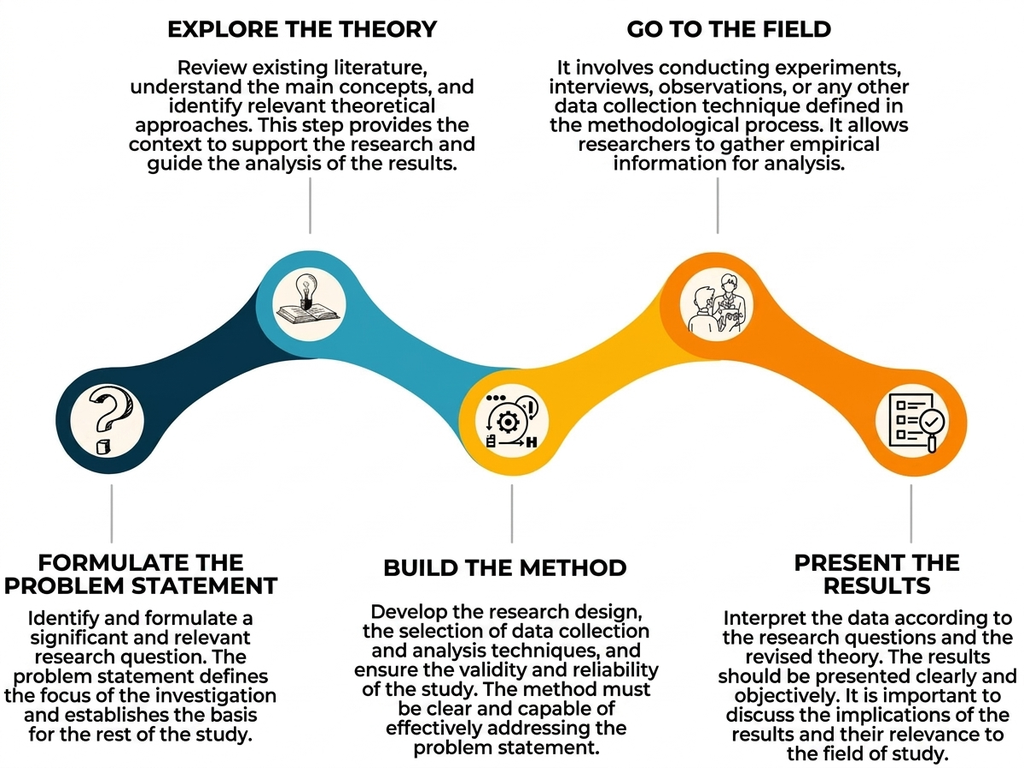
Source: Elaborated by the author from Volpato (2015) and Cyrino (2019).
Structuring the project appropriately not only helps to avoid distortions and deviations during the process, but also aids in overcoming the difficulties inherent in the journey of scientific research, as described by Volpato in his “Practical Guide to Scientific Writing”, from 2015. One of the main difficulties faced by researchers is the development of a work plan that reconciles a topic with the need for clarity and organization. This task can be especially challenging given the uncertainties that permeate the research process, requiring researchers to have critical analysis, flexibility, and adaptation skills. The following guide helps to understand how research can be structured in an effective manner, highlighting the importance of each component in producing high-quality data.
- Title
A short and informative description of the article’s content. Something concise and precise, that clearly represents the work. Volpato (2015) emphasizes that the title is the article’s hook and should address the main concepts listed in the research.
- Summary and abstract
A brief summary of the main topics of the work: objectives, methods, results, and conclusions of the study. Present in a summarized form the essence of the work (Volpato, 2015), generally between 100 and 250 characters. The summary must be in the language of the text, accompanied by the abstract, which is the English translation of this excerpt. It is common to prepare this text last, as it will contain the main information from each section of the work, from the objective to the results.
- Keywords
The abstract must be accompanied by keywords. These are the main words that guide the article. For the publication and subsequent citation of articles in journals, the adequate choice of these terms is important, so that the texts are captured in the journals’ search engines and reach their main readers (Garcia, Gattaz and Gattaz, 2019). In general, between three and five words are sufficient.
- Introduction
It is in this section that the author presents the research path to the reader and draws attention to the topic. The topic should contain the main information that led to the choice of the theme (Cyrino, 2019). In this part, it is important to bring data from current and reliable sources to contextualize the hypothesis and/or objective (example: IBGE, UN, WHO, IPCA, among other indicators and governmental sources); from there it is possible to elaborate the justification of the work to lead to the research problem.
REMINDER: good study must have a clear problem to be solved. Once established, it helps to outline the general objective and any specific objectives that will help answer the central problem of the article.
- State of the art survey/literature review/theoretical framework
This section, which has various nomenclatures depending on the work’s structure, concerns all the intellectual and literary context existing on the subject. In some types of texts, such as technical-scientific ones, the literature base should be presented together with the introduction. Cooper and Schindler (2003) argue that for a project to be recognized, it is necessary to know and use a vast bibliography on the subject matter.
In this section, the study’s contextualization structure should be built, aiming for an in-depth analysis of the topic, seeking possible gaps and/or contributions regarding what has been established in the literature. It is worth remembering that the literature must be present throughout the development of the text for the contextualization of the subject and validation of the adopted methodology, which should also be represented by references on the subject.
- Materials and methods/methodology
In this part, the researcher must provide a detailed description of the methods and procedures used to conduct the study, including information about the research design, samples, materials, and instruments used. This section should present the path your research will take, the methodological tools that were used, who and how many people/companies were studied. Here you should outline the task schedule, evidencing how the work was conducted.
In his book “Secrets and Tricks of Research”, Becker (2008) emphasizes that the methodological basis of a research plays a crucial role in ensuring the quality and credibility of the results. The author assesses that it is essential for researchers to identify the most appropriate methods for collecting and analyzing the data needed to answer their research questions. This may involve a variety of techniques, from interviews and observations to complex statistical analyses, depending on the nature of the research problem and the available data.
- Results and data analysis/discussion
In this section, the main contributions and results of the study should be presented as clearly and concisely as possible. Generally, this data is accompanied by tables, graphs, or figures, and the author can validate or refute variables, process the collected data and information, and detail the research findings.
Cyrino (2019) highlights that, depending on the text format and the chosen publication vehicle, the results and discussion can be presented in a combined and interleaved manner. This involves sharing the research findings according to the methods employed, while simultaneously discussing and interpreting the data, bringing the author’s grounded reflections.
In some journals and papers, it is recommended to separate these two sections. Therefore, it is crucial to study the journal before submitting a text for publication, in order to understand its specific guidelines.
- Conclusion/final considerations
The main findings of the study should appear in this section of the article, in addition to the author’s impressions regarding the study’s implications for the research field and recommendations for future research that may revisit the main points of the study. It is in this section that the contributions brought by the work’s results should be presented, in addition to answering the objective proposed by the research.
- References
The references section is responsible for the credibility and validation of academic work. It is not just a formality, but rather an essential part of the research process, demonstrating the theoretical and methodological basis used by the author.
Each journal has its specificities for citing references. ABNT, APA, and Vancouver are some of the main standards used to formulate citations. It is interesting to investigate the parameters of the chosen journal before submitting the article for publication and, then, adapt the text to the required standards and models (Cyrino, 2019).
Just like the journey of life, the construction of a scientific article is permeated by uncertainties, challenges, and discoveries. In the same way that Chico Buarque’s verses invite us to reflect on the paths we take, the preparation for writing a scientific article calls the researcher to experience the trajectory of scientific research with wisdom and structuring. We hope this text helps you tread a clearer path for your studies!
| To access the references of this text click here. |
This content was produced by:

Luiz Eduardo Giovanelli
Assistant Editor of the Strategies and Solutions Journal. Master’s student in Administration from the University of São Paulo. Specialist in Public Management from the State University of Ponta Grossa and graduate in Administration from the State University of Northern Paraná.
Who wrote this column
Editora Pecege