Technology
July 31, 2026
The world through a systemic lens
From software to social relations, how analyzing systems helps to understand complex problems

The word “system” is part of our vocabulary and appears frequently in services and activities related to technology. The association is understandable: digital systems are present at work, in studies, in shopping, in communication, in travel, and in entertainment. Often, we only realize how much they are part of our routine when one of them stops working. But the word is much older than computers.
“System” comes from the Latin systema, derived from the Greek sýstēma, which already carried the idea of gathered and organized elements. Before being associated with software, the term already referred to parts that, by relating to each other, form a unit. A system, therefore, is not just a set of things, but what arises from the relationships between them.
It is easy to understand why technology adopted this word. A computer depends on the integration between physical and digital components. Each part has specific functions, but it is the relationship between them that allows the whole to function and fulfill its purpose.
But the main relationship of systems with technology does not come solely from this analogy. In the first half of the 20th century, the expression systems engineering began to consolidate at Bell Telephone Laboratories to describe technological projects formed by different components, interfaces, and specialties. Systems engineering emerged from the need to integrate these parts and track the whole from problem definition to operation, even before the expansion of digital computers.
Despite its proximity to technology, General Systems Theory was born in biology. Still in the first half of the 20th century, Ludwig von Bertalanffy questioned explanations that treated living organisms as simple sets of independent parts. Knowing each component was not enough to understand how an organism stayed alive. It was necessary to observe how these parts organized themselves, influenced each other, and exchanged with the environment.
For Bertalanffy, organisms could not be reduced to isolated parts. They functioned through the relations between their parts and constant exchanges with the environment, which made them open systems. They received matter and energy, transformed resources, responded to the environment, and continuously reorganized themselves. Their stability did not come from the absence of change, but from the ability to change without losing their organization.
This approach helped consolidate the idea that complex phenomena are not understood solely by analyzing their parts, but also by the relationships that produce the behavior of the whole. Perhaps this is one of the most interesting characteristics of systems: some of them remain precisely because they are in transformation.
Elements of a system
To understand a system, it is not enough to identify its constituent parts. It is also necessary to observe its relationships, rules, flows, purpose, boundaries, and exchanges with the environment. These aspects help explain how the whole functions and why, at times, it stops functioning.
A disassembled bicycle still contains wheels, handlebars, pedals, chain, and all other parts. Still, it loses the ability to transport someone. The movement does not belong to an isolated component. It arises from the way the parts are organized and function together. This capability, present in the whole but not in the separate parts, is called emergent property. It is not an element of the system, but a result of its organization.
Therefore, identifying the parts is only the first step. It is also necessary to observe the relationships between them. On a bicycle, the pedals move the chain, which transfers force to the wheel. A change in any part can affect the others and prevent the assembly from producing the expected result.
Another aspect is purpose, that is, the result that guides the organization of the system. In a bicycle, the parts are assembled to allow movement. Purpose and emergent property, however, are not the same thing. Purpose represents what is expected from the system. Emergent property arises from the relationships between its parts and can generate planned or unexpected results.
The systems also have flows. The relationships show how the parts connect, while the flows indicate what circulates between them. In a bicycle, the cyclist’s effort is transmitted by the system until it is converted into displacement. In other systems, information, resources, materials, decisions, or people can circulate. When these flows are interrupted, concentrated, or delayed, the behavior of the whole changes.
Other important aspects are the rules, the limits, the exchanges with the environment, and the feedback loops. The rules condition the functioning of the parts. The limits define what will be considered part of the system. The exchanges show how it receives external influences and modifies the environment. Feedback loops, on the other hand, occur when the effects of an action return to the system and influence its subsequent movements. The bicycle is used in the comic book “The Cartoon Guide to System Dynamics,” by Professor João Arantes, to explain system dynamics concepts in a visual and accessible way.
Understanding a system, therefore, is not just listing its parts. It is observing how they relate to each other, what circulates between them, what purpose guides their organization, what rules condition their functioning, and what behaviors emerge from the whole. The parts matter, but it is the structure between them that helps explain the system.
Important conceptual adjustment: **the outcome does not need to appear as an element of the system**. It is a consequence of its functioning. The central elements that were missing in the development were rules, environment, and exchanges with the environment. Stocks and delays are also important in system dynamics, but can be left for a more in-depth explanation.
Interactions, causes and consequences
On a bicycle, the relationship between cause and consequence seems direct: the cyclist pedals and the bicycle moves forward. The action produces a close, visible, and almost immediate result. Not all systems respond this way. In complex systems, a consequence may appear long after the initial action, result from multiple causes, be reinforced by other interactions, or return to the starting point. It is also possible for two events to be related without one necessarily being the cause of the other.
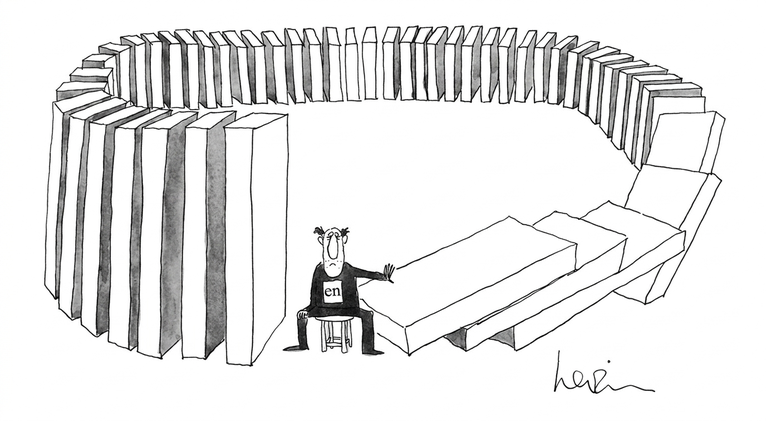
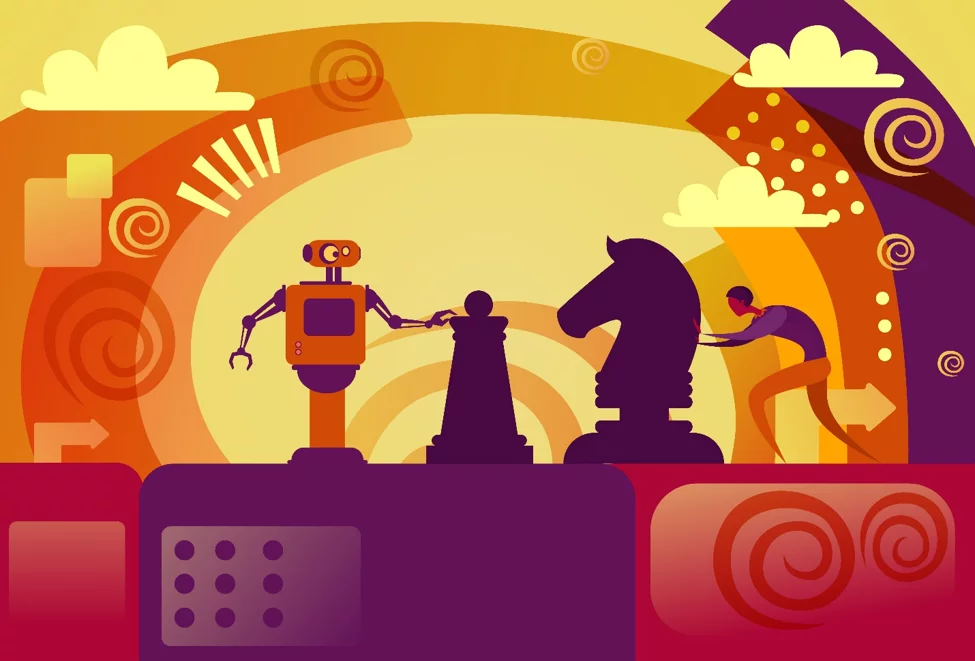
In the illustration, a man has just pushed one of the large pieces of the sequence without realizing that he also occupies the path of the movement he initiated. For the observer of the scene, the consequence seems evident. For the character, however, the action may have seemed small and localized. The effect only returns after traversing the entire structure.
Throughout life, we learn to recognize direct relationships between actions and outcomes. In complex systems, such as society, this relationship is less evident. People interpret rules, respond to incentives, change their behavior, and influence each other. Therefore, a decision can produce indirect, delayed, and different effects than planned.
The German sociologist Niklas Luhmann took systems theory to the study of society. In the book “Social Systems”, published in 1984, he argued that communication keeps social systems functioning. Thus, education, economy, law, and politics can be understood as networks of communication that organize and transform themselves over time. In this view, communication occupies a central role in the structure of social systems.
On a smaller social scale, we can observe a team. It may bring together creative professionals without producing good ideas collectively. The group’s creativity depends not only on individual capabilities but also on communication, trust, diversity of repertoires, power relations, and the way decisions are made. Therefore, the relationships between its members can produce results different from the defined objectives.
Systemic thinking
If systems are present in technologies, organizations, and social relations, understanding their functioning is not a competence restricted to specialists. We are also part of the systems we observe and are affected by the rules, decisions, and relationships that organize them.
Thinking systemically is to look beyond the immediate event. It means investigating the relationships that produced a result, the factors that reinforced it, the time needed for its effects to appear, and the consequences that may return to the system itself. This does not mean predicting everything or postponing decisions until all reality is known. Complex systems preserve uncertainties. Systemic thinking seeks to qualify the analysis before the action.
The Future of Jobs Report 2025, by the World Economic Forum, indicates that systemic thinking should gain relevance by 2030. The report links this demand to the advancement of artificial intelligence, data processing, robotics, and autonomous systems, which make work decisions and relationships more complex.
Understanding systems holistically expands our ability to deal with complex problems. Instead of acting only on the most visible symptom, it allows us to analyze relationships, rules, flows, and consequences before proposing a solution.
I have a degree in Systems Analysis and Development, one of the higher technology courses with the greatest presence in Brazil. In 2023, the course registered 285,310 enrollments, according to the Inep Higher Education Census. This training helped me develop skills that go beyond the technical field. The very name of the course anticipates an important sequence. First, analyze. Then, develop. Before creating a solution, it is necessary to understand the parts that will be connected, the rules that can be modified, the behaviors that will be stimulated, and the effects that may arise beyond the interface.
This logic is not limited to technology. Analyzing before developing also means better understanding a process before reorganizing it, a team before changing its structure, or a policy before putting it into practice. The more automated and interdependent work environments become, the greater the value of those who can see the whole, and not just execute one of its parts.
| To access the references of this text click here |
Who wrote this column
Lucas Tangi