Agribusiness
Innovation
Technology
October 02, 2024
The ABCs and the MVP
In a build-measure-learn cycle, agtechs can act leanly for the rapid development of solutions
Innovation is a fundamental concept for economic and social development, especially for agribusiness. It involves the creation and implementation of new ideas, processes, products or services that generate value for organizations and society as a whole.

In agriculture, innovation can occur in various areas, from the production of inputs to the development of machinery, software, and platforms to boost productivity and to operate the commercialization of products.
Whether through soil reading with sensors, the release of biological pesticides by drones, weather forecasting via applications, or traceability by blockchain, agro startups emerge as a source of innovation, optimizing operational routines and bringing impacts ranging from the reduction of costs to the improvement of resource use, providing greater assertiveness in decision-making.
However, along with the benefit of this technological package comes the risk of needing to test and learn quickly, with greater tolerance for error – a mindset not very common in agriculture. Producing in this sector involves risk (climate, exchange rates, prices, etc.), but not all producers have the appetite and financial resources to risk testing new technologies.
Startups operate under conditions of uncertainty and need initial partners to validate ideas and share risks. It seems that here we find a link that places agtechs, the agro startups, and farms working side by side, in an open innovation model, with field operations to grow and persevere.
Furthermore, the technical/scientific knowledge of startups needs to be validated with the practical experience of rural producers for trajectory adjustments and feedbacks, which allow for insights and can become a source of revenue in the form of a minimum viable product, the MVP.
A MVP is a simplified version of a product or service that allows testing its viability in the market with the minimum possible investment and effort. By launching an MVP, startups can receive customer feedback and validate their hypotheses quickly and efficiently before investing significant resources in the development of a product final. In a build-measure-learn cycle, agtechs can act leanly for the rapid development of solutions, considering MVPs, the user experience and the interfaces with which they will have to interact. Basically, it’s learning by doing, kneading clay and listening to those who will use the final product within the farm gates.
Through the MVP approach, a solution is developed in short cycles, in which constant user feedback allows for adjustments in development, the inclusion of new features (features), and the overall direction.
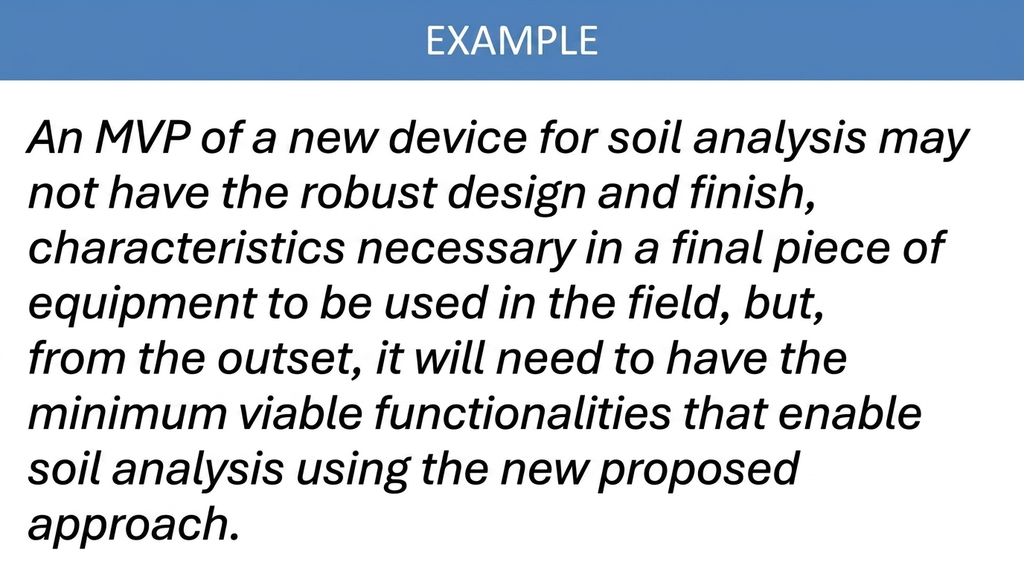
However, unlike a traditional approach, where the product will only be ready and available to the market at the end of an entire development cycle, in the MVP the minimum functionality is already available for use from the beginning in a production environment, and the feedback from users is captured and applied throughout the development.
Besides the MVP, other common practices in the context of co-development with startups include conducting proofs of concept (PoC) and pilot projects to validate the effectiveness of new technologies under real operational conditions. Although agricultural technologies require more time for validation, these practices allow companies to test more quickly, reduce innovation-related risks, and increase their chances of success and scaled implementation. The following section provides a practical example.
| Instead of hiring a new technological solution for its entire productive area and disbursing a large amount of capital, a producer or breeder could carry out a PoC of a given technology or an MVP; |
| The PoC must be carried out in a specific period, in a limited area of the property (a plot instead of the farm) or in a batch of animals (units instead of the herd). The PoC aims to test the concept of the solution, to evaluate the results and the technical and financial viability of consumption of what is proposed; |
| From the PoC, the experimentation may proceed to a pilot project, with defined technical hypotheses and premises for a longer period and, eventually, larger areas or plots for the solution’s application; |
| In pilot projects, there is the possibility of co-creating new solutions based on what technology developers previously did not know or did not see as an opportunity, due to not having applied the solution in a rural context or in a different agricultural culture; |
| During the pilot project, the producer can provide feedback for test trajectory adjustments, discuss scenarios for scaling up implementation with the technology partner, evaluate the business model and financial viability for contracting, or even make technical comparisons with other market solutions; |
| In certain situations where the pilot project does not proceed as planned in terms of outcome, even after feedback for trajectory adjustments, it will be better to interrupt the experiment even without success; |
| It is not easy to deal with failure in a rural operation, but the learning generated from experimentation will be very useful to continue addressing the problem, regardless of the solution; |
| Testing quickly, failing quickly, and learning quickly is still more advantageous than investing a lot of time and money in certain projects. This mitigates risks and allows experimentation and learning about new technologies. |
Although this “ABC” can help, it is important for each rural producer to understand their management moment and know what resources they have available and which innovation ecosystem partner networks can support their journey in seeking and experimenting with new technologies.
Another good practice, which also serves as relevant advice for those about to test new technologies, is to conduct a market survey (benchmark) to talk to other rural producers and active clients of the technology developer and compare impressions about the user experience and results achieved. With more information from those who have tested or already use a new product or service, it is possible to better direct PoCs and pilots, avoid errors already identified, and advance learning from a point of difficulty that has been overcome by other users in real situations.
| To access the references of this text click here |
Who wrote this column
Ricardo Campo