Sustainability
August 28, 2026
How sustainability is redesigning data centers
Digital economy meets physical limits and tries to reduce its environmental impact
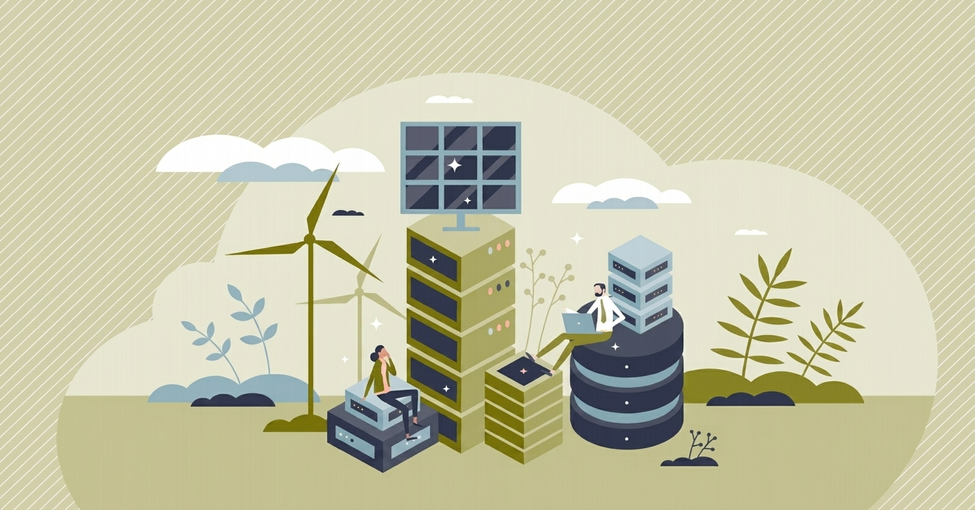
The accelerated growth of digital infrastructure transforms energy consumption, water availability, cooling, construction materials, and location into central variables for the design of the next generation of data centers.
For much of the digital transformation, the perception consolidated that computing was progressively becoming immaterial. The expression “cloud” contributed to this perception. However, the more digital the economy becomes, the greater the physical infrastructure needed to sustain it.
Behind every remotely hosted service are servers, processors, storage systems, communication networks, electrical substations, redundant power systems, and large cooling structures operating continuously.
This infrastructure consumes electricity, produces heat, uses water directly or indirectly, and relies on large quantities of concrete, steel, electronic components, and equipment with relatively short replacement cycles.
The scale of this process begins to alter the very way data centers are designed. Sustainability, in this context, gradually ceases to represent merely a corporate goal or an indicator used in ESG reports and begins to function as a concrete engineering constraint.
The infrastructure ceased to be invisible
The scale of the problem is first apparent in the consumption of electricity. The International Energy Agency updated its projections in 2026 and estimates that data centers consumed approximately 485 TWh of electricity worldwide in 2025. By 2030, this figure could reach about 950 TWh, practically double in just five years, equivalent to about 3% of global electricity demand. The projected growth is close to 15% per year, more than four times higher than the growth in electricity consumption of other sectors considered together (IEA, 2026).
The number is relevant not only for its magnitude. Data centers do not distribute this demand uniformly across the territory. Large facilities concentrate tens or hundreds of megawatts at specific points in the electrical grid, which requires simultaneous availability of generation, transmission, transformation, and distribution. A region may have sufficient energy in aggregate terms and still lack the necessary infrastructure to quickly connect new ventures of this scale.
The IEA itself projects that the electricity generation needed to supply data centers will increase from approximately 460 TWh in 2024 to over 1,000 TWh in 2030. Renewable sources are expected to account for almost half of the additional growth, but natural gas, coal, and progressively, nuclear power also appear in the projected expansion. Therefore, increasing the internal efficiency of the facilities does not eliminate the discussion about how this electricity will be produced (IEA, 2025).
This distinction between efficiency and absolute consumption is fundamental. A modern data center can perform much more processing using each kilowatt-hour more efficiently and, even so, increase its total consumption if its computational capacity grows at an even faster pace.
Company numbers
The companies’ own numbers show this evolution. Google reports that its global data center fleet presented an average PUE of 1.09 in 2025 — Power Usage Effectiveness relates all energy consumed by a facility to that effectively used by information technology equipment. An ideal value would be 1.0. According to the company, the average observed among participants in the Uptime Institute’s global survey in 2025 was 1.54. Google also claims to have delivered, in 2025, more than three times the computational capacity per unit of energy it could offer five years earlier (Google, 2026).
AWS exhibits similar behavior. In 2025, its data centers registered an average global PUE of 1.14, compared to 1.15 the previous year. These are significant gains considering the scale of operations, but they coexist with an infrastructure that continues to expand rapidly (AWS, 2026).
The conclusion is less intuitive than it seems: efficiency is necessary, but no longer sufficient. Sustainable architecture needs to simultaneously manage capacity growth, energy origin, network limits, and the amount of resources required for each additional unit of processing.
Efficiency, water and heat: the project is changing
The change becomes particularly visible in cooling. Almost all electricity consumed by computational components ends up converted into heat. As the power concentrated in servers increases, so does the amount of thermal energy that needs to be removed from relatively small spaces.
For decades, a large part of this problem was solved by cooling the environment and circulating large volumes of air through the equipment. The increase in computational density is beginning to change this logic. Instead of removing heat after it spreads through the cabinet and the environment, new architectures bring the cooling system closer to the component that produces this heat.
It is in this context that the use of direct liquid cooling in chips is growing. So-called cold plates allow liquid to circulate through structures installed next to the processors, removing thermal energy directly from the source. The consequence is not just a change in the equipment responsible for air conditioning. The physical design needs to incorporate new piping, pumps, heat exchangers, sensors, redundant systems, hydraulic distribution, and racks prepared for significantly higher densities.
The water then becomes part of the discussion in a more complex way. Evaporative systems can provide energetically efficient cooling, but they consume water. Dry or mechanical systems reduce water consumption, but may demand more electricity under certain climatic conditions. The sustainable solution does not consist simply in eliminating one of these variables, but in designing the system considering simultaneously water, energy, external temperature, and local characteristics.
Microsoft’s recent evolution illustrates this shift. Since August 2024, the company’s new proprietary projects have begun to incorporate an architecture based on closed-loop cooling. The liquid circulates continuously between servers and chillers, avoiding the evaporation used in traditional systems. The first projects of this type began to be implemented in 2026 and are expected to become operational from 2027. The company itself acknowledges that replacing evaporative cooling may lead to a nominal increase in electricity consumption, which is why this change needs to be combined with direct-on-chip cooling and operation at higher temperatures (Microsoft, 2024).
In June 2026, Microsoft reported that approximately 90% of its owned fleet operated with low or no water consumption cooling systems, depending on climatic conditions. The company also began to adopt designs capable of operating without water consumption for cooling evaporation, using closed circuits directly associated with computational components (Microsoft, 2026).
At AWS, Water Usage Effectiveness, an indicator that relates water withdrawal volume to computational load, reached 0.12 liters per kWh in 2025, compared to 0.15 in 2024 and with an accumulated reduction of 52% compared to 2021. In the region encompassing Central and South America, the company reported a WUE of 0.09 L/kWh in 2025, down from 0.23 recorded the previous year (AWS, 2026).
This data shows that sustainability is beginning to modify the very architecture thermal of computing. Instead of a relatively uniform cooling model, an infrastructure emerges adapted to the climate, water availability, server density, and energy profile of each region.
The concrete, the energy, and the address
The environmental impact of a data center, however, does not begin when the servers are turned on. Concrete, steel, cables, electrical equipment, and electronic components also generate emissions embedded in construction. Microsoft has already built its first data centers in Northern Virginia using a hybrid structure made of cross-laminated timber, steel, and concrete. According to the company’s estimates, the solution can reduce embodied carbon by about 35% compared to conventional steel construction and by 65% compared to typical precast concrete structures (Microsoft, 2025).
AWS has begun incorporating lower-carbon intensity materials at scale. By 2025, the company reported having built 39 data centers with lower-emission concrete and 33 with lower-emission steel. AWS also maintains programs for the recovery, repair, reuse, and recycling of equipment taken out of operation, seeking to extend the lifecycle of components before their replacement (AWS, 2026).
This expands the concept of sustainable architecture. It is not just about energy efficiency, but about considering the carbon footprint of the building, the origin of materials, the life cycle of equipment and its possibility of repair, reuse, and recycling.
The address also ceases to be just a real estate decision. Energy availability, transmission line capacity, climate, water availability, supply of low-carbon sources, and the possibility of integration with other infrastructures now directly influence the location of new developments.
This integration can transform even the heat produced by servers into a usable resource. In June 2026, 14 European industrial associations agreed to develop, together with the European Commission, a model for integration between data center operators, energy companies, and public authorities. One of the possibilities foreseen is to use the residual heat produced by data centers in urban heating systems, avoiding its simple dissipation into the environment (European Commission, 2026).
Regulation is beginning to catch up with this change. The European Union’s Energy Efficiency Directive has established monitoring and reporting obligations for data centers with a power demand exceeding 500 kW. The Commission is also preparing a classification system that considers not only energy efficiency but also water efficiency, clean energy use, waste heat recovery, and flexible operation capacity in relation to the electrical grid (European Commission, 2026).
A data center ceases to be considered efficient just because it presents a good PUE. The analysis now involves energy, water, embodied carbon, materials, waste, electrical flexibility, and territorial integration.
Brazil is already at the center of this transformation
In Brazil, the expansion is no longer a distant projection and already directly interferes with the planning of the electrical system. The second quarterly review of load forecasts for 2026 to 2030, released by ONS, EPE, and CCEE on August 7, 2026, presented an expressive change in estimates related to data centers.
The projection considers an average load of 315 MW in 2026, reaching an average of 5,653 MW in 2030. Between the first and second reviews conducted in 2026 alone, the estimate for 2030 increased by an average of 2,196 MW. In the base consulted in July, there were 27 access contracts already signed, 30 requests with a favorable access opinion, and another 21 requests still under analysis, the latter not yet even incorporated into the projection. The highest concentration of new loads occurs in the Southeast/Midwest, Northeast, and South subsystems (ONS; EPE; CCEE, 2026).
The speed of this review may be as significant as the final number itself. In a few months, planning had to incorporate more than 2 GW average additional for 2030. This shows that the discussion about data centers has already reached sufficient dimension to modify forecasts national of demand and electrical infrastructure planning.
There is also a strategic opportunity. The high presence of renewable sources in the Brazilian electricity system makes the country potentially attractive for operations interested in reducing emissions associated with energy consumption. The Brazilian Artificial Intelligence Plan itself allocated R$ 500 million to the Pró-Infra IA Sustentável program, focused on the development of infrastructure and data centers with sustainability-related requirements (Siqueira, 2025).
This advantage, however, does not eliminate local impacts. Renewable electricity still requires generation and transmission. Water resources are unevenly distributed across the territory. Lines and substations have physical limits. Large undertakings can significantly modify the demand of a given region even when the national system presents favorable conditions in aggregate terms.
This concern has already formally entered the Brazilian environmental agenda. In June 2026, the National Environment Council approved motion nº 147, which points out the need for national guidelines and socio-environmental safeguards specific to the licensing of data centers. The document explicitly mentions intense consumption of energy and water, greenhouse gas emissions, electronic waste, territorial pressure, and possible conflicts over access to natural resources (Conama, 2026).
The Brazilian discussion, therefore, should not be limited to the quantity of ventures the country can attract. The most relevant problem is to define where these data centers will be installed, how they will be connected to the electrical system, what cooling technology they will use, what their water demand will be, what materials will be employed, and how the accumulated impacts will be evaluated.
The next generation of digital infrastructure tends to be very different from that responsible for the first expansion of cloud computing. Liquid cooling directly on components, closed water circuits, systems capable of adapting consumption to network conditions, low-carbon energy sources, storage, low-carbon sources, equipment reuse, and heat recovery are gradually moving from isolated experiments to structural design decisions.
This also alters the sector’s economic logic. Energy efficiency reduces operational costs. Lower water consumption reduces exposure to local restrictions. Electrical flexibility facilitates integration with congested grids. Lower-carbon intensity materials reduce the embodied footprint of new developments. Recovery and reuse systems decrease waste and dependence on new raw materials. Sustainability therefore ceases to represent merely a reputational requirement and begins to interfere with the technical and economic viability of these facilities.
The growth of the digital economy will hardly be interrupted. The challenge will be to prevent the physical infrastructure needed to sustain it from growing with the same intensity in resource consumption and environmental impact. For many years, the abstraction of the “cloud” has made digital infrastructure seem distant from traditional physical limitations. The current expansion shows precisely the opposite. The future of data centers will be conditioned by energy, water, materials, electrical grids, climate, and territory. The most important evolution of this infrastructure may not only be in the processors installed inside the buildings, but in how these buildings will be designed to continue increasing their capacity without making the very growth they need to sustain environmentally unviable.
| To access the references of this text click here |
Who wrote this column
Maurício Acconcia Dias