Software Development
Innovation
Technology
May 19, 2025
How AI drives software development
Improper use of technology, without the due technical knowledge, can compromise the quality, security, and sustainability of the developed solutions

Artificial intelligence (AI) has become vital in the world of technology, and this also applies to those who create computer programs and applications. AI is no longer a passing fad but has consolidated itself as a force that enhances the development of software. Through advanced techniques such as machine learning (machine learning), natural language processing (NLP), and computer vision, AI expands the possibilities of innovation, optimizing everything from the conception stage to the maintenance and update phases.
This text explores how the strategic application of AI, made with knowledge grounded, can result in more modern, efficient software aligned with the needs of the contemporary market, which is constantly transforming. Also, the dangers associated with the inadequate use of this type of technology, without proper technical knowledge, will be addressed, as this can compromise the quality, security, and sustainability of the developed solutions.
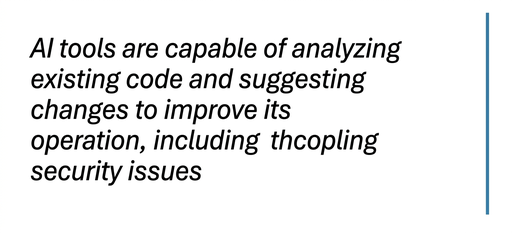
One of the areas where AI can help the most is in the creation and automatic refinement of code. Programs that learn from many code examples can help developers write repetitive parts, get ideas on how to program better, and even find points where the program might be slow. AI-powered tools can analyze existing code and suggest changes to improve its performance, including security aspects. This frees developers from manual and repetitive work, allowing them to focus on the overall structure of the program.
Another important application of artificial intelligence is in the detection of failures and the automation of tests in software systems. Intelligent algorithms can identify recurring error patterns, allowing for the creation of more comprehensive and efficient tests, including finding problems that might go unnoticed in human-made tests. Furthermore, AI can analyze error logs to quickly detect the cause of issues, optimizing the debugging and failure correction process.
The first phase of software conception — understanding what the client wants and writing down what the program needs to do — can also be improved with AI. Natural language processing techniques can be used to analyze documents with client requests and find ambiguous, contradictory or incomplete passages, ensuring that the demand is clear to all parties involved. Artificial intelligence can also assist the development team in prioritizing activities, considering the potential benefits and risks associated with each initiative.
Furthermore, AI analyzes data from old projects to predict problems, such as delays or extra expenses, and more accurately estimate the time and effort required at each stage of the projects, making planning more assertive and optimizing resources.
Technique
Even with the great potential of artificial intelligence in optimizing software development, it is very important that the developer has experience in code production, as they will need in-depth knowledge to find specific solutions for certain problems or to understand, supervise, and adapt solutions created by AI. Therefore, developers and software engineers need to be able to:
- Choosing the most appropriate AI tools and application methods: not all software problems are the same, nor do all AI tools help in the same way. Knowing which algorithm, which technique, or which tool to use at each moment is crucial for good results;
- Prepare and analyze data to “teach” AI: the efficiency of the artificial intelligence tool depends on the quality and relevance of the data used in its training. Professionals with technical knowledge must be able to collect, process, organize, and adequately analyze this data, so that the AI learns correctly and can apply this knowledge in new contexts;
- Understanding and verifying AI suggestions: AI tools provide various types of information, which must be critically checked according to the project’s objectives. It is necessary to understand how the software works to identify solutions that are effective and safe.
- Include AI in development: the use of AI does not replace the work that the IT professional was already doing. It is essential that the developer knows how to integrate artificial intelligence tools into their current activities, ensuring efficient synergy with other existing processes and tools.
- Monitor AI models: artificial intelligence tools can become outdated due to changes in data or demands. Therefore, it is important to constantly monitor their performance and make adjustments or new training when necessary.
Risks
If AI is used in software development by people without technical knowledge, it may harm the quality, security, and efficiency of managing any changes that may be necessary in the future.
AI tools that generate code without the supervision and review of experienced developers can cause the infiltration of errors security flaws into programs and result in code that does not work well or is susceptible to attacks, problems often difficult to trace.
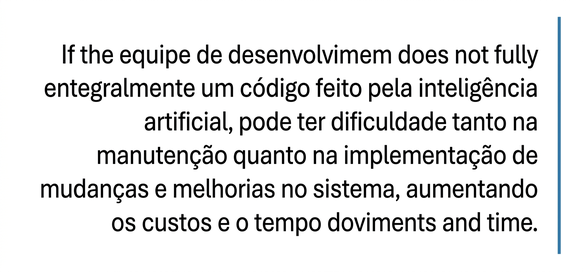
Furthermore, if the development team does not fully understand code generated by artificial intelligence, they may have difficulty both in maintenance and in implementing changes and improvements to the system, increasing costs and development time.
Improvements in one part of the program have the potential to harm others, so if the development team does not understand all aspects and consequences of an improvement in the code suggested by the AI, performance problems and the system’s ability to handle many users in the future may arise, for example.
Regarding security, while AI helps in locating failures, it can cause the paralysis of other important practices. Furthermore, a poorly trained AI can generate code with new security flaws or ignore already established rules.
Finally, it is important to know that AI can contain biases if the data used to train it presents these biases. This can lead to unexpected or unfair behavior in the software. And, as some AI models function as “black boxes”, it can be difficult to understand the reasons for their decisions, which makes it difficult to correct possible biases.
Conclusion
Artificial intelligence is a powerful tool that can change the way software is made, making work faster and programs better, while also facilitating the implementation of innovations. From helping to write and improve code to intelligently testing programs and understanding what customers need, AI has the potential to transform every step of development.
However, it is essential to remember that, to succeed, development teams need to have a lot of technical knowledge and experience. Using AI without care and experience can bring more problems than solutions, harming the quality, security, and adaptability of the software in the future.
Therefore, the best way to make the most of AI in software development is to combine machine intelligence with human knowledge and experience. Investing in the training and development of AI technical skills for IT professionals is fundamental to ensure that this powerful technology is used effectively and responsibly, paving the way for a future with more innovative and high quality software.
This content was produced by:

Cesar Soares Stenico
Systems developer, graduated in Computer Science and holds an MBA in Digital Business. Works on building web applications, with a strong enthusiasm for new technologies, blockchain systems, and software engineering. With an innovative profile, constantly seeks to apply modern and efficient solutions in systems development.
Who wrote this column
Skylar