Agribusiness
Innovation
Technology
February 11, 2025
Innovation in the trenches of the field
It is important to understand the producer’s needs, concerns, and any restrictions to ensure the success of innovative solutions
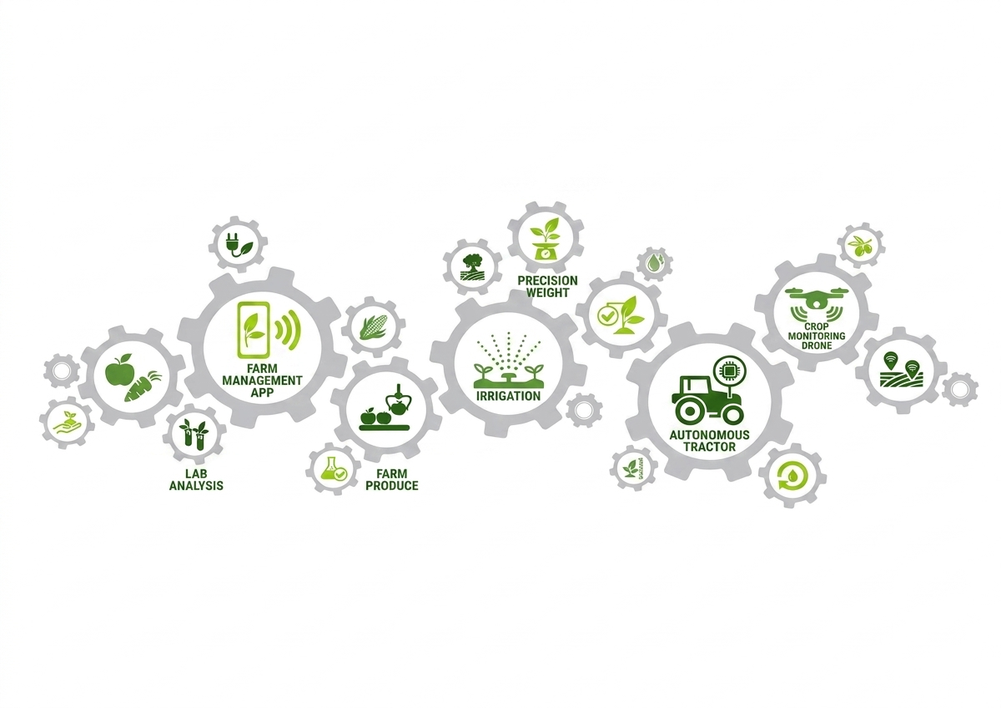
Engaging in agriculture is not an easy mission: it involves producing without certainty of results and facing risks related to climate and pests, in addition to price and exchange rate variations, input costs, and the macroeconomic context. The current scenario also imposes an additional challenge on producers, with global pressure for production in compliance with socio-environmental best practices, which is transparent and traceable by consumers — increasingly engaged and connected.
The innovations developer, whether in startups or technology development centers, must have business acumen to find market opportunities and empathy to understand the difficulties of those working in agriculture. Furthermore, they need to comprehend the different types of agricultural clients, know the access channels to this audience, and recognize the challenges that producers face in adopting technologies in the field.
Certainly, rural producers are the main users and beneficiaries of digital technologies in the agricultural sector. Therefore, it is important to understand their needs, concerns, and any restrictions to ensure the success of an innovation. But, in a country that is continental and multicultural, it is important to remember that there are multiple profiles of producers in Brazil.
According to the latest IBGE Agricultural Census (2017), there are about 15 million people employed in agricultural activities in the country. With this in mind and considering the type of agricultural crop, the production region, and the scale (family farming, large-scale, or agribusiness), it is necessary to adapt the approach for the different needs and perceptions regarding technology adoption.
It is also necessary to take into account the possibility of using intermediate channels, which play a fundamental role in the relationship with producers and end-users, since the agricultural chain is extensive and fragmented. Among them we can mention cooperatives, input resellers, machinery dealerships, technical consultants, sectoral entities, and regional associations.
In addition to being a means of market access and scale generation, these organizations can potentially support the testing of new technologies with partner producers who have a more suitable profile for technology adoption, as well as structuring a commercial approach by combining the innovative solution with offers that are already part of their portfolio. Examples include drone spraying as a service for pesticide purchase or a package of telemetry and access to a maintenance data analysis platform linked to the acquisition of machinery.
Considering communication channels is also an essential factor for the relationship with producers. According to the 8th edition of the “ABMRA Rural Producer Habits” survey, conducted by the Brazilian Association of Rural Marketing and Agribusiness with 3,000 farmers and breeders in 15 states of the country, 94% of rural producers own a smartphone, 76% use WhatsApp for negotiations, and 74% stay updated using the internet, with 57% of respondents using the network 15 times or more per day to check the weather forecast and other information.
Not to mention the growth in the use of artificial intelligence (AI), including generative AI (GenAI), which is already used to facilitate technical-commercial interaction and recommendation with producers, via chatbots and WhatsApp. It is certain that access channels and communication channels can be key elements to support the improvement of the diffusion and adoption of technology in the rural area. But, before moving forward, a brief explanation about the concept of adopting new technologies, including those from agtechs, is worthwhile.
Known as the “Law of Diffusion of Innovation”, the adoption curve of products or technologies was formulated in 1962 by sociologist and psychology professor Everett Rogers. The concept stemmed from the consideration of how innovations are generated and spread in society, based on the assumption that innovative products are not perceived by all consumers in the same way.
The objective of this theory is to explain why some people are interested in acquiring new products and services or in adopting a certain behavior before other consumers. In this conception, consumers are differentiated into five profiles, highlighted in the graph below.
Innovation adoption curve
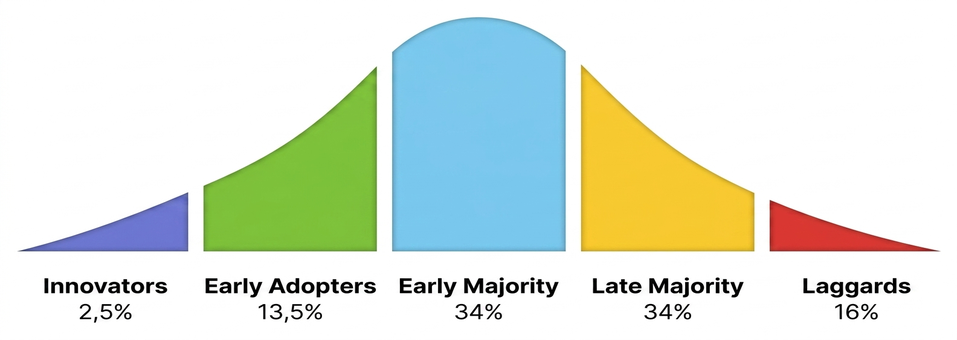
At first glance, this concept might even seem distant from agricultural reality; however, one only needs to remember that even among producers and breeders, there are innovators and early adopters who queue up to buy a new smartphone or to test drive a new drone model.
At the same time, whether due to resource limitations or resistance to change, there are laggard producers who will eventually need to learn to use new digital resources and navigate an online environment to formalize their socio-environmental compliance (as in the issuance of the CAR – Rural Environmental Registry) or to gain access to credit under better conditions (via bank apps and marketplaces).
Rural producers face a series of challenges even before thinking about validating new technologies. These are structural issues that affect the business as a whole, such as the lack of connectivity in rural areas, the limitation of incentivized financial resources for technological updates, and the lack of qualified labor to deal with the new.
Furthermore, concerns are common regarding the reliability of the generated data, the security of shared information, the behavior of new solutions installed in the operation, the cost of implementation and maintenance, and the compatibility with equipment and systems already in use in the production environment.
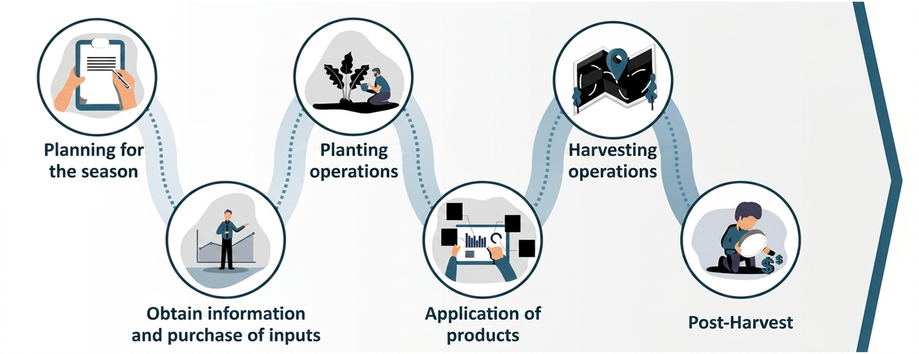
Additionally, in agriculture, technology validation cycles take longer, and the windows of opportunity in some processes are very short (preparation, planting, harvesting, breeding, restocking, etc.). Therefore, for developers interested in validating agricultural innovations, it is very opportune to take advantage of the phases already existing in the producer’s journey to initiate a digital adoption approach without overlapping routines, increasing receptiveness without burdening time and resources.
The producer’s journey
It is also common, in any process of change or adaptation to the new, to encounter resistance from employees, suppliers, and business partners, who may be accustomed to traditional methods of work and not feel secure to test something that might mean risk “in a game that is already being won”.

For these reasons, it is important to adopt an agile approach, user-centered and one that involves rural producers in the process of developing and validating technologies. After all, those on the front lines of the field know what their pains and battles are.
Using the Lean Startup approach to build, measure, and learn, experimentation and co-development with producers can happen through the execution of proofs of concept (PoCs) or pilot projects on experimental properties and areas. This approach allows for feedback directly from end users, and not just from property owners, which can enrich the process.
Continuous iteration and feedback from users of a new solution enable contributions to the improvement of innovations, especially in terms of user experience (UX) and user interface (UI).
There is no perfect formula for the success of technological innovation development in agribusiness. To increase the chances of winning the battle of technological adoption in agriculture, it is necessary to leave the development bench, get your boots dirty, talk and listen to those on the front of production.
If it were necessary to synthesize what could be a good path for this journey, the summary should highlight that it is fundamental to understand the diverse profiles of producers, to take advantage of intermediate channels to help generate scale, to use communication tools that “speak” to people in the field, and to ensure the involvement of end-users (and not just those who pay the bill) in the process of developing and validating technologies.
Finally, and no less importantly, better than a far-fetched solution is to adopt a user-centered approach, involving producers in the co-development and experimentation of innovations, to ensure they are effective and adequate fortheir reality. After all, even if an innovative idea stands on its own, it also needs to be capable of overcoming the difficulties of real agriculture and of adapting to unforeseen events that may arise.
| To access the references of this text click here |
Who wrote this column
Ricardo Campo