
Business
September 02, 2025
Retail product offering for people with restrictive diets
Authors: Amanda Melo de Siqueira and Flávio Henrique Mendes
DOI: 10.22167/2675-6528-2024071
E&S 2025, 6: e2024071
In recent years, there has been a significant increase in the demand for food intended for audiences with dietary restrictions, such as individuals with allergies, intolerances, or specific health and lifestyle preferences. This shift has driven the transformation of the retail sector and generated opportunities for the development of new business models linked to the restrictive eating niche[1].
The growth in consumption of healthier products has fostered the consolidation of the market known as free from — an expression that, translated from English, means “free of” certain potentially allergenic or undesirable ingredients, such as gluten, lactose, sugar, fat, eggs, soy, peanuts, and seafood[2]. This trend intensified after the approval, in 2013, of the gluten free seal by the Food and Drug Administration (FDA) — the agency responsible for overseeing the safety of products marketed in the United States — which enhanced the need for adequate labeling and transparency in food composition[3].
In 2023, according to the report “Panorama do Consumo de Alimentos Saudáveis no Brasil”[4], about 46% of Brazilians consumed healthy foods. Among the main reasons for this choice, health concerns stand out. Although prices represent a factor of attention, many consumers still opt to pay up to 20% more for nutritious foods compared to conventional ones[4]. In 2025, the National Health Surveillance Agency (Anvisa) received confirmation, through the Attorney General’s Office (AGU)[5], as the competent body for food labeling, which favored its technical role and guaranteed greater legal certainty in the sector.
Beyond the health benefits, offering products with this profile adds value to retail brands, especially those that demonstrate a commitment to food inclusion. Supermarkets that invest in options geared towards audiences with this type of diet are better evaluated by consumers and show greater potential for loyalty[6].
Given this circumstance, the present study aimed to analyze how retail chains in the northern zone of São Paulo offer products related to restricted diets, with an evaluation of price and perceived quality, considering the communication strategies these chains use on social media.
Initially, a literature review was conducted, as it is an exploratory research, characterized by understanding a specific phenomenon or question with theoretical or practical relevance in a still little-known field of study[7]. For this purpose, the multiple case study technique[8] was used, a research method that employs qualitative data obtained from real situations to understand phenomena in specific contexts[9].
Four retail units were analyzed, whose identities were preserved for ethical reasons: supermarket A, supermarket B, supermarket C, and supermarket D. In each case, the following were considered: i) availability, ii) price ranges, and iii) communication strategies on social media, such as Facebook and Instagram. The choice of supermarkets was based on convenience, using criteria (Table 1) such as the authors’ access (travel feasibility) and the fact that they are retailers with products aimed at the public with dietary restrictions (lactose-free, gluten-free, organic, diet, light, sugar-free, and vegan).
Table 1. Research methodological procedures
| Criterion | Description |
| Selection criterion for supermarkets | Convenience selection, based on authors’ access and network size, characterized as high-traffic neighborhood supermarkets |
| Access and locality | Easy access by public transport. Retailers A, C, and D are located in residential neighborhoods, while B is situated between residential and commercial areas. |
| Data recording method | Carried out through notes on a mobile phone and photographs obtained during in-person visits |
| Analyzed variables | Price range, quantity and variety of brands, internal signage of sectors and digital communication (Instagram and Facebook) |
| Organization and systematization | Data organized by supermarket and categorized according to product type: gluten-free, lactose-free, diet, organic, vegan, and dairy, with price comparisons between units |
| Audience predominance | According to data from the Brazilian Institute of Geography and Statistics (IBGE)[10], the predominant public in the analyzed neighborhoods belongs to the middle class. At Supermarket A, there is a presence of consumers from the middle and lower classes. |
| Analysis roadmap | Based on direct observation, focusing on the quantity of products, prices, and internal signage |
The study was conducted between March and April 2023, with on-site visits to each of the four retailers (A, B, C, and D). It is limited by being regional, which may not represent other retailers in the capital and in Brazil, justifying the need for further research on the topic.
The results revealed ease in finding products aimed at the audience with dietary restrictions in retailers A and B; however, difficulty was observed in the offering of these items in retailers C and D. This audience is generally served by large retailers, while hypermarkets and small markets rarely offer this product category. In parallel to this, prices tend to be higher than those of common products[11] — which can hinder access for consumers with lower purchasing power.
From the analysis of the four retailers, a difference was perceived in the product offering to the public with dietary restrictions. Supermarket A presented a larger assortment and organization, with more than 100 brands available, a wide price range, in addition to a dedicated and signposted section. On the other hand, the digital communication of free from items showed some fragility — which may reduce reach among the target audience.
In the case of Supermarket B, it showed efforts in serving this niche, with its own manufacturing and diversification in vegan and lactose-free products. Although it has accessible and structured digital channels, the volume of posts for this segment is still insufficient, which demonstrates inconsistency between the physical offering and the communication on the online platform.
Supermarket C, in turn, showed fragility in the physical organization of the store and in communication through digital channels. The scarcity revealed a small variety of brands for the selected unit — which can compromise the experience of consumers with restrictive diets. Nevertheless, social media did not present significant communication aimed at the sector, even with a good volume of followers.
Regarding Supermarket D, it showed unpreparedness in this segment. Its offering was reduced, with only 40 brands, and its online channel communication, despite being structured, did not include, in its editorial calendar, content targeted at this category, which led to a digital marketing strategy misaligned with the reality of the physical establishment.
A survey on the availability of food for people with dietary restrictions in snack bars in the downtown area of Belo Horizonte (MG) showed that, among the 72 snack bars consulted, 56 offered sugar-free products; six offered lactose-free options, and only one offered gluten-free products. Thus, it was also found that these establishments were unprepared to offer these edibles. However, an increase in this sector is projected to cater not only to the restricted public but also to those seeking a more assertive diet[12].
The price variation and the high cost of these foods among stores are other factors that can impact purchasing, which highlights a complementary challenge: economic accessibility. Many consumers have to pay more for these items[11], which exemplifies the food exclusion of part of the population with lower purchasing power.
To reinforce the divergence of values in the market, Afonso et al.[13] presented a comparison between common and gluten-free products, which indicated a 26% increase in the category of breads, cereals, pasta, flours, biscuits, and prepared foods. Such incompatibility was also confirmed by Galleazzi et al.[14], regarding the availability of gluten-free products in supermarkets in Chapecó (SC). Among the six stores visited, one did not have these items, and the prices of gluten-free products showed a variation between 51% and 103% of the average price of common items.
When comparing digital platforms, potential for growth in communication strategies is perceived, as it is a means of creating a lasting relationship with the user and can serve as a tool for educational content about healthy eating, in addition to promoting specific products and building loyalty with the audience with dietary restrictions. However, despite the growth in consumption of healthy foods in Brazil[4], retailers still face challenges in standardizing offers, integrating communication and consumer experience, and visibility in physical stores.
Supermarket A
Although the location produced some items internally, none fit the object of study. More than 100 brands present in the market were counted, with higher frequency in the gluten-free and lactose-free lines. Among the available brands were Jussara, Native, Jasmine, Natural Life, Vitao, Urbano, Wickbold, Campo Verde, and others. Tirolez, for example, is recognized in dairy derivatives, with cheeses, cream cheeses, ricotta cream, and mozzarella. Mãe Terra complements its offering in the organic line.
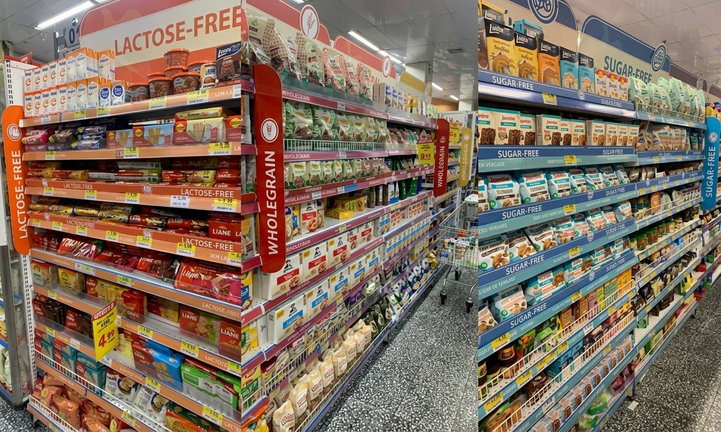
The establishment provided a wide variety of sugar-free, lactose-free, gluten-free, zero cholesterol, organic, decaffeinated, vegan, and chicken-based options for consumers who cannot ingest pork products (Figure 1).
Source: Original research results.
Price range
Beyond the product range, prices varied from R$ 2.45 to R$ 100.00. In the upper range, items such as lactose-free cheeses, generally sold in blocks, stood out; in the lower range, yogurts, milks, margarines, cream cheese, and mozzarella were found. For consumers with restrictions on pork consumption, the market offered alternatives such as plant-based vegan products, as well as chicken sausages and hot dogs.
Although they met specific demands, these foods are classified as processed and industrialized — which can also compromise health — with prices ranging from R$ 14.00 to R$ 25.00. For celiac consumers — individuals with gluten restriction — the variety of products was expressive and included cookies, breads, rice, beverages, and cake mixes. The prices of gluten-free items ranged from R$ 4.79 to R$ 43.90, reflecting the diversity and specialization of the portfolio aimed at restrictive diets.
Communication networks
Until the time of the research, Supermarket A did not use offline communication channels — such as printed flyers — to interact with its consumers. The chain’s communication strategy focused exclusively on the digital environment, with the institutional website, social networks, and WhatsApp application as the main means of contact with the public. The chain’s digital environment stood out for its visually attractive and functional proposal. The website offered fluid navigation and presented a diversified portfolio aimed at this niche, ideal for those who choose to shop without leaving home or prefer to use the “pick-up” option. The digital experience included the brand’s application or website, which expanded access and convenience and reinforced the chain’s omnichannel presence.
During the data collection period, in April 2023, the unit had 94.8 thousand followers on Instagram, with a total of 2,971 posts. The content covered diverse topics, such as recipes, promotions, exclusive benefits, tips, giveaways, and humanitarian actions. The network’s Facebook page, created on January 14, 2014, registered 164 thousand followers and 155 thousand likes, with publications replicated from Instagram, indicating a standardized content strategy across platforms.
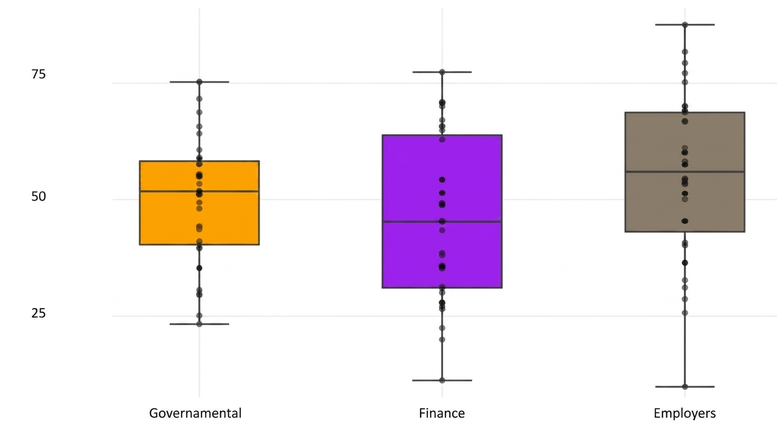
Despite the low visibility of products aimed at restrictive diets in digital channels, the supermarket offered, in its physical facilities, a significant variety of foods intended for this specific audience. Figure 2 illustrates examples of available offers, which demonstrates the attention to the demands of consumers with special dietary needs, even with limited digital media promotion.
Source: Social media/Facebook.
Supermarket B
Supermarket B presented a relatively wide range of products aimed at consumers with dietary restrictions. On the other hand, some disorganization was observed in the store’s internal layout, especially in the location of specific sections, which may hinder the shopping experience.
Although the variety is not as expressive as that found in Supermarket A, it was still possible to identify a significant presence of these products, suitable for the study profile. Just over 70 brands were counted, among which stood out: Parmalat, Mãe Terra, Fit Food, Banana Brasil, Good Soy, and Risovita, which demonstrates the unit’s effort to meet the demands of consumers in this niche.
Given this, it was noted that the network offered more lactose-free and vegan products, mainly from the Mãe Terra brand. However, compared to Supermarket A, the number of options from a given brand was still lower. A differential of this supermarket is its own production available in organic and vegan products.
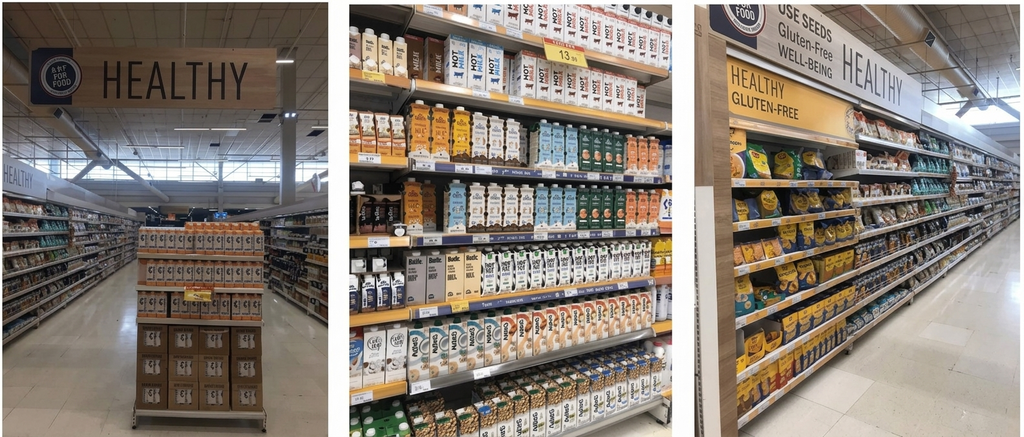
Despite there being a dedicated section for healthy products (Figure 3), the indication of its location was not very visible, depending on which side the consumer entered the store. Some items were displayed on other shelves in the market, outside their specific section. On social media, the brand primarily highlighted its own manufactured products.
Source: Original research results.
Price range
Supermarket B presented competitive prices compared to Supermarket A, mainly in categories focused on restrictive diets. Products such as lactose-free milk or plant-based alternatives were sold at prices ranging from R$ 5.59 to R$ 45.59. For the celiac public, the price range varied from R$ 2.59 to R$ 33.49, which included items such as gluten-free breads, cookies, flours, and pastas.
It was observed that the availability and complexity of goods varied according to the network unit, which can directly impact the shopping experience and the effectiveness of the consumer’s search for specific items. In general, the price difference between supermarkets A and B was not significant; however, there were occasional variations, such as in the lactose-free cheese category, where Supermarket B might not have the entire line informed on the website at the time of physical purchase.
This inconsistency between channels suggests the need for alignment between inventory and digital communication to better meet consumer expectations.
Communication networks
The network’s digital presence is concentrated exclusively in the online environment and is strategically consolidated. Digital platforms are not limited to displaying products; they function as channels for consumer relationship, offering practicality, information, and consumption stimulus. The frequent dissemination of recipes, promotions, and interactive content reveals a communication proposal that goes beyond simple sales and promotes a more engaging and personalized experience.
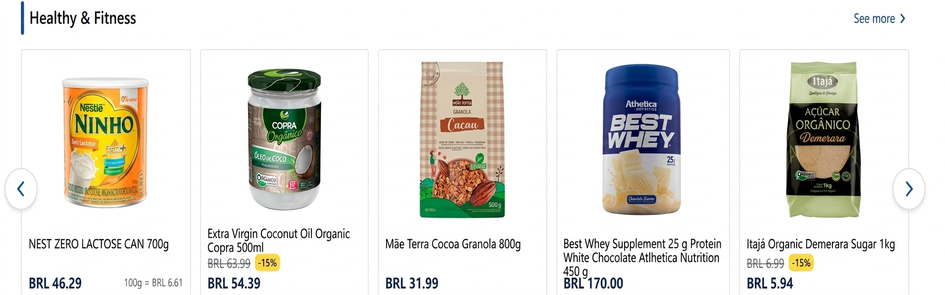
Upon accessing the website, the consumer finds an intuitive navigation, with well-defined tabs that facilitate product search. The “buy online and pick up in store” functionality, or alternatively, the delivery option expands the possibilities of accessing desired items and allows for catering to different consumption profiles. On the “Market” tab, current offers are displayed, and as the user scrolls down the page, participating products appear in an organized and visually accessible manner (Figure 4), which strengthens the link between digital convenience and commercial attractiveness.
Source: Supermarket website.
On social media, the performance presented interesting nuances. The Instagram profile, created on March 14, 2015, had 1.2 million followers and counted 1,496 posts until the analyzed period. Among these, only 31 were directed at the public with specific dietary needs, revealing a still timid presence in this segment and inferior when considering the page’s creation time — a situation that can generate negative conflict between brand and consumer. However, the network frequently promotes healthy recipes, which can be signaled as an indirect approach to this audience.
On the other hand, on Facebook, where the network has been active since April 6, 2013, the numbers are more modest: 11,000 followers and the same volume of likes as of 2023. It is important to note that content focused on the niche only began to be published in August 2020, ten years later. During 2023, the network intensified this strategy and new products aligned with the studied profile were presented, with the last identified post on November 1st of that year.
The brand’s behavior on social media shows a gradual advance in attention to specific niches, although it is evident that there is still room for editorial protagonism focused on food inclusion.
Supermarket C
Of Gaúcha origin, Supermercado C was another selected chain. A limitation is observed in the variety of brands available in the store, which indicates a reduced portfolio compared to other establishments analyzed, as well as in relation to other units of the supermarket. The main brands found at the location were Línea, Lowçucar, Wickbold, Italac, Santa Clara, Vitao, A Tal da Castanha, Corpus, among others.
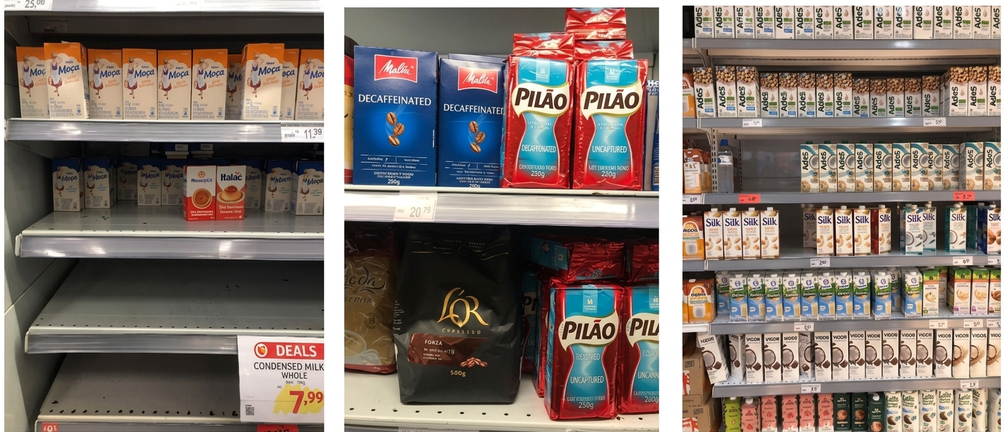
So to speak, the organization of physical space presented weaknesses, mainly in signage: there were no signs indicating sectors dedicated to healthy products, which hinders the orientation of consumers with specific needs. The presence of many shelves without restocking was observed (Figure 5) and, despite the scarcity of products, in the dairy section, there were options for lactose-free and plant-based milks.
Source: Original research results.
Price range
For the dairy line, lactose-free and plant-based milks from brands like Nestlé, Aurora, and Danone were in the range of R$ 6.00 to R$ 55.99 — the higher value corresponded to the purchase of cheese by weight. A differential for those who like sweets, such as ice cream, was the offer of three options, with prices between R$ 23.99 and R$ 47.99, all vegan.
For coffee consumers with caffeine restriction, such as Crohn’s Disease and Colitis[15] patients, there was a line of decaffeinated and sugar-free products, priced between BRL 12.49 and BRL 20.79, from the brands Melitta, Pilão, and L’OR Especiarias. For celiacs, gluten-free options were available for meal preparation, with prices ranging from BRL 6.99 to BRL 46.29, such as rice, pasta, cake mix, and flours.
Communication networks
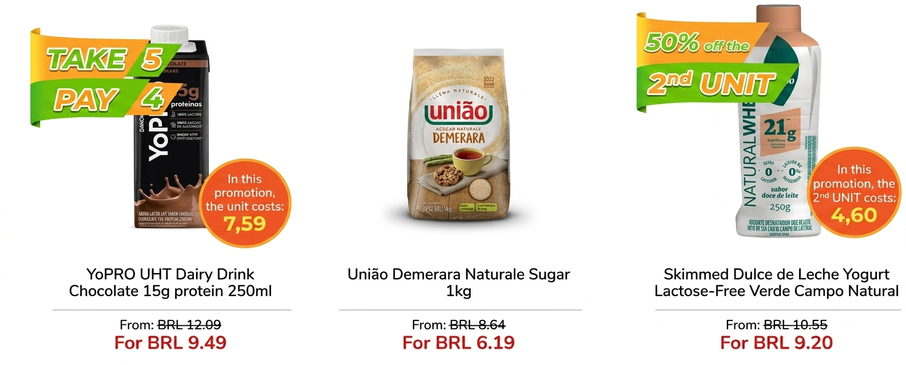
Supermarket C adopts a hybrid approach in its communication strategy, operating in both online and offline channels. However, the presence of products aimed at the study audience in physical promotional materials is quite limited — during the observation, only the promotion of organic sweetener and sugar was identified, suggesting low prioritization of this sector. On the homepage, the user can navigate through the available sections, and for the study audience, the location is found in the “Healthy” tab. Products on offer were identified, such as items from the lactose-free line (Figure 6).
Source: Market website.
Supermercado C’s digital performance showed good reach in terms of audience, but revealed limitations in directing content to audiences with specific dietary needs. On Instagram, the network had accumulated 97.7 thousand followers and 479 posts as of the analysis. However, since the profile’s creation on February 21, 2018, only eight publications were aimed at this audience, representing a minimal percentage of the total volume. The predominant content focuses on recipes and promotions through giveaways, with little emphasis on the disclosure of specialized products.
Supermarket D
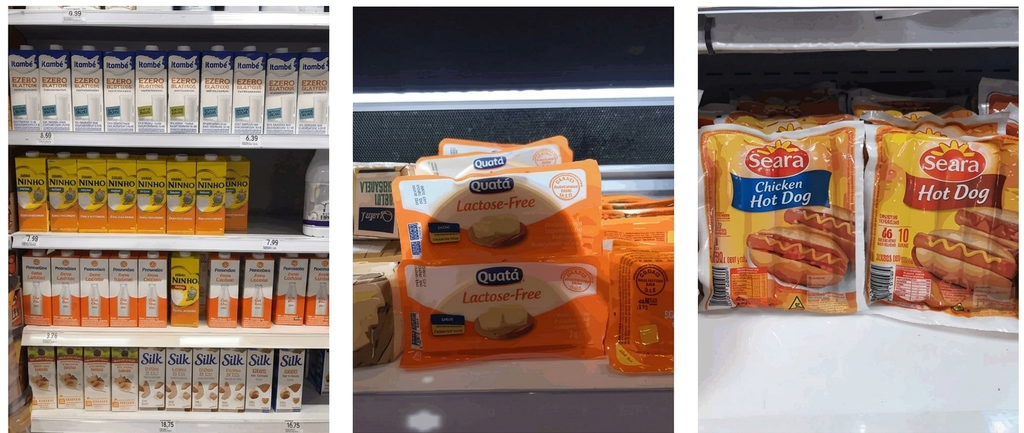
Supermercado D is part of a large national retail group, which brings together several supermarket chains and exclusive brands, such as Qualitá, Taeq, Club des Sommeliers, Finlandek, among others. During the visit to the location, a deficiency was noted in the commercialization of items related to the object of study. In total, there were 40 brands available, and in relation to the other mentioned chains, a low level of offerings was observed. Among the marketed brands were Native, Wickbold, Organic, Nature’s Health, Piracanjuba, Jussara, Campo Verde, Tirolez, among others. The establishment offered lactose-free, plant-based, and vegan products, as well as gluten-free and processed options (Figure 7).
Source: Original research results.
Still at Supermarket D, a greater presence of consolidated brands was identified, such as Nestlé, Tirolez, and Mãe Terra, with products aimed at different dietary profiles, which includes integral, organic, gluten-free, lactose-free, and no-added-sugar lines. These, albeit punctually, meet the demands of consumers with restrictions.
Price range
The network offered, in the dairy line, products with values between R$ 3.29 and R$ 26.79, which included yogurts and plant-based milks. Cheese options were in the range of R$ 29.39 to R$ 60.00. For celiacs, there was only one option, which was for the Wickbold brand, in the range of R$ 11.69 to R$ 13.99. For diabetics, it was possible to find few brand options, with values between R$ 5.19 and R$ 19.49, with products such as sweeteners, cake mixes, gelatins, and cookies.
Communication networks
Supermarket D adopts a multichannel communication strategy, with online and offline formats. Despite this, in physical communication — such as posters and in-store signage — no actions were identified aimed at the public with dietary restrictions, revealing an absence of specific targeting in this environment.
In the digital environment, the network operates through two distinct platforms: the institutional website and the Club, aimed at publicizing exclusive offers and promotions. On both homepages, users have access to navigation segmented by categories, which facilitates the location of products such as lactose-free, sugar-free, or gluten-free items. Furthermore, these options were noted to have greater visibility in the digital environments compared to the physical store.
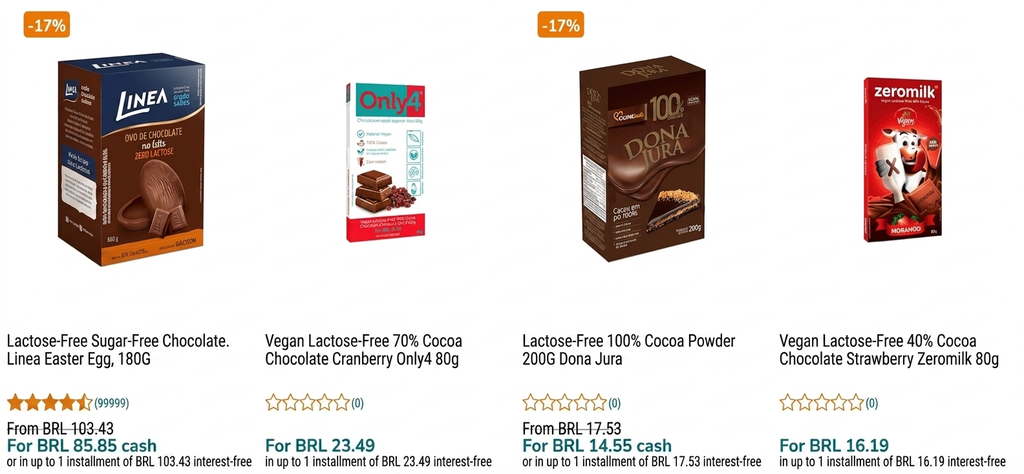
In the specific case of the Club, the platform highlights a variety of products with promotional prices aimed at the analyzed audience (Figure 8). This duality between a more structured online presence and limited offline communication evidences a more mature strategy in the digital format, but still disconnected from a complete omnichannel experience.
Source: Market website.
On social media, the network’s Instagram had 29.5 thousand followers and 555 posts as of the consultation date. On Facebook, the establishment had 3.7 thousand followers and 3.6 thousand likes. Communication between the network and its users aimed at building a good relationship was observed. However, the posts focused on recipes, commemorative dates, giveaways, tips, and products. Since the creation of Instagram on March 16, 2018, and Facebook on March 11, 2010, no information about products intended for people with dietary restrictions has been identified.
It was observed that the selected retail chains present distinct levels of maturity and readiness to serve the public with dietary restrictions. In Supermarket A, there was a highlight in the diversification and physical organization of products, while Supermarket D showed less commitment in offering for this segment. Regarding communication, none of the chains appeared prepared for a consolidated strategy in publicizing these foods, especially on social media. The lack of alignment between the digital presence and the physical operation of the establishments impacts the consumer journey and results in expectations that may not be met.
The research evidenced the existence of barriers for populations with dietary restrictions and low purchasing power, such as product scarcity and high prices. The results offer guidance for retail managers who intend to serve this niche. Layout organization, strengthening digital communication, and expanding the specialized portfolio are viable strategies to improve the shopping experience and increase loyalty.
Thus, it is recommended that future research broaden the geographical scope and address consumer opinions to understand their purchase intentions and expectations. In this context, public policies that encourage the production and commercialization of restrictive foods at lower prices become essential to ensure food equity.
REFERENCES
[1] Minaker, L.M.; Elliott, S.J.; Clarke, A. 2014. Exploring low-income families’ financial barriers to food allergy management and treatment. Journal of Allergy. 160363. https://doi.org/10.1155/2014/160363.
[2] Pinto, C.A.; Souza, B.R.; Peixoto, J.S.G.; Ishizawa, T.A. 2020. Rotulagem para alergênicos: uma avaliação dos rótulos comercializados com presença ou ausência de glúten e seus riscos inerentes à saúde dos celíacos no Brasil. Research, Society and Development. 9(6): e38963432. https://dx.doi.org/10.33448/rsd-v9i6.3432.
[3] Kamioka, G.A.; Stedefeldt, E.; Domene, S.M.A. 2013. Doença Celíaca no município de São Paulo: a disponibilidade de um mercado específico. Sociedade Brasileira de Alimentação e Nutrição. 38: 201-219.
[4] Associação de Promoção dos Orgânicos (Organis). 2023. Panorama do consumo de orgânicos no Brasil 2023. Disponível em: <https://mkt.organis.org.br/recursos/d5c60adab5c8d3925d9799e6c2cde40f/Image/Pesquisa-Nacional-Organis-2023.pdf>. Acesso em: 16 jul. 2025.
[5] Advocacia-Geral da União (AGU). 2025. Confirmada competência da Anvisa para rotular alimentos com glúten. Disponível em: <https://www.gov.br/agu/pt-br/comunicacao/noticias/confirmada-competencia-da-anvisa-para-rotular-alimentos-com-gluten>. Acesso em: 16 jul. 2025.
[6] Burden, M.; Mooney, P.D.; Blanshard, R.J.; White, W.L.; Cambray-Deakin, D.R.; Sanders, D. S. 2015. Cost and availability of gluten-free food in the UK: in store and online. Postgraduate Medical Journal. 91(1081): 622-626. http://dx.doi.org/10.1136/postgradmedj-2015-133395.
[7] Lösch, S.; Rambo, C.A.; Ferreira, J.L. 2023. A pesquisa exploratória na abordagem qualitativa em educação. Revista Ibero-Americana de Estudos em Educação. 18: e023141. https://doi.org/10.21723/riaee.v18i00.17958.
[8] Yin, R.K. 2015. Estudo de caso: planejamento e métodos. 5ed. Porto Alegre, RS, Brasil: Bookman.
[9] Creswell, J.W. 2010. Projeto de pesquisa: métodos qualitativo, quantitativo e misto. 3ed. Porto Alegre, RS, Brasil: Armed.
[10] Instituto Brasileiro de Geografia e Estatística (IBGE). 2022. Censo demográfico. Disponível em: < https://sidra.ibge.gov.br/Tabela/3170#resultado>. Acesso em: 16 jul. 2025.
[11] Capacci, S.; Leucci, A.C.; Mazzocchi, M. 2018. There is no such thing as a (gluten-) free lunch: Higher food prices and the cost for coeliac consumers. Economics & Human Biology. 30: 84-91. https://doi.org/10.1016/j.ehb.2018.06.001.
[12] Rodrigues, C.V.; Vieira, A.E.; Silva, C.A.; Amorim, M.M.A.; Gregório, E.L.; Amaral, D.A. 2019. Avaliação da disponibilidade de alimentos para pessoas com restrições alimentares em lanchonetes do hipercentro de Belo Horizonte/MG. Brazilian Journal of Development. 5(12): 28547-28562.
[13] Afonso, D.; Jorge, R.; Moreira, A.C. 2016. Alimentos com e sem glúten: análise comparativa de preços de mercado. Acta Portuguesa de Nutrição. 4: 10-16.
[14] Galleazzi, D.; Mello, E.M.; Kuhn, G.O. 2021. Disponibilidade de alimentos isentos de glúten em supermercados na cidade de Chapecó-SC. Monografia de especialização em Ciência e Tecnologia de Alimentos. Instituto Federal de Santa Catarina, Xanxerê, SC, Brasil.
[15] Organização Brasileira de Doença de Crohn e Colite (GEDIIB). 2019. Enfermagem em Doença Inflamatória Intestinal. GEDIIB, São Paulo, SP, Brasil.
COMO CITAR
Siqueira, A.M.; Mendes, F.H. 2025. Oferta de produtos no varejo para pessoas com alimentação restritiva. Revista E&S. 6: e2024071.
ABOUT THE AUTHORS
 Amanda Melo de Siqueira – Senior Digital Content Analyst. Marketing Specialist. São Paulo, SP, Brazil.
Flávio Henrique Mendes – Doctor of Science. Supervising professor. Rua Cezira Giovanoni Moretti, 580, Santa Rosa, 13414-157, Piracicaba, SP, Brazil.