
Business
May 30, 2025
Interaction between virtual influencers, digital followers, and consumer satisfaction
DOI: 10.22167/2675-6528-2025009
E&S 2025, 6: e2025009
Karen Beatriz Nascimento e João Gomes Martines Filho
The digital presence of consumers has broadened the consumption dynamic and made interactions with users, institutions, and influencers more diverse. In this context, interactive marketing gains prominence by centering the consumer, promoting engagement, loyalty, and conversions, in addition to creating a collaborative environment that improves the experience and generates valuable feedback[1,2].
In the creator economy era, where users consume content produced by other users, virtual influencers emerge as strategic marketing tools, promoting brands and products through high engagement and reach. Created by multidisciplinary teams and driven by artificial intelligence, virtual influencers win audiences, especially young ones, and form communities based on engagement and relationship. Their effectiveness depends on the perception of authenticity, reliability, and transparency, just as it happens with human digital influencers[3,4,5,6,7,8,9,10].
Corporate virtual influencers redefine brand identity and their interaction with the public, aligned with new consumption dynamics. Created by multidisciplinary teams, they offer total control over image, behavior, and narrative, adapting to different contexts. Their programmable nature favors engagement, improves the consumer experience, and expands reach to new audiences, differentiating them from human influencers[3].
Thus, this work aimed to investigate the relationship between national corporate virtual influencers and their audience on microblogging platforms, which can impact consumption. As discussed by Kaplan and Haenlein[11], microblogging involves the rapid diffusion of short and dynamic content, which favors frequent and real-time updates and immediate interaction between users. Therefore, the study also highlights attempts to reduce barriers and noise in communication from the real to the digital environment in order to change consumer perception and bring them closer to brands through the digital world.
The study’s theme aimed for a descriptive research, with the purpose of conducting a multiple case study of the relationship between the corporate virtual influencers Lu do Magalu, Nat da Natura, and CB das Casas Bahia and their audiences on the microblogging platform X. The research’s temporal scope is between March and July 2024.
The research used non-participatory observation of interactions between virtual influencers and their audience on the X platform. The study, descriptive in nature with a marketing focus, analyzed the communication between virtual influencers and consumers to understand its impact on engagement and brand relationship[12]. For this purpose, the content analysis technique according to Bardin[13] was used, a qualitative technique that allows for systematic interpretation of communicational content—written, oral, or visual—based on latent meanings present in the messages. The analysis was structured in three stages: (1) pre-analysis with non-participatory observation, screenshots, and descriptive notes; (2) categorization of interactions (social and transactional); and (3) interpretation of results. Furthermore, secondary data, documentary research, and platforms such as Social Blade[14] and Reclame Aqui[15] were employed to evaluate performance and audience satisfaction.
The selection of virtual influencers was based on a mapping on social networks, in which the X platform stood out as the main one for interaction. Influencers represented by 3D avatars showed greater impact, which guided the choice of those analyzed. Customer satisfaction evaluation was based on data from Reclame Aqui, based on reputation indices, associated with transactional interactions, and awards, influenced by voluntary votes and social engagement. Although virtual influencers do not act directly on Reclame Aqui, they mediate the first contact on social networks and WhatsApp and allow the brand to manage its communication tone.
According to Marinho et al.[16], brands adopt interactive and humanized strategies, with relevant content, active listening, and authentic personas to build consumer loyalty. Virtual influencers, supported by artificial intelligence, personalize interactions and broaden public understanding in a culturally complex digital landscape[3,17,18,19].
Chatbots and virtual influencers simulate human behaviors, personalize interactions, and strengthen bonds with the audience, which favors engagement and transmedia presence. By acting in transactional contexts, linked to purchases, and social contexts, humanizing communication, they expand engagement, boost sales, and promote brand loyalty [3,20,21].
Avatar construction
Online retail has driven the use of artificial intelligence to optimize communication. Chatbots with personalities adjusted to the audience reinforce sales and logistics, while automated avatars use adapted language and ensure their continuity via copyright[2,22]. The avatars can differ in terms of rendering, fidelity, and appearance, as demonstrated in Table 1.
Table 1. Avatar differentiation parameters
| Classification | Description |
| Rendering: a computer graphics process that generates visual representations, such as images or animations, of avatars in digital environments, based on a set of instructions. | |
| Two-dimensional (2D) | The avatar is rendered in a two-dimensional (2D) display using a 2D coordinate system, with movements limited to the horizontal and vertical plane, without depth. Examples include cartoon characters and pixel-based graphics. |
| Three-dimensional (3D) | The avatar is rendered using a three-dimensional (3D) coordinate system, allowing for greater depth and movement along three axes: vertical and horizontal, front and back, and diagonal. |
| Virtual human | This type of avatar seeks to represent a human being in a realistic manner, with high resolution and maximum quality. |
| Fidelity: characteristics of the avatar’s visual properties. | |
| Abstract | An abstract-looking avatar can be represented as a point or by means of a two-dimensional (2D) icon. |
| Low fidelity | It refers to a limited number of resources that make it difficult to distinguish one avatar from others, restricting its expressiveness and identification capacity. |
| High fidelity | It presents a greater number of features that distinguish it from other avatars, increasing its expressiveness and identification capacity. |
| Photo-realistic | Generated from the photograph of the individual controlling it, resulting in a more personalized and realistic representation. |
| Realistic | Capable of performing human actions, such as walking, running, jumping, dancing, smiling, and crying. |
| Avatar appearance: types of visual representation of a person, character, or entity in digital environments, such as in games, social networks, or virtual worlds. | |
| Human appearance (human-like) | They reflect the human appearance. Widely used in brand personas, “digital twins” of organizations and virtual worlds like Second Life. |
| Living creature | With the appearance of animals, they can represent species such as cats, dogs, birds, whales, among others. |
| Objects | They adopt a non-human and non-animal appearance, including inanimate objects, such as paper clips, refrigerators, chairs, among others. |
According to Blut et al.[26] and Mazurkiewicz-Pizlo[27], virtual assistants support customer service and purchases, while virtual influencers represent brand values, have an active presence on social media, address social issues, and expand their reach. They also promote other brands’ products, a common practice in retail.
The avatars of the corporate virtual influencers investigated present similarities regarding rendering, fidelity, and appearance, as seen in Table 2.
Table 2. Categorization of virtual influencers Lu, Nat, and CB
| Rendering | Three-dimensional: Rendered using a three-dimensional (3D) coordinate system, allowing for greater depth and movement along three axes: vertical and horizontal, front and back, and diagonal. |
| Fidelity | High fidelity: Presents a greater number of features that distinguish it from other avatars, increasing its expressiveness and identification capacity. |
| Appearance | Human appearance (“human-like”): Reflect human appearance. |
Lu from Magalu
Created in 2003 as a chatbot, Lu do Magalu evolved from a virtual assistant to a digital influencer, adopting its current design in 2014 (Figure 1). Humanized through emotions, memes, and language adapted to the platforms, she uses advanced computer graphics for realistic interactions[28].

Source: Data obtained from Magalu’s social network[29].
Nature’s Nature
Created in 2016 as a chatbot by Natura, the digital persona Nat was expanded in 2018 to represent the brand’s values and, in 2019, became the company’s “face” on X (Figure 2). On X, Nat interacts with users and virtual influencers to humanize the brand, generate identification with customers and resellers, and promote organic advertising.

Source: Data obtained from Natura’s social network[30].
CB of Casas Bahia
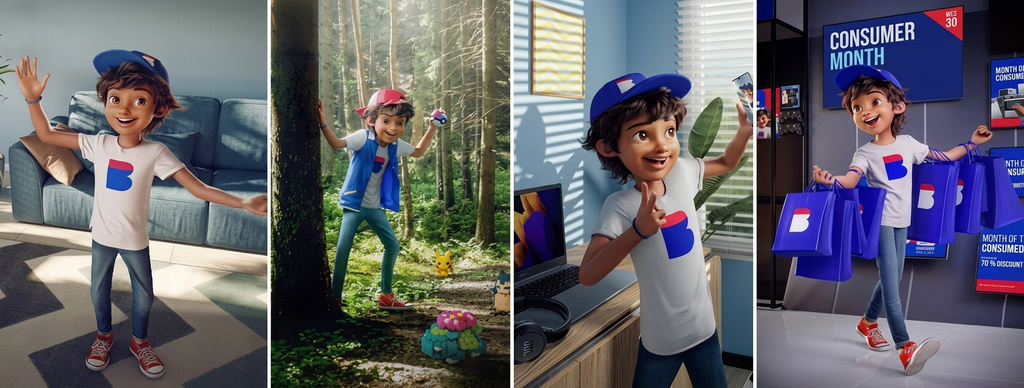
In 2020, Baianinho das Casas Bahia was transformed into the virtual influencer CB, a modern teenage version represented as a Black boy with a cap and smartphone (Figure 3). CB adopts youthful language, addresses sustainability and diversity, and strengthens the brand’s presence on social media.
Source: Data obtained from the social network of Casas Bahia[31].
Social interactions versus transactional interactions
According to Foster et al.[21], virtual influencers perform transactional and social functions, promoting shopping efficiency and consumer engagement, respectively. This duality strengthens relationships, expands brand reach, and enhances acquisition, retention, and market value.
Based on the research’s temporal scope, 567 publications were collected on the X social network. Of these, 433 originated from Magalu, 83 from Nat Natura, and 51 from CB das Casas Bahia, categorized according to Table 1.
Table 1. Categorization of posts
| Trademark | Collection period in the year 2024 | Total posts | Societal | Transactional |
| Lu from Magalu | 02/Mar. – 01/Jul. | 433 | 321 (74,13%) | 112 (25,86%) |
| Nat Natura | 04/Mar – 01/Jul. | 83 | 60 (72,28%) | 23 (27,71%) |
| CB of Casas Bahia | 01/Mar – 01/Jul | 51 | 26 (50,98%) | 25 (49,02%) |
Table 1 shows that Lu do Magalu prioritizes social interactions (74.13% of publications), standing out as an agent of emotional and symbolic connection with consumers. This relational strategy strengthens engagement, retention, and brand value, as proposed by Foster et al.[21].
Similarly, Natura’s Nat, with 83 posts and 72.29% social content, reinforces the brand’s value alignment and humanization, aspects highlighted by Mazurkiewicz-Pizlo[27] as fundamental to expanding reach and generating audience identification. Meanwhile, Casas Bahia’s CB, with 51 publications, balances social content (50.98%) and transactional content (49.02%), revealing a hybrid strategy that integrates interactive marketing with conversion objectives, a characteristic consistent with the transmedia logic described by Blut et al.[26].
These empirical data confirm that, although each influencer operates with distinct emphases, the social dimension of interactions is crucial for building lasting relationships, increasing loyalty, and strengthening brands’ digital presence, central elements in the context of the creator economy and consumption mediated by virtual influencers.
Follower retention and engagement
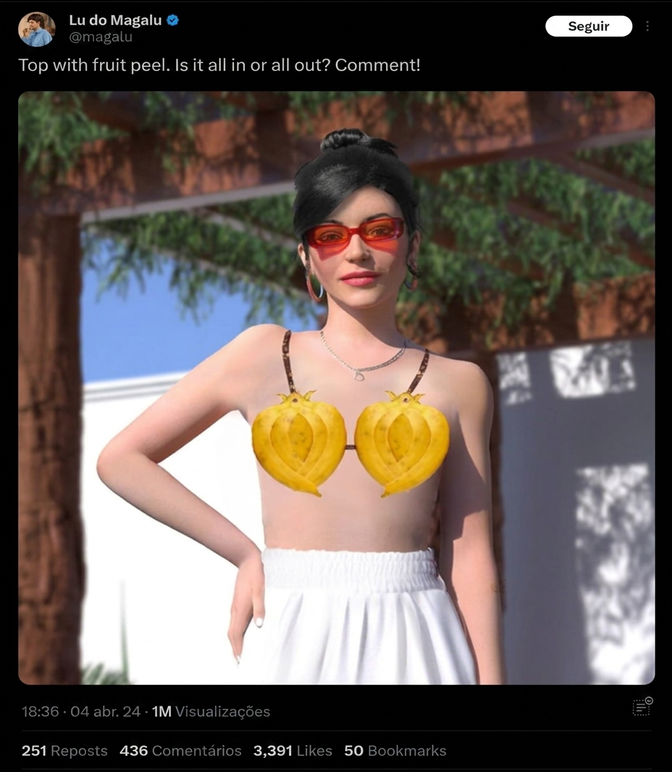
Lu do Magalu presents the highest number of followers and engagement, evidencing the success of her strategy oriented towards building bonds. In her most impactful publication — with 1.4 thousand comments, 694 reposts, 3.4 thousand likes, and over 1 million views (Figure 4) — there was a predominance of social comments among the most liked (99 out of 100). This reinforces her ability to promote symbolic and affective identification with the public, demonstrating the potential of virtual influencers in creating meaningful emotional connections.
The empirical evidence validates Foster et al.[21]‘s premise that social interactions strengthen engagement, consumer loyalty, and brand value, with virtual influencers acting as relational mediators, as exemplified by Lu’s case.
Source: Data obtained from Magalu’s social network[29].
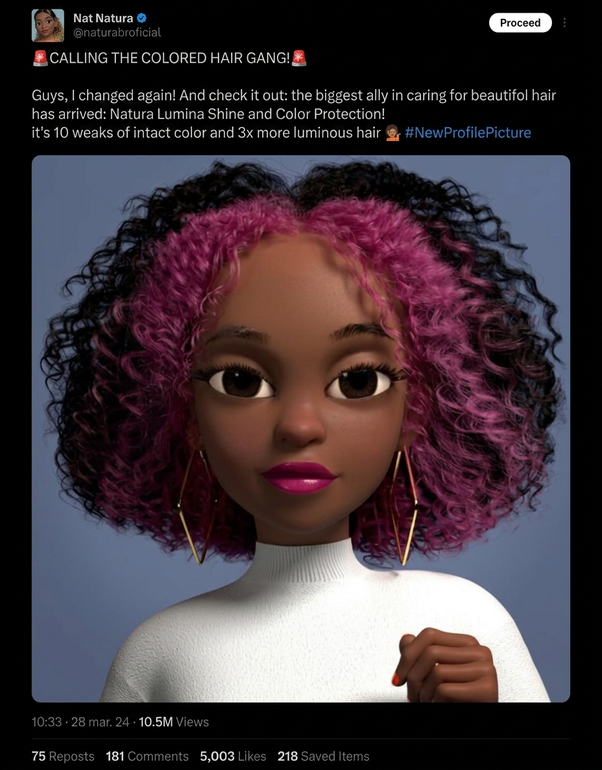
Nat da Natura’s publication with the highest engagement during the period, with 152 comments (only 6 transactional), 259 reposts, 5 thousand likes, and over 10.5 million views (Figure 5) demonstrates the effectiveness of a social content strategy that promotes meaningful interactions, organic engagement, the establishment of symbolic bonds, and the alignment of virtual influencers’ role as representatives of institutional values and promoters of identification with relevant causes and social awareness.
Nat reinforces brand trust and loyalty by adopting humanized communication, in line with Foster et al.[21], with continuous dialogue, socio-environmental issues, and affective narratives, expanding Natura’s symbolic capital in the digital environment.
Source: Data obtained from Natura’s social network[30].
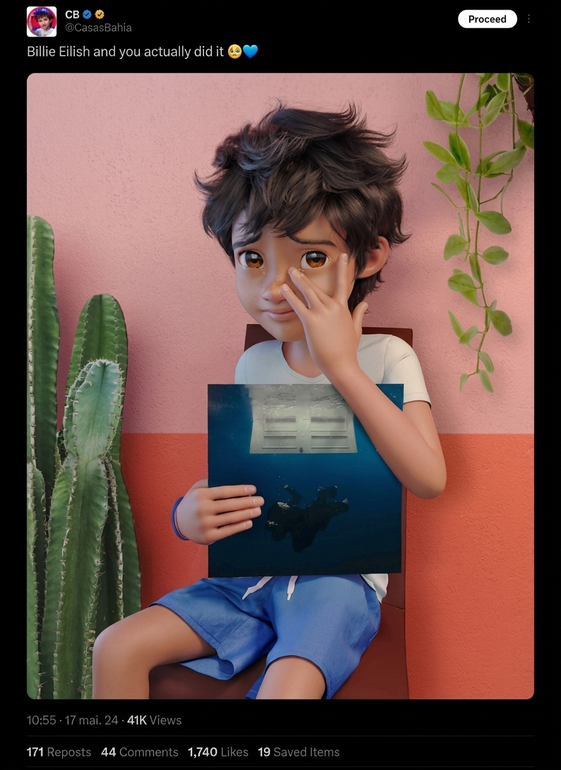
Casas Bahia’s social media account ranks third in followers and engagement among the analyzed influencers. Its most impactful publication during the period — with 32 comments (6 transactional), 221 reposts, 1.7 thousand likes, and over 40 thousand views (Figure 6) — signals the adoption of a social interaction strategy, but suggests a lower mobilization capacity compared to more established digital communities.
This capacity can vary according to the maturity of the virtual community, the symbolic identification with the influencer, and the frequency of interactions. Effective social engagement requires humanized communication through the consolidation of recurring bonds and recognition of the influencer as an authentic mediator[6].
Source: Data obtained from the Casas Bahia social network[31].
According to Social Blade[14], CB from Casas Bahia has more publications than Nat from Natura, but the lowest number of followers among the three. Lu from Magalu shows greater daily variation in followers and posts, while Nat and CB fluctuate less.
The comparative analysis of the three corporate virtual influencers reveals distinct strategies, yet centered on social interaction as a tool for engagement and brand building. Thus, it highlights the influencers’ role beyond promotion, mediating values, emotions, and bonds that strengthen communities and build consumer loyalty on social media, as indicated by studies on digital communication and relational marketing[5, 6, 10].
Tables 2 and 3 show that, despite the increase in posts during the period, there was a not very significant drop in the number of virtual influencers’ followers.
Table 2. Total publications in the period
| Period | Start (March/2024) | End (July/2024) |
| Lu from Magalu | 426.68 thousand | 442.93 thousand |
| Nat Natura | 33.91 thousand | 35.09K |
| CB of Casas Bahia | 241.79 thousand | 244.37 thousand |
Table 3. Total followers in the period
| Period | Start (March/2024) | End (July/2024) |
| Lu from Magalu | 1.35 million | 1.34 million |
| Nat Natura | 289.09 thousand | 285.64 thousand |
| CB of Casas Bahia | 213.70 thousand | 211.79k |
As shown in Table 2, Lu do Magalu showed the greatest growth in publication volume during the analyzed period, with an increase of approximately 16.25 thousand posts. In comparison, Nat da Natura and CB das Casas Bahia registered significantly smaller increases of 1.18 thousand and 2.58 thousand posts, respectively. These data reveal that the brands intensified their presence on the platform, possibly to increase their visibility and stimulate engagement.
However, the data in Table 3 point to a paradoxical trend: despite the increase in posting frequency, all analyzed brands experienced a loss of followers in the same period — Lu with a drop of 10,000, Nat with 3,450, and CB with 1,910 fewer followers. This phenomenon may indicate signs of saturation or communication fatigue, suggesting that increasing the volume of publications, in isolation, does not guarantee the maintenance of audience interest or loyalty.
The dissociation between digital presence and audience retention signals the need to review and adapt communication approaches to public expectations, as sustainable engagement demands relevant and authentic content, capable of generating symbolic value and meaningful relationships[5, 6, 10], avoiding the erosion of digital communities.
Impact on customer satisfaction
Awards and indicators from Reclame Aqui[15,32] confirm the impact of virtual influencer interactions. The awards, based on voluntary votes, can be influenced by the quality of customer service and social interactions on social media. Engagement on social media strengthens positive brand perception, reinforcing the hypothesis that relational communication and humanized automation promote consumer loyalty.
Lu do Magalu, for example, won the Reclame Aqui Award[32] in 2023 and 2024 in the e-commerce and marketplace category, in addition to earning the RA 1000 seal[33]. With a reputation of 8.3/10, 90.2% resolution rate, and 75.5% willingness to repurchase between March and August 2024[15], the brand demonstrates how the integration between automation and social content strengthens loyalty, a strategy consistent with the logic of interactive marketing and social interactions described in the study.
Nat da Natura, runner-up in its category in both editions[32], obtained a reputation of 7.9/10, with 100% of complaints answered and 72.4% repurchase rate[15]. These indicators confirm the effectiveness of approaches based on value identification, consistent with its performance in promoting social causes and emotional connection.
Despite good performance in awards[32], Casas Bahia’s CB showed a lower repurchase rate (63.8%) and consumer score (6.0), suggesting that efficiency in service (98.9% response and 84% resolution) does not guarantee loyalty[15]. The consolidation of deeper symbolic bonds, therefore, is still necessary to strengthen the relational dimension in the digital environment.
Together, the data demonstrate that the performance of corporate virtual influencers transcends reach and publication metrics: it is concretely manifested in the perception of reliability, resolution, and emotional connection with the consumer. Thus, strategies that balance operational efficiency with humanized communication prove more effective in building loyalty and consolidating reputations in the digital environment.
Challenges in social and transactional interaction
The analysis of Tables 1, 2, and 3 shows that Lu do Magalu stands out in terms of posting volume and social engagement, indicating that a higher frequency of publications is related to greater audience interaction, as pointed out by digital marketing literature. This convergence between social interaction and commercial results reinforces the role of virtual influencers in creating communities and in the effectiveness of personalized strategies, in contrast to exclusively transactional approaches, and opens up space for more in-depth studies in the area.
Despite the impact of the volume of publications, long-term success depends on the quality and relevance of the content. According to Foster et al.[21], high output does not ensure sustainable engagement without alignment with brand values and audience preferences. Social media algorithms prioritize authentic interactions and highlight the importance of balancing quantity and quality.
A common challenge for brands is follower retention, which is more costly and complex than acquisition. The volatility of user behavior, influenced by content saturation, lack of relevance, or emotional connection, requires strategies that promote continuous and value-added relationships, such as storytelling, content personalization, and direct interactions.
Relevance of virtual influencers
The transition from chatbots to virtual influencers favors more intuitive, informal, and real-time interactions and positively impacts marketing. Positive social experiences elevate customer satisfaction, even while maintaining the transactional relational base [21]. Lu and Nat stand out with hybrid strategies, while CB still faces engagement challenges.
Frequent exposure to a brand’s content increases familiarity, but follower retention remains a challenge. Nat Natura, with 72% of social posts, has a score of 7.9/10 on Reclame Aqui and 72.4% of consumers willing to do business again, while CB das Casas Bahia, with 51% of social posts, has a score of 7.6/10 and 63.8% retention. These data reinforce the importance of balancing social engagement and commercial efficiency.
This study analyzed how national corporate virtual influencers relate to the public on microblogging platforms and their impact on consumption. Metadata analysis from platform X, combined with data from Social Blade and Reclame AQUI, revealed that brands with more effective social interactions generate greater consumer satisfaction and increase the likelihood of new business.
The adoption of virtual influencers by national brands is a strategy to get closer to the public, reduce dependence on human influencers, and reinforce brand values. Developed by multidisciplinary teams, they act as spokespersons on social media and influence consumer perception. Awards such as those from Reclame AQUI and social media engagement prove their effectiveness, while evaluations show that the social interaction of these influencers directly impacts customer satisfaction and perceived value.
Future studies should analyze how consumer familiarity with the brand affects the effectiveness of virtual influencers. It is also relevant to investigate the impact of the integration between physical points of sale and virtual interactions on the perception of realism of these influencers, in addition to the effects of using visual gestures, non-verbal language, and facial expressions compared to the exclusive use of text in social and transactional interactions.
References
[1] Kotler, P.; Kartajaya, H.; Setiawan, I. 2017. Marketing 4.0. Sextante, Rio de Janeiro, RJ, Brasil.
[2] Silva, M.J.B.; Campos, P.O. 2024. Past, present, and future of avatar marketing: a systematic literature review and future research agenda. Computers in Human Behavior: Artificial Humans. 2(1): 100045. https://doi.org/10.1016/j.chbah.2024.100045.
[3] Andrade, N.A.; Rainatto, G.C.; Renovato, G. 2020. O papel dos Influenciadores Virtuais em marketing e seu processo de interações entre humanos e chatbots na economia algorítmica. International Journal of Business and Marketing 5(1): 23-35. Disponível em: https://www.ijbmkt.org/ijbmkt/article/view/154. Acesso em: 15 abr. 2025.
[4] Carvalho, G.J. 2018. Redes sociais e influenciadores digitais: Uma descrição das influências no comportamento de consumo digital. PMKT: Revista Brasileira de Pesquisas de Marketing, Opinião e Mídia 11(3): 288-299. Disponível em: 4-Redes-sociais-e-influenciadores-digitais-Uma-descric_o-das-influencias-no-comportamento-de-consumo-digital.pdf. Acesso em: 15 abr. 2025.
[5] Guerreiro, C.; Viegas, M.; Guerreiro, M. 2019. Social networks and digital influencers: Their role in customer decision journey in tourism. Journal of Spatial and Organizational Dynamics 7(3): 240-260. Disponível em: https://www.jsod-cieo.net/journal/index.php/jsod/article/view/198. Acesso em: 15 abr. 2025.
[6] Jacobsen, D.R.; Souza, F.M.S. 2023. Humanos virtuais influenciadores: gênese, características e contrapontos aos influenciadores digitais humanos. Brazilian Creative Industries Journal 3(1): 70-89. https://doi.org/10.25112/bcij.v3i1.3195.
[7] Jorge, A.; Marôpo, L.; Nunes, T. 2018. ‘I am not being sponsored to say this’: a teen youtuber and her audience negotiate branded content. Observatorio (OBS*): 76-96. https://doi.org/10.15847/obsobs0001382.
[8] Kadekova, Z.; Holienčinová, M. 2018. Influencer marketing as a modern phenomenon creating a new frontier of virtual opportunities. Communication Today 9(2): 90-104. Disponível em: https://www.researchgate.net/publication/329247338. Acesso em: 15 abr. 2025.
[9] Maden, D. 2018. The role of digital influencers in the diffusion of new products. Akdeniz Üniversitesi İletişim Fakültesi Dergisi (30): 119-141. https://doi.org/10.31123/akil.465923.
[10] Miranda, S.; Cunha, P.; Duarte, M. 2021. An integrated model of factors affecting consumer attitudes and intentions towards youtuber-generated product content. Review of Managerial Science 15(1): 55-73. https://doi.org/10.1007/s11846-019-00370-3.
[11] Kaplan, A.M.; Haenlein, M. 2011. The early bird catches the news: Nine things you should know about micro-blogging. Business Horizons 54(2): 105–113. http://dx.doi.org/10.1016/j.bushor.2010.09.004.
[12] Prodanov, C.C. 2013. Metodologia do trabalho científico: métodos e técnicas da pesquisa e do trabalho acadêmico. Editora Feevale, Novo Hamburgo, RS, Brasil. Disponível em: https://www.feevale.br/Comum/midias/0163c988-1f5d-496f-b118-a6e009a7a2f9/E-book%20Metodologia%20do%20Trabalho%20Cientifico.pdf. Acesso em: 12 maio 2025.
[13] Bardin, L. 2013. Análise de conteúdo. 5ed. Edições Brasil, São Paulo, SP.
[14] Social Blade. 2024. Analytics made easy. Disponível em: https://socialblade.com/. Acesso em: 08 mar. 2024.
[15] Reclame AQUI. 2025. Plataforma de solução de conflitos entre consumidores e empresas. Disponível em: https://www.reclameaqui.com.br/. Acesso em: 15 abr. 2025.
[16] Marinho, G.A.; Nogoceki, B. L. D. S.; Coelho, T. C. 2024. A importância da humanização da marca no mundo digital. Revista Formadores 21(2): 34-49. https://doi.org/10.25194/rf.v21i2.2119.
[17] Hawkins, D.I.; Mothersbaugh, D.L. 2019. Comportamento do consumidor: construindo a estratégia de marketing. 13ed. Elsevier, Rio de Janeiro, RJ, Brasil.
[18] Lévy, P. 1999. Cibercultura. 1ed. Editora 34, São Paulo, SP, Brasil.
[19] Maia, G.F.; Forechi, M.; Lopes, D.D.; Lopes, J.G.D.; Santos, K.N.; Pinent, M.; Amaral S.H. 2020. Comunicação e psicologia. Sagah, Porto Alegre, RS, Brasil.
[20] Albuquerque, I.V.; Vailati, A.L. 2024. Influenciadores virtuais e suas estratégias de monetização. Paradoxos 8(2): 1-18. https://doi.org/10.14393/par-v8n2-2023-71519.
[21] Foster, J.K.; McLelland, M.A.; Wallace, L.K. 2022. Brand avatars: impact of social interaction on consumer-brand relationships. Journal of Research in Interactive Marketing 16(2): 237-258. https://doi.org/10.1108/JRIM-01-2020-0007.
[22] Davlembayeva, D.; Chari, S.; Papagiannidis, S. 2024. Virtual influencers in consumer behaviour: a social influence theory perspective. British Journal of Management 36(1): 202-222. https://doi.org/10.1111/1467-8551.12839.
[23] Bao, L.; Lin, X.; Chen, Y.; Zhang, H.; Wang, S.; Zhe, X.; Kang, D.; Huang, H.; Jiang, X.; Wang, J.; Yu, D.; Zhang, Z. 2020. High-Fidelity 3D Digital Human Head Creation from RGB-D Selfies. ArXiv Cornell University. https://doi.org/10.48550/arxiv.2010.05562.
[24] Boellstorff, T. 2008. Coming of Age in Second Life: An Anthropologist Explores the Virtually Human. Princeton University Press. https://doi.org/10.2307/j.ctvc77h1s.
[25] Schlemmer, E.; Trein, D.; Oliveira, C. 2009. The Metaverse: Telepresence in 3D Avatar-Driven Digital-Virtual Worlds. @tic. revista d’innovació educativa (2): 26-32. Disponível em: https://www.redalyc.org/articulo.oa?id=349532298005. Acesso em: 15 abr. 2025.
[26] Blut, M.; Wünderlich, N.V.; Brock, C. 2024. Facilitating retail customers’ use of AI-based virtual assistants: a meta-analysis. Journal of Retailing 100(2): 293-315. https://doi.org/10.1016/j.jretai.2024.04.001.
[27] Mazurkiewicz-Pizlo, A. 2025. Virtual Influencers (VIs) As Marketing Communication Tools. European Research Studies Journal 28(1): 472-492. https://doi.org/10.35808/ersj/3955.
[28] Oliveira, D.C.; Ventura, J.B.S.; Silva, P.C. 2024. Narrativas de consumo de moda, inteligência artificial e emoções: o riso de Lu do Magalu. Organicom 21(44):133-46, São Paulo, Brasil. https://doi.org/10.11606/issn.2238-2593.organicom.2024.220272.
[29] Magalu. 2024. Lu do Magalu. Disponível em: https://x.com/magalu. Acesso em: 15 abr. 2025.
[30] Natura. 2024. Nat Natura. Disponível em: https://x.com/naturabroficial. Acesso 15 abr. 2025.
[31] Casas Bahia. 2024. CB da Casas Bahia. Disponível em: https://x.com/casasbahia. Acesso em: 15 abr. 2025.
[32] Reclame AQUI. 2025. Prêmio Reclame AQUI. Disponível em: https://www.reclameaqui.com.br/premio/. Acesso em: 15 abr. 2025.
[33] Aureliano A. 2022. Selo RA1000: Muito mais credibilidade na reputação. Blog Reclame AQUI. Disponível em: https://blog.reclameaqui.com.br/selo-ra1000-muito-mais-credibilidade-na-reputacao/. Acesso em: 15 abr. 2025.
Como citar
Nascimento, K.B.; Martines Filho, J.G. Interação entre influenciadores virtuais, seguidores digitais e a satisfação do consumidor. Revista E&S. 2025; 6: e2025009
About the authors
 Karen Beatriz Nascimento – Specialist in Digital Business from MBA USP/Esalq. Project Analyst at BRASFI. Rua Barão de Mesquita, 502, Tijuca, 20540-003, Rio de Janeiro/RJ, Brazil
João Gomes Martines Filho – Doctor in Agricultural Economics from The Ohio State University. Advisor professor of the MBA USP/Esalq and retired professor at USP/Esalq. Rua Cezira Giovanoni Moretti, 580, Santa Rosa, 13414-157, Piracicaba, São Paulo, Brazil