
Business
September 30, 2025
Experiment management in structures laboratories: implementation of project management tools
Authors: Marina Naomi Furukawa and Karoline Arguelho da Silva
DOI: 10.22167/2675-6528-2025029
E&S 2025, 6: e2025029
In the scientific scenario of solving engineering problems, theoretical and experimental methods are complementary. Studies of this nature are intended for the investigation of complex topics for which there are not yet adequate theories to solve them[1]. Historically, research in the structural area is a valuable tool of high scientific rigor, which paves the way for unraveling problems situated at the frontier of knowledge about structural mechanics and strength of materials[2].
From the perspective of the Project Management Institute (PMI), experimental programs are characterized as projects, as they constitute a finite and exclusive set of activities performed to achieve a specific objective, executed under constraints of time, budget, and human resources[3]. Normally, they follow a predictive lifecycle, as the scope is known and value is delivered at completion[4].
In contrast to the relevance of experimental analyses for the scientific scenario, Gilbert et al.[5] report the scarcity of guidelines for planning and executing structural engineering experiments. This neglect stems, in part, from the Dunning-Kruger Effect[6], which leads researchers to underestimate the complexity of managing the project and to disregard elementary planning practices, compromising cost, schedule, and quality.
These gaps manifest in the Structures Laboratory (LE), which provides services to companies and supports students. Currently, only a test plan is required, a document analogous to the Project Opening Term (TAP)[7]. The lack of standardization results in rework and ineffective communication, revealing weaknesses in the value delivery system.
Another critical point is the lack of a Work Breakdown Structure (WBS). The hierarchical decomposition recommended by PMBOK® guides the integrated monitoring of scope, time, and cost[8]. In the absence of this tool, managers and stakeholders lose reference of responsibilities, milestones, and acceptance criteria.
Given the above, this study aims to propose a new revised testing plan for service provision by the LE and the development of a standard WBS for structural engineering experiments. The proposed plan implements the Project Model Canvas (PMC) tool in the reception and management of projects by the LE. The PMC is a robust methodology, justified by its ability to facilitate planning and internal communication, without the need for costly and bureaucratic documents[9]. Furthermore, its application reduces the negative impacts associated with the LE’s current management model.
Furthermore, the development of a standard WBS aims to guide project managers, with guidelines for scenarios with few available specifications and to ensure the effective participation of stakeholders in the management and success of the experimental program.
This research focuses on investigating problems of the current management of the organization, through a case study in the structures laboratory of a public university located in São Carlos–SP, named LE in this work. The technical staff of LE is composed of five professionals, a coordinator, and a professor director of the laboratory.
The receipt and analysis of the experimental program trial plans requested by private companies or academics are the responsibility of the coordinator and the supervising professor. It should be noted that the laboratory team’s responsibility is essentially operational, and the project management throughout its entire lifecycle is the responsibility of the LE coordinator or the researcher responsible for the experiment.
Aware of the issues with the current syllabus model, the document proposed in this work follows the premises of the PMC. The plan was validated by the LE coordination and applied to the service provisions requested in the period between February and September 2024. In order to establish guidelines for the management of experimental programs, the adopted method follows the orientations of the PMBOK®[7] Guide for the development of a WBS.
The problems faced in the development of experimental research programs in the area of structural engineering will be systematically analyzed and, based on this, the parallel with the project management strategies and best practices proposed by the PMBOK® Guide[7] will be defined. In this sense, the subsequent items describe the guidelines of the methodologies applied to the development of the present study, as well as pertinent details about the scenario of experimental programs in structural engineering.
Project Model Canvas (PMC)
The PMC proved to be a highly suitable tool for developing a revised trial plan, as its principle is to organize the main project elements into a simple visual structure. According to Finocchio Jr.[10], the methodology follows a logic that connects objectives, needs, methods, and expected results, which facilitates understanding of the project and guides subsequent planning of scope and execution.
According to Sousa Neto[11], the PMC, analogously to the LE’s trial plan, reflects the essential aspects of a TAP, as defined in the PMBOK® Guide[7]. In other words, the Canvas methodology is intrinsically aligned with the necessary improvements in the current plan, as it transforms the initial requirements of a project into pragmatic, visual, and manageable elements[10].
The PMC, applied as a trial plan, assumes the role of a tool that organizes the logic of the experimental program and serves as a basis for planning its scope. Furthermore, it presents the preliminary information necessary to act as a guide, upon which a small group of stakeholders analyzes the project’s feasibility and logic. Figure 1 draws a parallel between those involved in the LE experimental program and the group of stakeholders defined by Finocchio Jr.[10] for the project’s construction.
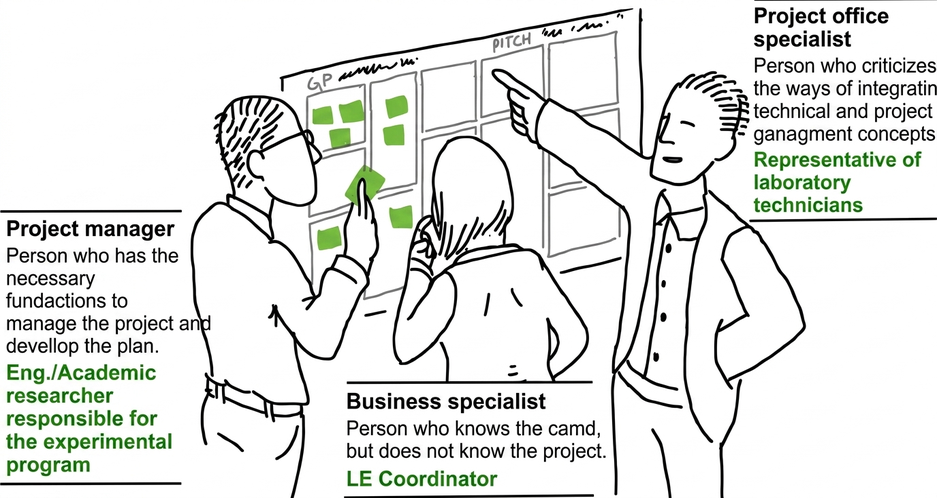
Source: Adapted from Finocchio Jr.[10]
Note: Eng./Academic: Engineer/Academic; LE Coordinator: Structures Laboratory Coordinator.
In this context, the PMC format trial plan is structured based on key questions: Why? What? Who? How? When? How much? Following this sequence of questions ensures effective communication of only the relevant information for this stage of the project[11].
Table 1 illustrates the trial plan framework in the PMC format and details the pertinent information for the experimental program for each of the key methodology questions. It is important to highlight that the information requested in the completion was defined in internal discussions with the LE team to present a proposal capable of solving the problems existing in the current model.
Table 1. Key questions of the trial plan in the PMC model
| Why? | What? | Who? | How? | When and how much? |
| What is the change in the current situation that the experimental program intends to solve? What is the added value of the results obtained experimentally? Examples of added value: data for numerical calibration, data for a technical report or structural dimension table, or investigation of the mechanical behavior of the part | Experimental model outline. List of results that will be obtained experimentally through measuring equipment or actuators. It is also pertinent to list restrictions and desirable aspects of these results. Examples: precision of actuator calibration data, and/or number of repetitions per model | Stakeholders, i.e., all people involved in the experimental program and who produce something for the project with their respective responsibilities | List of assumptions, example: expected static scheme, collapse mode predictions, number of loading modes for the test. Division of deliverable groups, i.e., test step flowcharts. List of relevant limitations of the experimental program, whether due to monitoring of undesirable behaviors during the test or any other imposed source | List of risks of the experimental program to be managed in the pilot trials stage. Deadlines to be met. Body financing the experimental program and estimate of project costs |
The implementation of the PMC methodology follows the document conception steps proposed by Finocchio Jr.[10] The phases are: (i) conceive, in which the key questions detailed in Table 1 are answered; (ii) integrate, ensures the consolidation of information established about the experimental program; (iii) resolve, dedicated to the analysis of obstacles encountered in filling out the PMC; (iv) communicate/share, uses the trial plan to develop project management in its subsequent stages.
As a consequence of the proposition of a new trial plan in the PMC model, it is noted that this work also establishes the relationship between the management of experimental programs in structural engineering and the project management strategies and guidelines of the PMBOK® Guide[7].
Work Breakdown Structure (WBS)
Understood as a decomposition of the project into smaller and manageable parts, the deliverable-oriented WBS is a crucial point of the scope management methodology[12]. In this sense, Norman et al.[8] indicate minimum requirements that characterize its efficient application, which served as the basis for the development of the standard model adopted in this work.
According to the authors, a WBS should have the following characteristics: (i) delivery orientation; (ii) hierarchical decomposition of tasks, so that each level includes 100% of the respective higher level; (iii) inclusion of the total project scope, which covers internal, external, and provisional deliverables; (iv) use of nouns and adjectives for description; (v) use of a coding scheme that represents the project hierarchy; and (vi) work packages that support the definition of a schedule with relevant activities and milestones. These elements make up the principles of the standard WBS developed.
Experimental programs in the area of structural engineering generally present the characteristics of a predictive project, due to the predictability of deliverables and deadlines. In this sense, the standard WBS developed in this study follows the premises of method-oriented grouping, a guideline that structures the project results based on a delivery process similar to the traditional “waterfall”. This approach facilitates the understanding of products and internal communication among the involved parties[8].
Understood the main characteristics that define the standard WBS for experimental programs in structural engineering, another relevant point is the levels addressed in the model developed in this study. The document aims to serve as a guide for the different experimental programs in the structures area, without detailing the level of work packages. In other words, the proposal seeks to cover the minimum scope that an experimental program needs to foresee throughout the project lifecycle.
The development of the standard WBS followed the best practices of the PMBOK® Guide[7]. In this sense, the structure resulted from three sequential processes, summarized as: (i) plan project scope management; (ii) document the needs of stakeholders; and (iii) define the project scope. Finally, the developed model will be applied to the experimental program of Furukawa and Malite[13] and to two other service deliveries of the LE that occurred between February and September 2024.
The trial plan developed in this work, based on the Project Model Canvas (PMC), is presented in Figure 2. Similar to Finocchio Jr’s model[10], it organizes the key questions from Table 1 into essential project factors.
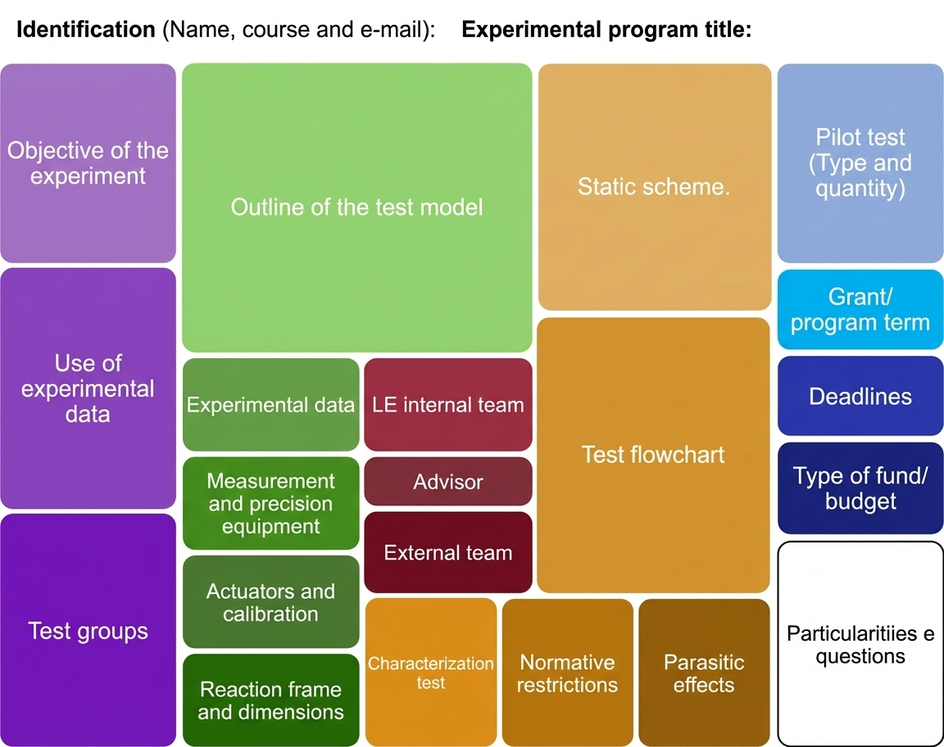
Source: Prepared by the authors.
To elucidate the key factors listed in Table 2, a parallel is drawn between the elements of Finocchio Jr.’s methodology[10] and those of the PMC proposed in this study. Furthermore, the PMC includes the field “Particularities and questions,” intended for additional observations not covered by the key factors, but considered relevant by the trial plan manager.
Table 2. Parallel between the key factors
| Elements | Key factors |
| PMC Finocchio Jr.[10] | PMC Trial Plan |
| Justifications | Objective of the experiment |
| SMART Objective | Trial groups |
| Objective of the experiment | |
| Future benefits | Use of experimental data |
| Product | Essay model outline |
| Requirements | Experimental data |
| Measuring and precision equipment | |
| Actuators and calibration | |
| Reaction portal and dimensions | |
| Stakeholders | External team |
| Team | Internal LE Team |
| Advisor | |
| Premises | Static scheme |
| Delivery groups | Flowchart of the trial |
| Restrictions | Characterization Essay |
| Regulatory constraints | |
| Parasitic effects | |
| Risks | Pilot study (type and how many) |
| Timeline | Scholarship/program deadline |
| Deadline | |
| Costs | Fund/Budget Type |
It is important to highlight that the information requested in filling out the trial plan in the PMC format (Figure 2) satisfactorily meets the demands of the LE coordination, without overburdening the project manager (Figure 1) with issues inaccessible in the initial phase of the experimental program. The previous model did not present this accessibility, which resulted in delays due to the absence of required information and communication failures between stakeholders.
The validation of the trial plan occurred through a meeting to present the proposal to the technical staff and the laboratory coordinator, followed by the application of the plan to trials that will be detailed sequentially. In all stages, those involved provided feedback, which allowed the document to be improved until the definition of the final model presented in this work.
Following the steps of the Canvas methodology, namely, (i) conceive, (ii) integrate, (iii) solve, and (iv) communicate/share, this work validated the effectiveness of the proposed trial plan in four experimental programs requested as a service to LE. In this context, Figure 3 illustrates an example of applying the plan to the experimental program called ‘SteelDeck’. Next, the results of the “communicate/share” stage will be presented, used to develop the program’s WBS.
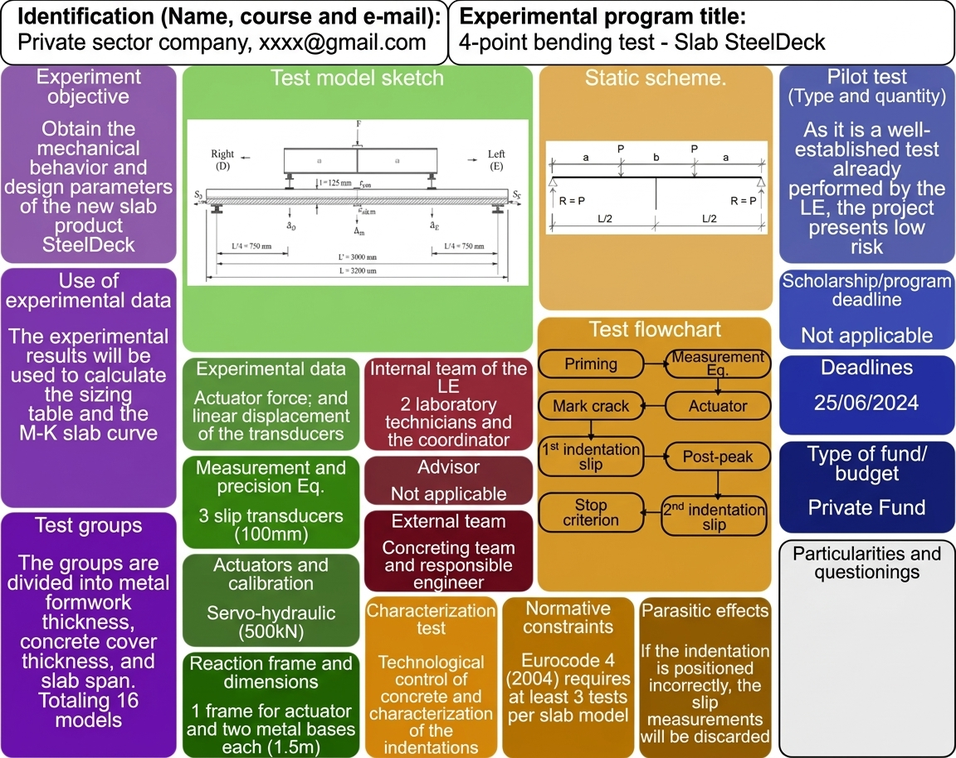
Source: Prepared by the authors.
Finally, Figure 4 summarizes the benefits of the new proposed plan model. The comparative analysis between the old and current scenario highlights how the PMC tool contributed to solving the main problems faced in the management of experimental programs at LE.
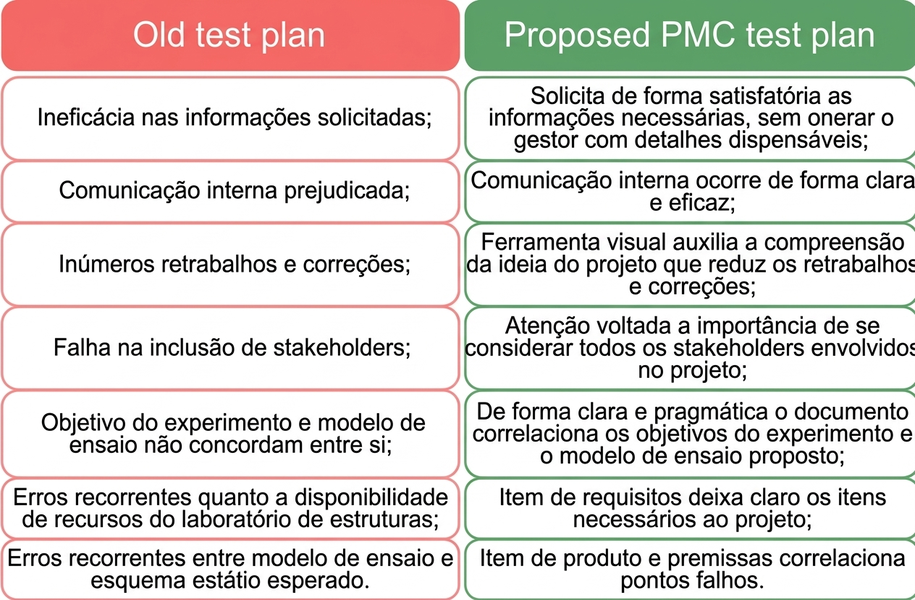
Source: Elaborated by the authors.
After the trial plan, the next challenge is to plan the project scope. Within this scope, the proposed standard WBS is presented in Table 3, structured in levels coded with numbers to represent the project scope hierarchy.
Table 3. Work Breakdown Structure (WBS) standard for experimental structural engineering programs
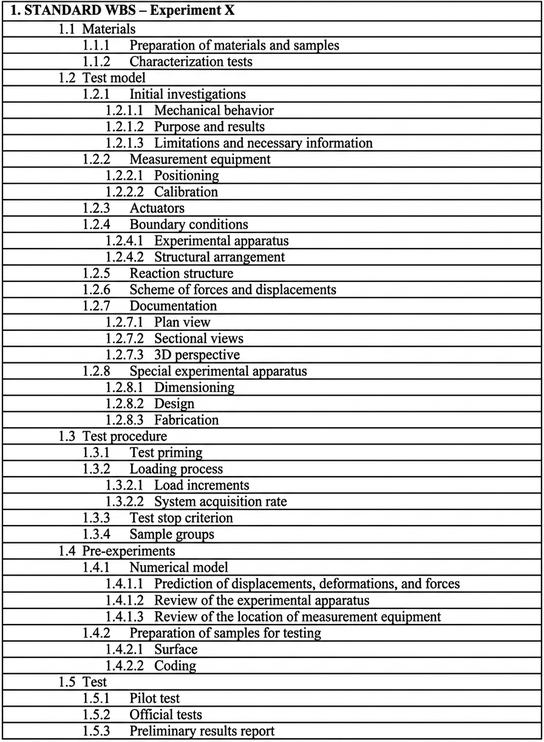
In Figure 5, the hierarchical WBS from Table 3 is presented graphically in an organizational chart format. The visual representation of the proposed structure allows for a quick and didactic understanding of the minimum scope required for project planning. Consequently, the guidelines detailed in Table 3 and illustrated in Figure 5 configure a consistent solution for the negligence scenario identified by the Dunning-Kruger Effect in experimental structural engineering programs.
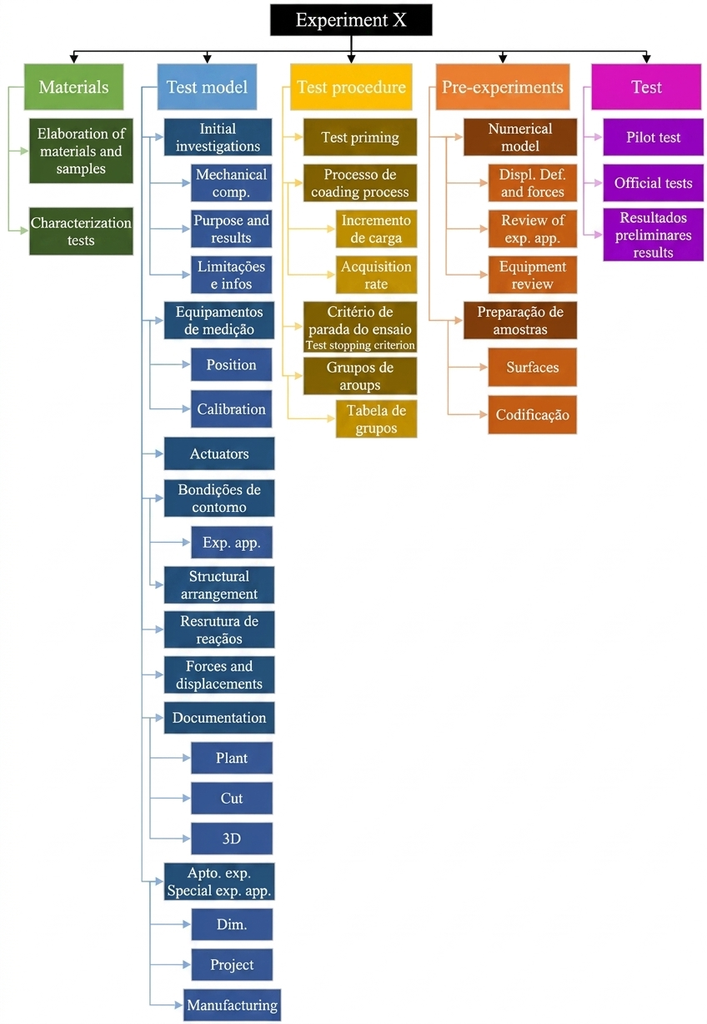
Source: Prepared by the authors.
Note: Comp.: behavior; Exp. app.: experimental apparatus; Special exp. app.: special experimental apparatus; Dim.: dimensioning; Acq. rate: acquisition rate; Def. and forces disp.: deformation and forces displacement; Exp. app. Rev.: Experimental apparatus revision.
According to Table 3 and Figure 5, the definition of the levels addressed by the standard WBS was structured to ensure that the minimum scope necessary for effective project management is contemplated. This proposal does not delve into the level of work packages, as its objective is to serve as a generic document, applicable to different experimental programs in the area of structures.
However, the elements of the lower levels provide sufficient details and guidance to support the scope definition and underpin project management, in addition to contemplating the detailing of relevant work packages and the elaboration of the experimental program schedule.
Before the proposed structure, there were no documents to assist in the scope planning of the experimental programs carried out at LE. To elucidate the benefits obtained with this unprecedented document and validate the applicability of the standard WBS, the study presents in Table 4 the application of the proposal to the experimental program of Furukawa and Malite[13].
Table 4. Application of the standard WBS to the study by Furukawa and Malite[13]
As per the parallel established in Table 4, it is observed that the scope description proposed by the standard WBS of Table 3 offers tools to mitigate recurring failures in several aspects: (i) monitoring and ensuring the quality of scope execution of deliverables; (ii) mapping the needs for financial, material, and labor resources; (iii) identification and anticipation of risks; and (iv) change management throughout the project. Furthermore, this structure serves as an instrument to identify the stakeholders of the experimental program, becoming an essential document to ensure effective communication in project management.
It is noted from Table 4 that the proposed standard WBS fulfills its purpose by providing clear guidelines for defining the scope of an experimental program in the area of structural engineering. In addition to guiding the necessary deliverables, the model presented in Table 3 adapts to the particularities of each experimental program.
In the item ‘1.5 Pre-experiments’ (Table 4), it is observed that some levels may not apply to certain programs, and the importance of the manager to adjust the document according to the project’s life cycle is highlighted.
The PMBOK[7] Guide recommends that the activities, tasks, and schedule milestones of a predictive project, such as experimental programs, be derived from the project’s WBS. In this context, based on the development carried out by Furukawa and Malite[13] (Table 4), it is observed that the standard model satisfactorily defines the necessary guidelines for the elaboration of work packages and, consequently, of the experimental program schedule.
Finally, in an analogous way to the results presented in Table 4 and with the intention of continuing the validation of the proposed methodology, Table 5 presents the application of the standard WBS (Table 3) to the experimental program called ‘SteelDeck’, requested as a service to the LE by a private structural engineering company.
It is noteworthy that the WBS presented in Table 5 was designed after the trial plan in the PMC format of Figure 2, as part of the “communicate/share” stage of Finocchio Jr.’s methodology.[10].
Table 5. Application of the standard WBS to the SteelDeck experiment
| 1 Standard Work Breakdown Structure | EAP SteelDeck |
| 1.1 Materials | Materials |
| 1.1.1 Development of materials and samples | Concrete |
| Plywood formwork | |
| Release agent | |
| MD75 metal form | |
| 1.1.2 Characterization Essays | Technological control of concrete |
| Tensile test on steel | |
| 1.2 Essay model | Essay template |
| 1.2.1 Initial investigations | Initial investigations |
| 1.2.1.1 Mechanical behavior | Failure modes bands of the array |
| Influence of mosses | |
| 1.2.1.2 Purpose and outcomes | Product sizing table |
| 1.2.1.3 Limitations and necessary information | Report of normative specifications |
| 1.2.2 Measuring equipment | Measuring equipment |
| 1.2.2.1 Positioning | Transducer positioning |
| Actuator positioning | |
| 1.2.2.2 Calibration | Transducer calibration |
| Actuator calibration | |
| 1.2.3 Actuators | Servo-hydraulic |
| 1.2.4 Boundary conditions | Boundary conditions |
| 1.2.4.1 Experimental setup | Experimental apparatus |
| Transfer beam | |
| Support | |
| (1) not applicable items | |
| 1.2.5 Reaction structure | Reaction portal |
| 1.2.6 Scheme of forces and displacements | Scheme of forces and displacements |
| 1.2.7 Documentation | Documentation |
| 1.2.7.1 Plan view | Plan view |
| 1.2.7.2 Sectional views | Cross-sections |
| 1.2.7.3 3D Perspective | 3D Perspective |
| (1) not applicable items | |
| 1. 3 Test procedure | Test procedure |
| 1.3.1 Test run | Essay Scoping |
| 1.3.2 Loading process | Loading process |
| 1.3.2. Load increments | Load increments |
| 1.3.2.2 System acquisition rate | System acquisition rate |
| 1.3.3 Trial stopping criterion | Trial stopping criterion |
| 1.3.4 Sample groups | Sample groups |
| 1.3.4.1 Table of groups | Group table |
| 1.5 Pre-experiments | Pre-experiments |
| 1.5.1 Numerical model | Numerical model |
| 1.5.1.1 Prediction of displacements, deformations, and forces | Prediction of displacements, deformations, and forces |
| 1.5.1.2 Review of the experimental setup | Review of the experimental apparatus |
| 1.5.1.3 Review of measurement equipment allocation | Review of measurement equipment rental |
| 1.5.2 Sample preparation for testing | Sample preparation for testing |
| 1.5.2.1 Surface | Surface |
| 1.5.2.2 Encoding | Encoding |
| 1.6 Essay | Essay |
| 1.6.1 Pilot study | Pilot study |
| 1.6.2 Official tests | Official essays |
| 1.6.3 Preliminary results report | Preliminary results report |
Experimental programs in structural engineering, framed as predictive projects, hold significant scientific and technological value. This study proposed improvements in two critical stages of the lifecycle of these programs within the LE context, through the implementation of PMC as a new test plan model and the development of a standard WBS.
The application of the PMC showed significant gains in clarity, standardization of information, and communication among stakeholders, in addition to favoring the identification and mitigation of risks. In turn, the standard WBS allowed defining an adaptable minimum scope, by guiding managers and researchers on essential deliverables and reducing errors, rework, and planning gaps.
As a limitation, it is observed that the adoption of the proposed tools requires additional effort to adapt them to different institutional realities, as well as alignment with the project management maturity level of each organization. This need may demand adjustments in scope, detail, or format of the documents to ensure their full applicability and effectiveness in diverse contexts.
For future investigations, it is recommended to expand the application of the presented methodologies in other laboratories and engineering areas, in order to evaluate their effectiveness in different operational scenarios and complexity levels. It is also suggested to develop and apply quantitative performance indicators that allow for an objective measurement of the impact of the proposed improvements on the management and execution of experimental programs, which strengthens the empirical basis for their dissemination and consolidation as good practices in the field of project management.
REFERENCES
[1] Doebelin, E.O. 1990. Measurement systems: application and design. 4ed. New York, NY, USA: McGraw-Hill.
[2] Hossdorf, H. 1972. Modelos reduzidos – método de cálculo. 1ed. Madrid, Espanha: Instituto Eduardo Torroja.
[3] Keeling, R.; Branco, R.H.F. 2017. Gestão de projetos: uma abordagem global. 3ed. São Paulo, SP, Brasil: Saraiva.
[4] Giotis, T. & Chatzipanos, P. 2013. AgiWater: bridging ‘agile’ and ‘waterfall’ in the context of the PMBOK® guide and ISO 21500. Paper presented at PMI® Global Congress 201. EMEA, Istanbul, Turkey. Newtown Square, PA: Project Management Institute.
[5] Gilbert, B.P.; Fernando, D.; Pham, C. H. 2022. Experimental techniques in structural testing: common mistakes, how to avoid them and other advice. Structures. 41: 1687–1699. https://doi.org/10.1016/j.istruc.2022.05.091.
[6] Kruger, J.; Dunning, D. 1999. Unskilled and unaware of it: how difficulties in recognizing one’s own incompetence lead to inflated self-assessments. Journal of Personality and Social Psychology. 77(6): 1121–1134. 1999. https://psycnet.apa.org/doi/10.1037/0022-3514.77.6.1121.
[7] Project Management Institute. 2021. Um guia do conhecimento em gerenciamento de projetos (Guia PMBOK®): padrão de gerenciamento de projetos. 7ed. Newtown Square, Pennsylvania, USA, Project Management Institute.
[8] Norman, E. S.; Brotherton, S. A.; Fried, R. T. 2009. Estruturas analíticas de projeto: a base para a excelência em gerenciamento de projetos. Trad. PMI Standard. 1ed. São Paulo, SP, Brasil: Blucher.
[9] Ferreira, T.C.; Ota, M.A. 2018. Contribuições do Project Model Canvas no gerenciamento de cursos online: do planejamento às etapas de execução. In: 24º CIAED Congresso Internacional ABED de Educação a Distância. São Paulo, SP, Brasil. 1-10. Disponível em: http://dx.doi.org/10.17143/ciaed/XXIVCIAED.2018.215. Acesso em: 24 jul. 2024.
[10] Finocchio Jr., J. 2013. Project Model Canvas. 1ed. Rio de Janeiro, RJ, Brasil: Elsevier.
[11] Sousa Neto, M.V. 2014. Gerenciamento de projetos: Project Model Canvas. 1ed. Rio de Janeiro, RJ, Brasil: Brasport.
[12] Ferruccio da Rocha, M. A., & Rodrigues Junior, P. R. (2023). Gestão de projetos: aplicação de uma estrutura analítica de projetos em um projeto de desfile de uma escola de samba. Arquivos do CMD, 9(2), 165–178. https://doi.org/10.26512/cmd.v9i2.47650.
[13] Furukawa, M.N.; Malite, M. 2025. Experimental analysis of the mechanical behavior of steel storage rack base plate upright connections. Thin-Walled Structures. 214: p. 113340. http://dx.doi.org/10.1016/j.tws.2025.113340.
COMO CITAR
Furukawa, M.N.; Silva, K.A. Gestão de experimentos em laboratórios de estruturas: implementação de ferramentas de gestão de projetos. Revista E&S. 6: e2025029.
ABOUT THE AUTHORS
 Marina Naomi Furukawa – PhD candidate in Engineering. Specialist in Project Management. Rua Profa. Nicoleta Stela Germano, 60, Apt 71, Jardim Paraiso, 13561-090, São Carlos, São Paulo, Brazil.
Karoline Arguelho da Silva – Temporary Professor of the Production Engineering Department of the Polytechnic School of the University of São Paulo. Prof. Luciano Gualberto Avenue, 380, Butantã, 05508-010, São Paulo/SP, Brazil.