
Education
February 26, 2026
“The MBA Project was one of the best choices I made”
A large part of the people who decide to pursue an MBA (Master of Business Administration) have in mind the idea of improving their professional activity, whether with a promotion or even opening their own business. But do they see the possibility of transforming a feasibility study into a solid and innovative operation?
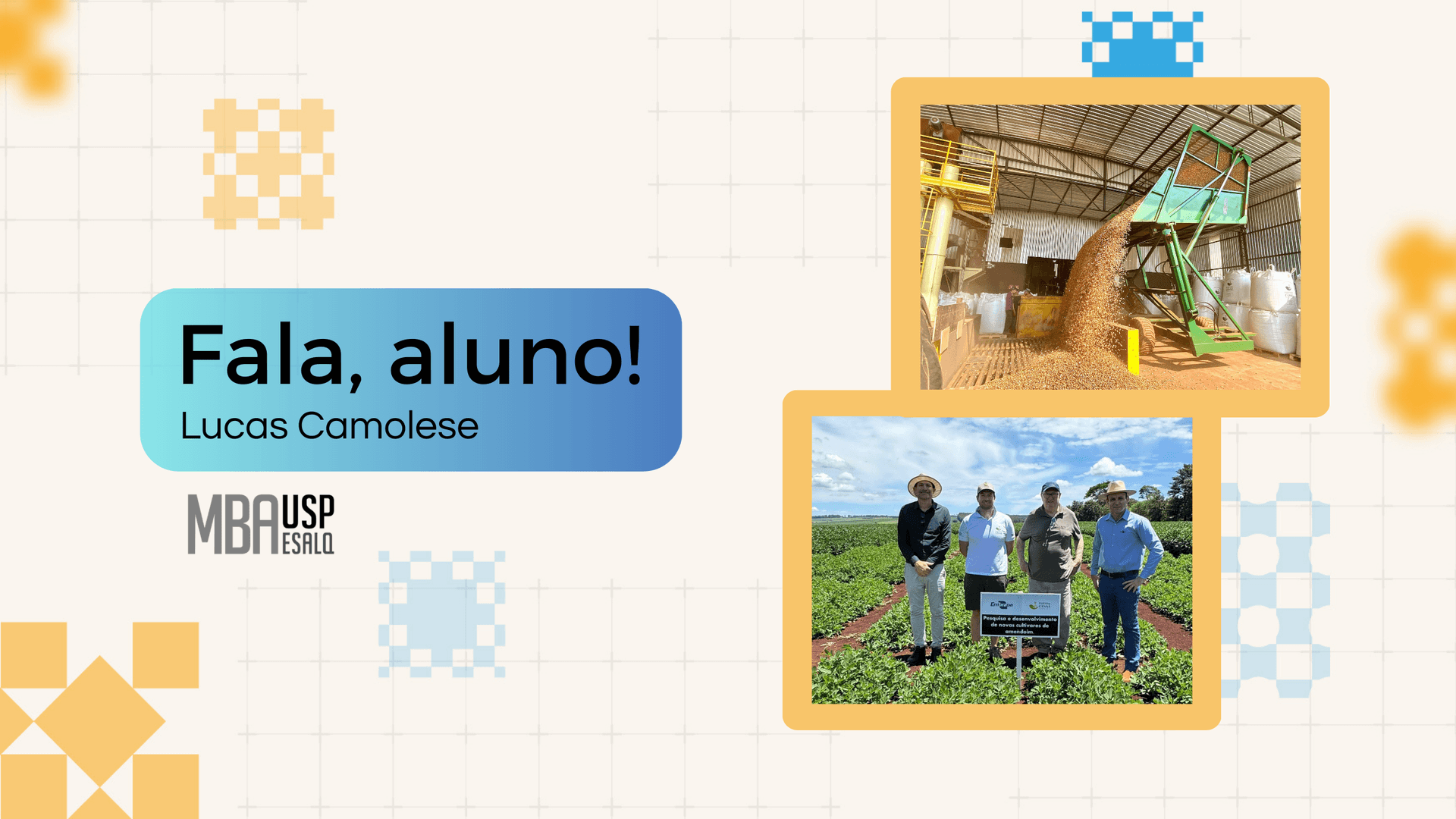
This is what happened to Lucas Camolese, administrative director of Cerealista Fazenda Canaã, a family business in the interior of São Paulo. In this interview, he explains how it was possible to convert an academic analysis into real strategic decisions, which resulted in the implementation of a peanut seed processing unit (UBS) on the property.
According to him, the venture was entirely planned and designed in the TCC (final course project) of the specialization in Agribusiness of the MBA USP/Esalq, including physical layout, operational flows, production capacity, equipment selection, quality control, and compliance with the requirements of the Ministry of Agriculture.
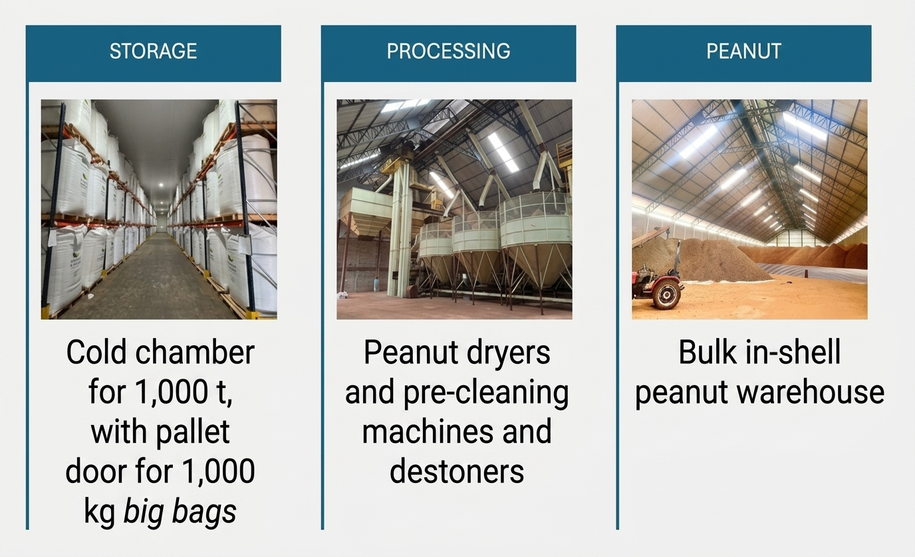
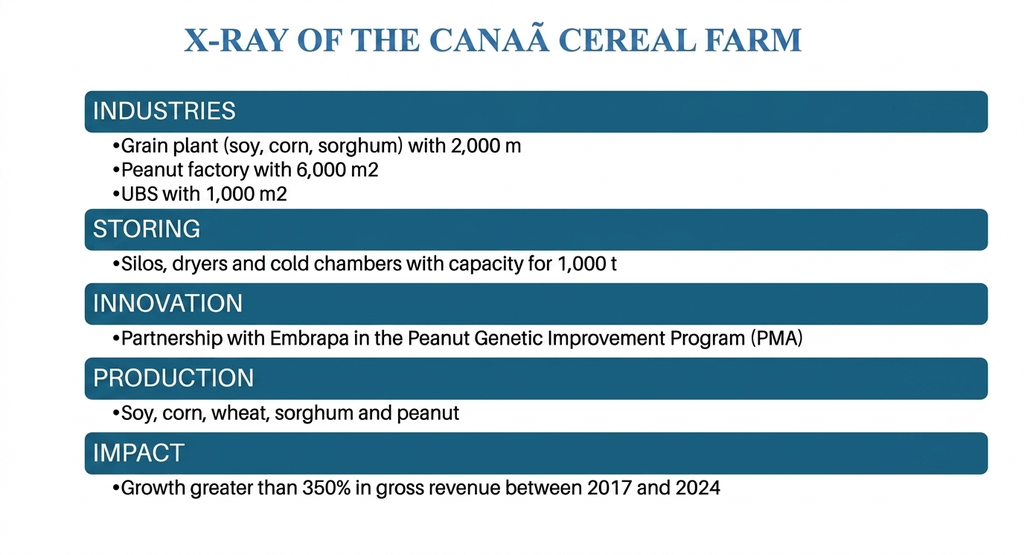
The unit currently operates as an integrated complex for receiving, cleaning, drying, processing, and storing seeds. The warehouse has a capacity for approximately 6,250 tons of unshelled peanuts; the cleaning system, for about 25 tons per hour, while drying can reach 100 tons per day. With this, the UBS has a processing capacity of 5 tons per hour. All this structure supports the certified peanut seed production activity, which has helped the company register a growth of over 350% in recent years. Learn about this experience by reading the interview below.
| In this section, E&S Journal gives voice to those who turned the learning of the MBA USP/Esalq into results |
|---|
| Here you will get to know real stories from alumni who made the most of the course experience, applied their knowledge in the market, and transformed what they learned into assets for their businesses and professional decisions. |
E&S Journal – What was your professional journey like before the USP/Esalq MBA?
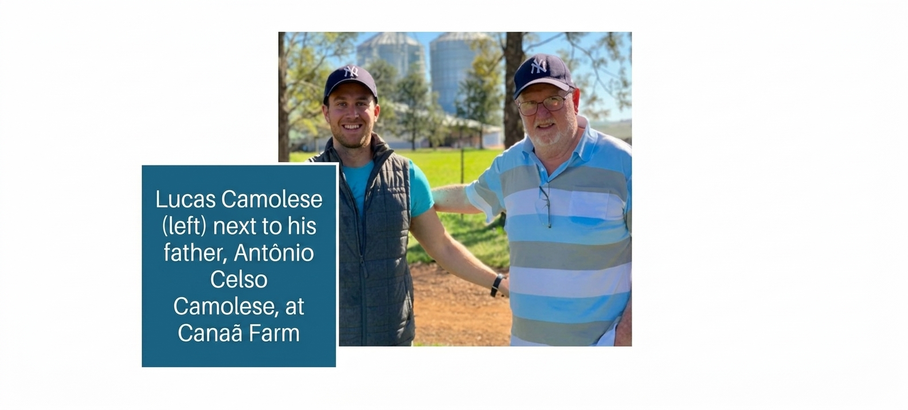
Lucas Camolese – I graduated in International Relations from FAAP in São Paulo. I worked in multinational companies during college and after graduating. Then I opened a franchise in a shopping mall. In 2017, I decided to sell the store and started working here on the farm. I had corporate experience in multinationals, I had my own business, and then I decided to work with my father, to help out here. I brought many market insights to the farm. As my father graduated from Esalq, I decided to do the USP/Esalq MBA. It was excellent, it was an environment where I learned a lot. I was also able to do a TCC (Final Course Project) focused on something I wanted to implement here on the farm: adding value to commercial [raw, unbeneficiated] peanuts, which we already sold. Around the same time, the partnership with Embrapa emerged, and we closed an agreement to develop new peanut cultivars through genetic improvement.
E&S Journal – What is the structure of Fazenda Canaã?
Lucas Camolese – It stopped being just a farm for soybeans, corn, wheat, sorghum, and peanuts to become an industry. And we process soybeans, sorghum, wheat, as well as peanuts. The peanut industry is our main operation today because we sell the seed, which has a lot of added value.
E&S Journal – What was different before you did the MBA?
Lucas Camolese – When I arrived [to work on the farm], in 2017, we didn’t have a silo, there was no industry. We implemented the silo for processing soybeans, wheat, and sorghum. In 2020, when I started the MBA, we were already also producing commercial peanuts. That’s why I decided to adopt as the theme of my TCC a project on how to add value to the production of commercial peanuts. The MBA helped me formalize the idea, the business plan to implement a UBS (seed processing unit) in the operation.
E&S Journal – So you decided to do the MBA to help your father?
Lucas Camolese – Yes, exactly. I had already been here [on the farm] for three years, implementing things, organizing, working on several fronts. In 2020, I decided to pursue an MBA in agribusiness because I wanted to better understand the agronomic side of the activity; on the administrative side, I already had the background.
E&S Journal – What were your initial expectations about the course? Were they met?
Lucas Camolese – My expectation was to gain as much knowledge as possible in agriculture. I achieved the goal. From the beginning, I wanted to shape the theme, because I had the plan to implement the UBS. Everything came together, it was a study laboratory. I did the TCC already thinking about actually implementing it here. It was spectacular.
E&S Journal – What was the knowledge that helped you the most?
Lucas Camolese – I created three scenarios, the optimistic, the pessimistic, and the standard, and I was able to study what my price margin would be to have profitability. I would say that, perhaps, if I hadn’t done the TCC, I wouldn’t have gone so deep into the theoretical and practical parts, and really gotten into the subject. I might not have had the foundation I had to start the activity with confidence.
E&S Journal – What were the main technical, economic, and operational challenges you faced in this phase?
Lucas Camolese – It was fundraising, because we depend on BNDES, on credit lines. It was very difficult, bureaucratic, but we managed. Also the technical, industrial part, because I had never processed before; so I had to visit several industries to understand how it worked, to be able to arrive at the best possible industrial plant. And the human resources part too, training the staff to work in the industry, because we are not in a peanut region, there are not many professionals in this field.
E&S Journal – Why was your focus on peanuts?
Lucas Camolese – Because I had several friends who were planting. I did a 50-hectare test of only peanuts in 2018, 2019, and I saw that there was a lot of potential. Then I already started investing in machinery and planting peanuts commercially. After we started planting here, we called neighbors and producers, and today, there are already about 10 or 12 producers planting peanuts in the region. It’s interesting for us because we sell the seed. And for them, it’s highly profitable.
E&S Journal – In what way did the MBA disciplines contribute directly to the project’s structuring?
Lucas Camolese – All management classes helped a lot.
E&S Journal – Did they help structure the project?
Lucas Camolese – Yes, and the TCC (Final Project) subject as well, along with the supervision. I had to sit down and do the work, it added a lot to implementing the operation too.
E&S Journal – What was the role of academic advising?
Lucas Camolese – I think the meetings [with the advisor] were important because we were aligning our thoughts with the business plan. And it was implemented, it’s there, concrete proof of what we wrote on paper. It’s really cool to see that.
E&S Journal – At what point did you realize that the TCC had the potential to become a business?
Lucas Camolese – It was in the finalization phase of the spreadsheet and the written theoretical part, including I was already making budgets.
E&S Journal – How was the transition from the academic project to practical execution? Did it require adaptation?
Lucas Camolese – Yes, for sure. I remember having included a forecast for machinery expenses. Sometimes it deviated a little, sometimes it was a higher or lower amount. [This happened ] more in the industrial part and with machinery for planting.
E&S Journal – What aspects of the TCC planning were decisive for the successful implementation of the unit?
Lucas Camolese – The scenarios part. I managed to predict my payback. The first years were great, it was that optimistic scenario. Now it’s a more pessimistic scenario, it’s seasonal. Creating these scenarios within the TCC helped me a lot, because I was able to have predictability.
E&S Journal – What are the differentials of the Fazenda Canaã UBS?
Lucas Camolese – The main differential is the seed quality. Few companies have cold storage today, and we do. We store the seed for the period it is here, preserving the seed’s germination and vigor. Another differential is two electronic machines we have, imported from China, with artificial intelligence. They “read” the peanut and perform selection according to the standard we request from them. They are two extremely technological machines that perform a fine comb at the seed output, which is extremely necessary for you to have quality.
E&S Journal – What is the importance of the partnership with Embrapa for the company’s market positioning?
Lucas Camolese – Embrapa is extremely important because it brings technical knowledge regarding seeds, they develop new cultivars. We have test fields with 15 varieties of peanuts. They make crosses and send me these varieties. I set up an experimental field here, plant all the varieties in small quantities, and see which one develops best in the region. Every year we have these fields here, and Embrapa technicians evaluate them. And all of this is part of a study that is at Embrapa. They identify the best ones, and then they launch them on the market. I am one of the people who will launch and sell them on the market.
E&S Journal – Is your counterpart able to sell the varieties that result from this research?
Lucas Camolese – Exactly. With this partnership, I can sell and at the same time encourage the peanut culture improvement program.
E&S Journal – Where does your seed certification come from and how does it impact profitability?
Lucas Camolese – We have a certifying body approved by the Ministry of Agriculture, Pró-Sementes. When we create the batches, they come here, take samples, and send them to the laboratory. Every seed has a germination certificate. If it doesn’t meet a minimum germination standard, I cannot sell it; they block the batch. It’s a very serious operation.
E&S Journal – The numbers show significant growth for the company. What do you attribute this performance to?
Lucas Camolese – I attribute it to the peanut culture, it was what boosted revenue. It is also a result of the operation, but the seed itself was what added more value to the operation.
E&S Journal – What did this experience change in your way of thinking about management, innovation, strategy?
Lucas Camolese – Wow, everything! Even though I had already worked in multinationals in São Paulo, I don’t think there’s anything more rewarding than agriculture. And the progress we’ve made here has been very significant. I think the MBA project was the best choice, one of the best choices I’ve made professionally, because it brought me a lot of content that I could apply here.
E&S Journal – What skills did you develop in the MBA?
Lucas Camolese – The management part. I still have all the material, sometimes, when I have a doubt, I even look in the class folder and consult it. And I also maintained a relationship with my advisor. We are always exchanging ideas.
E&S Journal – What advice would you give to someone who wants to follow the same path you followed?
Lucas Camolese – Certainly, you have to do it (an MBA), even though daily life is hectic. We can find time. The classes are recorded, so you can watch them later. At your own pace, at the time you deem best.
| ABOUT THE INTERVIEW |
|---|
| Interviewee: Lucas Camolese, administrative director of Cerealista Fazenda Canaã, was a student in the specialization course in Agribusiness of the MBA USP/Esalq. TCC Advisor: Alexandre Barreto, project director of the Piracicaba Technology Park (PTP) |
| To learn more about the course, access: MBA in Agribusiness USP/Esalq |
Who published this interview
Luiz Eduardo Giovanelli