
Innovation
Startups
Technology
April 25, 2025
A journey between gladiators and lions
Startup innovation solutions, also present in the fields of management and business culture, inspire large corporations

“Hail, market, those who are about to undertake hail you!”
In a mix of courage and great resilience — to manage to “kill a lion a day” while developing new business opportunities —, the founders of startups are individuals who throw themselves into the challenge of entrepreneurship without certainty of imminent success, in an environment of high risk and competition.
Besides an innovative product or business model, to support the battles with the gladiators who already occupy the arena of the sectors in which they intend to operate, entrepreneurs also need to make decisions and take risks based on their intuitions, on what the innovation ecosystem has conceptualized as a “leap of faith”.
However, this is not an epic of many heroes. After all, not all startups manage to validate and scale innovative solutions, surviving the trials of the coliseum called the market. Just to give a dimension, the research “Causes of mortality of Brazilian startups”, conducted by Fundação Dom Cabral with 355 entrepreneurs, indicated that at least 25% of startups die within less than one year of life, and at least 50% die before completing four years.
For those who persevere and conquer their place among the champions of the creative economy, there is no other option than to challenge the status quo to provoke changes in the structures of economic segments and large business empires. It may even seem like a Hollywood movie script, but in this story, the challengers need much more than a leading role with engaging dialogue to survive and win over the masses. There is no room for powerpoint and storytelling promises that do not deliver real value for some unmet demand by the dominant players.
In a battle between insurgents and incumbents, startups play a fundamental role in promoting innovation and driving economic growth, and to better understand their way of being, it is important to first understand how they operate. Startups are emerging companies that seek to develop and commercialize innovative products or services, in a repeatable and scalable business model, often using technology as a competitive differentiator.
However, along with technologies, there are methods and processes to support the entrepreneurial journey. Among them is Lean Startup, which is a methodology for the creation of products and services described in the book “The Lean Startup” by Eric Ries. The author’s proposal is that continuous and sustainable innovation depends on a correct process, not on a brilliant idea or the best marketing timing. The methodology’s objective is to reduce risks, losses, and time involved in startup activities.
The application of this method involves the identification and elimination of waste in development processes and is based on the use of Minimum Viable Products (MVPs), in an iteration process that involves three steps: build, measure and learn.
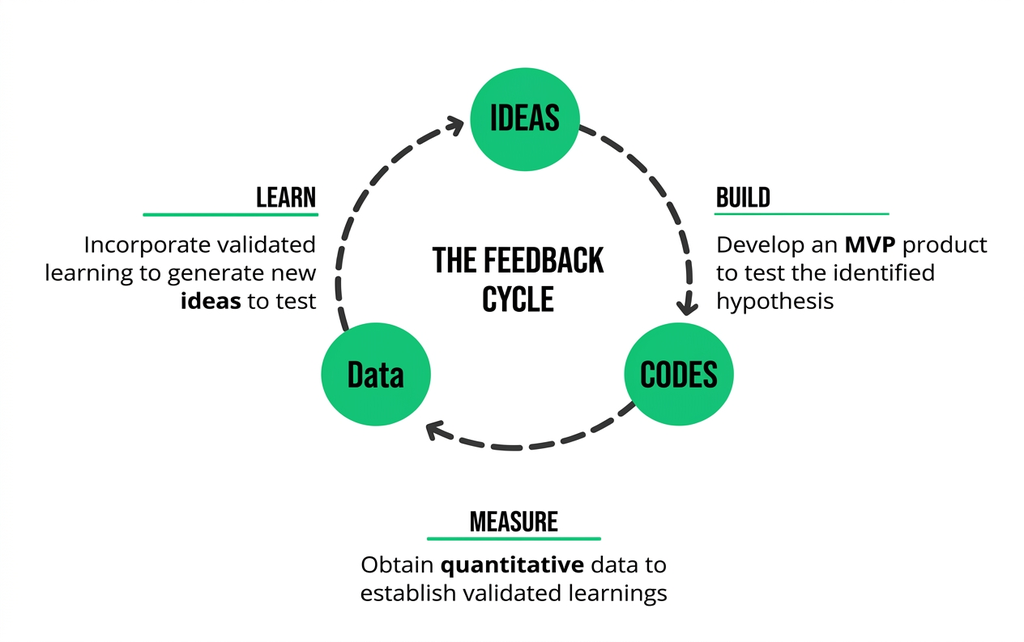
Source: AAA Innovation.
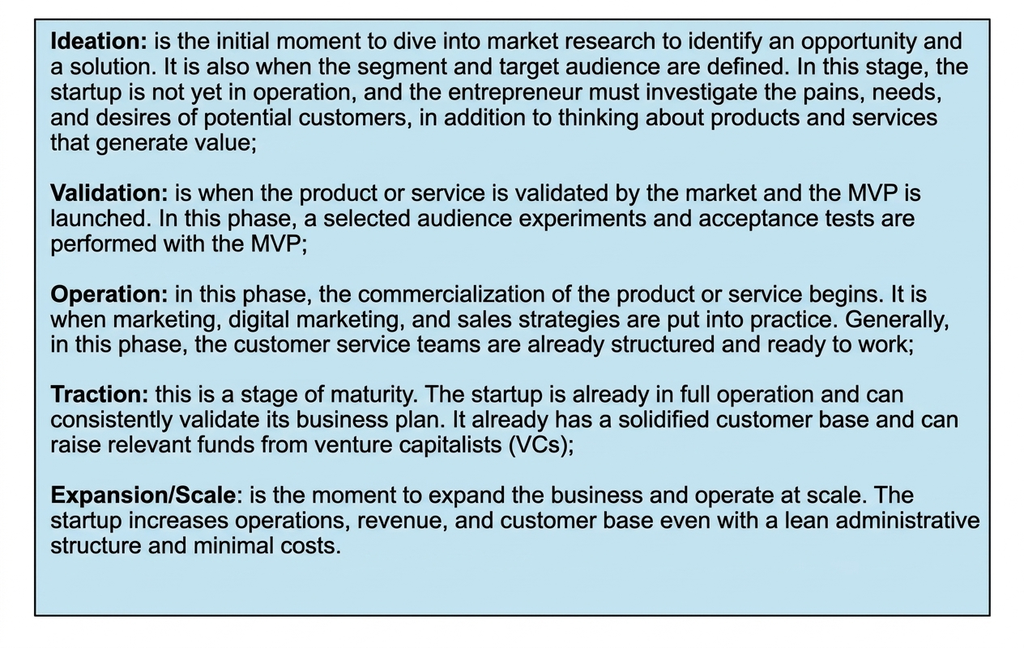
Another common characteristic in the trajectory of startups is that these companies generally go through a life cycle that includes stages such as ideation, validation, operation, traction, and expansion. Regardless of the stage, it is important to establish success indicators and monitor the critical factors that can influence the success or failure of this type of business.
Regarding the metrics, it is common for startups to use indicators such as customer acquisition cost (CAC), monthly recurring revenue (MRR), the conversion rate of leads into customers, and customer churn rate, among others.
However, each startup may establish its own mix of indicators, depending on the business model and the characteristics of the solution developed. For example: a hardware (physical product), a SaaS (software as a service, consumed online) or a combination of both accompanied by complementary services.
Metrics and indicators are important elements for measuring the health and performance of a startup. However, it is not just with good numbers that this type of venture can avoid its death sentence. The reasons for failure of a startup can stem from a series of factors external or internal to the management of the business itself.
From issues of lack of product-market fit (product-market fit) to the lack of people with technical capacity to form the team in the traction phase, or even the reaction of a large company, which may resort to a hostile strategy in an attempt to maintain its position.
The lack of capital is also one of the biggest difficulties for startups, whether in the ideation phase or the expansion phase, as financial resources are one of the main fuels to keep the company in operation or to sustain acceleration and growth. This is not to mention the much-feared “valley of death,” which comprises the phase between product development and the moment the company begins to generate enough revenue to cover operational costs.
It is possible to notice that the “startup founder” does not have an easy life. It is no wonder that, according to the research “The Top 12 Reasons Why Startups Fail”, conducted by CB Insights, only 10% of startups survive and 70% cease operations between two and five years of existence. In the list below, it is possible to check the 12 reasons for failure mapped by the organization.
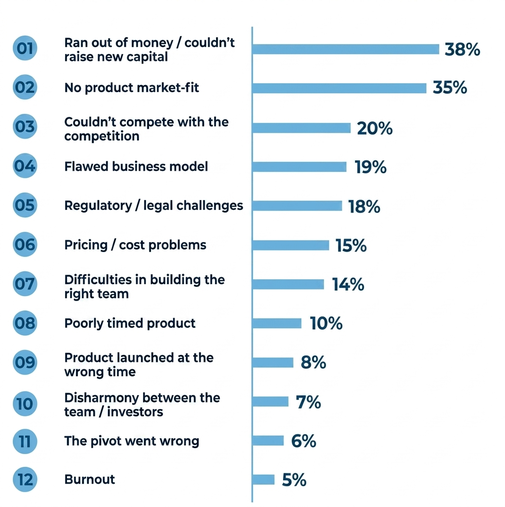
Source: Adapted from “The Top 12 Reasons Why Startups Fail”.
Even though there is still a level of distrust among market agents regarding the operating model of the startup ecosystem, which tends to be very proactive and unconventional, in order to avoid doing more of the same, it is important to highlight that this sector of the economy is very competent and is not solely based on the ‘bread and circuses’ policy.
The entrepreneurial environment has very particular characteristics, it has a large support network — with incubators, accelerators, hubs, angel investors, among others —, and founders also manage to innovate in management and in the culture that guides businesses. So much so that large corporations have started to use benchmarks from entrepreneurship to accelerate their digital transformation journeys or, even, to start investing and acquiring startups.
Between gladiators and lions, startups will continue their journey in search of consecration in this new economy, which is based on the triumvirate of human capital, new technologies, and new business models. It is an approach that puts traditional companies in check, but does not prevent them from helping to consolidate emerging companies, by learning, investing, and signing their checks.
| To access the references of this text click here. |
Who wrote this column
Ricardo Campo