
Science communication: antidote against disinformation

Column

Digital Consumer

Education

Social Networks

July 25, 2025

Science communication: antidote against disinformation

Bringing society closer to research results strengthens public trust in science and contributes to more informed decisions

In the 18th century, while smallpox outbreaks ravaged various parts of the world, movements against vaccination began to emerge — even before the production of vaccines as we know them today. At that time, a procedure called “variolation” was common, in which healthy people were inoculated with substances from the wounds of the sick, in an attempt to produce immunity (Britannica, n.d.). Despite representing an advance for the time, the practice was viewed with distrust in various sectors of society.

Although variolation involved risks — as some healthy people ended up being infected —, the process evolved and gave rise to vaccination, which proved so effective as to eradicate the disease from the planet (Britannica, n.d.). Nevertheless, distrust persisted, largely fueled by disinformation (read more in the text Anti-vaccine movements, below).

In the current context, this distrust has taken on new dimensions. Vaccine hesitancy, previously motivated solely by rumors and lack of knowledge about how vaccines work, is now intensified by denialist campaigns on social media, which are dedicated to questioning widely established scientific consensuses in areas such as health and the environment, in favor of specific economic interests of certain sectors (Galhardi et al., 2022).

The main antidote to combat this evil — which gained more strength with the Covid-19 pandemic — is accessible and clear scientific dissemination, especially in a scenario, like the current one, in which mistaken or manipulated information, which appeals to emotions, personal beliefs, and prejudice, circulates more efficiently and quickly than that based on solid evidence.

Scientific communication plays the role of bringing society closer to the knowledge generated by research, in a simplified and practical way, strengthening public trust in science and contributing to more informed decisions. By presenting clear and contextualized information, scientific communication functions as a reflective instrument, helping to develop critical thinking (UFACB, n.d.).

However, the dissemination of scientific information lacks efficiency, as it has not (yet) reached the speed at which the automated algorithms of social networks spread all kinds of information, including false ones, nor the appeal and influence that the content of social networks has on the audience: according to the DataReportal 2024 report, Brazilians spend an average of 9 hours and 13 minutes connected to the internet, of which 3 hours and 37 minutes are spent browsing social networks (read more in the column Brands and the era of the attention economy: the new currency of the digital world). Among the many challenges of scientific dissemination are:

  • adapt the science content to the different languages of the algorithmic logic of social networks;
  • curtail the production and dissemination of low-quality science, in publications of low reputation and without scientific rigor, such as the so-called predatory journals;
  • promote the scientific literacy of laypeople and the media literacy of scientists (ABC, 2024). 

Overcoming these challenges is also important to weaken the distrust in scientific institutions. Research conducted in 2019 by the Ministry of Science, Technology, Innovations and Communications (MCTIC) and the Center for Management and Strategic Studies (CGEE) showed that nine out of ten Brazilians trusted science, but did not know how to name scientists or research or science outreach institutions, evidencing the need to expand the reach and efficiency of outreach. The survey interviewed 2,200 people over 16 years old in all regions of Brazil.

Another survey, conducted in 2022 by the National Institute of Science and Technology in Public Communication of Science and Technology (INCT-CPCT), found that this trust decreased after the Covid-19 pandemic, due to the trail of “informational disorder” (fake news) it left behind — dubbed by the World Health Organization (WHO) as “infodemic”.
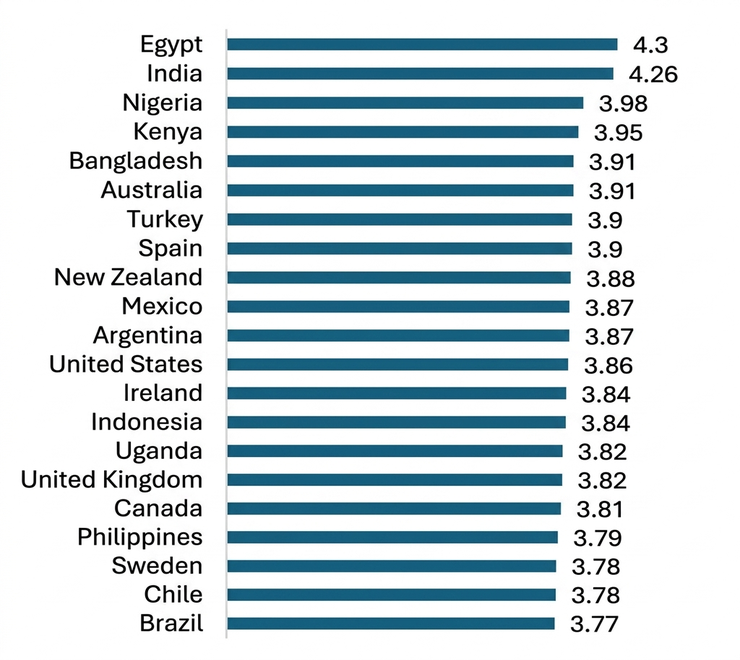
Figure. Weighted means of confidence in scientists across countries and regions (1=very low; 3=neither high nor low; 5=very high)
Source: Nature Human Behaviour.

“The role of more robust, continuous, and well-structured science communication and science education policies becomes evident from this data,” states the study text, which was supported by the National Council for Scientific and Technological Development (CNPq). A survey-type investigation, conducted between November 2022 and August 2023 in 68 countries and published in “Nature Human Behaviour,” showed differences regarding the population’s trust in scientists around the world. Brazil ranks 21st, behind countries such as Egypt, India, Uganda, and Chile (figure).

“Infodemics have happened in one way or another in past epidemics, but what is happening now is on a global scale, where people are connected through different means and share information more quickly,” says Tim Nguyen, who manages the WHO’s epidemic information service, in a text on the entity’s website.

Operation

The mechanism that drives the information false was described by the University of Oxford. Researchers analyzed 830 news sources and concluded that misleading information (which they called “junk news”) is promoted by groups with financial interests, who optimize their content to appear with prominence in search engines on the internet and on social networks, through SEO (Search Engine Optimization) techniques.

The research, published in 2020, investigated why, during the Covid-19 pandemic, users had been exposed to misleading content. Among the main conclusions, the study highlights that websites of great prestige also promoted disinformation, inadvertently, by amplifying their online visibility — the republication of news without proper fact-checking may be one of the causes.

AI

Another instrument that has been serving — unintentionally or not — for scientific disinformation is Artificial Intelligence (AI). According to a report by “The Guardian”, in 2023, more than 10,000 articles published worldwide were subject to retractions due to improper and/or inadequate use of AI, linked to reasons ranging from authorship of information to data processing (read more in the column AI in scientific writing: advances and ethical implications).

“In the context of post-truth, people tend to prioritize their personal beliefs over scientific facts, a phenomenon exacerbated by the logic of algorithms on social media,” says a passage from the book “Challenges and strategies in the fight against scientific disinformation,” released in 2024 by the Brazilian Academy of Sciences, which proposes guidelines and actions to combat scientific disinformation, with a focus on education.

“Mitigating scientific misinformation requires a solid understanding of science, communication strategies, and media manipulation. Among the actions, the importance of developing critical thinking about media and social networks is highlighted, helping people to objectively evaluate information, verify evidence, and recognize biases,” says the text.

Psychological factor

But why is it so easy to spread false information? Psychological factors contribute greatly to this phenomenon, according to the APA (American Psychological Association). “People are more likely to share misinformation when it aligns with personal identity or social norms, when [the information] is novel, and when it evokes strong emotions,” states text on the entity’s website.

Concerned about the situation, in February 2024 the body issued a resolution addressed to psychologists, educators, researchers, and public policymakers titled Combating Misinformation and Promoting Psychological Science Literacy, with the aim of increasing public awareness of the psychological mechanisms behind the creation and dissemination of misinformation.

Among other things, the resolution proposes the “inclusion of the psychological science point of view in public health campaigns, educational programs, and political initiatives that address health misinformation”. The text also highlights that the possible consequences of misinformation include even violence, as happened with the cell phone towers that were set on fire in England after the circulation of false information about the supposed dangers of 5G wireless technology. “We are all susceptible to misinformation to some extent, even on subjects we know, because fact-checking is an arduous cognitive task,” the text states.

The role of scientific journals

Given the speed at which information circulates and the amount of data available, the role of scientific journals becomes even more relevant: they are the ones that help to organize, validate and give visibility to the knowledge produced by researchers and specialists. “Through editorial curation, peer review, and adherence to ethical and methodological criteria, these publications ensure that the knowledge present there is reliable and useful,” states Simone Oliveira, coordinator of Editora Pecege, responsible for the publication of the scientific journal “Quaestum” and the technical-scientific publication “Estratégias e Soluções (E&S)”.

“As editorial coordinator, I realize that journals play a formative role, not only for authors but also for reviewers, editors, and society (readers). Each accepted article, each opinion issued, each adjustment made, strengthens scientific and editorial culture. The publication process is, in itself, a space for learning and intellectual growth,” she says.

For her, it is also important to recognize that the publishing world needs to keep up with social transformations, technological and cultural, and this requires “openness to new formats, articulation with other areas of knowledge, attention to language, accessibility, visibility, and structured editorial policies to validate publications”. The challenge, she says, “is to maintain this commitment to quality without losing sight of the fluidity of processes, the transparency of decisions, and the real impact that science can (and should) have on the world”.

Anti-vaccine movements

The first vaccine considered a success story, according to the World Health Organization (WHO), emerged in 1796, against smallpox. Developed by the English physician Edward Jenner from the cowpox (vaccinia) virus, it caused unease and distrust in some sectors of society at the time, who did not understand the immunization process and feared side effects, even if mild.

A few decades later, on the other side of the Atlantic, the launch of a vaccination campaign in Brazil, in the town of Paracatu (MG), in 1832, led a group of people to stone the house of the Chairman of the Municipal Council, a position equivalent to mayor, out of fear of information from anonymous pamphlets claiming the politician intended to infect everyone. It was later proven that these were fake news distributed by a judge who was a political enemy of the Chairman of the Council (Westin, 2020).

In 1853, an anti-vaccine movement began to organize in London and culminated in the creation of an anti-vaccination league (Oliveira et al, 2022). Despite all the attacks, research continued, and currently, vaccines protect against more than 30 diseases, from pneumonia to cervical cancer, and immunization helps prevent up to 5 million deaths per year globally (WHO, n.d.).

The opposing voices, however, did not subside. The anti-vaccine movement gained new momentum in 1998, when British doctor Andrew Wakefield published a paper in the medical journal “The Lancet” suggesting that the measles, mumps, and rubella (MMR) vaccine could cause autism. The study, filled with ethical, technical, and methodological flaws, was eventually retracted.
To access the references of this text click here

This content was produced by:

Renata de Gáspari Valdejão Almeida

LinkedIn

Assistant Editor of the “Strategies and Solutions (E&S) Magazine”, published by Pecege Publishing House. She is a journalist, screenwriter, and researcher. She worked for 16 years at “Folha de S.Paulo”, as an editor and reporter, and collaborated with several national circulation magazines, such as “Época Negócios”, “Revista Pais & Filhos”, and “Superinteressante”. She worked in the communication area of the USP School of Medicine and was the Audiovisual Coordinator of UNA-SUS/UFMA, in Maranhão.

Who wrote this column

Editora Pecege

Produz materiais nas áreas de agronegócios, educação, gestão e tecnologia, prestando serviços de padronização, revisão, elaboração de ficha catalográfica e produção gráfica. Gerencia a publicação das revistas Quaestum (científica) e Estratégias e Soluções – E&S – (técnico-científica) e publica livros em diversas áreas.

You may also like

October 02, 2026

Determinants of supermarket location in São Paulo

A study investigated the determining factors for supermarket location in the state of São Paulo, with the objective of investigating the factors that explain the presence and expansion of these establishments, considering socioeconomic, demographic, and market dimensions. Data from the 2010 and 2022 Demographic Censuses of IBGE and information from the National Registry of Legal Entities of the Federal Revenue of Brazil were used to build a georeferenced database. A Random Forest classification model was applied, adjusted by grid search with cross-validation, prioritizing the recall-macro metric due to the imbalance of the dependent variable, which represented the presence or absence of supermarkets within a 50-meter buffer. The results indicated that supermarket location is strongly associated with demographic, income, and population characteristics in the surrounding area. The analysis of variable importance showed that sociodemographic factors, such as elderly literacy, household income, and the presence of other food establishments, exerted significant influence, especially in the immediate vicinity. The findings reinforced the hypothesis that the spatial distribution of supermarkets is not random, being conditioned by socioeconomic characteristics and the commercial structure of the territory, offering subsidies for business decisions and urban planning.

Keywords: Spatial Analysis; Machine learning; Expansion; Commercial location; Supermarkets.

Neuroscience And Learning In Education

October 02, 2026

Anti-Racist Education: Inclusive Educational Practices and Social Development

Antiracist education, understood as a structuring axis of inclusive education and social development, was investigated in the Brazilian context. The study aimed to identify and analyze, based on legal documents and teachers’ perceptions, educational practices capable of promoting antiracism in school and society, and how the implementation of Laws nº 10.639/03 and nº 11.645/08 contributed to social justice. A qualitative and documentary approach was adopted, with analysis of educational legislation, curricular guidelines, institutional reports, and academic literature. Complementarily, a semi-structured questionnaire was applied to 295 Basic Education teachers. The data were evaluated quantitatively and qualitatively, through thematic content analysis, and validated with bibliographic studies. The results revealed a paradox: despite a robust legal framework, the implementation of antiracist policies proved fragile and sporadic, with a lack of teacher training, adequate teaching materials, and monitoring. Significant educational inequalities between white and black students were found to persist, and most teachers acknowledged the occurrence of racism in schools, but without clear institutional protocols. Neuroscientific analysis showed that racism negatively impacts students’ cognitive and emotional development. It was concluded that antiracist education is central to quality education, requiring political commitment, public investment, and intersectoral articulation. The integration of Neuroscience in teacher training and the production of qualified materials are crucial to strengthen the school’s role in building a more just and inclusive society.

Keywords: Social Development; Antiracist Education; Social Justice; Law 10.639/03; Inclusive Educational Practices.

Neuroscience And Learning In Education

October 02, 2026

Paths of Inclusion: Perceptions of Parents and Teachers on the Schooling of Students with Dual Exceptionality in the Brazilian Context

Dual Exceptionality, characterized by the coexistence of High Abilities/Giftedness and neurodevelopmental disorders, represents a complex phenomenon that challenges traditional identification and schooling models. The study aimed to understand the perceptions of parents or guardians, teachers, and other education professionals regarding the schooling of students with Dual Exceptionality in the Brazilian context, investigating challenges, pedagogical strategies, and possibilities for inclusion based on equity. The research adopted a qualitative, exploratory, and descriptive approach, and collected data through an online, voluntary, and anonymous questionnaire answered by 25 participants. Discursive data were analyzed using thematic content analysis. The results indicated that knowledge about the topic is often built from personal and professional experiences, revealing gaps in systematic training. Difficulties were identified in identifying these students, in teacher training, and in implementing individualized educational plans, pedagogical flexibility, and curriculum enrichment. Socio-emotional repercussions, such as frustration and low self-esteem, were reported. However, some schools demonstrated inclusive practices based on equity, articulating specific needs and potentialities. Although the results do not allow for generalizations, they highlighted the need to strengthen professional training and the articulation between school, family, and specialized services. It was concluded that the inclusion of students with Dual Exceptionality requires practices that simultaneously recognize their difficulties and potentialities, ensuring equitable conditions for participation, learning, and development.

Keywords: Human development; Teacher training; School inclusion; Neurodivergence; Pedagogical practices.

October 02, 2026

Data Transformation into Strategy: Applied Research for Ecotourism Operation Optimization

The growing demand in ecotourism in Minas Gerais has driven the search for business intelligence to transform customer data into strategic information. The study aimed to structure a data science pipeline to collect, segment, and classify the customer base of an ecotourism operation, in order to optimize marketing actions and anticipate market movements. An exploratory, quali-quantitative research was conducted through a case study. 2,777 transactional records from an ecotourism company, referring to January 2024 to December 2025, were used. The methodological process involved automated data collection (Google Sheets API), processing and enrichment (ETL), validation, and creation of RFM (Recency, Frequency, and Monetary Value) attributes. Dimensionality reduction via PCA and K-Means clustering was applied, with the number of clusters defined by the Elbow method and Silhouette Score. The results were validated with DBSCAN and K-Medoids. The results revealed the identification of three behavioral customer segments: “Loyal”, “Low Value”, and “Potential”. The “Loyal” segment represented the highest accumulated economic value, while the “Potential” segment stood out for its high average ticket and potential for conversion into recurrence. The integration of data analysis techniques proved to be a robust and replicable method for generating intelligence in ecotourism. It was concluded that the structured data science pipeline enabled the behavioral segmentation of the customer base, the statistical validation of the groups, and the creation of a predictive system for new buyers, providing subsidies for data-driven strategic decisions and future analyses.

Keywords: Clustering; Business intelligence; Machine Learning; Customer segmentation; Decision making.

October 02, 2026

Classification of defaulting customers using supervised machine learning techniques

The risk of default in credit operations demanded analytical approaches to anticipate losses. This study comparatively evaluated the performance of supervised machine learning models in classifying defaulting customers in credit card operations. The public dataset “Default of Credit Card Clients” from the University of California Irvine was used, with 30,000 observations and class imbalance. The algorithms Logistic Regression, Random Forest, and Extreme Gradient Boosting were employed. The imbalance was addressed by assigning weights to the classes, and model optimization occurred with the RandomizedSearchCV method, prioritizing sensitivity. Cross-validation results indicated that the Extreme Gradient Boosting model showed a higher capacity for identifying the defaulting class and better discriminatory performance, followed by Random Forest and Logistic Regression, with a sensitivity of 0.8250 and an AUC-ROC of 0.7844 for XGBoost. Interpretability analysis, conducted by the Shapley Additive Explanations (SHAP) technique, highlighted the predominance of variables associated with payment behavior, especially the history of delays. It was concluded that tree-based models, particularly boosting techniques, proved to be more suitable for capturing complex patterns in the data, configuring themselves as consistent alternatives for credit risk management.

Keywords: Machine Learning; Credit Card; Classification; Extreme Gradient Boosting; Credit Risk.

October 02, 2026

Sentiment Analysis on Brazilian Banks on Twitter/X: Comparison between Traditional and Digital Institutions

A study analyzed public perception of Brazilian financial institutions on the Twitter/X platform, highlighting the importance of sentiment monitoring on social networks for understanding reputation and customer experience in the banking sector. The objective was to compare user perception of the image and reputation of traditional and digital banks, based on the sentiment patterns identified in the analyzed manifestations, seeking to identify structural differences between these groups. The methodology was based on the analysis of 1,096 tweets collected between November 2022 and June 2023. Two complementary sentiment analysis approaches were used, the sum and the average of labels, to capture the majority sentiment and nuances of perception. Additionally, the Market Profile Model, with indicators of emotional reputation, reputational risk, neutrality, and polarization, and the Banking Clustering Model, which allowed grouping institutions according to perception patterns, were developed. The results indicated a predominance of neutral and negative sentiments, a higher volume of interactions in digital banks, and structural differences in the emotional intensity of perceptions, with greater stability in digital banks and greater polarization in traditional ones. It was concluded that the combination of analytical and statistical techniques contributed to an in-depth understanding of institutional image in the digital environment, demonstrating the importance of data-driven reputation management strategies.

Keywords: Digital banks; Traditional banks; Data modeling; Opinion mining; Social Networks.

October 02, 2026

Optimization of annual budget planning through project management methodologies

The Annual Budget Planning (POA) is a crucial process for translating organizational strategy into operational and financial goals, but it frequently faces deadline pressures, interdepartmental dependencies, and the repetition of habitual expenses. The study aimed to analyze how the combined application of project management practices and Zero-Based Budgeting (OBZ) can optimize the POA. To this end, a case study was developed in the Brazilian operation of a publicly traded company in the beverage sector, using documentary research of its 2023 results report and an anonymous questionnaire applied to 47 respondents. Documentary analysis indicated growth in net revenue, expansion of gross profit and adjusted EBITDA, and contained advancement of selling, general, and administrative expenses, suggesting cost discipline and operational leverage. The complementary survey revealed a high perception of cascading effect on the schedule, strong support for defining cost package owners, and a preference for technical justification of expenses, in addition to demand for controlled flexibility after the baseline definition. It was concluded that structuring the POA as a project, associated with the rigor of OBZ, increased the process predictability, reinforced accountability for expenses, and broadened the coherence between budgetary execution and economic-financial performance.

Keywords: Cost Control; Operational Efficiency; Zero-Based Budgeting; PMBOK; Beverage Sector.