Data Science
Publishing
Education
May 29, 2025
Open science: between the ideal and the possible
Absence of clear policies, lack of standardization in data opening processes, and structural inequalities are hindrances
“Scientific knowledge, like language, is intrinsically the common property of a group or it is nothing”. This sentence from the physicist and one of the most influential philosophers of science of the 20th century Thomas Kuhn (1922–1996), in his celebrated work “The Structure of Scientific Revolutions” (1962), recalls that science has always been a collective endeavor.
However, perhaps it has never been sufficiently evident how essential collaboration, transparency, and information sharing are for the advancement of knowledge. Open science recovers this critical dimension highlighted by Kuhn by proposing a more dialogical scientific practice, guided by constant questioning of current paradigms, in which criticism, review, and sharing are not threats, but essential factors for scientific progress.
In this sense, as Mário Bunge highlights in the 1987 update course on epistemology, a critical and fair understanding of knowledge can inspire more balanced scientific practices, capable of promoting the integral and continuous development of scientific research. This is an essential condition for this model of doing science to consolidate in a sustainable way across the various theoretical approaches to investigation. It is precisely in this aspect that the complexity of the issue lies: rethinking the way we produce, validate, and disseminate scientific knowledge. Nevertheless, concerns persist regarding sensitive data and the fear that sharing information may expose or weaken researchers (Ribeiro and Oliveira, 2024).
Inspired by principles such as free access to publications, transparency in research data, societal engagement in investigative processes, and the strengthening of citizen science, this approach has been gaining ground worldwide. According to the USP Open Science project, this new way of doing science is defined as “an inclusive construction that combines various movements and practices, aiming to make multilingual scientific knowledge available openly, accessible, and reusable for everyone,” guided by access to knowledge (USP Portal).
Brazil has stood out in this scenario: in 2023, 156,800 scientific articles were published, 75% in open access, which guaranteed the country the 10th position worldwide in scientific production, according to data from the international catalog OpenAlex presented by Capes (Coordination for the Improvement of Higher Education Personnel). The results not only demonstrate the vigor of national scientific production but also highlight the growing commitment to the principles of open science (Capes, 2023). These numbers, linked to discussions about the limits and impacts of open science, reveal fertile ground for fostering debate about an academy more connected with contemporary challenges and with the democratization of knowledge.
Nevertheless, according to Heinz and Miranda (2024), the implementation of open science occurs gradually and, often, below the desired pace. This is due, among other factors, to the structural complexity involved in this process, such as the need for robust technological infrastructure and continuous investments, especially focused on data transparency and accessibility, in addition to well-defined institutional policies to ensure the secure and efficient sharing of scientific data (Heinz and Miranda, 2024; Ribeiro and Oliveira, 2024). This scenario highlights that, although open science represents a significant advance in the democratization of knowledge, its consolidation depends on coordinated efforts among researchers, institutions, and policymakers.
Challenges
Despite the advance of open science in Brazil, its consolidation still encounters important resistances both at the individual and institutional levels. Many researchers fear that the early sharing of data and results may lead to undue appropriation of their discoveries or to the compromise of their competitiveness in funding calls and academic evaluations, based, mostly, on traditional productivity metrics (Heinz and Miranda, 2024).
From an institutional point of view, the challenges are also significant. The absence of clear policies, the lack of standardization in data opening processes, and structural inequalities between regions and institutions hinder the adoption of truly open practices, as pointed out in the work “Open Science in Brazil: achievements and challenges,” organized by researchers from UFRGS and Ibict in 2025. Launched in April, the work indicates that the consolidation of open science in Brazil demands more than institutional will: it requires profound cultural changes, investments in infrastructure, and coordinated actions among funding agencies, universities, government, and research centers.
Another central aspect is the very conception of open science, which is often still perceived with distrust or confused with a simple bureaucratic requirement. In January 2025, researchers from CNPq (National Council for Scientific and Technological Development) published an article on the Capes website titled “Open Science: an unbiased view”, in which they suggest that the implementation of open science should be gradual, respecting the particularities of the national scientific system and considering the real working conditions of Brazilian researchers.
A month later, a group of researchers from various institutions published a response letter on the Zenodo repository — an open data platform — titled “Promotion and Implementation of Open Science in Brazil: response to the article ‘Open Science: an unbiased view’”. This statement well illustrates the different visions surrounding the topic. Although they acknowledge the obstacles mentioned in the original text, the authors of the letter argue that an excessively cautious stance can retard advances that are already underway. For them, it is necessary to overcome the view that open science imposes only burdens and, instead, highlight the gains in transparency, collaboration, and social impact that it can offer.
In this sense, the discussion should not be restricted to technical feasibility, but must also address the role of open science as a driver of responsibility in scientific practice. Despite the obstacles within the scientific community itself, different institutions have been experimenting with promising paths to make open science more viable and effective.
In Brazil, the movement towards open science began in the 1990s, with the creation of the SciELO (Scientific Electronic Library Online) portal, a pioneering virtual library focused on expanding free access to national scientific journals. SciELO not only democratized access to knowledge produced in Brazilian institutions but also established standards of quality and international visibility for these publications.
In parallel, there was a rapid adoption of the free publishing software OJS (Open Journal Systems), which contributed significantly to the editorial autonomy of academic journals and to the consolidation of more accessible and sustainable scientific publishing practices (Marques, 2024). These actions were fundamental to paving the infrastructure for open science in the country and continue to be a reference in free access and participatory editorial management initiatives.
Awareness
Another area of activity has been the training and awareness of researchers within research centers, such as universities. Institutions like UFRGS, Unicamp, and Fiocruz have been promoting workshops, courses, and events focused on training in data management, the use of open repositories, and good scientific sharing practices, contributing to reducing resistance and increasing understanding of the benefits of openness.
Another relevant example is the work of the Brazilian Institute of Information in Science and Technology (Ibict), a unit of the Ministry of Science, Technology, Innovations and Communications (MCTIC) that has been acting as the national articulator of open science through the development of platforms, guidelines, and public repositories such as Oasisbr (a database that brings together thousands of open access publications in the country). By offering technical and methodological support, Ibict has contributed to the standardization of scientific information at various institutional levels (Campos et al., 2023).
In the international scope, the practice of Data Management Plans (DMPs) stands out, required by funding agencies such as the National Science Foundation (NSF) in the USA and Horizon Europe in the European Union. These plans oblige researchers to reflect, from the beginning of their projects, on how they will store, protect and eventually share the collected data (Spichtinge, 2022). In Brazil, Fapesp already adopts similar guidelines in some of its calls, being a way to promote a culture of planning and responsibility in the use of scientific data (Agência Fapesp, 2023). These practices increase the visibility of research and favor inter-institutional collaborations, in addition to meeting the principle of public return on knowledge funded with public resources.
Furthermore, openly making scientific knowledge available is an act that challenges the current global scenario, marked by the geopolitical division of scientific production, as recommended by Unesco (United Nations Educational, Scientific and Cultural Organization). Thus, open science is configured as a powerful tool for democratizing knowledge in the face of inequalities existing between the global North and South, provided it is accompanied by effective policies for digital inclusion, equitable funding, and recognition of diverse research trajectories (Unesco, 2020).
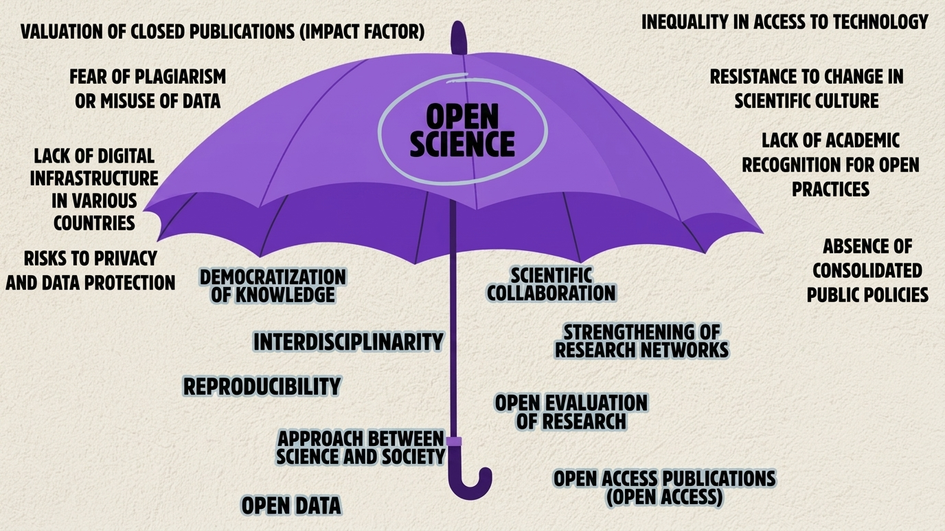
In connection with this discussion, several views and questions arise regarding the viability and applicability of open science in all areas of knowledge. These challenges include risks associated with plagiarism and the misuse of data, which, combined with the insufficiency of digital infrastructure in many regions, contribute to resistance to changes in scientific culture (Capes, 2025).
The following figure represents open science as an umbrella that shelters different fundamental principles and practices. At the same time, it highlights the main challenges that hinder its consolidation. This visual metaphor synthesizes the contrasts faced by open science, emphasizing its transformative potential in the face of existing barriers in the contemporary scientific landscape (Caballero-Rivero et al., 2019).
Far beyond open access
Just as Kuhn wrote, paradigm shifts require a break in traditional ways of thinking and doing science. In this sense, open science can be understood as one of these silent revolutions, which challenge “normal science” and propose new criteria for validation and circulation of knowledge. More than guaranteeing free access to scientific articles, open science discusses changes in the culture of research. This involves making data accessible for reuse, adopting more transparent peer review practices, and even allowing citizens to actively participate in scientific projects (Unesco, 2020).
This movement is not just technical. It demands, above all, an ethical and political review regarding the place that science occupies in society. Who has access to knowledge production? Who benefits from it? Who participates in its construction? By answering these questions, open science reveals itself as an opportunity to bring academia closer to social reality and broaden the impact of knowledge (Marques, 2024).
This reconfiguration is not a simple task. By requiring the opening of processes, data, and decisions, open science challenges historically consolidated hierarchical structures in the scientific field. Instead of knowledge produced by a few and validated by peers in closed spaces, a more horizontal model is proposed, where different actors, including non-academics, can participate in the formulation of questions, data collection, and interpretation of results (Marques, 2024).
This entire process demands constant adaptation, with the development and improvement of clear guidelines on open science, considering the varied economic and structural contexts that involve scientific production. Questions about the viability of this approach in different areas of knowledge still persist.
Repositioning science as common good, bringing it closer to social demands, and building a culture of openness based on trust, on the wide and accessible dissemination of knowledge, can indeed be one of the most significant transformations of our time (Marques, 2024). More than a “silent revolution”, open science can be the engine of a new social contract around knowledge: fairer and more inclusive. As discussed in this text, truly open science also needs to be a science that listens: attentive to the limits, dilemmas, and potentials of its own subjects.
| To access the references of this text click here. |
This content was produced by:

Luiz Eduardo Giovanelli
Master in Business Administration from the University of São Paulo. Specialist in Public Management from the State University of Ponta Grossa and graduated in Business Administration from the State University of Northern Paraná. Since 2023, he has been one of the assistant editors of the Revista Estratégias e Soluções.
Who wrote this column
Editora Pecege