Strategy
Innovation
Technology
May 05, 2025
Smart cities: the future we want to inhabit today
Municipalities that monitor their progress cease to depend on rhetoric and begin to build concrete legacies
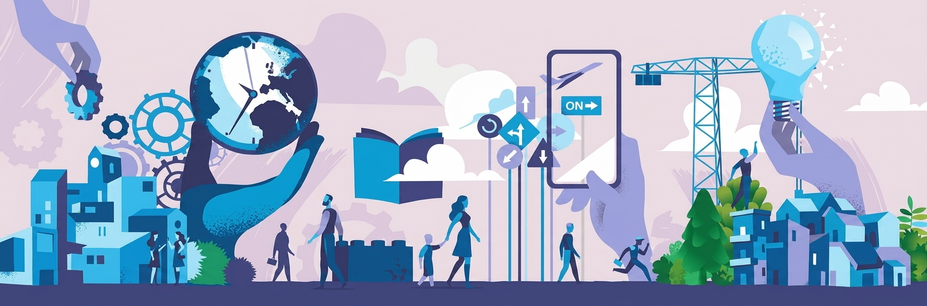
Throughout history, few inventions have shaped civilization as much as cities. More than spaces for habitation or production, cities have always been stages for innovation, diversity, and major social transformations, a living synthesis of culture, economy, and coexistence.
But, if every city is, by essence, a continuous project for the future, the question that arises in the 21st century is: what future are we building?
Today, cities concentrate more than 56% of the world population and account for a large part of global economic activity, an index that should reach 70% by 2050, according to the UN. In Brazil it is estimated that more than 87% of the population lives in urban centers, according to IBGE. At the same time, urban centers are the epicenter of inequalities, environmental crises, infrastructure pressures, and social exclusion. This urban paradox shows that, more than ever, we need to rethink the role of cities in the face of contemporary challenges.
It is in this context that the concept of Smart Cities gains strength, but it is still often misinterpreted as a simple race to adopt digital technologies. But is urban intelligence just about installing sensors, applications, and free wi-fi networks?
Frequently, the concept of Smart Cities is still reduced to the idea of digitalization, which is a big mistake. After all, true urban intelligence lies not in its technological infrastructures, but in the city’s capacity to promote inclusion, full development, resilience, and citizen participation. A city can only be considered smart by also promoting smart citizenship, connecting technology, democratic governance, sustainability, and social innovation around a clear purpose: to improve people’s lives and respect the planet’s limits. And, to do so, it is necessary to face a reality that many prefer to ignore. Today’s cities show unmistakable signs of urban and social exhaustion and collapse:
- Uncontrolled growth and unproductive urban voids;
- Degradation of historical heritage and cultural identity;
- Increase in the homeless population and social vulnerability;
- Inefficient mobility, traffic chaotic and lack of multimodal transport;
- Pollution, heat islands and environmental disasters aggravated by unbridled urbanization;
- Public services overloaded and unequal;
- Violence urban, social polarization and exclusion digital;
- Loneliness amidst hyperconnectivity;
- Outdated education and precarious labor markets.
It is clear that these challenges will not be overcome with isolated solutions or technologies applied in a fragmented way. It is necessary to understand that cities are living and complex systems, which require responses integrated, that articulate innovation with territorial justice, sustainability and active participation of society. A smart city is essentially born from the way it is governed. Centralized, opaque, and bureaucratic models can no longer support current complexity.
It is necessary to build collaborative governance systems, integrating public authorities, the private sector, academia, and civil society around decisions oriented by data and evidence. To achieve this, tools such as participatory digital platforms, urban observatories, and innovation laboratories (living labs) already demonstrate, in various parts of the world, that it is possible to redesign urban management with greater transparency and efficiency.
In the 21st century, cities must be designed and reordered based on principles that transcend mere functionality. They need to incorporate an integrated vision, where economic development, social justice, and environmental balance go hand in hand. In this sense, smart cities must also be:
- Innovative: capable of transforming your daily challenges into creative solutions, developing local responses with the potential for global impact, by fostering ecosystems of experimentation and continuous adaptation;
Sustainable: structured in harmony with the environment, ensuring that urban growth respects ecological limits, promotes the regeneration of natural resources, and guarantees quality of life for present and future generations; - Resilient: prepared to face and adapt to social, economic, and climatic shocks, building flexible urban systems capable of withstanding adversities and recovering from crises with agility and efficiency;
- Sponges: integrated into the logic of nature, adopting solutions based on green and blue infrastructure, capable of absorbing and managing rainwater, mitigating floods, reducing heat islands, and improving the urban microclimate, promoting more livable cities;
- Digital: where technology is applied ethically and strategically, expanding access to public services, ensuring digital inclusion, and putting innovation at the service of citizenship and governmental transparency;
- Educators: committed to the continuous formation of critical, conscious, and engaged citizens, transforming the urban space into an environment of permanent learning, where knowledge circulates and empowers communities;
- Inclusive: structured to ensure that everyone — regardless of origin, economic condition, or location — has full access to the opportunities, rights, and benefits of urban life, eliminating barriers and promoting social equity;
- Creative: environments that recognize and enhance cultural diversity, art, and innovation as drivers of development, stimulating talent expression and fostering original solutions for complex problems;
- Entrepreneurs: cities that cultivate dynamic economic ecosystems, encouraging entrepreneurship, impact economy, and cross-sector collaboration, promoting income generation, skilled employment, and sustainable competitiveness.
Cities will not become smart through mere technological adoption. They will only evolve when there is integration social and courage from public management to rethink priorities, break with exclusionary models and adopt innovation as a tool for development, inclusion, sustainability, and social purpose. Jan Gehl (2010), architect and urban planner, advocated the maxim: “Change the mindset, change the cities”. For him, when people’s mindset shifts from the accumulation of goods to quality of life, cities naturally follow this change and become more human environments.
Among the most promising tools to drive the digital and sustainable transformation of Brazilian cities is the adoption of urban sandboxes, controlled experimentation environments that allow testing innovative solutions directly in the territory, with regulatory flexibility and public oversight. As an urban innovation environment, the sandbox allows emerging technologies, such as IoT, artificial intelligence, sustainable mobility, and GovTech solutions, to be applied agilely and safely, anticipating adjustments before large-scale adoption in the territories.
In Brazil, some municipalities already stand out and demonstrate how this strategy can be effectively applied:
- Foz do Iguaçu (PR) implemented a sandbox in the Vila A neighborhood, transforming the region into a living laboratory for urban innovation. The initiative allows startups and companies to test technologies related to electric mobility, renewable energy, smart lighting, and public safety, positioning the city as a benchmark for Smart City solutions;
- In Rio de Janeiro (RJ), the city hall created a regulatory sandbox focused on urban innovation and economic development, opening space for the experimentation of technologies in areas such as mobility, environment, security, and digital public services. The initiative seeks to bring the public sector closer to the Carioca innovation ecosystem, encouraging partnerships with startups and universities.
More than a de-bureaucratization tool, the sandbox positions municipalities as open innovation platforms, bringing together government and the creative ecosystem to co-create responses to urban and social challenges.
Cities that adopt this strategy begin to orchestrate the transformation, stimulating a culture of continuous experimentation, collaboration, and evolution, essential pillars for truly intelligent, inclusive, and sustainable territories.
For any city aiming to be smarter, sustainable, and inclusive, the adoption of realistic indicators and clear metrics is not an option, it is the basis of management. To guide cities in this process, international standards, such as NBR ISO 37120, NBR ISO 37122, and NBR ISO 37123 (ABNT), establish solid benchmarks for evaluating not only the efficiency of urban services but also the degree of innovation, sustainability, and resilience of the territory.
More than technical instruments, these indicator systems represent a true pact with transparency and efficient governance. Measuring quality of life, tracking public service performance, and monitoring economic development means committing to evidence-based decision-making and ensuring continuous, measurable urban evolution for society.
Cities that monitor their progress cease to depend on rhetoric and begin to build concrete legacies, where each data point is an opportunity for improvement and each indicator, a signal that the future is being guided with responsibility and strategic vision.
The debate about smart cities is not technical. It is ethical. It is about deciding whether we want to live in territories that repeat the past or that design a fairer future. In “The Death and Life of Great American Cities” (1961), Jane Jacobs highlighted that cities have the capacity to offer something to everyone, but only when they are created by everyone.
It is worth remembering that cities reflect what we as a society choose to build and cultivate. Today technology is available. Knowledge is accessible and the challenges are urgent. The question is: are we prepared to transform this potential into reality?
| To access the references of this text click here. |
Who wrote this column
Pedro Chamochumbi