Digital
September 09, 2025
Bobbie Goods, love strawberry, pacifier trend: platforms as consumption infrastructure
Discovery, production, distribution, and purchase happen in the same circuit, and each new peak trains the system for the next
I may even seem late talking about these subjects, but I’m not. If there is anything that social media has taught us is that relevance is not measured by “who posted first”, but by who understood how the wave forms, propagates, and converts into behavior. In some cases, into sales.
What I propose for this article is to think about some recent phenomena that have taken over social media and which you have certainly heard of: the Bobbie Goods coloring book, the viral phenomenon of the love strawberry, the trend of pacifiers for adults, and the “memetic” and iconic reincarnation of Odete Roitman, not as curiosities of the feed, but as evidence that platforms have ceased to be media to become infrastructure for consumption, whether of the content itself or of the product behind the trend. On them, discovery, production, distribution, and purchase happen in the same circuit, and each new peak trains the system for the next.
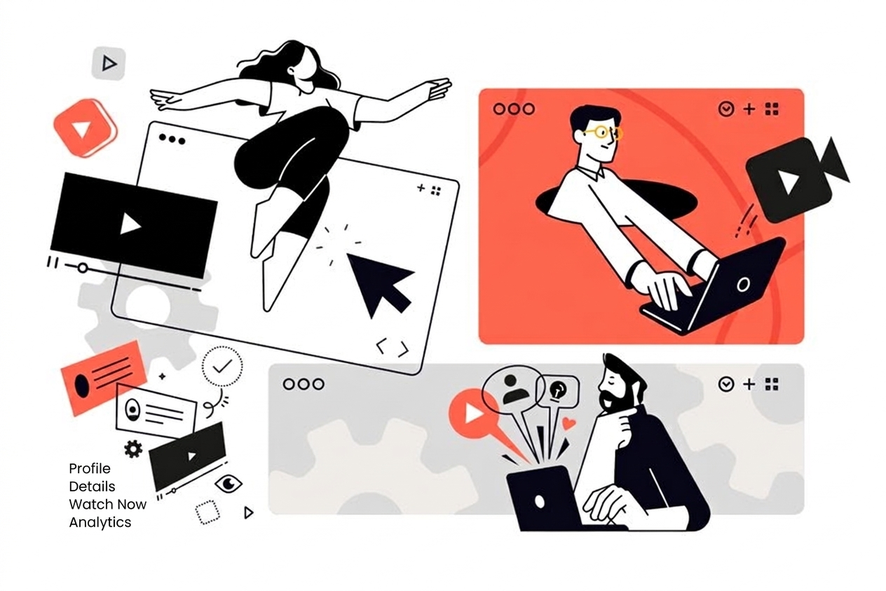
The platforms have become a consumption infrastructure because they shorten the path between seeing, desiring, and acting. TikTok’s algorithmic “for you” (FY) feed, Instagram’s “reels/explore”, and YouTube’s “shorts” put content in front of people who are not even followers yet, increasing the factor of “discovery“.
On the production side, the applications themselves offer templates and effects that put everything in the right format without much technical effort: ready-made templates, automatic captions, narration (voice-over), green screen, video acceleration (time-lapse), and response features like duets (which allow creating a video side-by-side with another person’s video). When this material is created in easy-to-copy videos, it gains scale with repeatable formats like ASMR (Autonomous Sensory Meridian Response, which is the appeal of sound and texture), POV (point of view), among several others, which multiplies reach organically.
The conversion sticks to the content, because the click is closer: it can be given by a direct link, by a DM (private message) or by the platform’s native store. All this shortens the path between liking and buying or requesting information. And all this returns in simple data to read: retention in the first 10 seconds, click-through rate, saves, shares, and remixes.
This data helps to repeat what worked and adjust what didn’t work in the next publication. The result is a compact funnel: seeing, desiring, and acting happen in minutes. We are not just talking about gaining audience. We are talking about a logistics of attention that culminates in a behavior, whether it’s purchasing or sharing.
In the examples in this column, you can see this mechanism end-to-end. In the “love strawberry”, the close and the sound of the cone (ASMR) grab attention, and the profile already provides a link and DM for the menu and orders. The jump from the feed to WhatsApp or delivery happens right there. At Bobbie Goods, the sped-up “color with me” video, with the color names on the screen, creates a simple ritual to reproduce; the video points to the link of the book or kit, and followers start publishing their own versions, fueling more discoveries.
Regarding Odete Roitman, the iconic lines become soundbites (short excerpts of the character’s speech) for lip sync and reactions. The profiles leave a fixed and permanent path for short video clips: on Instagram, with links in the bio or in highlights; on TikTok, through pinned comments, videos, and links in the bio. YouTube uses comments and the description with a link, and X, the pinned post with a link. It is this combination — which unites algorithmic discovery (process by which content is found by new users), facilitated production, copyable format, one-click purchase, and data to adjust and refine new videos — that transforms social media into consumption infrastructures.
Let’s get back to Bobbie Goods. At first glance, they are cute coloring books with a cozy aesthetic. But what makes this content scale is not just the delicacy of the stroke, it’s the way it ritualizes time. A format simple enough for anyone to reproduce without fear, which turns viewers into co-authors. When this gesture becomes a shareable habit, the algorithm recognizes the recurrence and promotes reward with more delivery. By similarity, it recommends other coloring videos, creating an “infinite shelf” that sustains discovery.
From the commercial side, the bridge is installed: books, kits, pens, papers, all a click away. Affection turns into a shopping cart not because someone “pushed a sale”, but because the experience was designed for participation, and the infrastructure shortened the path.
In the case of the “love strawberry”, the driver is sensory. As mentioned earlier, the “crock” sound works as a trigger for attention and desire. The ritual is hypnotic: melt, dip, harden, break. There is no need to explain anything, as the pleasure is evident. The format calls for close-ups and clean audio; it is easy to replicate in real kitchens; the audience recognizes the sequence and awaits the climax.
In a matter of hours, repetition creates critical mass: duets with reactions, tutorials, comparisons, memes. The transition from the feed to purchase is almost natural. When the square allows, there’s a line at the physical storefront. This is what happened with several bakeries. And here lies the difference between noise and results: those who had price, stock, automatic response, and payment methods ready captured the window; those who didn’t, became spectators of their own peak. The point isn’t “getting lucky with the trend“, but already operating with content and conversion linked from the start.
Odete Roitman is yet another example. The character reappears in the remake with layers that dialogue with the social media era: quotable phrases, surgical irony, scenes that fit into any contemporary joke. The phenomenon shows an important displacement: the soap opera may fluctuate on open TV and, at the same time, dominate social networks, taking the plot’s success to another channel.
The value ceases to fit into a single metric (TV audience) and is distributed across attention portfolios: time viewed, clip replication, mentions, name searches, creative appropriations. The TV audience feeds social networks, which in turn feed the TV audience. The soap opera Vale Tudo has been a success across all screens.
Each trend becomes an asset of the platform, not a happy accident. That’s why saying “after the hype” isn’t arriving late: it’s looking at how the system is working and how we are captured to act within that system.
The recent trend of adult pacifiers illustrates how the algorithm amplifies any gesture that combines emotional clarity and repetition, even when the promise is “relief” for anxiety. Influencers’ humor accelerates diffusion; the use of pacifiers by celebrities disseminates the fact; e-commerce responds with segmented supply; and the conversation easily slides into the normalization of a habit that carries psychological warnings. If platforms are infrastructure, brands and vehicles need to be context regulators: it’s not possible to turn everything into visibility and automatic validation.
For business, it is also necessary to accept that strategy, here, means testing and learning in short cycles, understanding that the thread that connects all of this is not just the moment, but the mechanism: emotional appeal, native resources, imitable format, coupled conversion, return data. However, it means understanding that not all phenomena that fill our feed will be leveraged within this mechanism. Not every trend should be reproduced solely out of fear of missing out.
Here, what matters least is to nail the next trend; what matters more is to build a strategy to participate in any that makes sense for the business with aesthetic coherence, operational capacity and risk governance, of course. And another thing: not all brands opt for this type of strategy. But for all of them, it is fundamental to understand that platforms are infrastructure and function based on retention mechanisms, offering ready-made resources for this. Everything else, the buzz, the reach, the “it seems like everyone is talking about it,” is a consequence.