June 30, 2025
The scientific journal and the Web of Science criteria
Inclusion in international databases is one of the main standards used to attest to the quality of a journal
The oldest scientific journal in the world, the Philosophical Transactions of the Royal Society of London, turns 360 years old in 2025, being recognized as the first periodical exclusively dedicated to science (Jornal da USP, 2022). Since then, science has advanced through different phases: in the 17th century, the Newtonian revolution; in the 19th, Darwin’s theory of evolution and Jenner’s discoveries; in the 20th, the structure of DNA, antibiotics, and the theory of relativity; and, already in the 21st century, the accelerated development of artificial intelligence. In parallel with these advances, scientific publications have multiplied: there are more than 40,000 active journals, with about 6,000 articles published daily around the world (Jornal da USP, 2022; Fapesp, 2020). Amidst this massive volume of production, the distinction between what is merely published and what is, in fact, recognized gains centrality. The prestige of a scientific journal has become a fundamental element for the credibility of science and the guidance of the academic community (Ferreira & Caregatto, 2014).
But, after all, what makes a scientific journal recognized? Inclusion in international databases is one of the main criteria used to attest to the quality of a journal. These platforms apply rigorous requirements regarding publication regularity, editorial quality, process transparency, and academic impact. At the same time, being present in these databases represents one of the biggest challenges faced by scientific journals (Ferreira & Caregatto, 2014). Furthermore, this process helps researchers identify predatory journals, which simulate scientific criteria but lack rigor and transparency (Andrade et al.; 2023).
In this scenario, indexing strategies become even more relevant, especially given the urgency to expand the reach of science produced in Brazil and ensure its insertion into global knowledge circuits. But what do these databases really demand? And what do our journals need to face to get there?
These issues gain even more relevance in a landscape of technological transformations and ethical challenges in scientific production. Having journals committed to solid criteria of evaluation, visibility, and impact is fundamental to ensure the credibility of shared knowledge (Machado et al., 2024). Some directories and databases, such as Web of Science (WoS), index a selected set of journals considered to have the highest impact. WoS includes about 22,000 scientific journal titles (Bibliotecas USP, n.d.). In addition to functioning as an index of editorial quality, the platform offers resources for citation analysis, allowing visualization of both the works referenced in an article and those that subsequently cite it (Clarivate, n.d.).
The global editor-in-chief of WoS, Anna Treadway, states: “Impact is not a criterion for acceptance into the Web of Science Core Collection. Any journal that meets our 24 transparent quality criteria is accepted for indexing.” However, the importance of indexing goes beyond journal impact. This scenario reveals a double challenge: on the one hand, meeting rigorous international criteria; on the other, preserving local editorial identity, commitment to plurality of voices, and the operational and financial viability of journals (Ferreira & Caregatto, 2014). Carvalho et al. (2025) assess that the pursuit of international recognition thus becomes an exercise of reconciliation between quality and context, between universalization and regionality of the produced knowledge.
Based on the lecture “Web of Science Criteria: An Overview of Brazilian Scientific Journals”, given by Anna Treadway and Deborah Dias in May 2025, in partnership with Abec, this column proposes a constructive analysis of the WoS indexing criteria and the challenges faced by national journals regarding indexing, in addition to editorial practices and the use of AI. The guests also provided important clarifications, which were compiled into five questions answered by Anna Treadway exclusively for this column.
Step-by-step for indexing
Indexing in international databases is often seen as a step of consolidation and recognition for scientific journals. As highlighted by the Lilacs (Latin American and Caribbean Health Sciences Literature) Good Practices Guide, the definition of a clear, public, and updated editorial policy is one of the fundamental pillars for journal qualification. This structure not only guides the internal editorial process but also informs the scientific community about the journal’s commitments to the ethics and integrity of the review process and the information published.
The Ibict (Brazilian Institute of Science and Technology Information) emphasizes that indexing criteria are directly linked to the visibility, interoperability, and reliability of publications, requiring alignment with international standards and the use of consistent metadata (IBICT, 2025). In this context, WoS stands out for using a set of 28 criteria to evaluate journals, as detailed by Anna Treadway. These criteria are organized into:
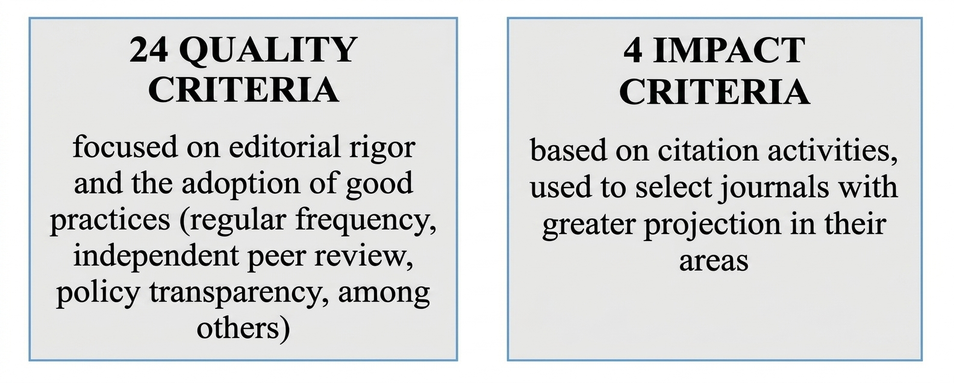
These criteria are reviewed by an internal Web of Science team, composed of specialized editors with no ties to publishers or research institutions, which aims to ensure impartiality in decisions (ABCD/USP n.d; Clarivate, n.d.). According to Anna Treadway, a fundamental step for journal indexing is editorial screening, an initial stage where basic information about the journal is evaluated. The most common failures in this process stem from inaccuracies or inconsistencies in the information available on the journal’s website, which, in most cases, can be easily corrected.
“We advise all editors to carefully review the information on their websites before submitting the journal for evaluation, in order to ensure that it is consistent, accurate, and sufficiently detailed to provide transparency not only to the Web of Science editorial staff, but also to readers and authors,” she states.
As presented in Figure 1, the initial screening aims to ensure the accurate identification of the journal submitted for evaluation, in addition to establishing a communication channel for clarification of doubts or concerns.
This is a mapping of the main requirements that a journal must meet to advance in the process. This analysis includes, for example, checking the ISSN, journal title, publisher, URL, content access, existence of review policies, and expert evaluation information. Treadway highlights that this applies to all information provided by the journal about itself: it must represent it accurately. The most common failures in this phase stem from inaccuracies or the absence of this information on the journal’s website, but they can be corrected before resubmission for evaluation (ABCD/USP).
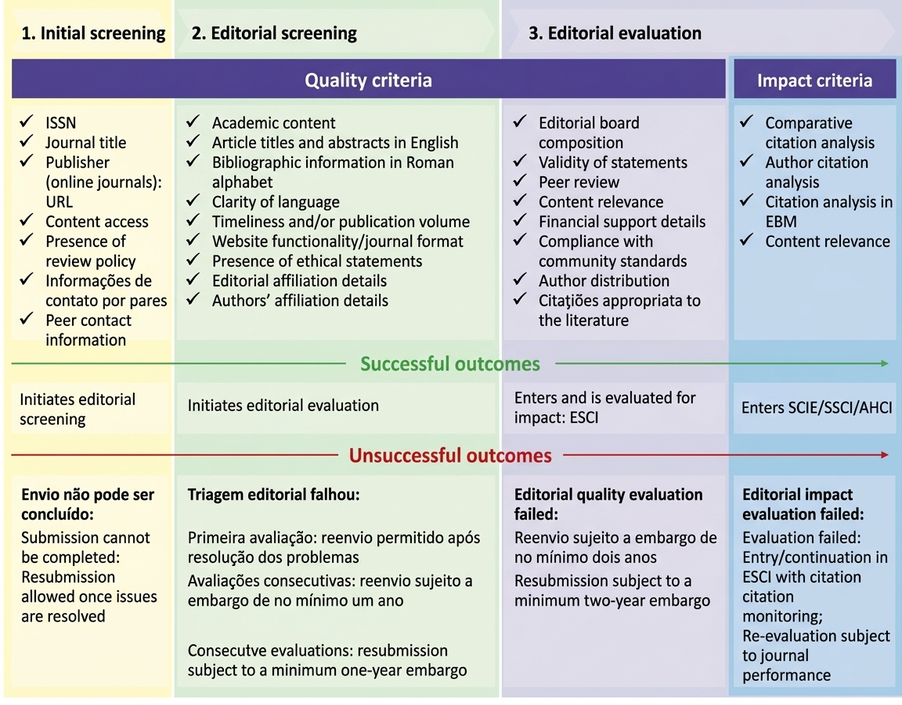
Source: Adapted by the author from Clarivate data.
As evidenced, after the initial eligibility check, the editorial screening stage begins, which functions as a preliminary filter aimed at analyzing the journal’s identity, transparency, and organization. In this phase, WoS editors assess whether the journal meets the minimum requirements to proceed with the indexing process. Among the criteria observed are the academic content, the clarity of the language, the translation of titles and abstracts into English, adherence to the publication schedule, the presence of ethical statements, as well as the structure of the website, which must be functional, navigable, and contain basic information such as editorial and author affiliations.
Once this phase is overcome, the journal is submitted to editorial evaluation, a moment when elements that reflect the maturity and editorial governance of the journal are examined. This includes the composition and diversity of the editorial board, the transparency of instructions to authors, a clear description of the peer-review process, adherence to the scientific community’s practices, and compliance with ethical standards. Aspects such as the geographical distribution of authors, financial support, and the consistency of citations used are also verified.
Editorial screening determines whether a journal will proceed to full peer review. Failures at this stage usually stem from inaccuracy or inconsistency in the information provided on the journal’s website, which can be easily corrected. “Many journals — not just Brazilian ones — are rejected because the information on their websites is inconsistent or because important information is not available,” emphasizes Treadway.
This transparency ensures that the scope of the journal is aligned with the authorship profile. Geographical diversity, which refers to the inclusion of researchers, journals, and productions in the global circuit of scientific dissemination (Carvalho et al., 2025), is not a universal requirement, but it must be consistent with the declared scope, meaning that evidence is sought that the content published in the journal aligns with the scope and purpose statement of the journal itself. “If a journal claims to focus on Brazilian research, we expect to see significant representation of Brazilian authors. If it declares a geographically diverse perspective, this should be reflected in the author profile,” says Treadway.
She highlights that, in addition to the 24 quality criteria considered in the first phase of the evaluation, focused on editorial rigor and good publication practices, there are four more criteria focused on impact. These criteria aim to identify journals with greater relevance in their fields, using citation activity as the main indicator. They are: comparative citation analysis, author citation analysis, citation analysis in EBM (Editorial Board Members), and content relevance. This phase therefore contemplates not only the editorial structure but also the journal’s recognition in the scientific ecosystem.
It should be noted that failure to meet the criteria in any of the phases may result in rejection, with consequences such as embargoes for new submissions, ranging from one to two years, or even continuous monitoring in case of conditional entry. According to Clarivate, which provides Web of Science to academic institutions, these restrictions reflect the commitment to maintaining the quality of its collection, reinforcing that indexing is not definitive, and that the journal’s permanence is linked to its ability to maintain consistent and transparent standards over time.
Evaluation and overview of the indexations
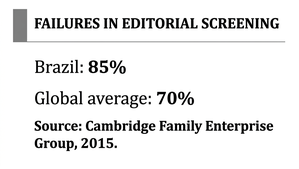
The rigorous indexing process refers to the need for coherence between institutional discourse and the practices effectively adopted by journals. According to Clarivate data, the results of the evaluation of Brazilian journals show that 85% of them are rejected already in the editorial screening, a percentage higher than the global average, which is 70%.
When it comes to quality criteria in the editorial evaluation phase, the rates drop to 48% in Brazil and 46% globally, indicating persistent flaws in the initial aspects of the submission process. These data reinforce the importance of constant attention to basic quality criteria and practices that support the credibility of publications.
The growing distrust regarding the distance between what is declared in editorial policies and what is observed in practice has generated unease among authors, reviewers, and readers. Treadway clearly warns about this by stating: “This is one of the main aspects that Web of Science editors look for as part of their holistic evaluation of a journal. We compare the published content with the declared editorial policies.”
This rigor reveals that, more than meeting technical criteria or achieving impact metrics, journals need to cultivate editorial authenticity, that is, ensure that the declared identity, commitments, and promises are effectively incorporated into their practices. And in the reevaluation process, any journal that fails to comply with quality criteria will be removed from WoS. “When we observe that a journal is not adhering to its own guidelines, it is rejected.”
A critical example lies in the functionality of websites: according to data from Clarivate, 85% of Brazilian journals that do not pass the editorial screening present flaws in this aspect, mainly due to not providing complete and updated information on fundamental aspects such as scope, peer review process, author instructions, editorial board composition, access model, and ethics policy.
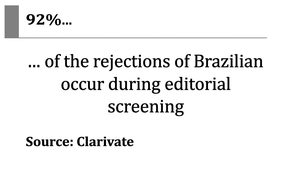
The information architecture and navigation in journal portals must ensure direct and transparent access to published content, including clear links between the journal’s website and the publisher’s. Furthermore, it is not enough for this information to be available: it must be consistent with the journal’s editorial practice, as Treadway highlights. “We believe that the 24 quality criteria are within the control capacity of each journal. This includes ensuring that the policies declared by the journal are being implemented in the content it publishes.”
The requirement, therefore, is not in the submission to external norms, but in coherence between what is declared and what is practiced. One piece of data reinforces this gap: 92% of Brazilian journals that do not pass the editorial screening have flaws in the presentation of clear ethical declarations. The absence of this type of information compromises the transparency of the requirements made of authors and the conduct expected in publications. For Clarivate, all these criteria are under the direct control of the editorial teams. The real challenge, therefore, lies in making effective the policies that each journal already declares to follow.
Artificial intelligence
Among the most discussed topics currently in the field of editorial integrity, the advance of AI in scientific production stands out, which has provoked questioning and apprehension. As Machado et al. (2024) point out, it is fundamental that editorial teams be prepared to deal with this new conjuncture, understanding the technologies involved in order to recognize both the concrete risks and the possible opportunities. A recent column published by Editora Pecege reinforces this theme on the impact of AI in various scenarios, including the scientific one (The extinction of creativity). In Treadway’s opinion, the scenario deserves monitoring: “This is an emerging policy area that we are monitoring to determine how to reflect best practices in our criteria, as new standards are established.”
The director’s positioning aligns with the recommendations of entities such as Cope (Committee on Publication Ethics), an international reference organization in scientific communication integrity and ethics. Cope reinforces the need for transparency and responsibility in the use of artificial intelligence tools, pointing out that these technologies should not be listed as authors and that their use in the writing or revision process must be clearly declared, with due mention of the tool, the version, and the function performed (Cope, n.d.).
According to the guidelines published in 2023 by Cope, the objective is to preserve responsible authorship and ensure editorial traceability in the face of new risks associated with automation. According to the director, scientific journals are already taking measures in the face of this new reality. “Organizations created to provide guidance to journal editors, such as Cope, WAME, CSE, and ICMJE, have developed recommendations related to the use of AI, and some journals and publishers have explicit policies in place.”
In Brazil, this movement is beginning to materialize into concrete actions. The Ciência da Informação Journal, published by Ibict, released in February 2025 a specific policy on the use of AI in scientific writing. The rule establishes that authors must explicitly declare which tools they used, detail its use in sections such as acknowledgments or methodology, and assume full responsibility for the generated content, recognizing that the use of AI does not exempt the author from ethical and scientific responsibility (MCTI, 2025).
Similar practices have been adopted by international publishers, such as Sage Publications, which prohibit the use of artificial intelligence in the review of confidential manuscripts, but authorize its use in editorial activities, provided it is duly declared. These examples reinforce that the challenge lies not in prohibiting AI, but in establishing clear and responsible guidelines for its use (Machado et al., 2024). Goulart and Araújo highlight, in this context, that promoting awareness about the ethical use of these tools is fundamental, but without neglecting the appreciation and development of human competencies, which remain indispensable, even with the growing adoption of technologies in academia.
Faced with this scenario, scientific journals must define, based on recognized ethical standards adapted to their reality, a clear editorial stance regarding technological transformations and their conduct with the use of such tools. Attentive to these challenges, the Revista Estratégias e Soluções (E&S) is in the process of updating its editorial standards, including specific guidelines on the use of artificial intelligence, guided by ethics, transparency, and contextual appropriateness. The new version of the guidelines will be published in 2025.
Treadway reinforces the importance of this editorial autonomy by stating: “We do not prescribe the policies that journals should adopt or the methods they should follow to deal with threats to research integrity.”
In this sense, the advance of AI imposes an important reflection on editorial management, demanding objective positions in the face of dilemmas still under construction by publishers. As demonstrated, the international debate already signals minimum guidelines, and national initiatives are beginning to consolidate their own protocols. However, it is not just a matter of formally complying with these recommendations, but of the critical internalization of these principles in daily editorial practice and in the environment in which each journal operates.
Towards good editorial practices
Despite all the advances, including technological ones, in the indexing process, the criteria adopted by databases such as WoS, evidenced by its executive editor, reaffirm the importance of editorial integrity and transparency in the practices declared by journals. The appreciation of regional diversity, the recognition of multiple languages, and the focus on editorial quality, rather than impact, represent important steps towards more reliable science.
The table below provides a list of complementary readings on the Web of Science journal evaluation process, suggested by Treadway.
| Further reading |
| 1. Clarivate. (n.d.). Journal evaluation process and selection criteria. Web of Science. Available at: https://clarivate.com/academia-government/scientific-and-academic-research/research-discovery-and-referencing/web-of-science/web-of-science-core-collection/editorial-selection-process/journal-evaluation-process-selection-criteria/. 2. Committee on Publication Ethics. (2023). Authorship and AI tools. Available at: https://publicationethics.org/cope-position-statements/ai-author. 3. International Committee of Medical Journal Editors. (n.d.). Defining the role of authors and contributors. In Recommendations for the conduct, reporting, editing, and publication of scholarly work in medical journals. Available at: https://www.icmje.org/recommendations/browse/roles-and-responsibilities/defining-the-role-of-authors-and-contributors.html#four. 4. Jackson, J., Landis, G., Baskin, P. K., Hadsell, K. A., English, M., & CSE Editorial Policy Committee. (2023). CSE guidance on Machine Learning and Artificial Intelligence Tools. Science Editor, 46, 72. https://doi.org/10.36591/SE-D-4602-07. 5. World Association of Medical Editors. (n.d.). Chatbots and generative AI in scholarly manuscripts. Available at: https://wame.org/page3.php?id=106. |
Interviewer: Anna Treadway – Editor-in-Chief of Web of Science since 2019, where she leads the global team of editors and coordinates operational and strategic guidelines. A graduate in Biochemistry with Molecular Biology from the University of Leeds in the UK, she previously served as Head of Scientific Reports and the BMC series at Springer Nature, as well as Publishing Director at Informa, with responsibility for around 180 academic journals.
Contribution: Deborah Dias – Regional Solutions Consultant at Clarivate since 2007, with over 30 years of experience in technical support and training. Graduated in Archaeology, Software Engineering, and Marketing Administration, she actively participates in conferences and symposia focused on bibliometrics and scientific production analysis.
| To access the references of this text click here |
This content was produced by:

Luiz Eduardo Giovanelli
Master in Business Administration from the University of São Paulo. Specialist in Public Management from the State University of Ponta Grossa and graduated in Business Administration from the State University of Northern Paraná. Since 2023, he has been one of the assistant editors of the Revista Estratégias e Soluções.
Who wrote this column
Editora Pecege