
The curse of the free PoC

Column

Innovation

Startups

Technology

September 01, 2025

The curse of the free PoC

In the best practice of open innovation, the ideal is that startups and corporations maintain a fair relationship

The construction of partnerships is fundamental in the innovation ecosystem for the generation of value among the agents that compose it. In this context, initial investors and clients are important parts for the gears of startups to start turning. 

The credential of venture investors and companies are distinctive features that make a big difference in the entrepreneurial journey. But, to sell something in the corporate environment, it is expected that the business playbook be followed. Looking specifically at startups with solutions focused on companies that operate in the B2B (business-to-business) model, there are particularities that need to be considered so that the beginning of the relationship with clients generates more friction than revenue.  

Companies that deal with companies are organizations in search of a common benefit. In this equation, it is worth remembering that startups are early-stage companies, seeking a repeatable business model, scalable, operating in an environment of risk and uncertainty. As companies that follow a path that is not usually very easy, startups must also take care to avoid some corporate “ghosts” and thus, reduce risks that are not usually so evident, such as not combining the game, acting without method, and delivering results by working for free.

Don’t lower the price, increase the perceived value

In the best practice of open innovation, the ideal is that startups and corporations maintain a fair relationship, which is productive and balanced, to favor the “win-win” between the parties involved. Unfortunately, there are still cases that do not follow this trend.

And here there is a shared responsibility, with some companies bargaining the most they can and entrepreneurs anxious to close deals at any cost — sometimes even at no cost, mobilizing their teams for free experimentation deliveries.

The promise of a big contract and the visibility that a strong brand can bring to a startup is indeed an important asset for those who are starting out and makes a big difference when it comes to opening doors. However, obtaining branding and recognition as payment is not something that makes the numbers add up in the long run.

What is given is given. If it is free, it becomes easier to break the commitment if another priority arises within an organization. Imagine, furthermore, the difficulty of a future negotiation, in which a buyer already starts from the premise that the relationship began as a unilateral and unpriced exchange. It will not be simple to adjust the perception of value for something that already started with a price of zero.   

More than following the old saying — “what is agreed upon is not expensive” —, in projects that aim to assess the potential for adoption and large-scale implementation of a product, it is better that the scope, deliverables, and, especially, the values be defined right from the start, for greater effectiveness in experimenting with new technologies.

It is even possible to point out some forms of experimentation that seem to deviate from this recommendation of not offering the free lunch to potential clients. As part of the marketing strategy of some startups and technology-based companies, especially those operating in the software segment, trial, demo versions, or the freemium approach are ways to promote products through user use and interaction without charges.

However, in the vast majority of these tastings, potential clients test the products as they are already available, with limitations of some functionalities and within a determined period for consumption.  

DemonstrationIt is the abbreviated form of the word “demonstration”. It means a trial or sample version of a digital product (software, game, music, etc.). Demos are usually released to leads who may be interested in trying the product to increase publicity. 
TestTest of a product or service for a determined period. Through this system, the user can test an application or software trial, for example, proving the benefits in practice, before acquiring it.
FreemiumIt is a business model in which companies offer users the most basic version of a product for free, while incentivizing them to upgrade to a paid premium version that comes with additional and advanced features.

Sharing risks and results

The risk is present in the venture of startups, and it would not be different for those who take the risk of acting with them. But there are ways and methods to mitigate this issue with the possibility of evaluating the value, the concept, and the performance of new solutions before establishing a commitment more firm between technology developers and corporations.

The PoV, the PoC, and the Pilot are the most practiced forms for this purpose. StartupBootcamp, a global network of investment and acceleration for startups, helps with the definition of these methods:

  • PoV – Proof of Value (the smallest and most focused of the experiments)
    • Objective: to prove the value of a solution for both the startup and the corporation.
    • Commercial conditions: normally no costs; occasionally, direct costs are covered by the parties involved.
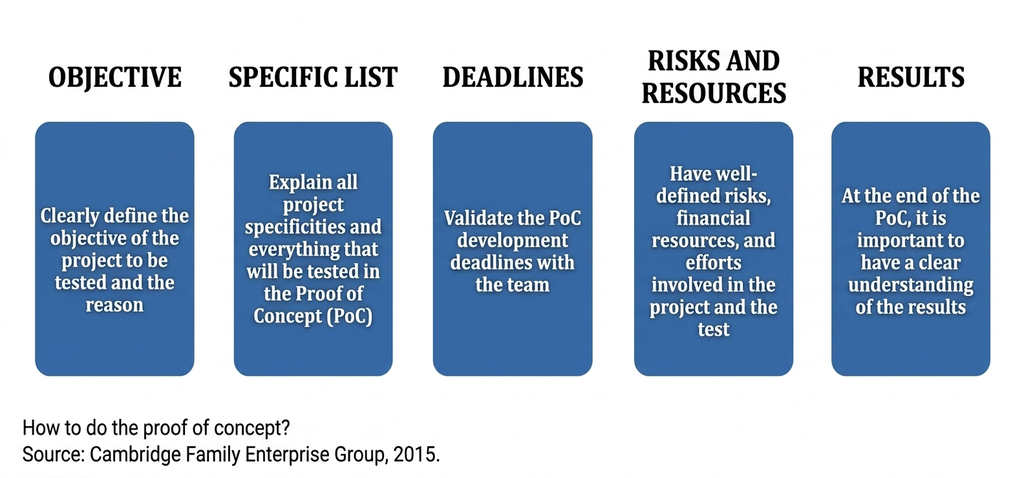
  • PoC – Proof of Concept (the experiment that serves as a bridge between the proof of value and the transition to a pilot or commercial agreement)
    • Objective: to carry out an operational test, on a small scale, with specific defined time and scope.
    • Commercial conditions: normally, direct costs are covered by the contractor. The hiring of the PoC already involves the company’s purchasing department, but with minimal approval. The time allocated by the startup and by the corporation can be considered in-kind contribution (in-kind).
  • Pilot – Pilot project (experimentation format, with pre-defined technical scope and commercial conditions, on a larger scale than the PoC, directly impacting the operation and business areas of the corporation where the solution will be applied)
    • Objective: use proven results to co-create and deliver real value to the company.
    • Commercial conditions: contracting and approval of the project proposal with the involvement of the company’s purchasing department and the involved business areas, due to the higher investment level and the application in an operational environment.

In the end, regardless of whether these forms of experimentation are successful or not, the two parties can benefit. On one hand, companies will have a better understanding of the investment needed for tests, and the teams involved will gain knowledge in emerging technologies and fluency for future tests with other partners. In turn, startups will be able to collect feedback on performance and user experience, capture suggestions for improvements, and gain insights into pain points that were not previously mapped.
Practice is practice; game is game

In popular wisdom, that which is very cheap is not usually well-regarded, and what is free tends to be undervalued. Also from collective knowledge comes the saying that “when the alms are too much, the saint becomes suspicious”. However, trying out the solutions of startups in offers subsidized by consolidated partners or traditional suppliers can be something interesting from the point of view of cooperation and value generation. It would be “seeing is believing” enabled by a third party, in a B2B2C (business-to-business-to-consumer) approach.

It is a way to offer market access and reduce customer acquisition costs for new entrants, mitigating the level of distrust from early adopters regarding what still needs to be proven. Of course, there is no free lunch at this table. Big techs and established suppliers may even have greater room to subsidize free trials for partner startups that add value to their offerings, but the cost is usually embedded in the fine print of commercial negotiations and in the share of sales that are confirmed. A test is a test; a contract is a contract.

Nevertheless, this triangulation example shows how open innovation translates into cooperation and results. Startups scale up, established suppliers update and complement their portfolios, and their customers experience novelties that have already been qualified.

Better PoC than never

Among open innovation practitioners in the corporate environment, there is a common understanding that experiments with new technologies should occur strategically and aligned with the companies’ objectives. Whether to increase operational efficiency with a focus on the core business, or to anticipate trends that can pave the way for new businesses or new markets.

To give a sense of how this already happens in Brazil, according to the 100 Open Startups platform, in 2024 more than 62,000 open innovation partnerships were carried out between startups and companies, resulting in R$ 10.8 billion in contracts, with a growth of 69% compared to 2023. However, for those who already use the inventive potential of startups to advance the technological development agenda, keeping one’s feet on the ground is fundamental to avoid wasting resources (money, time, and effort), to mobilize areas with adoption potential within organizations, and to engage key people to test and implement what has synergy and offers a good relationship between investment and potential return.
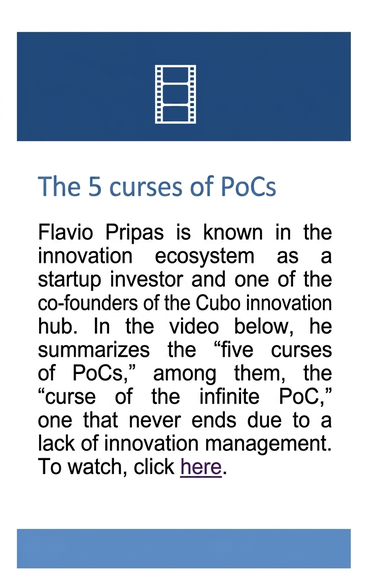
This posture is a way to avoid what the innovation ecosystem has come to call the “PoC factory,” where companies prioritize the innovation pipeline with various experiments, but do not necessarily convert them into practical and concrete results.

Indeed, it is a challenge for innovation professionals to manage projects by balancing the urgency to innovate, to raise awareness among people, and to prove results for solutions that are still consolidating in the market.

One way to balance this scale is to structure an innovation portfolio with short- and long-term objectives, composing a basket with two types of projects: those with quick results and those that demand greater institutional commitment. It would be something like running a marathon by doing several sprints of 100 meters, to deliver immediate value and obtain intangible, not to say political, capital necessary to proceed with initiatives of greater ambition on a long journey of transformation and promotion of the innovation culture.

Another way to give visibility to the assets generated by open innovation, which is valuable for both startups and innovation managers, is to consolidate results using a combination of quantitative and qualitative indicators. Some examples are:

  • cost reduction potential;
  • percentage increase in assertiveness;
  • reduction in time for the execution of some activity (quanti);
  • user and customer satisfaction index;
  • socio-environmental compliance services;
  • less exposure of workers to operational risks;
  • reputational damage reduction (quali). 

After all this review, it is clear that there is no ready-made recipe, much less a free one, for those who want to innovate or need to remain innovative. Looking at the current market moment, in which innovation has been relegated in corporate planning and budgeting, if you have to choose between doing the quick thing to deliver results or prioritizing the fundamentals for a relevant business case in the long term, prefer the middle ground. To go far, without ceasing to be fast.

Who wrote this column

Ricardo Campo

É professor das Faculdades Harven, CNA e professor-coordenador do eixo de Empreendedorismo e Inovação da graduação em Negócios Digitais da Faculdade Pecege. Com MBA em Marketing pela FGV e mestrado em Administração e Agronegócios pela ESALQ-USP, sua trajetória inclui a atuação na área de consultoria do BID Invest, nos times de Inovação da Raízen e do Pulse Hub, assim como nos áreas de marketing da DSM/Tortuga e do Rabobank Brasil.

You may also like

October 02, 2026

Determinants of supermarket location in São Paulo

A study investigated the determining factors for supermarket location in the state of São Paulo, with the objective of investigating the factors that explain the presence and expansion of these establishments, considering socioeconomic, demographic, and market dimensions. Data from the 2010 and 2022 Demographic Censuses of IBGE and information from the National Registry of Legal Entities of the Federal Revenue of Brazil were used to build a georeferenced database. A Random Forest classification model was applied, adjusted by grid search with cross-validation, prioritizing the recall-macro metric due to the imbalance of the dependent variable, which represented the presence or absence of supermarkets within a 50-meter buffer. The results indicated that supermarket location is strongly associated with demographic, income, and population characteristics in the surrounding area. The analysis of variable importance showed that sociodemographic factors, such as elderly literacy, household income, and the presence of other food establishments, exerted significant influence, especially in the immediate vicinity. The findings reinforced the hypothesis that the spatial distribution of supermarkets is not random, being conditioned by socioeconomic characteristics and the commercial structure of the territory, offering subsidies for business decisions and urban planning.

Keywords: Spatial Analysis; Machine learning; Expansion; Commercial location; Supermarkets.

Neuroscience And Learning In Education

October 02, 2026

Anti-Racist Education: Inclusive Educational Practices and Social Development

Antiracist education, understood as a structuring axis of inclusive education and social development, was investigated in the Brazilian context. The study aimed to identify and analyze, based on legal documents and teachers’ perceptions, educational practices capable of promoting antiracism in school and society, and how the implementation of Laws nº 10.639/03 and nº 11.645/08 contributed to social justice. A qualitative and documentary approach was adopted, with analysis of educational legislation, curricular guidelines, institutional reports, and academic literature. Complementarily, a semi-structured questionnaire was applied to 295 Basic Education teachers. The data were evaluated quantitatively and qualitatively, through thematic content analysis, and validated with bibliographic studies. The results revealed a paradox: despite a robust legal framework, the implementation of antiracist policies proved fragile and sporadic, with a lack of teacher training, adequate teaching materials, and monitoring. Significant educational inequalities between white and black students were found to persist, and most teachers acknowledged the occurrence of racism in schools, but without clear institutional protocols. Neuroscientific analysis showed that racism negatively impacts students’ cognitive and emotional development. It was concluded that antiracist education is central to quality education, requiring political commitment, public investment, and intersectoral articulation. The integration of Neuroscience in teacher training and the production of qualified materials are crucial to strengthen the school’s role in building a more just and inclusive society.

Keywords: Social Development; Antiracist Education; Social Justice; Law 10.639/03; Inclusive Educational Practices.

Neuroscience And Learning In Education

October 02, 2026

Paths of Inclusion: Perceptions of Parents and Teachers on the Schooling of Students with Dual Exceptionality in the Brazilian Context

Dual Exceptionality, characterized by the coexistence of High Abilities/Giftedness and neurodevelopmental disorders, represents a complex phenomenon that challenges traditional identification and schooling models. The study aimed to understand the perceptions of parents or guardians, teachers, and other education professionals regarding the schooling of students with Dual Exceptionality in the Brazilian context, investigating challenges, pedagogical strategies, and possibilities for inclusion based on equity. The research adopted a qualitative, exploratory, and descriptive approach, and collected data through an online, voluntary, and anonymous questionnaire answered by 25 participants. Discursive data were analyzed using thematic content analysis. The results indicated that knowledge about the topic is often built from personal and professional experiences, revealing gaps in systematic training. Difficulties were identified in identifying these students, in teacher training, and in implementing individualized educational plans, pedagogical flexibility, and curriculum enrichment. Socio-emotional repercussions, such as frustration and low self-esteem, were reported. However, some schools demonstrated inclusive practices based on equity, articulating specific needs and potentialities. Although the results do not allow for generalizations, they highlighted the need to strengthen professional training and the articulation between school, family, and specialized services. It was concluded that the inclusion of students with Dual Exceptionality requires practices that simultaneously recognize their difficulties and potentialities, ensuring equitable conditions for participation, learning, and development.

Keywords: Human development; Teacher training; School inclusion; Neurodivergence; Pedagogical practices.

October 02, 2026

Data Transformation into Strategy: Applied Research for Ecotourism Operation Optimization

The growing demand in ecotourism in Minas Gerais has driven the search for business intelligence to transform customer data into strategic information. The study aimed to structure a data science pipeline to collect, segment, and classify the customer base of an ecotourism operation, in order to optimize marketing actions and anticipate market movements. An exploratory, quali-quantitative research was conducted through a case study. 2,777 transactional records from an ecotourism company, referring to January 2024 to December 2025, were used. The methodological process involved automated data collection (Google Sheets API), processing and enrichment (ETL), validation, and creation of RFM (Recency, Frequency, and Monetary Value) attributes. Dimensionality reduction via PCA and K-Means clustering was applied, with the number of clusters defined by the Elbow method and Silhouette Score. The results were validated with DBSCAN and K-Medoids. The results revealed the identification of three behavioral customer segments: “Loyal”, “Low Value”, and “Potential”. The “Loyal” segment represented the highest accumulated economic value, while the “Potential” segment stood out for its high average ticket and potential for conversion into recurrence. The integration of data analysis techniques proved to be a robust and replicable method for generating intelligence in ecotourism. It was concluded that the structured data science pipeline enabled the behavioral segmentation of the customer base, the statistical validation of the groups, and the creation of a predictive system for new buyers, providing subsidies for data-driven strategic decisions and future analyses.

Keywords: Clustering; Business intelligence; Machine Learning; Customer segmentation; Decision making.

October 02, 2026

Classification of defaulting customers using supervised machine learning techniques

The risk of default in credit operations demanded analytical approaches to anticipate losses. This study comparatively evaluated the performance of supervised machine learning models in classifying defaulting customers in credit card operations. The public dataset “Default of Credit Card Clients” from the University of California Irvine was used, with 30,000 observations and class imbalance. The algorithms Logistic Regression, Random Forest, and Extreme Gradient Boosting were employed. The imbalance was addressed by assigning weights to the classes, and model optimization occurred with the RandomizedSearchCV method, prioritizing sensitivity. Cross-validation results indicated that the Extreme Gradient Boosting model showed a higher capacity for identifying the defaulting class and better discriminatory performance, followed by Random Forest and Logistic Regression, with a sensitivity of 0.8250 and an AUC-ROC of 0.7844 for XGBoost. Interpretability analysis, conducted by the Shapley Additive Explanations (SHAP) technique, highlighted the predominance of variables associated with payment behavior, especially the history of delays. It was concluded that tree-based models, particularly boosting techniques, proved to be more suitable for capturing complex patterns in the data, configuring themselves as consistent alternatives for credit risk management.

Keywords: Machine Learning; Credit Card; Classification; Extreme Gradient Boosting; Credit Risk.

October 02, 2026

Sentiment Analysis on Brazilian Banks on Twitter/X: Comparison between Traditional and Digital Institutions

A study analyzed public perception of Brazilian financial institutions on the Twitter/X platform, highlighting the importance of sentiment monitoring on social networks for understanding reputation and customer experience in the banking sector. The objective was to compare user perception of the image and reputation of traditional and digital banks, based on the sentiment patterns identified in the analyzed manifestations, seeking to identify structural differences between these groups. The methodology was based on the analysis of 1,096 tweets collected between November 2022 and June 2023. Two complementary sentiment analysis approaches were used, the sum and the average of labels, to capture the majority sentiment and nuances of perception. Additionally, the Market Profile Model, with indicators of emotional reputation, reputational risk, neutrality, and polarization, and the Banking Clustering Model, which allowed grouping institutions according to perception patterns, were developed. The results indicated a predominance of neutral and negative sentiments, a higher volume of interactions in digital banks, and structural differences in the emotional intensity of perceptions, with greater stability in digital banks and greater polarization in traditional ones. It was concluded that the combination of analytical and statistical techniques contributed to an in-depth understanding of institutional image in the digital environment, demonstrating the importance of data-driven reputation management strategies.

Keywords: Digital banks; Traditional banks; Data modeling; Opinion mining; Social Networks.

October 02, 2026

Optimization of annual budget planning through project management methodologies

The Annual Budget Planning (POA) is a crucial process for translating organizational strategy into operational and financial goals, but it frequently faces deadline pressures, interdepartmental dependencies, and the repetition of habitual expenses. The study aimed to analyze how the combined application of project management practices and Zero-Based Budgeting (OBZ) can optimize the POA. To this end, a case study was developed in the Brazilian operation of a publicly traded company in the beverage sector, using documentary research of its 2023 results report and an anonymous questionnaire applied to 47 respondents. Documentary analysis indicated growth in net revenue, expansion of gross profit and adjusted EBITDA, and contained advancement of selling, general, and administrative expenses, suggesting cost discipline and operational leverage. The complementary survey revealed a high perception of cascading effect on the schedule, strong support for defining cost package owners, and a preference for technical justification of expenses, in addition to demand for controlled flexibility after the baseline definition. It was concluded that structuring the POA as a project, associated with the rigor of OBZ, increased the process predictability, reinforced accountability for expenses, and broadened the coherence between budgetary execution and economic-financial performance.

Keywords: Cost Control; Operational Efficiency; Zero-Based Budgeting; PMBOK; Beverage Sector.