Ai
Marketing
Technology
August 21, 2025
Marisa Maiô’s artificial intelligence
When creativity meets memory and activates the repertoire of a generation
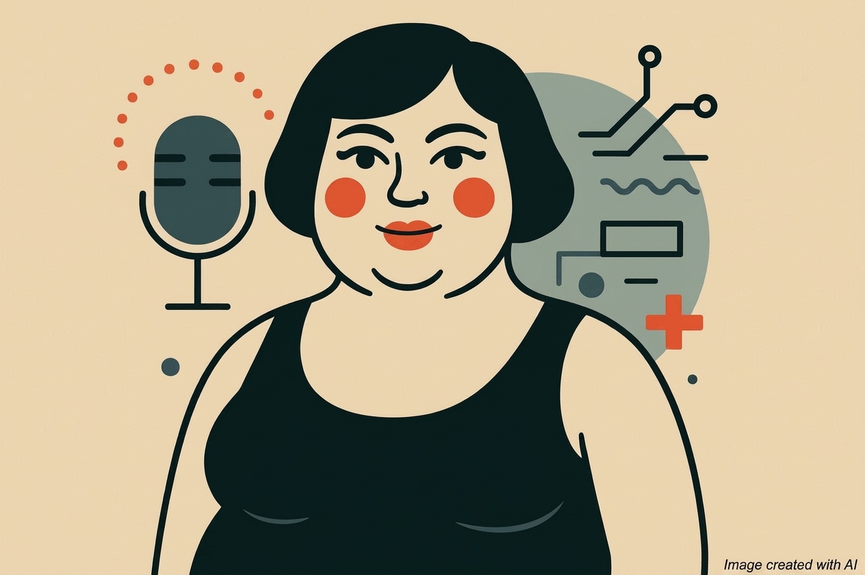
I was scrolling through the feed of reels on Instagram when I was surprised by a talk show worthy of Silvio Santos and Casos de Família — all at the same time. The saturated colors, the sharp cuts, the witty jokes, and a certain nostalgia captured my attention right from the first scene. It was like stumbling upon a 90s television production, the kind you watch half embarrassed, half mesmerized. I thought: “What show is this that I’ve never seen?”. It wasn’t TV, it was Marisa Maiô.
The fact is that I haven’t had a television at home for at least five years. I work with artificial intelligence daily, I study the subject academically — my final paper was on AI — and I use generative tools in my daily life, even before ChatGPT gained fame. Even so, I was caught by surprise. At first, I thought I was in front of a real talk show, the kind that airs on open TV and that, for some reason, I had never seen before.
I even thought: “Am I really that out of touch? I need to check later if this program is on TV.” Only after I stopped to observe more calmly, notice the details, and read the comments did it dawn on me: all of that was created with artificial intelligence. If this already confused someone who works daily with these tools, imagine for someone who doesn’t have that technical background or frequent contact with the subject.
Marisa Maiô is the creation of the illustrator and actor from Rio de Janeiro, Raony Phillips, also responsible for “Girls in the House” — a pioneering series that, years ago, already showed the potential of digital narratives produced with few resources and a lot of repertoire. But this time he went further: he conceived a complete talk show using Google’s Veo 3 technology, capable of generating highly realisticvideos. The leap is significant.
If in “Girls in the House” the language of “The Sims” served as a basis for infamous humor full of social criticism, in “Marisa Maiô”, Raony takes this spirit to another level — more ambitious, more experimental, more strange as well — still, everything there has identity. To contextualize: released in 2000 by Electronic Arts, the simulation game “The Sims” served as an aesthetic starting point for Phillips, who sought inspiration in it to shape both the characters and the everyday situations portrayed in the series.
The aesthetics, the rhythm, the humor — nothing sounds generic or automated. On the contrary: there is something profoundly human. If you look calmly, it’s too absurd — in the best way. The jokes, the timing of the cuts, the way the characters behave, the surreal situations: everything is as chaotic as it is calculated. Yes, there are moments when the lines sound mechanized, the dubbing has that almost robotic dissonance, and the characters always seem to be recorded on the same fixed plane, with changes of scenery that happen without much spatial logic. Still, none of this detracts from the strength of the experience — on the contrary, it all contributes to a unique aesthetic, almost hypnotic, that mixes the artificial and the familiar.
At times, it’s impossible not to recall the universe of “GTA” (the video game), with its disproportionate reactions and characters wandering mechanically. Or the viral videos where people imitate NPCs (non-playable characters), with repetitive movements, empty stares, and rehearsed lines that border on nonsense. “Marisa Maiô” approaches this logic with precision: the small absurdities, the “quasi-reality” and the slight dissonance create a feeling that it could be real — but it isn’t. And perhaps that’s exactly why it works so well.
“Marisa Maiô”’s official Instagram profile (@marisamaiooficial) already has over 200,000 followers, despite very few posts. The viralization was instantaneous — courtesy of the algorithm, which was sustained by the content. Raony’s YouTube channel, Rao TV, where he publishes his original series, has over 2.5 million subscribers and 170 videos — many of them with millions of views, especially the episodes of “Girls in the House”. In other words: this is not a digital accident, but an author who deeply understands the medium in which they are inserted — and knows how to bend it to favor the narrative.
AI does not replace creativity, it reveals it. Raony is an example of someone who, with a solid repertoire and creative mastery, found in digital tools a means of expression. Artificial intelligence, in this context, does not take the creator’s place — it makes viable what, until then, seemed unfeasible: producing an entire program in a few days, without a camera, without a cast, without a studio. AI functions here as an extension of the imagination, not as a shortcut for improvisation.
Much is discussed about authorship and originality in times of creative automation. But what makes Marisa Maiô singular is not the AI itself, but what was done with it. The tool amplified what already existed: observation, timing, social criticism, and aesthetic sensibility. None of this is produced with code. This comes from repertoire, and repertoire comes from experience.
This finding inevitably leads to a connection with Vilém Flusser’s thought. Almost four decades ago, in 1989, the philosopher wrote the essay “Memories” in Berlin, which discussed how technological advances — especially those related to memory — would transform our way of thinking, creating, and acting.
Flusser, born in former Czechoslovakia and naturalized Brazilian, lived a large part of his life in Brazil, where he produced a remarkable body of work on communication and technology. I have been researching his work for over a year, including in my undergraduate thesis, precisely because of its relevance today: he anticipated the transition from cultural memory to electronic memory and its effects on creativity and consumption.
It is no wonder that artificial intelligence has been occupying an increasingly larger space in everyday life — including in marketing, where it has been used for segmentation of audiences, personalization of campaigns and predictive analysis of behavior. According to an industry report by Research and Markets, released by GlobeNewswire (2024), the global AI in marketing market is expected to grow from US$ 41.9 billion in 2023 to over US$ 220 billion by 2030, with an annual growth rate of 26.7%.
In the corporate environment, this advancement is visible: besides the use of generative AI, investments in training focused on specialized intelligent agents, integrated into business routines and innovation strategies, have been increasing. The scenario indicates that these solutions will be increasingly present in the daily lives of companies seeking competitive differentiation.
Expanded critical capacity
According to Flusser, the displacement of cultural memory to electronics would have two central effects: (1) the enhancement of the capacity to store and share data; and (2) the amplified critical capacity, by simulating mental functions outside the human body and, with that, questioning them. For Flusser, by ceasing to memorize facts, we could dedicate ourselves to creative data manipulation — to structure, and not just content. This would pave the way for a new era of amplified creativity. AI, today, seems to fulfill this prediction with surprising accuracy.
Flusser concludes his essay by recalling that all those ideas were just predictions, but there is something incredibly lucid in his analysis. Artificial intelligence does not threaten human creativity — on the contrary, it highlights its origin and importance.
Technological advancement does not create on its own, but opens up space for creations previously unfeasible. It is plausible to imagine that “Marisa Maiô” would never have existed without access to these resources. In another historical moment, the idea could have remained only in the realm of imagination or encountered logistical, technical, and financial limitations.
It is not AI that creates. It is us. But now, with more tools, more accessible repertoire, and more possible paths for invention. The great transformation is not in the machines themselves, but in the mirror they return to us about who we are and who we can still become.
Who wrote this column
Natasha Barreto de Oliveira