
Data Science Analytics
Financial Management
August 05, 2024
The interest in bitcoin and altcoins: an academic perspective
Social network analysis technology promises to shape the future of finance

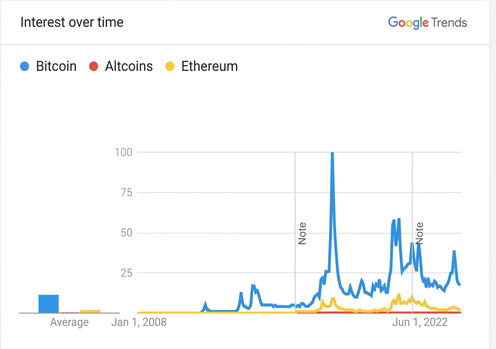
Despite not being at its peak of interest, according to Google Trends, bitcoin and altcoins are awakening growing interest among investors, speculators, and researchers. In terms of academic research, this interest is evident in the Capes Periodicals Portal (Coordination for the Improvement of Higher Education Personnel).
In a quick search between 2008 – the year bitcoin was created – and 2023, it is possible to find 7,747 results. When including 2024, this number increases to 9,308, indicating that more than 20% of bitcoin-related searches were published in 2024 – and the year is not over yet. This growth in the number of publications reflects the increasing academic interest and the continuous importance of the topic in the context of scientific and technological research.
The rise of bitcoin and other cryptocurrencies has captured public attention and created a wave of research seeking to understand and predict their market behaviors. This academic curiosity can be observed in various initiatives that utilize machine learning models, sentiment analysis on social networks, and portfolio optimization techniques.
Recently, Kadhim et al. (2024) proposed a cryptocurrency price prediction model using a hybrid deep learning approach. This model analyzes the influence of social media on bitcoin’s value, using on-chain data – recorded in the public cryptocurrency database – and Twitter information, between 2014 and 2022.
Through algorithms such as Twitter-RoBERTa and VADER for sentiment analysis, combined with an LSTM (long short-term memory) neural network, the model managed to achieve interesting results in predicting market trends. This research highlights how emotions and perceptions expressed on social media can have a direct impact on cryptocurrency prices, providing important insights for traders and investors.
Furthermore, Jahanbin and Chahooki (2024) developed a hybrid model for sentiment analysis in social media texts about cryptocurrencies, using a technique known as transfer learning. This technique involves adapting a neural model, which was previously trained on a large volume of data (the source domain), to perform tasks in a new domain (the target domain), often with a limited amount of data. Using a sample of 25,000 tweets from cryptocurrency influencers between November 2021 and December 2022, the model achieved an accuracy of 88% and a loss rate of only 3%.
This hybrid model employs pre-trained BERT (deep learning) to extract linguistic features from the source domain and apply them to an implicit neural network for analysis in the target domain. BERT, a transformer-based neural network, is trained on large volumes of data to capture a series of linguistic patterns. In the proposed model, these pre-trained features are transferred to an implicit neural network, which is especially effective for handling continuous and intermittent data, such as texts, images, and videos. The methodology also includes the use of temporal decay to adjust the learning rate in the AdamW optimization algorithm. Temporal decay allows the learning rate to gradually decrease over time, optimizing the training process and avoiding excessive adjustments. This combination of advanced deep learning techniques demonstrates the model’s effectiveness in understanding market perceptions.
Another relevant study, conducted by Wang et al. (2024), investigated the optimization of portfolios during global crises using network centralities to select assets, including cryptocurrencies. Network centralities are metrics that measure the importance or influence of a node in a network, in this case, a financial network composed of different assets. The research analyzed 86 assets from July 2017 to June 2023, suggesting that specific centralities improve portfolio performance.
Using various centrality measures, the results indicated that eigenvector, hybrid, and PageRank centralities improve portfolio performance, while eccentricity and intermediation are inadequate. The centrality measures used include:
- Degree: measures the number of direct connections of a node;
- Eigenvector: considers not only direct connections but also the importance of connected nodes;
- Eccentricity: measures the greatest distance between a node and any other node in the network;
- Betweenness: assesses the frequency with which a node appears on the shortest path between other nodes;
- PageRank: developed by Google, it measures the importance of a node based on the quality and quantity of connections;
- Hybrid centralities: combine multiple centrality measures for a more robust assessment.
Research suggests that, during global crises, peripheral assets in inter-market networks are more suitable for investment. Peripheral assets are those that have fewer direct connections and are therefore less influenced by systemic fluctuations. This highlights the importance of emerging markets that are less exposed to external shocks and have greater financial stability.
A bibliometric review conducted by Carè and Cumming (2024) explored the transformations in the financial sector caused by technological advancements and automation between 1984 and 2022. Analyzing 863 articles, the authors identified a consistent upward trajectory in research focused on high-frequency trading and algorithmic strategies.
The research highlighted emerging trends in cryptocurrencies and machine learning, which will continue to shape future research directions. In terms of cryptocurrencies, a growing interest was observed in the development of price prediction models and sentiment analysis. Regarding machine learning, the most prominent areas include optimizing trading strategies and integrating deep learning techniques into trading systems.
The growing integration of advanced technologies, such as machine learning and social network analysis, promises to shape the future of finance. Research such as that highlighted promotes advances in academic knowledge and provides tools for traders, investors, and regulators. Cybersecurity will also play an important role in protecting financial markets against growing threats. Ultimately, interdisciplinary collaboration and continuous innovation will be essential to navigate challenges and seize opportunities in a dynamic market.
The growing interest in bitcoin and other cryptocurrencies, both in the market and in academia, reflects the continuous transformation of the financial sector driven by technological innovations. The research illustrates the diversity of approaches and methodologies used to understand and predict the behavior of cryptocurrencies, from hybrid deep learning models for price forecasting to sentiment analysis and portfolio optimization. These investigations contribute to the advancement of academic knowledge and provide solid tools for traders, investors, and regulators in decision-making.
| To access the references of this text click here |
Who wrote this column
José Erasmo Silva