
Strategy
Environment
Sustainability
April 30, 2024
ESG and Oscar Wilde
ESG politicization leads companies to abandon the acronym

A few days ago, I read an intriguing news item in “The Wall Street Journal”. Titled “Step Aside, ESG. BlackRock Is Doing ‘Transition Investing’ Now” (“Step aside, ESG. BlackRock is doing ‘Transition Investing’ now”, in free translation). The authors’ subtitle, Pitcher and Ramkumar (2024), helped to clarify: “The world’s largest asset manager has ditched the acronym as it pumps billions of dollars into clean energy”.
This made me reflect a bit on the history of ESG (an English acronym for Environmental, Social, and Governance, which defines a set of practices aimed at the environment and society) and on how we arrived at the situation highlighted by the news.
In the year 2000, the United Nations Organization(UN) established 8 goals with 22 targets that aimed to promote human dignity and simultaneously address poverty, hunger, disease, illiteracy, environmental degradation, and discrimination against women by 2015. Approved by the General Assembly, the Millennium Development Goals (MDGs) were adopted by 189 countries and 23 international organizations. Figure 1 shows these goals.
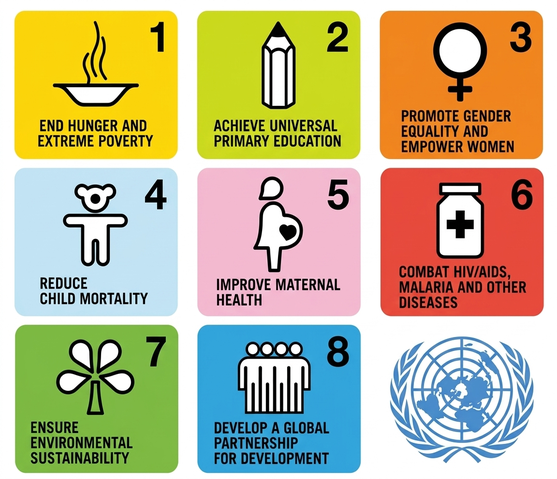
Source: United Nations Organization – UNO (2000)
Because governments, academics, UN agencies, civil society, and the private sector were involved, notable results were achieved. As a consequence, in January 2015, the negotiation process for the development agenda post-2015 began in the UN General Assembly. It is not surprising that everything evolved rapidly and, in September of that same year, during the Sustainable Development Summit, the 2030 Agenda for Sustainable Development was presented. The document detailed the new 17 Sustainable Development Goals (SDGs) and their respective 169 targets.
Strongly based on the previous ones, the SDGs are broader and more inclusive, encompassing the environmental, social, and economic dimensions. Figure 2 shows the 17 SDGs.
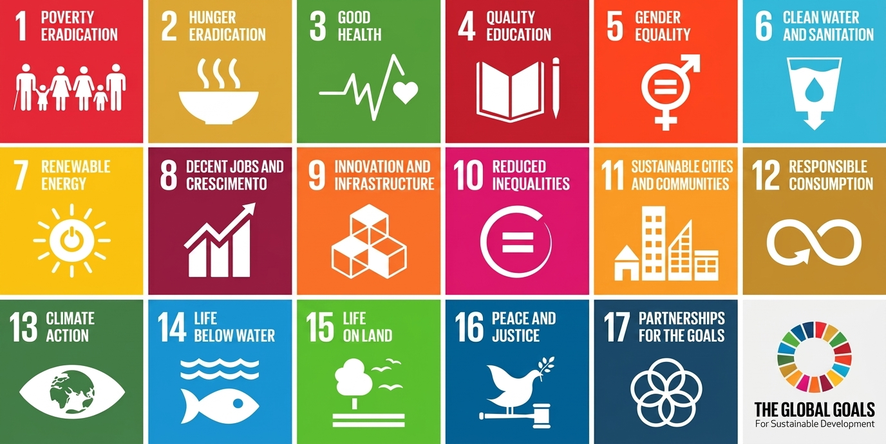
Source: United Nations Organization – UNO (2015).
The time for companies: the UN Global Compact
In the early 2000s, in parallel with the Millennium Development Goals, the then UN Secretary-General, Kofi Annan, launched the Global Compact, a voluntary corporate citizenship initiative to encourage companies to adhere to principles related to human rights, labor, environment, and anti-corruption.
The Global Compact established ten principles based on four foundational documents: (1) the Universal Declaration of Human Rights, (2) the Declaration of the International Labour Organization on Fundamental Principles and Rights at Work, (3) the Rio Declaration on Environment and Development, and (4) the United Nations Convention Against Corruption. Companies should:
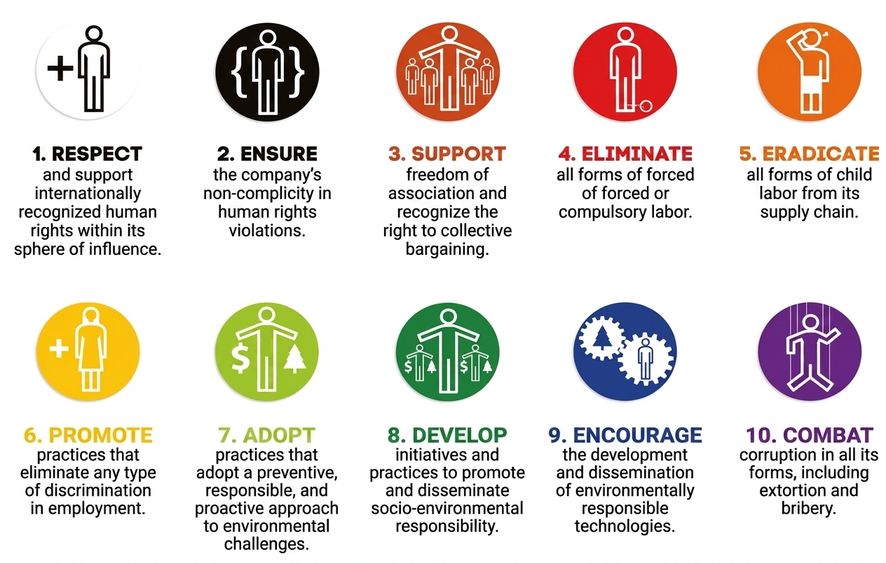
Source: United Nations – UN (2000).
This initiative remains alive and growing: almost 25,000 companies worldwide are part of it. In Brazil, about 2,300 companies are involved, with Natura having been the pioneer, back in 2000.
The Emergence of ESG
Aware of the influence peers have on each other, in 2004 Kofi Annan invited 18 financial institutions from 9 countries, managing over US$6 trillion in assets, to “develop recommendations and guidelines on how best to integrate environmental, social, and corporate governance themes into asset management, securities brokerage services, and related research functions”. Released the same year, the result was a UN report (2004) titled “Who Cares Wins: Connecting Financial Markets to a Changing World” (Who Cares Wins: Connecting Financial Markets to a Changing World, in free translation). It was in this document that the acronym ESG emerged, mentioned 123 times throughout its 41 pages!
The document’s subtitle is enlightening: “Recommendations from the financial sector to better integrate environmental, social, and governance themes into asset analysis, management, and insurance brokerage”. In other words, financial institutions speaking to their peers about the importance of environmental, social, and governance factors. Its executive summary provided an excellent justification: “Companies that perform better in relation to these themes can increase their value to shareholders by, for example, appropriately managing risks, anticipating regulatory actions or accessing new markets, while simultaneously contributing to the sustainable development of the societies in which they operate”.
A curiosity: the Banco do Brasil was one of the 18 financial institutions invited to participate in the document’s elaboration.
The Big Three
BlackRock, Inc. is one of the largest financial asset managers in the world. Together with Vanguard Group and State Street Global Advisors (which was part of the working group for the document “Who Cares Wins”), they form what the market calls The Big Three, the world’s largest investment fund managers.
According to their 2023 annual reports, BlackRock manages assets of around US$10 trillion, Vanguard of US$7.6 trillion, and State Street of US$4.1 trillion. Together, they total US$21.7 trillion across private and public pension funds, university endowment funds, and corporate funds. Even small investors make up a significant portion of these financial companies’ clients.
According to professors Lucian A. Bebchuk, from Harvard Law School, and Scott Hirst, from Boston University Law School, collectively they hold a significant stake in American publicly traded companies. In their study “Big Three Power And Why It Matters”, (Bebchuk and Hirst, 2022), the authors estimated that these three financial institutions alone hold almost 25% of the votes at the annual shareholder meetings of companies listed on the S&P500 index (an indicator that tracks the performance of the North American stock market based on the price fluctuations of shares of 500 of the largest companies in that country, similar to our Ibovespa). This shows the power of influence of these three companies on the destinies of large corporations in the USA.
Figure 4 presents in blue the 11 largest GDPs on the planet, according to a report by the World Bank (2022). Added to them, in orange, are the values of the funds managed by The Big Three. Alone, they would occupy the third, fourth, and sixth places on the list. Combined, the funds managed by these companies would make up the second place, surpassing the GDP (Gross Domestic Product) of China.
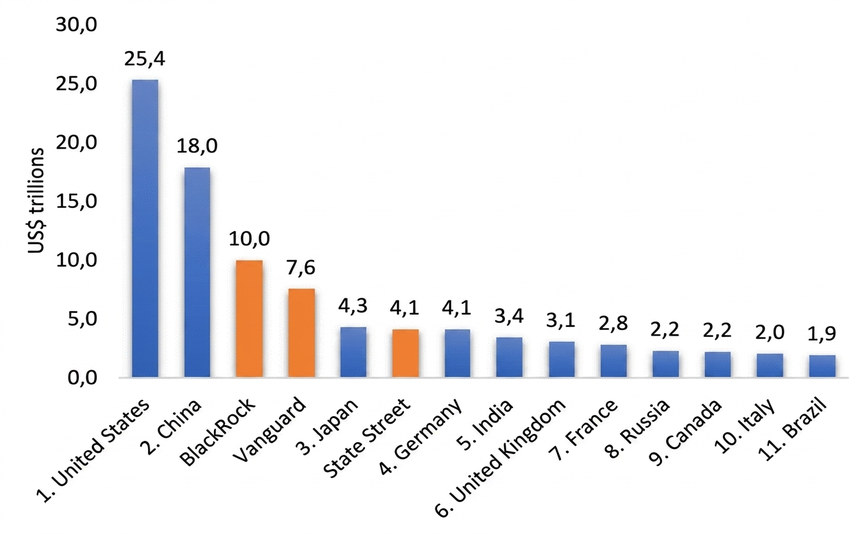
Source: Adapted from World Bank (2022) and annual reports of BlackRock, Vanguard, and State Street (2023).
The Politicization of ESG
Even before the ESG concept was formalized, concern for environmental and social issues was already on the radar of a growing number of companies. The idea began before the end of the 20th century and was named Corporate Social Responsibility (CSR). The condemnation of the apartheid regime in South Africa and child labor, and the prevention of environmental disasters, such as the Exxon-Valdez oil spill in Alaska, were precursor corporate actions.
More recently, in the wake of society’s hyper-polarization, the concept of sustainability has been used as a leitmotif for disagreements between the far-right and the far-left. One side claims that ESG is a construction coordinated by financial institutions and advocates for hyper-regulation. The other side asserts that ESG is part of the woke culture that diminishes companies’ competitiveness and investment profitability.
The situation reached such a point that, at the end of 2020, the United States government’s Department of Labor issued a regulation (“Financial Factors in Selecting Plan Investments”) that affected retirement plans regulated by the Employee Retirement Income Security Act (ERISA), of 1974. This regulation stipulated that “plan fiduciaries select investments and investment courses of action based solely on financial considerations relevant to the economic value of the risk-adjusted return of an investment or investment course of action”.
Although guidelines like this one only affect pension funds regulated by the 1974 law, i.e., private ones, it is a reality of that market that public employee fund managers are influenced by them. This led to an explosion of state government actions to limit or discourage investments that considered ESG factors.
An article by David A. Cifrino (2024) published in January of this year in Harvard University’s “Social Impact Review” reports, for example, that the Florida government has ordered the withdrawal of US$2 billion in investments from BlackRock due to its vision and policies related to ESG. Furthermore, the Attorneys General of 19 states sent a letter to BlackRock accusing the financial institution of putting the climate agenda ahead of the best interests of the beneficiaries.
BlackRock’s Vision
Larry Fink, CEO and chairman of BlackRock, was an early supporter of including ESG factors in investment decisions. In his annual letters to the CEOs of S&P500 companies over the past decade, he highlighted the importance of investing in companies that value environmental, social, and governance aspects. His statements on sustainability have been constant and direct.
- “We focus on sustainability not because we are environmentalists, but because we are capitalists and fiduciaries for our clients”;
- “Every company and every sector will be transformed by the transition to a Carbon Neutral world (“Net Zero”). The question is: will you lead or will you be led?”
- “The next 1,000 unicorns will not be search engines or social media companies; they will be innovative, sustainable, scalable – startups that will help the world decarbonize and put the energy transition within everyone’s reach”;
- “When we associate the powers of the public and private sectors, we can achieve truly unbelievable things. This is what we must do to achieve Carbon Neutral (Net Zero)”.
This changed in 2023. In that year, during a roundtable discussion with the cochairman of The Carlyle Group at the Aspen Ideas Festival, he stated: “I no longer use the word ESG, because it has been completely weaponized… by the far left and the far right”. However, Fink said that eliminating references to ESG will not change BlackRock’s positioning: the company will continue to engage with companies that focus on themes related to decarbonization, corporate governance, and social causes that will be addressed by them. In its 2023 Annual Report, the company cites the acronym ESG 86 times and explicitly states the risks associated with this topic. In summary, the company foresees risks associated with (1) potential failures by/with key suppliers, (2) regulatory changes in the US and in international markets, and (3) a “growing focus by regulators, authorities, customers, and other stakeholders on ESG matters that may adversely affect BlackRock’s reputation and the business itself”.
And Oscar Wilde?
Oscar Wilde was an Irish writer from the second half of the 19th century. He wrote classics such as the novel “The Picture of Dorian Gray” and the play “The Importance of Being Earnest”. Intelligent, witty, and extravagant as few, Oscar Wilde was one of the most important influencers of London at that time.
Maintaining homosexual relations was considered a crime in England and Wales until 1967, in Scotland until 1980, and in Northern Ireland until 1982. For this reason, he was sentenced to two years in prison in 1895. During his trial, Oscar Wilde was questioned by the prosecutor about the meaning of the expression “the love that dare not speak its name”, the last verse of the poem Two Loves, by Lorde Alfred Douglas, his lover.
Your brilliant answer ends with the phrase “That’s how it should be, but the world doesn’t understand. The world ridicules it and sometimes puts someone in the stocks because of it”. This phrase can be easily transposed to the present moment and applied to sustainability.
It is interesting to note that, currently, the US and international markets are moving in opposite directions regarding sustainability: while in the United States the topic continues to be the center of growing controversies, the United Kingdom, Singapore, Hong Kong, Taiwan, and Australia have indicated their intention to support the International Sustainability Standards Board (ISSB) standards on the mandatory issuance of specific content in sustainability and climate reports, which should be issued along with periodic financial reports.
The fact that the acronym ESG is no longer spoken does not mean that its concept has ceased to exist, that the subject is no longer relevant, or that it will cease to be taken into consideration by a significant portion of the corporate world, including the financial sector. These entities, governments, and companies share the same vision that was expressed by former UN Secretary-General Ban Ki-moon in August 2023, during the International Conference Amazonia and New Economies in Belém (PA): “We do not have a plan B because we also do not have a planet B”.
| To access the references of this text click here. |
Who wrote this column
Ciro Barbieri da Cunha