
Data Science
Data Science Analytics
Technology
June 09, 2025
Between sensors and algorithms: the new logic of industrial maintenance
Previously restricted to highly technological environments, predictive support now presents itself as a concrete and accessible possibility
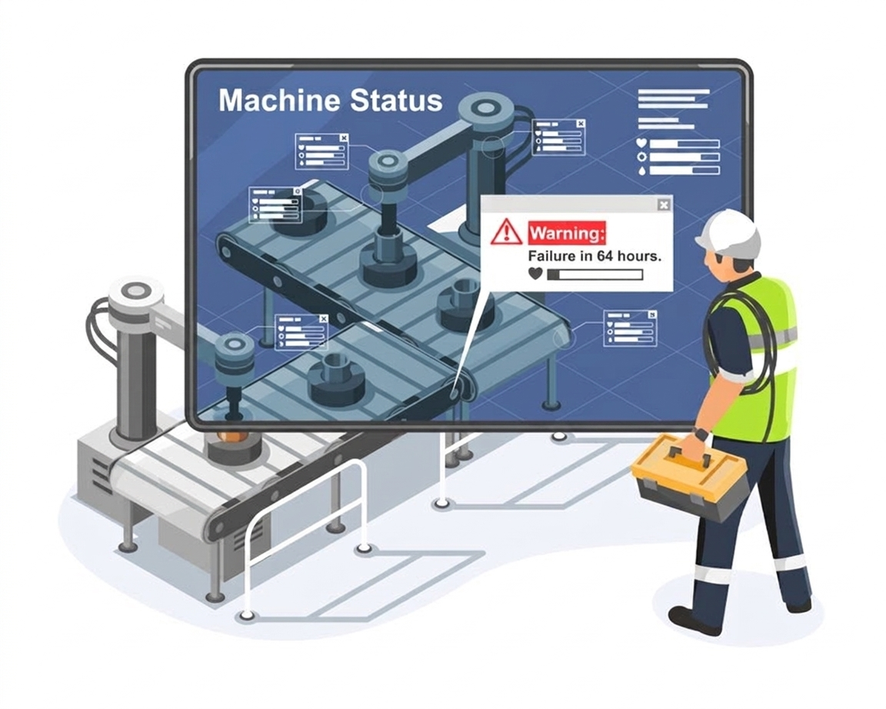
Predictive maintenance has been gaining prominence in modern industry, by allowing the anticipation of failures and the optimization of the availability of productive assets. Unlike traditional models, such as corrective and preventive maintenance, this approach uses real data from operation and intelligent algorithms to indicate the ideal moment for intervention, reducing unplanned downtime and operational costs (Es-sakali et al., 2022; Poór & Basl, 2019).
With the advancement of Industry 4.0, embedded sensors, industrial networks, and monitoring systems have started to generate large volumes of data in real-time, which has opened space for the application of data science techniques, such as machine learning, neural networks, and statistical models (DalzCochio et al., 2020; Esteban et al., 2022). In this context, data science acts as a means to convert raw data into useful information for maintenance decisions.
The growing availability of operational data and the maturation of analytical tools have transformed predictive maintenance into a concrete application of data science within industrial operations. Models such as recurrent neural networks, support vector machines, classification algorithms, and deep learning techniques are already successfully used to predict failures, estimate the remaining useful life of equipment, and classify degradation patterns (Nikfar et al., 2022; Singh et al., 2023; Wang et al., 2024).
Furthermore, more recent approaches, such as transfer learning, continual learning, and federated learning, have been explored to overcome limitations like labeled data scarcity, non-stationary operational environments, and privacy constraints in decentralized applications (Ahn et al., 2023; Azari et al., 2023; Hurtado et al., 2023). These advances demonstrate that data science occupies a strategic position in the transition from reaction-based maintenance models to prediction- and optimization-oriented strategies.
Applications
The application of data science in predictive maintenance is already a reality in several industrial sectors, with emphasis on the areas of energy, manufacturing, and transportation, and the aerospace sector. In low-voltage industrial motors, for example, algorithms such as neural networks, random forest and support vector machines have been successfully used to detect failures and classify them with an accuracy greater than 95%, even with relatively small datasets (Nikfar et al., 2022).
In more complex industrial environments, such as automotive production lines and wind turbines, multivariate sensors integrated with deep learning models, like CNNs and LSTMs, have enabled more robust diagnostics and early interventions, with near 100% accuracy in anomaly detection (Abdullahi et al., 2024; Gawde et al., 2024). These results illustrate how adequate data collection and processing, combined with well-calibrated predictive models, can reduce unexpected failures and increase asset availability with a direct impact on productivity.
Beyond conventional predictive models, the use of digital twins has been consolidated as a sophisticated extension of data science applied to maintenance. The term “digital twin” refers to the creation of a virtual replica of a physical asset, such as an engine or turbine, which mirrors its behavior in real-time through the integration of sensors and computational models. Just as a human twin shares genetic characteristics, the digital twin shares operational data with its physical counterpart. By integrating physical and data-driven models, digital twins enable real-time simulations , continuous diagnostics, and accurate estimations of the remaining useful life of critical components, such as engines, gearboxes, and battery systems (Singh et al., 2023; van Dinter et al., 2022; Zhong et al., 2023).
In recent studies, distributed digital twin architectures have been successfully applied to wind turbines, combining physical sensors, cloud computing, and deep learning models for high-accuracy, low-latency fault prediction (Abdullahi et al., 2024). In another example, the conversion of time series into images using techniques such as Gramian Angular Fields, subsequently analyzed by convolutional networks, allowed for the detection of critical faults in industrial motors with 100% accuracy, outperforming traditional models such as SVM (Kiangala & Wang, 2020).
These cases demonstrate that, when well applied, the tools of data science offer not only predictive accuracy, but also visualization, transparency and decision-making that is more agile.
Scale
Given the diversity of equipment, operational contexts, and privacy restrictions, more recent approaches have sought to make predictive models more generalizable, scalable, and collaborative. Federated learning, for example, has been used to train predictive models distributed across multiple factories without the need to centralize data, protecting confidentiality and adapting algorithms to the peculiarities of each industrial unit (Ahn et al., 2023). Transfer learning, on the other hand, has proven useful for leveraging previously trained models on similar equipment, reducing the need for large volumes of labeled data and accelerating adoption in new assets (Azari et al., 2023).
In dynamic scenarios, where the system’s behavior changes over time, continuous learning has been explored to ensure models update themselves without losing acquired knowledge, handling different operational regimes and variations in sensor data (Hurtado et al., 2023). These applications demonstrate the maturity of data science in the field of maintenance, not just as a prediction tool, but as adaptive and strategic technology.
Challenges
Despite the advances, the implementation of predictive maintenance based on data science faces challenges. One of the main obstacles is related to the quality and availability of data. Old equipment is often not prepared to provide real-time data, and even when sensors are available, collection can be affected by noise, losses, and inconsistencies, compromising the effectiveness of predictive models (Dalzochio et al., 2020; Esteban et al., 2022).
Furthermore, the scarcity of failure records is a recurring problem, as most assets operate for long periods without critical failures. This limitation particularly affects supervised models, which rely on labeled data to learn degradation patterns (Azari et al., 2023; Divya et al., 2023).
In response to this scenario, many studies have invested in hybrid or unsupervised approaches, as well as in the use of synthetic data and digital twins as alternatives to simulate failures and enrich training sets (Singh et al., 2023; Zhong et al., 2023).
Another challenge concerns the integration of predictive models into the culture and decision-making processes of organizations. Even when data is available and analytical capacity exists, it is common to find resistance from managers and operational teams to fully trust the recommendations provided by artificial intelligence algorithms, especially when these models function as black boxes — although the algorithms generate predictions or diagnoses, they do not transparently explain how they reached those conclusions, which hinders the validation by professionals who rely on this information to make critical decisions (Chen et al., 2021; Gawde et al., 2024).
To mitigate this problem, several approaches have incorporated explainable artificial intelligence (XAI) techniques, such as LIME and variable importance analysis, allowing experts to understand the factors that led to the prediction of a failure or the triggering of an intervention (Ahn et al., 2023; Gawde et al., 2024). Furthermore, the adoption of predictive technologies often encounters the absence of qualified personnel, requiring new professional profiles with skills in data science, maintenance, and digital technologies (Poór & Basl, 2019). This reinforces the need for training programs and cultural change that align digital transformation with strategic objectives of reliability and operational performance.
Additionally, regulatory and financial aspects also impose barriers to the large-scale adoption of predictive maintenance based on Data Science. In sectors such as railway, aeronautics, and energy, the implementation of predictive systems must meet rigorous safety and traceability requirements, which demands technical validation of models and transparency in decision-making (Rokhforoz & Fink, 2021; Scott et al., 2022).
From the economic point of view, the initial investment required for the acquisition of sensors, network infrastructure, cloud storage, and analytical model development can be high, especially for small and medium-sized enterprises (Chen et al., 2021; Meng et al., 2022). Although several studies demonstrate a positive return on investment over time, the absence of standardization in architectures, platforms, and protocols hinders the replication of solutions among companies and sectors (Ton et al., 2020; van Dinter et al., 2022). In response, recent initiatives have sought to develop generic frameworks and maturity models that assist organizations in planning the gradual transition from traditional to predictive maintenance (Mesarosova et al., 2022; Poór & Basl, 2019).
Conclusion
The consolidation of predictive maintenance as a strategic practice in industrial organizations has been directly driven by the advancement of data science. Statistical models, machine learning algorithms, and artificial intelligence techniques have proven highly effective in predicting failures, estimating the remaining useful life of assets, and generating early alerts based on real operational data (Esteban et al., 2022; Nikfar et al., 2022; Singh et al., 2023).
At the same time, Data Science has enabled the development of more sophisticated solutions, such as digital twins and distributed architectures with edge computing, capable of processing information in real-time and making decisions locally (Abdullahi et al., 2024; Zhong et al., 2023). Predictive maintenance, previously restricted to highly technological environments, now presents itself as a concrete and accessible possibility, provided it is structured based on relevant data, adequate methods, and an integrated organizational vision.
The future of predictive maintenance is directly linked to the evolution of increasingly adaptive, collaborative, and explainable approaches. Trends such as continuous learning, federated learning, and transfer learning are expected to gain prominence, as they allow for constant model updates even in decentralized environments, with little labeling or subject to operational changes (Ahn et al., 2023; Azari et al., 2023; Hurtado et al., 2023).
Furthermore, the integration between data science and areas such as logistics, production, and asset management enables a broader view, connecting technical decisions to business strategies (Meng et al., 2022; Wang et al., 2024). In this context, the ability to interpret models, ensure data quality, and train professionals capable of intermediating technical and analytical knowledge will be decisive for success. More than a technological evolution, predictive maintenance represents a shift in mindset: from reactive repair to intelligent anticipation, from isolated analysis to data-driven decision-making. In this new scenario, data science ceases to be a support tool and begins to occupy a central place in engineering, asset management, and the construction of resilient industrial operations. Organizations that know how to unite technical knowledge, quality data, and strategic vision will be better prepared to compete in increasingly demanding, dynamic, and information-driven industrial environments.
| To access the references of this text click here. |
Who wrote this column
José Erasmo Silva