
Finance
Innovation
Technology
May 23, 2025
DeFi: redefining the financial system
Decentralized finance enables direct transactions between economic agents and challenges traditional intermediation models
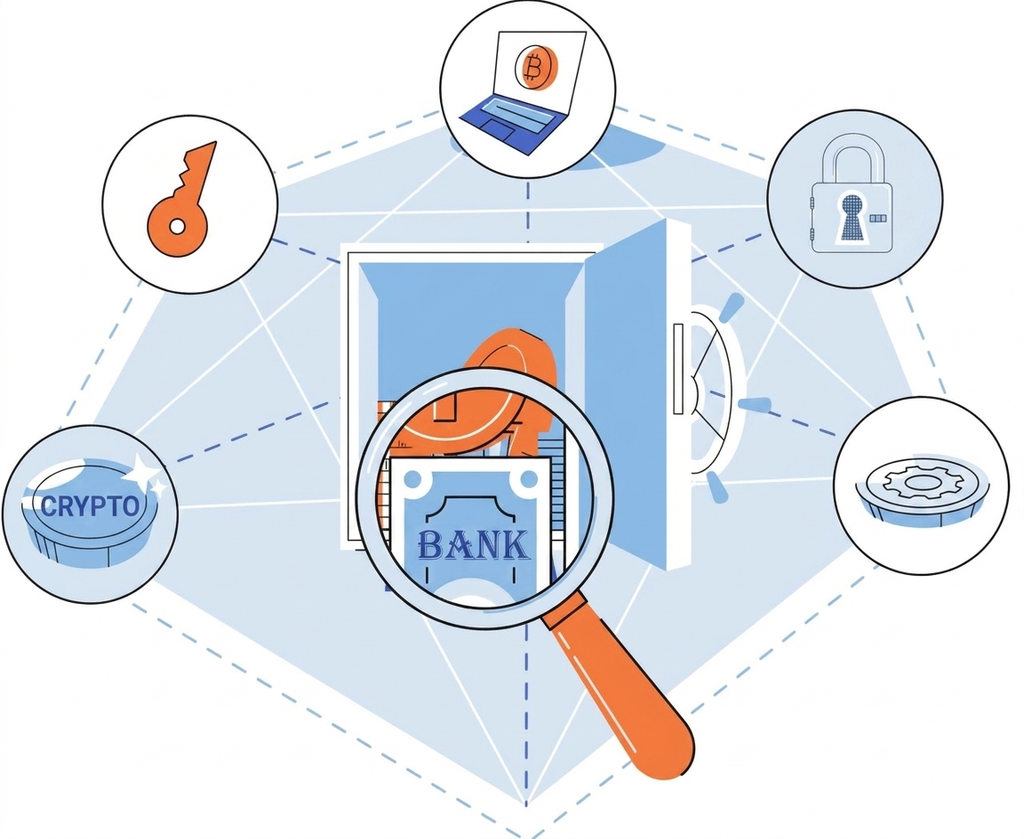
In recent years, a new financial architecture has been gaining ground on the global stage, challenging the traditional structures of banking intermediation. This is a movement known as “decentralized finance”, or DeFi, an ecosystem based on blockchain that allows the offering of financial services without the presence of centralized institutions.
It is estimated that this market has moved hundreds of billions of dollars since 2020, with increasing participation from individual users, developers, and institutional investors.
For John, Kogan, and Saleh (2023), the smart contracts used in DeFi not only automate transactions but also significantly expand the set of viable economic exchanges by eliminating the need for trust between parties. This new financial logic paves the way for a more transparent, accessible and potentially more efficient system.
Decentralized finance operates through smart contracts, which are programmable codes that automatically execute financial instructions when certain conditions are met. These contracts are hosted on public blockchains, such as Ethereum, allowing users to perform operations like loans, asset exchanges, insurance, and financial investments without human intermediation.
According to Gramlich et al. (2023), this model allows anyone with a digital wallet to interact directly with decentralized finance protocols, reducing operational costs and access barriers. The elimination of intermediaries allows for more transparency and autonomy, characteristics that distinguish DeFi from the conventional financial system.
Opportunities
One of the most discussed attractions in the context of DeFi is the possibility of generating passive income through direct interaction with protocols. Users can, for example, lend their cryptoassets to third parties on decentralized lending platforms and receive interest in return, or provide liquidity to exchanges, obtaining remuneration proportional to the transaction volume.
As highlighted by Bhambhwani and Huang (2024), audited protocols with higher reputations tend to attract more users and capital volume, reflecting greater confidence in the sustainability of these returns.
There are also so-called airdrops, which consist of the free distribution of digital tokens to users who interact with certain platforms or meet specific criteria, such as making transactions or previously holding certain assets.
This practice has been adopted as a strategy to stimulate community engagement, promoting the adoption of new protocols and rewarding user participation. In addition to the possibility of income, DeFi also enables access to credit more efficiently and, in many cases, with lower interest rates than those charged by traditional banks, as pointed out by John et al. (2023) and Momtaz (2024). Such practices have been consolidated as alternatives to conventional applications, although they involve operational and market risks.
Risks and challenges
Despite its transformative potential, the DeFi ecosystem faces a series of structural challenges. One of the main ones is related to the security of smart contracts, which, when poorly written or insufficiently audited, become vulnerable to attacks and manipulations. According to Aspembitova and Bentley (2023), attacks targeting oracles, which function as mechanisms responsible for providing external data to contracts, have been responsible for significant losses in lending protocols.
Furthermore, the absence of specific regulation hinders legal accountability in cases of fraud, as shown by the forensic analyses conducted by Trozze, Davies, and Kleinberg (2023). Another critical point refers to the complexity of the platforms, which still represent a barrier to entry for less experienced users. These factors highlight the need for technological and regulatory maturity for DeFi to consolidate in a secure and sustainable way.
Final considerations
Decentralized finance represents a major break in how financial services can be conceived, offered, and used. By enabling direct, auditable, and programmable transactions between economic agents, DeFi expands access and challenges traditional intermediation models. However, its consolidation will depend on overcoming technical challenges, such as the security of contracts, and institutional ones, such as the creation of regulatory structures compatible with the decentralized nature of these systems. As Salami (2021) argues, it is fundamental that regulatory efforts keep pace with technological evolution, creating environments that combine innovation with user protection. Understanding its dynamics is, therefore, essential for anyone wishing to follow and participate in the ongoing economic transformations.
| To access the references of this text click here. |
Who wrote this column
José Erasmo Silva