Digital Consumer
July 31, 2026
The Rise of Substack
Platform allows authors to publish newsletters through subscriptions, transforming content into a final product

I’m addicted to Substack. And the reason isn’t the platform itself. Simply because it doesn’t have the classic mechanisms that have sustained the logic of social networks over the last decade. There isn’t an infinite feed driven by intermittent stimuli, and the algorithm works differently, focusing on the connection of communities and conversion into subscriptions, rather than on total screen time or easily viral content.
And yet, I come back. I read long texts. I open the emails that arrive for me. I subscribe to newsletters. This behavior, which contradicts the dominant narrative that attention spans are getting shorter, points to something more structural: it’s not the platform that retains. In the case of Substack, it’s the type of content it enables.
Substack is a publishing platform founded in 2017, structured on a relatively simple model: allowing authors to publish newsletters and monetize directly their audience through subscriptions. Its initial growth was strongly associated with independent journalists, many of them from traditional newsrooms, who began to explore more autonomous forms of content production and distribution. Over time, the platform has expanded its scope, incorporating writers, analysts, specialists, and, more recently, brands. Nevertheless, its structural base remains anchored in three elements: authorial writing, direct distribution (mainly via email), and recurring monetization.
This finding leads us to a relevant change in how we understand the role of content. For a long time, it was treated as a means: a resource to attract, engage, and, ultimately, convert to another product or service. What is beginning to consolidate now is another configuration, in which content does not abandon this function, but also begins to operate as a final product. It does not necessarily lead to an external offer. It is the offer itself.
Substack’s growth should be viewed through this lens. More than a new publishing platform, it represents an infrastructure that organizes and enables this model. The combination of authorial writing, direct email distribution, and the possibility of recurring monetization creates an environment where the relationship between producer and audience becomes less intermediated and more economic. It’s not just about producing content, but about sustaining a continuous delivery of value capable of justifying payment.
This movement is articulated with a revaluation of long and directed content (a trend I have already discussed here in other articles). After years of predominance of short, fragmented, and highly replicable formats, a saturation is observed that compromises differentiation. The excess of available information does not eliminate the demand for content; on the contrary, it reorganizes this demand around more demanding criteria. Reading time ceases to be a barrier and becomes a signal. Those who stay are more willing to delve deeper, and this alters the quality of the relationship built.
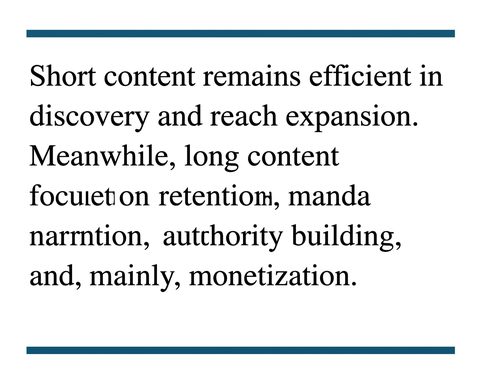
This is not a return to the past, nor a replacement of short content. What is observed is a specialization of roles within the digital ecosystem. Short content remains efficient for discovery and reach expansion. Long content, on the other hand, concentrates retention, authority building, and, mainly, monetization. This distinction is central to understanding why subscription-based models find fertile ground in this context.
It is at this point that Substack connects most clearly with the evolution of the creator economy. If, at first, creators depended mainly on platforms based on advertising and algorithms to scale audience, now a gradual migration to models based on community and direct revenue is observed. The success metric shifts: reach loses centrality to retention, and superficial engagement gives way to recurring connection.
This transition, however, does not eliminate tensions. The idea of disintermediation needs to be relativized. Although Substack reduces dependence on algorithms as in the distribution models we are accustomed to, it is still a platform, with its own rules, with a type of algorithm, with limitations and forms of mediation. Furthermore, the sustainability of the model depends on a demanding factor: consistency.
Without the recurrence of relevant deliveries, the subscription logic quickly weakens. What is gained in autonomy, is increased in responsibility. And regarding consistency, one must pay attention precisely to this characteristic of long content: it requires more time, more preparation, and more attention in writing. This more elaborate, more “robust” content is what keeps me on Substack.
The entry of brands into this environment adds an important layer of complexity. By occupying Substack, brands cease to act solely as issuers of institutional messages or promotional content and begin to compete for space in a territory that values authorship, depth, and regularity. This implies a change of role: from an advertising line to an editorial line.
This transition raises relevant strategic questions. The first of these concerns the nature of the content produced. For a brand to be relevant in this context, it is not enough to inform or publicize; it is necessary to produce something that stands on its own, regardless of the product or service offered. This requires the development of original thought, analytical skills, and a recognizable voice, elements that are not always part of the traditional structure of corporate communication.
The second question is more structural and perhaps more sensitive: what will happen to the Substack ecosystem as more brands join it? Digital platforms have a history of transformation as new players begin to compete for attention within them. Environments initially perceived as spaces for qualified exchange tend, over time, to incorporate dynamics of promotion, competition for visibility, and standardization of formats.
Therefore, there is a risk (distant, but still a risk) that the logic that currently differentiates Substack, based on depth, direct relationship, and less algorithmic interference, may be affected by practices closer to traditional social networks. This does not necessarily mean an inevitable distortion, but it points to a delicate balance. If the presence of brands contributes to raising the quality and diversity of content, it can strengthen the ecosystem. If, on the other hand, it reproduces promotional and superficial dynamics, it can compromise the very value that sustains the model.
This discussion is still open and very new, and perhaps this is one of the most interesting aspects of the current moment. Substack has not reached its full potential, but it already operates as a consistent indicator of change. It reveals that there is room for models in which content does not depend exclusively on massive scale to generate value and in which the relationship with the audience can be built on more direct and sustainable bases.
What keeps me on Substack is this possibility of having access to new, targeted content that speaks to me more deeply. Content that differentiates itself not by size, but by its essence and what it provokes in me: the desire to keep reading. Whether this model will expand dominantly or coexist with other formats is not yet possible to say. But it already imposes an important review: producing content is no longer just a visibility strategy. In certain contexts, it has become a business strategy, with all the demands that this implies. An alternative for content creators who do not want to depend on algorithmic logic and who wish to deliver more than seven seconds.