
Business
April 17, 2025
The role of leadership in the implementation of the Lean Manufacturing methodology
DOI: 10.22167/2675-6528-2024016
E&S 2025, 6: e2024016
Alda Fabiana Moreira Domingues e Paulo Roberto Palauro
Lean Manufacturing or Lean Mindset has proven to be an important tool for process optimization, cost reduction, and improvement of product quality[1]. Its implementation requires leadership commitment, which plays a fundamental role in developing team knowledge, motivation, and engagement; in defining objectives; and in ensuring the sustainability of the improvements made[1]. In this context, it is important to understand the role of leadership in implementing improvements through Lean Manufacturing, especially in companies seeking to increase their market competitiveness[2].
According to Latorre[3], organizations were planned and built to achieve their objectives through a set of activities carried out by two or more people. Leadership is an important function in all organizations, as it plays a fundamental role in directing their subordinates in the administration of their activities[4]. Dahl[5] adds that leadership needs to adopt Lean thinking and principles for the company to evolve continuously.
A company in the auto parts sector located in the interior of São Paulo — where the multinational operates in the stamping, machining, and assembly segments — implemented the Lean Manufacturing methodology as a way to optimize its processes and reduce its production process costs. The company had been facing challenges related to market competitiveness due to the emergence of competitors and pressure for cost reduction and delivery times.
From this scenario, this case study aimed to analyze the role of leadership in the implementation of the methodology in the company in question, seeking to identify the strategies and actions that were adopted by leaders to ensure the success of the implementation, the improvements achieved, and the results obtained. To meet the proposed objective, the study sought to answer the following research question: what improvements related to process and planning can be achieved by combining concepts of Lean Manufacturing? For this purpose, a qualitative approach was adopted with quantification in data collection and treatment. The research is classified as applied, as it seeks to solve a concrete problem and reduce waste.
For the development of the research, initially, communication was made with the manager responsible for the organization in order to present the idea and the objective of the study. The possibility of collecting data from the company through images, interviews, and more detailed information was also requested. Subsequently, an intervention and training application was carried out for the employees.
The implementation of Lean Manufacturing began with the formation of a multidisciplinary team, which included collaborators from different areas. Their responsibility was to map existing processes and identify improvement opportunities during the months of October to December 2022. The company’s CEO clearly defined the objectives for implementing the methodology, as well as the role of each collaborator in the process, and provided the necessary financial and technological resources for it.
From the perspective of technical procedures, the research is characterized as a case study, aiming at the discovery and interpretation of a context, and seeking to portray reality completely and in depth[6]. In other words, it is a research, developed in stages, that intended to investigate a current phenomenon within a real scenario that allowed for a detailed analysis of the processes of the organization studied (Table 1).
Quadro 1. Etapas do desenvolvimento do trabalho
| No. | Step | Definition | Objective to achieve |
| 1 | Knowledge about the topic | Tools and applications with two approaches: the systematized one, with the search for articles involving the organization and standardization of processes to increase efficiency and reduce errors, selecting the best quality ones and classifying them; and the non-systematized one, with good quality articles showing disorganized processes, lack of efficiency, and difficulties in decision-making. | Bibliographic review |
| 2 | Planning | Development of collaborators in the Lean methodology | Training and Development Dojo Construction |
| 3 | Data collection | The process time measurement was carried out with the help of operators, engineers, and those responsible for production planning and control. When manual data collection was necessary, teams were formed, including operators from all work shifts | Current situation |
| 4 | Current stage | Generation of the value stream map (VSM) that allowed understanding the process operation and diagnosing points that demand greater attention and bottlenecks | Current Value Stream Map (VSM) |
| 5 | Analysis | Identify the improvements that would be implemented, based on the current state of the previous stage. The improvements were classified to prioritize their possible implementations | Plan the improvements |
| 6 | Presentation of results | Through the previous steps, it was possible to build the map of the future state, which allows visualizing how the operations will be after the implementation of the improvements | Value stream map (VSM)) after analysis |
| 7 | Implementation | Application of improvements | Minimize the possibilities of errors and lack of employee confidence regarding the future state. |
The Lean Manufacturing is a methodology that aims at maximizing productive efficiency and minimizing waste, the central idea is to produce more with less, increasing productivity and decreasing production costs[7].
It is a methodology that has proven effective in companies of all sizes and sectors. It is based on the assumption that all company activities should be aligned with customer needs, always seeking to offer products and services with high quality and added value[10] — aiming, for example, to reduce the delivery time of a product to the consumer.
Some Lean Manufacturing tools considered fundamental for process improvement, and which will be addressed in the present work, are: The eight wastes; Obeya; 5S Program; The 5 Sens; VSM (Value, Stream, Mapping); and Kaizen.
The eight wastes
The Toyota Production System (TPS), in number of eight wastes and refers to all elements and activities that do not add value to the production process, increasing its production costs [12]:
1. Overproduction: more products are manufactured than actual demand, resulting in excess inventory, storage costs, and potentially obsolete products.
2. Waiting: machines or materials are idle, without effective use, slowing down the production flow, increasing cycle time.
3. Transportation: seeks to minimize unnecessary transport that consumes resources and time.
4. Overprocessing: simplification of processes to eliminate overprocessing, seeking to optimize the factory layout and processes to minimize non-productive movement.
5. Inventory: maintaining excessive inventories consumes space, capital, and can lead to quality problems.
6. Movement: unnecessary movement of people or materials leads to waste in the production process.
7. Correction or rework: emphasizes the need for defect prevention from the start.
8. Intellectual waste: this waste occurs when employees are not encouraged to contribute ideas, improvements, or innovations, resulting in a loss of potential and opportunities for company growth.
Dojo
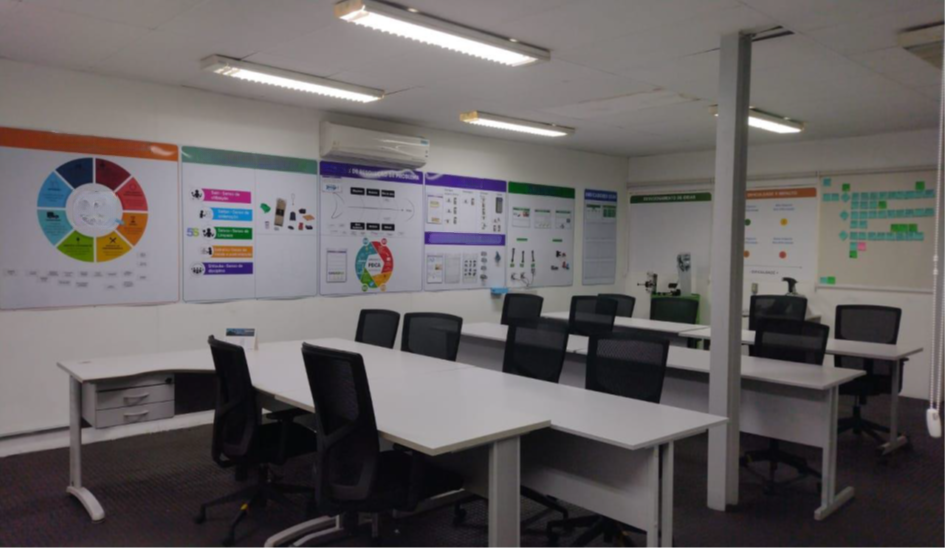
Japanese word meaning “large room”[13], where visual management is used for better planning of continuous improvement activities. Within a room, theoretical and practical training are carried out, such as defining goals, problem analysis and solution, structured action plan, and kaizen events, which are events or initiatives focused on continuous improvement within a company or organization. Addressed within this room are: production data, quality data, projects. In this environment, groups of collaborators with specific knowledge are gathered, bringing an approach to the location where the improvement will be made. In the context of this study, it began with the creation of a place called Dojo Lean, where collaborators received training and developed their Lean Manufacturing skills (Figure 1).
Source: Original survey data.
5S Program
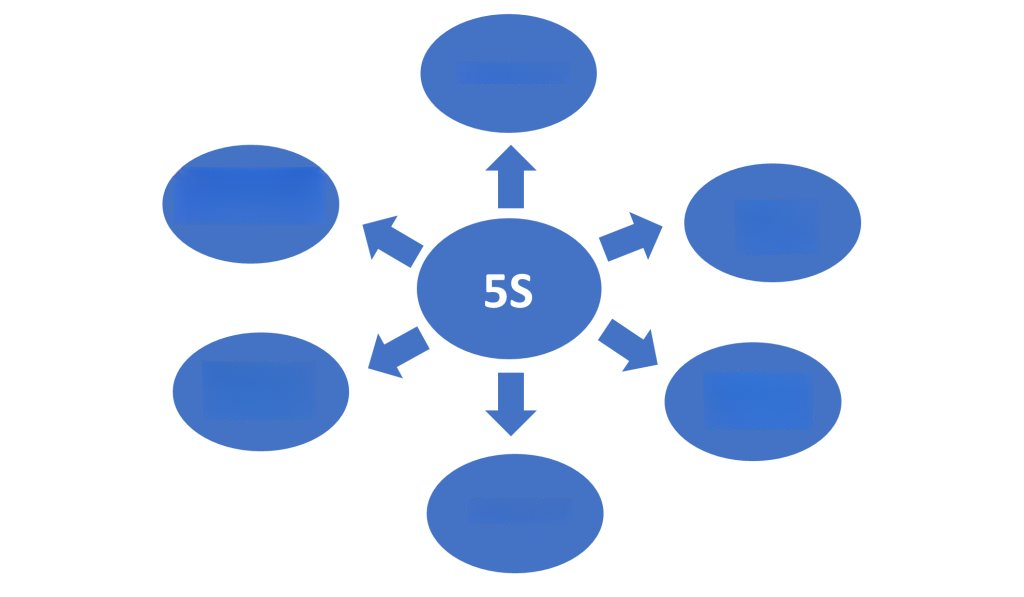
It was created with the objective of enabling a work environment with more productivity and less waste. The implementation of this tool in Japanese companies caused them to become the focus of study for organizations in countries such as the United States, the United Kingdom, and Brazil14]. According to Haroldo[15], 5S is the physical and behavioral basis for the success of Lean Manufacturing. Furthermore, it is one of the essential tools that, if well implemented and used, allow for leveraging the productivity of the company’s administrative and productive processes[16]. Vieira Filho[17] lists the various benefits that companies can obtain with the implementation of the 5S methodology (Figure 2).
Source: Adapted from Vieira Filho[17].
Santos et al.[18] highlight that organizing a sector and standardizing all necessary items in the workplace optimizes time and reduces direct and indirect production costs[19], exceeding client expectations. All applied aspects allow for greater safety in work execution and prevent accident risks. Finally, it is necessary to eliminate unused materials and equipment to increase productivity, generating significant gains[16].
The 5 Senses
1. Seiri: a sense of simple use, organize, free up space, and allow only what will be used in the workplace. The employee or company must check the materials present in the work environment, including files stored on the computer, and question whether the item is useful for the development of the work[20].
2. Seiton: is defined as the sense of ordering and tidiness, and is a sequence of the first step (Seiri)[12]. Since, in the previous step, of discarding, the employee has already divided the work material between necessary and unnecessary items, keeping only what is essential to perform their function, in this step it is necessary to organize them, order them, and focus on storing them in safe places. This last factor is of great importance, after all, incorrect storage of a certain tool, for example, can lead to accidents.
3. Seiso: is the concern with cleanliness. Research shows that a clean work environment, besides being adequate, is more pleasant and tends to motivate employees[21]. It is important to highlight that seiso also provides more safety for employees working with dangerous equipment, in addition to having benefits regarding their maintenance. This is because cleanliness provides a better quality of life for the employee and promotes product quality, whether on the production line or in material conservation[21].
4. Seiketsu: has a broader meaning and encompasses everything from health and hygiene to the standardization of production processes. Here, the main concern refers to the employee’s health, including their personal hygiene, concern for the environment’s lighting, ergonomics, ventilation, colors, and all the details that facilitate the exercise of the function[21].
5. Shitsuke: understood as the sense of self-discipline, it presupposes that all collaborators must demonstrate commitment and mutual respect, and work in synergy for the company to maintain organization and achieve its objectives. This sense encompasses the duties of all collaborators as members of an institution and the possibility of them being able to contribute suggestions aimed at continuous improvement[21].
VSM (Value, Stream, Mapping):
The VSM is a value stream mapping system, used to achieve a better systemic view, which designs the flow of materials from the beginning to the end of the process. There are two types of VSM: the first is the current, which consists of the representation of the flow of information and materials at the moment the process is happening. The second is the future, which represents the flow of information and materials with the already optimized production processes. The VSM is fundamental for identifying waste and opportunities throughout the process[22] .
Kaizen
The word Kai means to change, and Zen means better, that is, to change for the better[23]. It is known as a practice of continuous improvement. In its application, it is necessary to respect some main steps that are linked to mapping the current state of the organization. First, the processes are detailed, and then each one is mapped to have a holistic view of the production flows and identify possible improvements by analyzing the movement of materials and people.
An important part of having a well-implemented kaizen is standardization, which is any operation repeated more than once in the process, being considered the basis for producing correct products, avoiding waste. It is a tool to ensure safety, quality, productivity, and process stabilization, so that it can then achieve a basis for evolution[12].
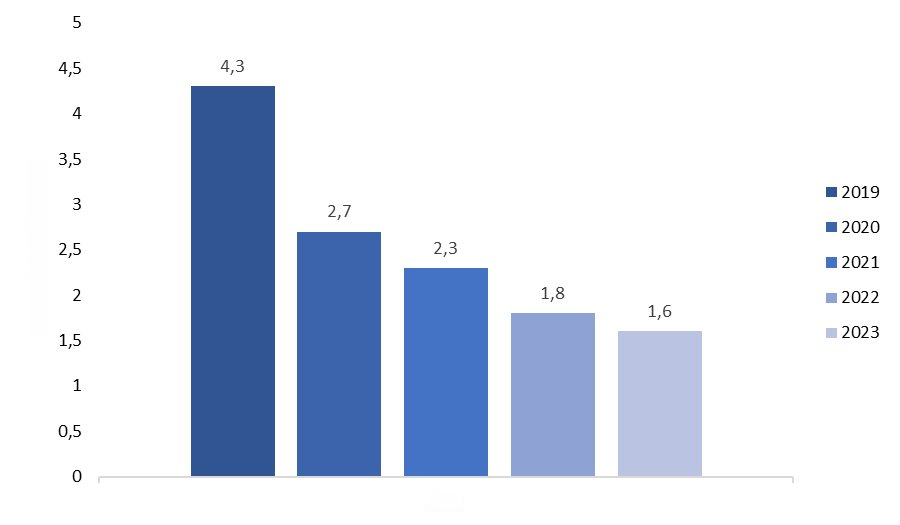
In this study, the data collection that preceded each kaizen event contributed to the realization of these so that they presented optimal results, as it was possible to observe the process as it was being done, with its successes and errors. The results of the data collection from the organization’s quality sector, responsible for customer complaints regarding non-conforming parts (which do not meet the established specifications), were organized in a graph based on cost per million (CPM) (Figure 3).
Source: Original survey data.
Source: Original survey data.
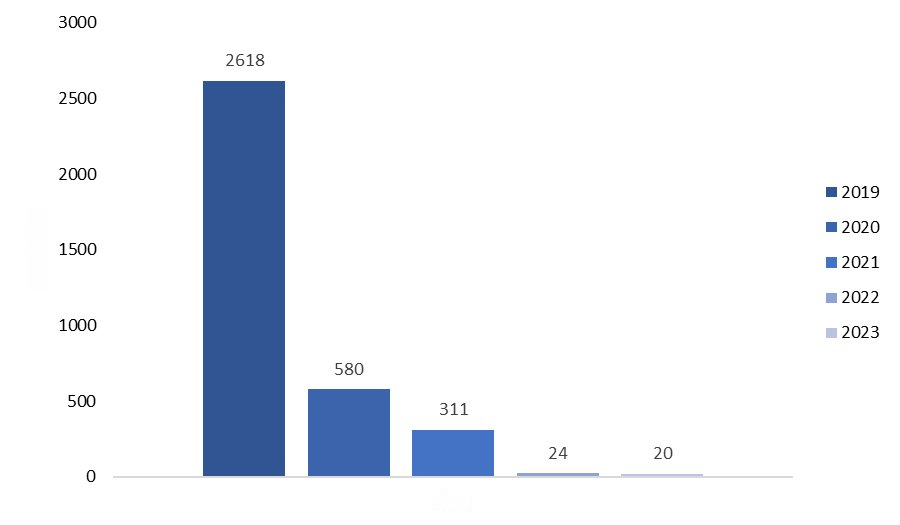
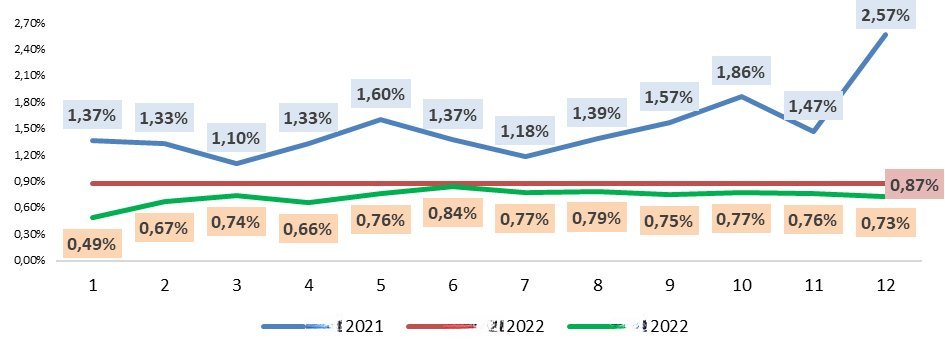
Another analyzed data was rework, one of the 8 wastes. It was observed that the company had a high rate of scrap or discarded parts for not being in compliance with the quality standards required by the client (Figure 5).
Source: Original survey data.
After data collection, improvements and kaizens analyses were performed, it can be observed: the increase from 6 kaizens, in 2020, to 35, in 2022; approximately 50% reduction in the discard of non-conforming parts, going from 11%, in 2021, to 16%, in 2022; and improvement and standardization of processes, which ensured a better work environment for employees and a reduction in accident rates.
It was observed that the implementation of Lean Manufacturing generated significant improvements in the company’s processes, as unnecessary processes were eliminated and production time was reduced; and product quality increased, decreasing the amount of rework and returns. Thus, the company managed to reduce its operational costs and improve its profitability.
In order to convey the importance of continuous improvement and its impacts on the company’s bottom line, a practical methodology was developed for leadership to follow:
1. Define the objectives of continuous improvement, including what changes are necessary and the expected results.
2. Communicate the objectives to everyone, highlighting the importance of continuously working to improve processes, products, and services.
3. Identify the critical processes that directly impact the quality of products or services.
4. Promote the participation of collaborators in the continuous improvement process, encouraging the suggestion of ideas and the presentation of proposals.
5. Closely follow the implementation of the proposed improvements and monitor the results, in order to ensure that these improvements are executed effectively.
6. Communicate the results of the implementation of improvements, highlighting the benefits for the company and for the employees.
There are also other possibilities to assist in the development of a practical methodology to convey to collaborators the importance of continuous improvement; they are:
1. Recognize and encourage collaborators who contribute ideas and suggestions for improvements, creating an environment that fosters innovation and creativity.
2. The leader can establish performance indicators to measure the results of continuous improvement, such as defect reduction, productivity increase, customer satisfaction, among others.
3. The leader must hold periodic meetings with the team to discuss the progress of the proposed improvements and present the results obtained, ensuring transparency and the involvement of all.
4. Continuous improvement must involve all sectors, ensuring they work together to achieve the objectives.
5. The leader must create a continuous learning environment, encouraging the search for new solutions and improvement, valuing the culture of continuous improvement as a competitive differentiator for the organization.
The results obtained with the implementation of Lean Manufacturing were as expected at the time the proposal was formulated. Significant improvements were observed in the company’s processes and profitability, which reflected the need for strong and committed leadership to define clear objectives, the role of collaborators, and to provide adequate support and resources for the implementation of the methodology.
The context of the company “AutoPartes” may be unique and the results may not be directly applicable to other organizations. The implementation of the methodology is not without challenges and each company may face specific obstacles on its path to continuous improvement.
References
[1] Riani, A.M. 2006. Estudo de caso: o Lean Manufacturing aplicado na Becton Dickinson. Monografia (Graduação) – Programa de Graduação em Engenharia de Produção, Universidade Federal de Juiz de Fora.
[2] Iuga, M.V.; Kifor, C.V. 2013. Lean Manufacturing: The when, the where, the who. Revista Academiei Fortelor Terestre. 18(4): 404-410.
[3] Latorre, S.Z. 2015. Mas, afinal, o que é essa tal organização? Senac São Paulo, São Paulo, SP, Brasil.
[4] Chiavenato, I. 2007. Administração: Teoria, Processo e Prática, 4ed. Elsevier, Rio de Janeiro, RJ, Brasil.
[5] Dahl, J. 2021. Liderança Lean: Como garantir o Sucesso e Desenvolver uma Estrutura de Liderança. Alta Books; Rio de Janeiro, RJ, Brasil.
[6] Lüdke, M.; André, M.E.D.A. 1986. Pesquisa em Educação: abordagens qualitativas. São Paulo: Editora Pedagógica e Universitária.
[7] Pacheco, D.A.J. 2014. Teoria das Restrições, Lean Manufacturing e Seis Sigma: limites e possibilidades de integração. Production 24(4): 940-956. https://doi.org/10.1590/S0103-65132014005000002
[8] Wilson, L. 2010. How to implement Lean Manufacturing. McGraw-Hill Education, New York, NY, USA.
[9] Bhamu, J.; Sangwan, K. 2014. Lean Manufacturing: literature review and research issues. International Journal of Operations & Production Management 34(7): 876-940. DOI: 10.1108/IJOPM-08-2012-0315.
[10] Wahab, A.N.A.; Mukhtar, M.; Sulaiman, R. 2013. A conceptual model of Lean Manufacturing dimensions. Procedia Technology. 11: 1292-1298. https://doi.org/10.1016/j.protcy.2013.12.327.
[11] Tejeda, A.S. 2011. Mejoras de Lean Manufacturing en los sistemas productivos. Ciencia y sociedad.
[12] Narusawa, T.; Shook, J. 2011. Kaizen Express: Fundamentos para sua jornada Lean. 2ed. Lean institute Brasil, São Paulo, SP, Brasil.
[13] Nascimento, D.L.M.; Quelhas, O.L.G.; Meiriño, M. J.; Caiado, R.G.G.; Barbosa, S.D.J.; Ivson, P. 2018. Facility Management Using Digital Obeya Room By Integrating Bim-Lean Approaches – An Empirical Study. Journal of Civil Engineering and Management. (24)8: 581-591. Disponível em: https://doi.org/10.3846/jcem.2018.5609.
[14] Anvari, A.; Ismail, M.Y.; Hojjati, S.M.H. 2011. A study on total quality management and Lean Manufacturing: through Lean thinking approach. World applied sciences jornal.12(9): 1585-1596.
[15] Haroldo, R. 2006. A Bíblia do 5S, da implantação à excelência: conheça a metodologia que levou empresas no Brasil a serem benchmarking. Casa da Qualidade, Salvador, BA, Brasil.
[16] Carreras, M.R.; García, J.L.S. 2010. Lean Manufacturing. La evidencia de una necesidad. Ediciones Díaz de Santos.
[17] Vieira Filho, G. 2003. Gestão da Qualidade Total: uma abordagem prática. Alínea, Campinas, SP, Brasil.
[18] Santos, T.M.; Rodrigues, R.A.; Garcia, G.F.R.; Reis, O.H.B. 2017. KAIZEN E5S: estudo e aplicação em uma indústria alimentícia. Anais do VII congresso Brasileiro de Engenharia de Produção (Conbrepro). Ponta Grossa, Paraná, Brasil.
[19] Chauhan, G.; Singh, T. P. 2012. Measuring parameters of Lean Manufacturing realization. Measuring Business Excellence. 16(3): 57-71. DOI: 10.1108/13683041211257411.
[20] Schonberger, Richard J. 2019. The disintegration of Lean Manufacturing and Lean management. Business Horizons. 62(3): 359-371, 2019. DOI: https://doi.org/10.1016/j.bushor.2019.01.004.
[21] Seleme, R.; Stadler, H. 2008. Controle da qualidade: as ferramentas essenciais. Editora Ibpex, Curitiba, PR, Brasil.
[22] Womack, J. P.; Jones, D.T. 2011. A Mentalidade Enxuta nas Empresas Lean Thinking. Elsevier, Rio de Janeiro, RJ, Brasil.
[23] Oliveira, E. B.; Magno, R.N.O.; Quaresma, S.F.S.; Barata, M.P.C. Implantação de um novo layout de uma linha de montagem de motocicletas estruturado a partir da metodologia MASP e ferramentas Lean Manufacturing. Brazilian Journal of Development. 7(4): 37002-37024.
Como citar
Domingues, A.F.M.; Palauro, P.R. O papel da liderança na implementação da metodologia Lean Manufacturing. Revista E&S. 2025; 6: e2024016
About the authors
Alda Fabiana Moreira Domingues – Specialist in Business Management. Rua José dos Santos, 142, Ypê VIII, 13846-410, Mogi Guaçu,
São Paulo, Brazil.
Paulo Roberto Palauro – Doctor in Business Administration from Methodist University of Piracicaba. Travessa Amália Dedini, 82, Jardim Europa, 13416-510, Piracicaba, São Paulo, Brazil