
Agribusiness
December 03, 2025
Family farming in Rio Grande do Sul: socioeconomic relevance, public policies, and barriers to access rural credit
Authors: Patrícia Possobon Burmann and Matheus Luís Docema
DOI: 10.22167/2675-6528-2025034
E&S 2025, 6: e2025034
Family farming has gained increasing prominence for its strategic role in the economy and in promoting food and nutritional security, consolidating itself as an essential pillar both in Brazil and globally[1]. Representing 77% of the country’s agricultural establishments, this segment employs more than 10 million people, corresponding to 67% of the sector’s workforce and 40% of the economically active population’s income. In Rio Grande do Sul, family farming represents 80.5% of rural properties, which occupy 25.3% of the total area[2]. According to Law No. 11.326/2006, Brazilian family farming is characterized by rural establishments of up to four fiscal modules, managed with predominantly family labor and which obtain a significant part of their income from agricultural activities[3].
In the state of Rio Grande do Sul, family farming is strongly supported by the National Program for Family Farming (Pronaf), created in 1995, which offers subsidized credit and differentiated conditions, consolidating itself as a relevant financial instrument for farmers. Despite the importance of Pronaf, access to rural credit faces challenges, such as excessive bureaucracy, lack of information about financing lines, and difficulties in obtaining guarantees[4]. Between 2013 and 2022, Pronaf accounted for 70-75% of rural credit contracts, but only 14-15% of the total volume, indicating concentration in large producers and limited access for the majority of family farmers[5].
Rural credit, in turn, is fundamental for the modernization of the agricultural sector, enabling the adoption of technologies, increased productivity, and higher producer income. Furthermore, agribusiness carries significant weight in the national economy, representing 29.4% of Brazil’s Gross Domestic Product [GDP] in 2025[6]. In Rio Grande do Sul, family farming plays a strategic role in food security, job creation, and sustainable development[7].
In this context, it becomes essential to highlight the role of public policies aimed at rural credit and family farming, which structure and condition producers’ access to financial instruments. Since the creation of the National Rural Credit System (SNCR) in 1965, the Brazilian state has played a central role in offering subsidized credit and regulating financing conditions, promoting agricultural modernization and the expansion of national production[8]. From the 1990s onwards, with the political recognition of family farming and social mobilizations demanding differentiated policies, specific programs emerged, such as Pronaf, considered an institutional milestone in the productive inclusion of this segment[9].
These policies evolved in three generations: a first focused on strengthening agriculture and agrarian matters (land reform, credit, technical assistance); a second phase marked by social and welfare policies; and a third centered on building markets oriented by food security and environmental sustainability[9]. This set of instruments consolidated as the basis for rural development and for reducing inequalities in the countryside, especially between small and large producers.
Thus, the relationship between rural credit, public policies, and family farming constitutes a key element for understanding the productive and socioeconomic dynamics of Brazilian agricultural regions. Given the relevance of rural credit as an essential instrument for the socioeconomic strengthening of family farmers, this study sought to analyze the main obstacles to its access in the state of Rio Grande do Sul.
Participant selection and sampling type
This research is an exploratory study with a qualitative-quantitative approach that analyzed data obtained from family farmers, credit agents, and public policy specialists, aiming to understand access to development programs in the state. Data collection was carried out through structured questionnaires and interviews, covering different localities in Rio Grande do Sul selected based on regional agricultural diversity. This diversity includes variations in production systems and socioeconomic conditions: while the Northwest and the Central Plateau are characterized by mechanized agriculture focused on grain production, the Serra Gaúcha stands out for its fruit and wine production, and the Southern Half for extensive livestock farming and irrigated rice cultivation. These differences justified the choice of areas capable of representing the state’s agricultural heterogeneity. Participants were selected through intentional sampling, considering their involvement in activities characteristic of family farming.
The questionnaires were distributed through institutional channels, unions, cooperatives, and rural extension networks, resulting in 91 valid responses. The application was carried out via Google Forms©, with dissemination by partner institutions and local media. All participants signed the Free and Informed Consent Term (TCLE), ensuring voluntary and anonymous participation.
For the interviews with specialists, 12 professionals with consolidated experience in rural credit were selected, including financial agents, cooperative technicians, and sector consultants. The choice followed the expertise criterion, as recommended in the literature for qualitative studies focused on public policy analysis.
Structure of the data collection instrument and questions applied
The field research took place between February and March 2025, with the questionnaire structured into three thematic blocks: (i) socioeconomic profile (sex, age, education level, income, location, property area, and production type); (ii) experiences and conditions of access to rural credit, including questions about the frequency of Pronaf use, financed amounts, difficulties faced (guarantees, documentation, bureaucracy), financial institutions used, and purpose of funds; and (iii) perceptions of public policies, addressing the evaluation of Pronaf’s effectiveness, perceived bottlenecks, and suggestions for improvement. Interviews with specialists followed a semi-structured script containing questions about institutional barriers, evaluation of credit analysis criteria, importance of technical assistance, and proposals for improving the system.
Theoretical basis for the construction of the questionnaire
The instrument’s development was based on literature concerning public policies for family farming, rural credit, and unequal access to financing, taking as references studies related to the structural effects of Pronaf[9,10] and on institutional barriers and financial education[11]. These studies guided the inclusion of variables related to bureaucracy, collateral requirements, knowledge of programs, and the role of technical assistance, elements considered determinants in the literature for explaining the inclusion or exclusion of family farmers from the rural credit system.
Profile of rural credit sector specialists
Among the 12 specialists interviewed, the majority (58.4%, n=7) work as representatives of cooperatives or credit agents, with 11 respondents (91.7%) having more than seven years of experience in the field. This profile highlights a technical body with consolidated knowledge, lending credibility to the perceptions reported. Although these professionals do not hold formal positions in public policy formulation, their role as representatives of cooperatives and credit agents positions them as important intermediaries between the State and rural producers. Through credit granting, technical guidance, and coordination with public bodies, they indirectly influence the implementation of policies such as Pronaf, functioning as facilitators of practices and strategies that reflect, at the local level, the objectives of public policies. However, the absence of representatives directly linked to policy formulation may limit the understanding of the conception and systemic coordination of these agricultural policies[12].
Characterization of the profile of family farmers
Among the 91 producers who responded to the questionnaire, the male sex predominated (93.3%, n=84), reflecting traditional patterns of rural family management in Brazil. The superiority of male producers was also observed in other surveys, although the growing female participation in certain regions and specific production chains[13] stands out. The predominant age group of the respondents was 45 to 59 years old, and more than 25% of the participants did not complete elementary school, highlighting challenges related to the aging of the rural population and educational barriers[14]. These factors directly influence the adoption of technologies and the understanding of bureaucratic requirements for accessing credit. The geographical concentration of respondents in the northwest region of the state favored a regionalized interpretation of Pronaf, with a predominance of agriculture focused on grain production (57.2%, n=52) and small properties of 10 to 50 hectares (65.9%), compatible with the program’s criteria[15].
Access to rural credit, via Pronaf
The majority of producers interviewed (98.9%, n=90) have already used Pronaf, indicating wide dissemination of the program. However, the qualitative analysis revealed recurring difficulties, such as the requirement for guarantees (18.7%, n=17) and excessive bureaucracy[16]. Of the participants, 30.8% (n=28) reported having already faced difficulties in obtaining credit, while 69.2% (n=63) did not face problems. These results suggest that, although the majority have access to credit, a significant portion still faces barriers, demanding attention in financing policies.
The analysis of the main obstacles to obtaining credit revealed that the requirement for collateral was the most cited factor by respondents, representing 53.1% of the responses. This data highlights a significant barrier, especially for family farmers who often do not have sufficient assets to offer as collateral. The lack of documentation constituted another relevant challenge, pointed out by 12.5% of participants, possibly related to the bureaucracy of financing processes, hindering access for farmers with lower schooling or limited technical assistance.
Lack of knowledge about credit programs was cited by 9.4% of respondents, indicating the need for greater dissemination and guidance on available lines, eligibility requirements, and benefits. Additionally, 25% of participants mentioned other factors, detailed in open-ended responses, such as guarantor requirements and changes in instruments like Proagro, credit restrictions for specific purposes (such as purchasing used trucks or machinery), criticisms of the agricultural insurance system and the agricultural year limit. These findings reinforce the importance of revising rural credit policies, making them more inclusive, flexible, and adapted to the reality of producers, especially family farmers.
Regarding the financed amounts, it was observed that most operations exceeded R$ 30,000, with resources predominantly allocated to the acquisition of agricultural inputs and machinery and equipment. This pattern reveals a strong orientation of farmers towards investments in productive modernization. However, the high concentration of financing for this type of purpose also suggests a possible dependence on credit to maintain mechanized production systems, which may limit agricultural diversification. Similar results were identified in a study conducted by the Federal University of Rio de Janeiro (UFRJ), highlighting that even with the offer of subsidized credit, many farmers still face structural obstacles, such as a lack of financial education, excessive bureaucracy, and collateral requirements, which restrict full access to development programs. According to the study, integrating rural credit with financial training programs can enhance its effectiveness, improve resource utilization, and reduce institutional barriers[11].
The distribution of requested credit value ranges revealed that the majority of producers (n=66) requested values above R$ 20,000 (Figure 1). Subsequently, 16 producers requested funds between R$ 10,000 and R$ 20,000, while lower ranges, such as less than R$ 5,000 and R$ 5,000 to 10,000, were reported by only four producers each. This data indicates that most farmers seek higher financing amounts, possibly to meet greater production or investment demands.
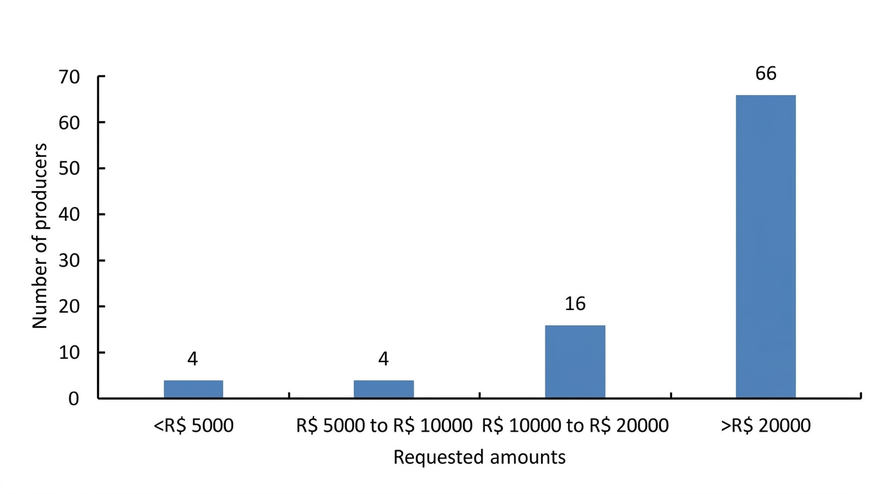
Source: Original research results.
Purpose of the use of credits
The majority of respondents (64.4%) used credit to acquire agricultural inputs, indicating that the main objective of financing is to sustain production. Subsequently, 17.8% allocated resources to equipment, 5.8% to infrastructure, and 5.6% to expanding the area, while only 1.1% used credit for debt payments. Other uses accounted for 5.3% of cases. These data indicated that credit played a central role in the direct development of agricultural activity, with a focus on production and modernization.
In Rio Grande do Sul, Pronaf resources are predominantly applied to the purchase of inputs (64.4%) and equipment (17.8%), evidencing a focus on production intensification. Although this strategy can increase productivity, it also implies economic and environmental risks, especially without strategic planning and adequate technical assistance. Specialization and production concentration favored by credit can make family farmers vulnerable to market fluctuations and climate changes, in addition to limiting productive diversification and income generation[10]. In this context, public policies associated with Pronaf should prioritize not only access to credit but also technical assistance and rural extension programs. In recognition of this need, the Ministry of Agrarian Development and Family Agriculture (MDA) of the Federal Government announced, in 2024, an investment of R$ 19 million in technical assistance for more than four thousand family farmer families, including those located in Rio Grande do Sul[14].
Main impacts and benefits of rural credit on family farming in Rio Grande do Sul
Among the farmers who accessed Pronaf, more than 91% rated its impacts as positive, highlighting increased production and income. However, only 14-15% of total rural credit is allocated to family farming, and the benefits are more evident among producers linked to cooperatives or with access to technical assistance, demonstrating the need for complementary policies to expand reach and effectiveness[5].
Expert perceptions: barriers and proposals
Qualitative interviews identified significant bottlenecks, such as complex documentation, unintuitive operating systems, and the requirement for real collateral. For 58.3% of specialists, easing these criteria would be essential to broaden access, especially for young farmers (family succession) or those without consolidated assets. The main suggestions from specialists to improve access to rural credit included reducing bureaucracy, increasing the dissemination of financing programs and financial management training, as well as creating specific credit lines, updating financing limits, and refining risk criteria, with the aim of making credit more accessible, fair, and efficient. Bureaucracy was mentioned in 10 out of 12 interviews, aligning with the analyses by Reis[13], which highlight the need for modernization and digitalization of processes (Table 1).
Table 1. Main suggestions from specialists on access improvements through rural credit in support programs for family farming in the state of Rio Grande do Sul
| No. | Suggestion | Main objective |
| 1 | Reduce bureaucracy for credit release | Streamline the credit access process |
| 2 | Expand the dissemination of financing programs | Improve producers’ knowledge about credit |
| 3 | To ease the required guarantees | Facilitate access for family farmers |
| 4 | Training of farmers in financial management | Improve the use of resources obtained via rural credit |
| 5 | Update of credit limits according to the sector’s reality | Increase the producer’s investment power |
| 6 | Refinement of risk analysis criteria | Avoid undue exclusions of producers with access potential |
Evaluation of institutions and technical support
Banco do Brasil and cooperatives such as Sicredi and Cresol stand out as the main intermediaries of rural credit, with their performance being valued by the interviewed specialists. Among the rural producers participating in the survey, greater use of Banco do Brasil (54.9%) was observed, followed by Sicredi (16.5%) and Caixa Econômica Federal (7.7%). However, it is essential to emphasize that these results exclusively reflect the behavior of the analyzed sample and do not allow for generalizations to all family farmers in the state. Thus, the apparent preference for public banks and cooperatives should be interpreted as a specific trend of the respondents, and not as a structuring characteristic of the sector at the state level.
Technical assistance and effectiveness of Pronaf
Studies indicate that family farmers with access to technical assistance are more successful in using and obtaining rural credit. However, inequalities persist that reinforce the need for public policies focused on technical training in the countryside. Producers with higher schooling and income have easier access to Pronaf and technical assistance, evidencing regional disparities: the South and Center-West predominantly use private ATER, while the North and Northeast depend on public ATER[18]. Surveys by the Federal Court of Accounts (TCU) point to deficiencies in coordination, insufficient supply, and low continuity of technical assistance and rural extension, highlighting the importance of associating credit expansion with technical support adapted to regional realities.
The results confirm the relevance of Pronaf for the productive inclusion and sustainability of rural communities, but identify recurring obstacles, such as collateral requirements, documentary bureaucracy, and communication failures between producers and financial institutions, which compromise full access to the program. These barriers highlight the need for greater coordination between public bodies, cooperatives, and banks, aiming for more inclusive and effective rural credit policies. In Rio Grande do Sul, family farmers specifically face bureaucracy, collateral requirements, and lack of technical assistance to access Pronaf. To increase the program’s effectiveness, it is recommended to simplify processes, offer continuous technical support, and promote financial education, strengthening family farming, family succession, and sustainable rural development.
REFERENCES
[1] Empresa Brasileira de Pesquisa Agropecuária (Embrapa). Agricultura familiar. 2025. Disponível em: <https://www.embrapa.br/tema-agricultura-familiar/sobre-o-tema>. Acesso em: 21 nov. 2025.
[2] Governo do Estado do Rio Grande do Sul. 2025. Agricultura familiar é desenvolvida em 25% da área rural no RS. Porto Alegre: Secom; 2025. Disponível em: <https://www3.estado.rs.gov.br/agricultura-familiar-e-desenvolvida-em-25-da-area-rural-no-rs-aponta-ibge>. Acesso em: 21 nov. 2025.
[3] Instituto Brasileiro de Geografia e Estatística (IBGE). 2019. Censo Agropecuário 2017: Resultados Definitivos. Rio de Janeiro. Disponível em: <https://www.ibge.gov.br/estatisticas/economicas/agricultura-e- pecuaria/21814-2017-censo-agropecuario.html?t=publicações>. Acesso em: 21 nov. 2025.
[4] Noskoski, L.E.C.; da Costa, N.L.; de Oliveira, G.N.; Dalcin, M.S.; Mabetana, K.P.F. 2024. O Pronaf no estado do Rio Grande do Sul: Uma revisão sistemática da literatura. Revista de Gestão e Secretariado 15(5): e3836-e3836.
[5]Climate Policy Initiative [CPI]; Pontifícia Universidade Católica do Rio de Janeiro [PUC- Rio]. 2023. Agricultura Familiar Brasileira: Desigualdades no Acesso ao Crédito. Rio de Janeiro. Disponível em: <https://www.climatepolicyinitiative.org/pt-br/publication/agricultura-familiar-brasileira-desigualdades- no-acesso-ao-credito/>. Acesso em: 21 nov. 2025.
[6] Cepea; Confederação da Agricultura e Pecuária do Brasil (CNA). 2020. Acesso ao crédito e modernização do setor agrícola. Piracicaba: ESALQ/USP. Disponível em: <https://www.cepea.esalq.usp.br/>. Acesso em: 21 nov. 2025.
[7] Brasil. Ministério do Desenvolvimento Agrário e Agricultura Familiar. 2024. MDA vai investir R$ 19 milhões em assistência técnica para mais de 4 mil famílias de agricultores familiares. Disponível em: <https://www.gov.br/mda/pt-br/noticias/2024/12/mda-vai-investir-r-19-milhoes-em-assistencia-tecnica-para-mais-de-4-mil-familias-de-agricultores-familiares>. Acesso em: 21 nov. 2025.
[8] Vitorino, L.V.; Ervati, R.B.; da Vitória Gomes, R. 2025. Educação no campo e financiamento do agronegócio: desafios e impactos do crédito rural na gestão e produção rural. Revista Foco 18(5): e8544-e8544.
[9] Grisa, C.; Schneider, S. 2014. Três gerações de políticas públicas para a agricultura familiar e formas de interação entre sociedade e estado no Brasil. Revista de economia e sociologia rural 52: 125-146.
[10] Conterato, M.A.; Bráz, C.A.; Rodrigues, S.R. 2021. A commoditização do Pronaf e os desafios da agricultura familiar no Rio Grande do Sul. Revista Grifos 30(51): 190-211.
[11] Vasconcellos, I.M.; de Carvalho, É.J.; de Jesus Lopes, V.; Gomes Junior, N.D.M.; Ruella, P.R. 2024. Educação financeira e acesso ao crédito na agricultura familiar: reflexões sobre o PRONAF e as barreiras institucionais. Retratos de Assentamentos 27(2): 39-60.
[12] Scapin, B.; Troian, A.; de Oliveira, S.V. 2022. PRONAF e o processo de (des)territorialização da agricultura Familiar de Nova Palma e Pinhal Grande (RS). Revista Brasileira de Gestão e Desenvolvimento Regional 18(2).
[13] Reis, C.A.F. 2024. A participação das mulheres na cadeia produtiva florestal brasileira. Colombo: Embrapa Florestas. Disponível em: <https://www.infoteca.cnptia.embrapa.br/infoteca/handle/doc/1168071>. Acesso em: 21 nov. 2025.
[14] Farias, J.S.; Vitor, T.L; Lins, P.V.; Pedroza Filho, L.E.A. 2015. Inclusão digital na terceira idade: um estudo sobre a propensão de idosos à adoção de tecnologias da informação e comunicação (TICs). Revista Gestão & Tecnologia 15(3): 164–188.
[15] Estado do Rio Grande do Sul. 2019. Agricultura familiar é desenvolvida em 25% da área rural no RS, aponta IBGE. Produção rural, 2019. Disponível em: <https://www.estado.rs.gov.br/agricultura-familiar-e-desenvolvida-em-25-da-area-rural-no-rs-aponta-ibge#:~verno>. Acesso em: 21 nov. 2025.
[16] Figueiredo, F.A.; Rabelo, D.A. 2023. Dificuldades e possibilidades para acesso ao Programa Nacional de Fortalecimento da Agricultura Familiar – PRONAF.
[17] Brasil. 1996. Decreto nº 1.946, de 28 de junho de 1996. Institui o Programa Nacional de Fortalecimento da Agricultura Familiar – PRONAF. Diário Oficial da União, Brasília, DF, 1 jul. 1996. Disponível em: <https://www.planalto.gov.br/ccivil_03/decreto/D1946.htm>. Acesso em: 21 nov. 2025.
[18] Cruz, N.B.; Machado, B.S.; Neves, M.C.R.; Mattos, L.B. 2024. Determinantes do acesso a programas de financiamento de crédito rural no Brasil: uma análise a partir da PNAD 2014. Revista Econômica do Nordeste 55(2): 27-46.
COMO CITAR:
Burmann, P.P.; Docema, M.L. Agricultura familiar no Rio Grande do Sul: relevância socioeconômica, políticas públicas e barreiras ao acesso ao crédito rural. Revista E&S. 2025; 6: e2025034.
ABOUT THE AUTHORS
 Patrícia Possobon Burmann – Agribusiness Specialist (MBA USP/Esalq). Banker. Regional Superintendent Ijuí (Banco do Brasil). Rua Quinze de Novembro, 593, Centro; 98700-000, Ijuí, Rio Grande do Sul, Brazil.
Matheus Luís Docema – Researcher at the Agricultural Research and Rural Extension Company of Santa Catarina (Epagri). MBA USP/Esalq advisor professor. Rua Cezira Giovanoni Moretti, 580, Santa Rosa; 13414-157, Piracicaba, São Paulo, Brazil.