
Tax Management
January 15, 2026
PIS/Cofins and digital platform commissions: impacts on the restaurant sector in light of tax reform
Authors: Luigi Terlizzi Pina and Eliza Remédio Alecrim
DOI: 10.22167/2675-6528-2025035
E&S 2026, 7: e2025035
The advancement of technological intermediation platforms — delivery apps and marketplaces in general — has created business models based on complex financial flows, which challenge the traditional concepts of revenue and billing adopted by tax legislation. The bar and restaurant sector, heavily impacted by the covid-19 pandemic and dependent on these platforms for the maintenance of its activity, has become an emblematic example of the tax distortions generated by the digital economy[1].
In the current operating model, the restaurant makes sales through applications, which receive full payment from the consumer and retain a percentage as commission, before passing the balance to the establishment. From an accounting perspective, this commission does not represent an inflow of the restaurant’s own wealth, but rather constitutes revenue for the application, which earns it as remuneration for the intermediation service[2].
However, the tax authorities understand that the calculation basis for the Program for Social Integration (PIS) and the Contribution for the Financing of Social Security (Cofins) must cover the total sales amount, including the portion corresponding to the commission, which imposes a tax burden on the taxpayer higher than that compatible with their tax capacity and compromises the neutrality of the system.
The issue gains additional relevance with the recent tax reform implemented by Complementary Law (LC) No. 214/2025[3], which established the Tax on Goods and Services (IBS) and the Contribution on Goods and Services (CBS), replacing the taxes currently levied on consumption. The new regime adopts an ‘out-of-invoice’ (incidência por fora) model and, in its Article 274, item II, expressly recognizes that amounts not passed on to bars and restaurants, related to delivery services or intermediation by digital platforms, do not form part of the tax base for IBS and CBS.
Given this context, the present article aims to examine, from a legal-tax perspective, the non-incidence of PIS and Cofins contributions on commissions paid by restaurants to digital platforms, analyzing how current legislation and tax reform address the issue. To this end, a qualitative methodology is employed, based on bibliographic, legislative, and jurisprudential research, in addition to the analysis of intermediation contracts practiced by platforms in the sector.
The study seeks to demonstrate that such commissions are not classified as revenue of the establishments, in light of the concept consolidated by the Supreme Federal Court (STF), as well as to show that LC 214/2025[3] corrects this distortion by expressly excluding these portions from the tax base of the IBS and the CBS.
Beyond the theoretical analysis, the research proposes a comparative exercise between the regimes before and after the reform, illustrating the practical effects of excluding commissions on the tax burden of the food sector. Finally, considerations are presented on the repercussions of this regulatory change for taxpayers and for the future of digital economy taxation in Brazil, indicating the study’s limitations and avenues for future research.
The research adopts a qualitative approach, with a deductive method, based on the analysis of legal documents, such as laws, opinions, and judicial decisions, as well as standard contracts used by delivery platforms, collected in the period from 2022 to 2024.
Document analysis is understood as a methodological procedure that mobilizes methods and techniques aimed at the apprehension, understanding, and interpretation of documents of diverse natures, as discussed by Sá-Silva, Almeida, and Guindani[4].
Likewise, the choice for the qualitative approach is justified by its adequacy for investigating meanings, motivations, beliefs, values, and attitudes that guide social and institutional practices, in line with the conception presented by Minayo[5].
In this sense, the contractual clauses of two market-leading platforms, namely iFood and Rappi, were examined in order to identify patterns of remuneration, retention, and transfer of invoiced amounts in online operations.
Furthermore, a bibliographic and jurisprudential research was conducted at the STF and the Administrative Council for Tax Appeals (CARF), identifying the jurisprudential advancement regarding the concept of revenue and turnover for the calculation basis of PIS and Cofins.
Finally, on the occasion of the tax reform, the impact of Complementary Law No. 214/2025[3], regarding the tax treatment of commissions that remunerate digital platforms and marketplaces, in light of the tax base of the IBS and the CBS, was analyzed.
The investigation revealed that the contractual structure established between restaurants and digital delivery platforms constitutes a hybrid legal business, involving elements of software licensing, intermediation service provision, and financial transfer. In this dynamic, the amount corresponding to the commission retained by the app does not represent an inflow of the restaurant’s own wealth, but rather constitutes the remuneration due to the platform for the service provided.
From a legal-tax perspective, this empirical data shows that the manifestation of taxable wealth — the base on which PIS and Cofins are levied — does not materialize in relation to the commission portion. This understanding aligns with the consolidated jurisprudence of the STF, which, when judging Extraordinary Appeal (RE) 574.706/PR[6], in 2017, established that taxable gross revenue corresponds only to the financial inflow that integrates into the taxpayer’s assets as new and own wealth, thereby excluding amounts that merely pass through accounting records, as is the case with digital platform commissions.
In economic terms, the result of the analysis shows a structural distortion in the model prior to the tax reform: the calculation base for PIS and Cofins included revenues not belonging to restaurants, which artificially increased the tax burden and violated the principles of ability to pay and fiscal neutrality.
This distortion became even more severe for micro and small enterprises classified under the Special Unified Regime for Collection of Taxes and Contributions due by Microenterprises and Small Businesses, or Simples Nacional, whose unified calculation base — the total gross revenue — was inflated by third-party amounts.
The enactment of Complementary Law No. 214/2025[3] expressly corrects this incongruence. Article 274 excludes from the tax base of the IBS and CBS the amounts not passed on to bars and restaurants due to delivery services and order intermediation carried out by digital platforms. This is a relevant innovation from three perspectives:
- legal, for consolidating in express norm the understanding that only own revenue is taxable;
- economic, by reducing the double taxation of digital operations; and
- systemic, for aligning the Brazilian model with international guidelines for the taxation of the digital economy, especially the recommendations of the Organisation for Economic Co-operation and Development (OECD), within the scope of the Base Erosion and Profit Shifting (BEPS)[22] project.
The results also demonstrate that the new incidence model outside of IBS and CBS reinforces transparency and eliminates the implicit cumulativeness of the previous regime, bringing it closer to the principles of fiscal neutrality and simplicity sought by the reform. However, the study reveals a point of practical attention: the coexistence of IBS and CBS with Simples Nacional may reintroduce part of the corrected distortion, as the unified collection document (DAS) will continue to be calculated on gross global revenue, without expressly excluding retained commissions.
Finally, in light of the theoretical contributions of Carrazza[7] and Ataliba[8], the results reinforce that the tax base of a tax must accurately reflect the taxable event and the underlying economic reality. Thus, the legislative recognition of the exclusion of commissions confirms the trend of approximation between tax doctrine and digital economic practice, in line with the constitutional principle of fiscal justice.
Operational and fiscal aspects of the legal relationship established between delivery platforms and restaurants
The legal relationship established between restaurants and the delivery app is formalized through an adhesion form, to which general conditions are attached that regulate the relationship between the parties, establishing paid service plans by commission on delivery orders, with percentages that can range from 12% (basic plan) to 23% (delivery plan).
Furthermore, depending on the contracted plan, the application company may charge the establishment a fee on orders paid through the application, at a rate of 3.2%, as well as a monthly fee between R$ 100.00 and R$ 130.00, intended for the remuneration of the licensing of the software used.
In a practical context, the business model uses exactly one Software as a Service (SaaS), made available to restaurant managers via login and password, as an instrument to operationalize the relationship between the restaurant and the platform, which functions as a digital environment for order management and billing.
The consumer user, in turn, by downloading the application, adheres to the terms of use made available by the platform, through which they accept the intermediation service provided by the application.
From a legal perspective, what the delivery platform promotes constitutes a typical business agency and intermediation service, for which it receives, in return, the commission due to it at the time of transferring to the establishment the amounts paid by consumers through online orders.
The activity performed by the application fits the legal definition provided in the main part of art. 710 of the Civil Code. By the agency contract, a person undertakes, on a non-occasional basis and without a tie of dependency, the obligation to promote, at the expense of another, in return for remuneration, the execution of certain business, in a determined area, which characterizes distribution when the agent has the thing to be negotiated at their disposal.
In the accounting and economic plan, the forecast of values that integrate the restaurant’s assets and the delivery platform’s assets is perfectly identifiable. That is, the restaurant invoices the entirety of the revenues obtained through online orders, minus the commission, which is invoiced by the app before being transferred.
However, this separation of values is not clearly revealed in the definition of taxable income for restaurants in the analyzed operation. The way in which the gross revenue of establishments, for federal tax purposes, especially with regard to the calculation basis of PIS and Cofins, comes to reflect the portion retained by the delivery platform is emblematic.
In this line, Iglesias[9] argues that, in the taxation of goods and services in digital economies, one of the biggest challenges lies in the absence of physical support and delimited borders, in contrast to traditional forms.
The author’s position is shown to be adequate in sustaining the difficulty of identifying the contributors and the active subjects of tax obligations in operations of this nature, since the physical absence of companies at the users’ domicile makes the commercial relationship more complex, which generates conflicts of competence and results in double taxation of the incidence bases[10].
For this reason, the OECD published the report titled The Role of Digital Platforms in the Collection of VAT/GST on Online Sales[11], which became the starting point for the debate on the responsibility of digital platforms in the context of consumption taxation, under the premise that, if the platform constitutes the economic hub, it can also constitute, when possible, the tax hub[12].
In this model, the main distortion that constitutes the object of the present investigation arises: establishments that sell through delivery marketplaces do not receive the gross sales amount, which results in the payment of taxes on amounts that do not enter the cash register.
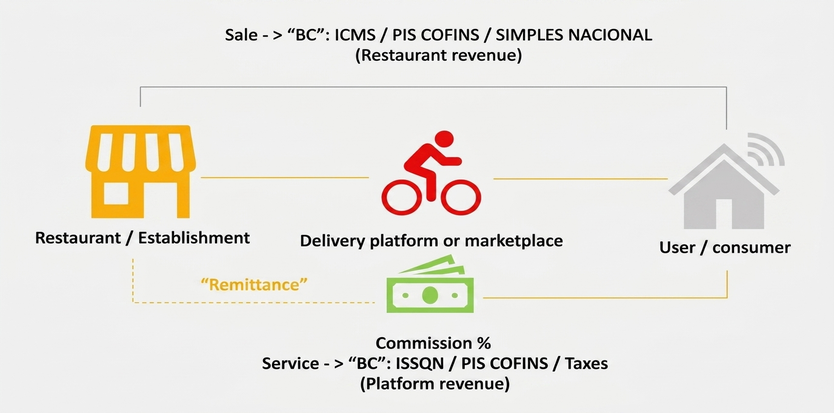
Figure 1 presents the flow of an online sale intermediated by delivery platforms. The consumer places the order through the platform, which intermediates the operation with the restaurant. For tax purposes, the total sales value is attributed to the establishment, while the platform retains a commission for the service provided and transfers the net amount to the restaurant.
Source: Elaborated by the authors.
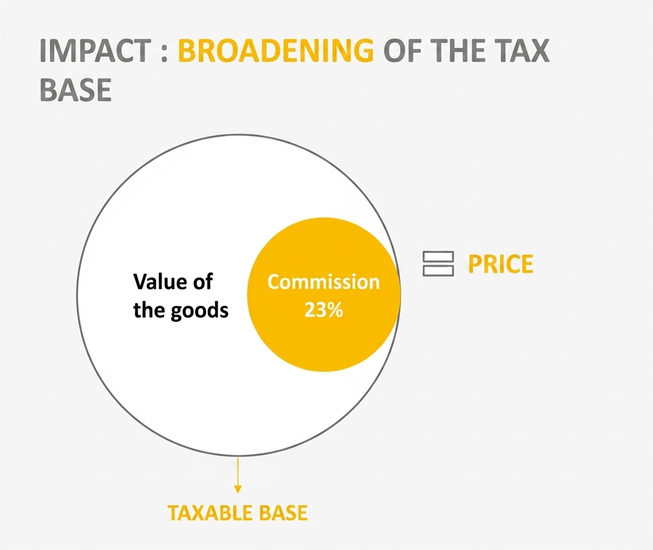
Figure 2 illustrates the impact of broadening the tax incidence base. The final price paid by the consumer includes the platform’s commission, which, although it constitutes revenue for the intermediary company, is part of the taxable base attributed to the restaurant, increasing the amount on which taxes are levied.
Source: Elaborated by the authors.
Concept of revenue for PIS/Cofins and its application to operations intermediated by digital platforms – historical synthesis
Since its creation, PIS (LC 7/1970)[13] and Cofins (LC 70/1991)[14] have had gross revenue or gross operating revenue as their calculation basis, according to art. 195, I, “b”, of the Federal Constitution (CF).
With Law No. 9.718/1998[15], there was an attempt to broaden the concept of revenue to encompass any financial income, however, the STF restricted this interpretation by declaring the unconstitutionality of the expansion for exceeding the constitutional text in the judgment of RE 346.084[16].
Starting from Constitutional Amendment (EC) No. 20/1998[17] and the consolidated jurisprudence in the judgments of appeals 357.950, 390.840, the understanding has been consolidated that taxable income corresponds only to that arising from the taxpayer’s typical economic activity.
Since then, the Judiciary has faced several debates on the subject and, even under Law No. 12.973/14[18], which altered the calculation basis for contributions with the aim of expanding the gross revenue concept, the inclusion of amounts unrelated to the revenue from the taxpayer’s own business activity has not been admitted.
In this regard, the STF has positioned itself in an absolutely peaceful manner to the effect that gross revenue and turnover, for the purpose of defining the calculation basis for the incidence of PIS and Cofins, are synonymous terms and correspond to the totality of the revenues earned from the sale of goods, from the provision of services, or from the sale of goods and services, arising from the exercise of business activities, as can be seen from the judgments of the appeals RE 684.092/PR and Agravo Regimental (AgR) in Agravo em Recurso Extraordinário (ARE) 1.210.308/RS.
Following this line of reasoning, the understanding enshrined by the STF, in the judgment of Extraordinary Appeal No. 574.706/PR[6], on March 15, 2017, in which the “thesis of the century” was established, excluded the inclusion of the Tax on Circulation of Goods and Services (ICMS) from the calculation basis of PIS and Cofins, as it does not fit the concept of turnover or gross revenue, since it is an amount that does not integrate the taxpayer’s assets, with a mere accounting entry of amounts destined for third parties, in this case, the State.
The doctrine follows in the same direction, stating that the calculation basis must reflect the taxpayer’s own wealth, linked to the taxpayer’s operation[19].
From this analysis, with the application of these understandings and concepts to the situation of sales through the delivery app, it is concluded that the commission intended for the delivery platform does not integrate the billing or gross revenue of the establishments, for the purposes of PIS and Cofins taxation, since such amount is part of the platform’s own business activity, corresponding to remuneration for the intermediation or agency service provided in the operation.
Thus, the conclusion that the commission that remunerates the agency or intermediation service provided by the platform should not be included in the calculation base of PIS and Cofins due by the establishments is correct, as it is an amount that departs from the constitutional concept of revenue or turnover (art. 195, I, “b”, of the CF).
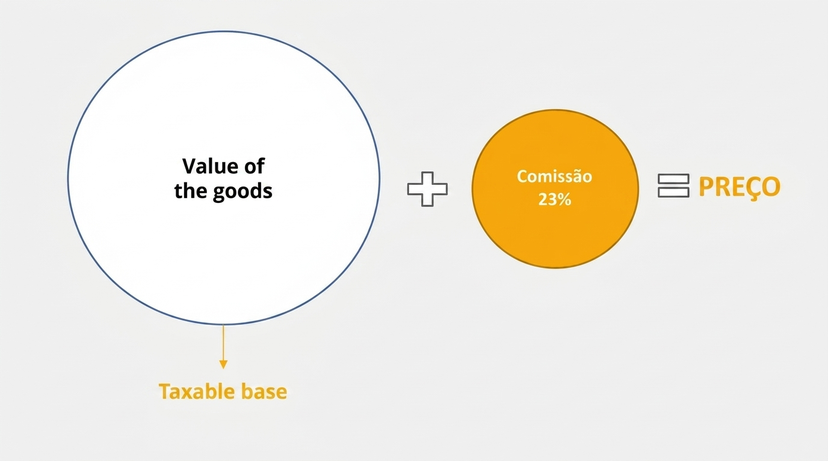
Figure 3 presents a practical example of the proposed solution, in which the calculation base for PIS and Cofins is composed exclusively of the merchandise value, excluding the platform commission, as this portion does not integrate the establishment’s revenue or turnover.
Source: Prepared by the author.
Tax reform: the calculation basis of IBS/CBS and the commission that remunerates intermediation through digital platforms
The present study began in mid-2022, when the thesis regarding the exclusion of delivery platform commissions from restaurants’ taxable income was still in its embryonic stage, if not nonexistent, just as there were no decisions on the matter within the Judiciary.
On that occasion, Complementary Law Bill No. 43/23, dated March 9, 2023, emerged, in line with the understanding drawn from the present investigation. This proposition foresaw the end of “double taxation” on amounts transferred to digital platforms operated by applications, such as commissions withheld on online sales.
According to the project, the amounts transferred to the organizations responsible for digital platforms, commonly referred to as commissions or intermediation fees, are taxed by the digital platform companies themselves and should not be subject to new taxation by the companies using these services, i.e., the restaurants, which merely transfer these amounts.
In the scenario of companies opting for Simples Nacional, the proposal is even more relevant, because, in the unified tax collection regime, the calculation basis corresponds to gross revenue (art. 3, §1º, of Complementary Law no. 123, of December 14, 2006)[3] and does not allow deductions, according to Consultation Solution Disit/SRRF05 no. 5.007/2025, published on August 13, which established that, in Simples Nacional, commission fees paid to marketplaces cannot be deducted from the gross revenue calculation basis.
Finally, this debate takes on new dimensions in light of the new context introduced by the tax reform, promoted by EC 132/2023, implemented through the enactment of LC 214/2025.
Art. 274 of LC 214/2025[3] established that the tax base for the specific regime of IBS and CBS in operations of bars and restaurants corresponds to the value of the supply of food and non-alcoholic beverages prepared on the premises.
From this device, a scenario is configured in which values that, although not passed on to establishments, inflated the tax calculation base, cease to be part of the calculation base of the IBS and CBS. This practical result stems from the dynamics of the “por fora” incidence of IBS and CBS, which eliminates the controversy over the incidence of taxes on third-party revenues, including taxes themselves[20].
For this reason, the sole paragraph of art. 274 of LC 214/2025[3] determines that the amounts not passed on to bars and restaurants due to the delivery service and intermediation of food and beverage orders through digital platforms are excluded from the calculation base of the new Dual Value Added Tax (VAT).
This is an express correction of the economic distortion with which PIS and Cofins have coexisted for years, which reinforces the non-incidence of these taxes on unbilled amounts, which reduce the value of the typical transaction.
On the other hand, it is worth asking whether, by mentioning “delivery services”, art. 274 exempts the hypothesis of outsourced delivery services, not provided by a digital platform, since delivery applications do not always perform the delivery and, in several situations, limit themselves to intermediation in the online environment.
In this context, the adoption of equal treatment for amounts not passed on to restaurants and bars is advocated, regardless of whether the delivery service is provided by a digital platform or not.
The question also arises regarding the establishments that will remain in the Simples Nacional during the validity of the new IBS and CBS. Although these taxpayers pay the new taxes, the revenue remains subject to the Simples Nacional calculation base in relation to the other taxes – a gray scenario during the transition period when both systems will coexist.
In this scenario, what treatment will be given to commissions not passed on to bars and restaurants? Will these amounts be excluded from the calculation base of the IBS and CBS, but remain included in the calculation base of Simples Nacional? For example, in the hypothesis of the regular hybrid regime, a concrete risk of contamination of the Simples Nacional calculation base by the IBS and CBS base is identified, which may nullify, in practice, the exclusions provided for in LC 214/2025[3], if there is no adequate segregation.
Indications are that the discussion about commissions will remain if there is an inclusion of amounts not passed on in the calculation base of Simples Nacional after LC 214/2025[3].
Comparative analysis: before and after LC 214/2025
In order to illustrate the practical effects of the tax reform on the taxation of commissions on establishments’ revenue, a comparative Table 1 is presented below between the regimes before and after LC 214/2025[3].
Table 1. Comparative theoretical framework before and after tax reform
| Scenario | Calculation base | Incidence on commission | Note |
| Before the reform (PIS/Cofins) | Total gross revenue (including retained commission) | Yes, undue | Controversy recognized by doctrine and jurisprudence |
| After the reform (IBS/CBS – LC 214/2025) | Value of food and beverage supply | No, expressly excluded | Corrects distortion and ensures neutrality |
Simplified simulation (post-transition, 2033 scenario)
In a scenario of full implementation of the reform, a restaurant opting for the specific regular regime would present the following simplified calculation base, as presented in Table 2.
Table 2. Specific regime simulation Tax Reform
| Revenue item | Estimated rate | Calculation base |
| Non-alcoholic beverages and foodstuffs | 16.8% (IBS/CBS) | Gross revenue – tips – delivery and platform intermediation % |
| Alcoholic beverages | 28% + IS (to be defined) | Gross revenue |
In a simplified simulation of an operation where the online order corresponds to R$ 100.00 (one hundred reais) and the commission is 20%, it is obtained in Table 3.
Table 3. Practical simulation of a R$ 100.00 (one hundred reais) request:
| Tribute | Calculation base | Estimated rate | Tax amount |
| Simples Nacional DAS (annex I – bracket 5) | R$ 100.00 | 14,30% | R$ 14.30 |
| IBS/CBS | R$ 80.00 | 16,80% | USD 13.44 |
From the simulation above, it is possible to identify the distortion of the post-reform dynamics, as the calculation base for the DAS remains gross revenue – including marketplace commissions, while the IBS and CBS are levied on the net transfer.
This context, in the transition scenario, tends to intensify inconsistencies, as the transition admits a hybrid regime (regular, i.e., DAS + IBS and CBS), in which IBS and CBS are collected outside of DAS – which highlights an environment still uncertain regarding the treatment of commissions in establishments opting for the Simples Nacional and, additionally, regarding the accounting method for this dynamic model.
In this regard, it is evident that LC 214/2025 missed the opportunity to adopt a more assertive stance and adapt the Simples Nacional to the reality of the digital economy[21].
Limitations of the study and future research perspectives
The present study presents limitations inherent to its methodological and temporal scope. The analysis focused on the period of normative transition between the validity of the PIS and Cofins regime and the implementation of LC 214/2025, without covering empirical data related to different establishment sizes or varied digital intermediation contractual models.
Furthermore, part of the legal interpretations set forth may undergo adjustments as regulatory acts and consolidated administrative and jurisprudential understandings regarding the application of the new consumption tax system are edited.
For future research, it is recommended to deepen the empirical analysis based on accounting and fiscal data from restaurants, conduct a comparative analysis with VAT regimes in other countries, and examine the practical impacts of the reform on Simples Nacional and on the revenue segregation mechanisms in operations mediated by digital platforms.
The analysis developed allows us to affirm that the commission retained by digital delivery platforms has its own specific legal nature, intended for the remuneration of the intermediation service provided by the application. This characteristic distinguishes the commission value from other portions that make up the restaurant’s revenue, which is why it does not form part of the calculation base for PIS and Cofins.
It is fundamental to recognize that, in the analyzed operation, there is a direct legal relationship between the application and the final consumer user, and not just between the application and the restaurant. This intermediation grants autonomy to the activity carried out by the platform, so that the retained percentage does not constitute the establishment’s own revenue, but rather income from third parties, which characterizes mere accounting transit in the financial flow of the operation.
The enactment of Complementary Law No. 214/2025[3] reinforced this logic by stipulating, in its Article 274, that amounts not passed on to bars and restaurants due to digital delivery and intermediation services do not form part of the tax base for the IBS and CBS. This provision enshrines, at the legislative level, the thesis defended in this work and corrects the historical distortion observed in the previous regime.
In summary, it is concluded that the commission retained by digital platforms does not integrate the taxable revenue of restaurants, neither from the perspective of PIS and Cofins, nor under the IBS and CBS system, as it does not represent own wealth, but autonomous remuneration of a third party. The legal treatment established by LC 214/2025 consolidates this understanding and contributes to the neutrality intended by the new tax system.
REFERENCES
[1] Massa, M. R. 2022. O “boom” das plataformas de delivery no Brasil e suas consequências peculiares. Fundação Getulio Vargas (FGV). Acesso em: 8 jan. 2026. Disponível em: https://portal.fgv.br/artigos/boom-plataformas-delivery-brasil-e-suas-consequencias-peculiares
[2] Associação Brasileira de Bares e Restaurantes. 2025. Decisões judiciais aliviam carga tributária sobre taxas de delivery. ABRASEL. Acesso em 08 jan 2026. Disponível em: https://abrasel.com.br/noticias/noticias/decisoes-judiciais-aliviam-carga-tributaria-taxas-delivery/.
[3] Brasil. Lei Complementar n. 214, de 16 de janeiro de 2025. Institui o Imposto sobre Bens e Serviços (IBS), a Contribuição Social sobre Bens e Serviços (CBS) e o Imposto Seletivo (IS); cria o Comitê Gestor do IBS e altera a legislação tributária. Diário Oficial da República Federativa do Brasil, Brasília, DF, 16 jan. 2025. Edição extra, p. 1. Disponível em: https://www.planalto.gov.br/ccivil_03/leis/lcp/lcp214.htm. Acesso em: 8 jan. 2026
[4] Sá-Silva, J. R., Almeida, C. D., & Guindani, J. F. 2009. Pesquisa documental: pistas teóricas e metodológicas. Revista Brasileira de História e Ciências Sociais, 1(1), 1–15. Disponível em: https://periodicos.furg.br/rbhcs/article/view/10351
[5] Minayo, M.C.S. 2009. Pesquisa social: teoria, método e criatividade. Rio de Janeiro, RJ: Vozes.
[6] Brasil. Supremo Tribunal Federal. Recurso Extraordinário nº 574.706/PR, Tema 69, exclusão do ICMS na base de cálculo do PIS e Cofins. definição de faturamento, Relatora Min. Carmen Lucia, Brasília, DF, 15 mar. 2017. Acesso em: https://portal.stf.jus.br/jurisprudenciaRepercussao/verAndamentoProcesso.asp?incidente=2585258&numeroProcesso=574706&classeProcesso=RE&numeroTema=69
[7] Carraza, R.A. 2002.ICMS. 9 ed. São Paulo, SP: Malheiros.
[8] Ataliba, G. 2021. Hipótese de incidência tributária. São Paulo, SP: Malheiros.
[9] Iglesias, T.P. 2020. O conflito de competências tributárias sobre o consumo na era das novas tecnologias: uma reflexão sobre a tributação dos softwares. Revista Direito Tributário Atual, 44, 1–25.
[10] Faria, R. V., Silveira, R. M., Monteiro, A.L.M.R. (Coords.). 2018. Tributação da economia digital: desafios no Brasil, experiência internacional e novas perspectivas. 1 ed. São Paulo, SP: Saraiva.
[11] OECD. 2025. The role of digital platforms in the collection of VAT/GST on online sales. Acesso em 25 nov. 2025. Disponívem em: https://www.oecd.org/en/publications/the-role-of-digital-platforms-in-the-collection-of-vat-gst-on-online-sales_e0e2dd2d-en.html
[12] Uhdre, D.C. 2021. Marketplaces: Possibilidades e limites à sua responsabilização no âmbito da tributação indireta. Revista Direito Tributário Atual, 48, 134–151. São Paulo: Instituto Brasileiro de Direito Tributário (IBDT).
[13] Brasil, Lei Complementar nº 7, de 7 de setembro de 1970, a União instituiu o PIS, o Programa de Integração Social, publicado no Diário Oficial da União (DOU), DF, em 8 de setembro de 1970. Acesso em https://www.planalto.gov.br/ccivil_03/leis/lcp/Lcp07.htm
[14] Brasil. Lei Complementar nº 70, de 30 de dezembro de 1991. Institui contribuição social para financiamento da Seguridade Social, e dá outras providências. Brasília, DF: Presidência da República. Disponível em: https://www.planalto.gov.br/ccivil_03/leis/lcp/lcp70.htm. Acesso em: 08 de jan. 2026.
[15] Brasil. Lei nº 9.718, de 27 de novembro de 1998. Altera a legislação tributária federal. Brasília, DF, 27 nov. 1998. Disponível em: https://www.planalto.gov.br/ccivil_03/leis/l9718.htm. Acesso em: 8 jan. 2026
[16] Brasil. Supremo Tribunal Federal, Recurso Extraordinário nº 346.084, Tribunal Pleno, constitucionalidade superveniente – artigo 3º, § 1º, da lei nº 9.718, de 27 de novembro de 1998, Relator Min. Ilmar Galvão, Brasília, DF. acesso em https://portal.stf.jus.br/processos/detalhe.asp?incidente=2023191
[17] Brasil. Emenda Constitucional nº 20, de 15 de dezembro de 1998. Modifica o sistema de previdência social, estabelece normas de transição e dá outras providências. Publicada no DOU de 16 dez. 1998, p. 1. Disponível em: https://www.planalto.gov.br/ccivil_03/constituicao/emendas/emc/emc20.htm. Acesso em: 08 jan. 2026.
[18] Brasil. Lei nº 12.973, de 13 de maio de 2014. Altera a legislação tributária federal relativa ao Imposto sobre a Renda das Pessoas Jurídicas – IRPJ, à Contribuição Social sobre o Lucro Líquido – CSLL, à Contribuição para o PIS/Pasep e à Contribuição para o Financiamento da Seguridade Social – Cofins; revoga o Regime Tributário de Transição, e dá outras providências. Publicado no DOU de 14 de maio de 2014. Disponível em: https://www.planalto.gov.br/ccivil_03/_ato2011-2014/2014/lei/l12973.htm . Acesso em: 08 jan. 2026
[19] Barreto, A. 1998. Base de cálculo, alíquota e princípios constitucionais. São Paulo, SP: M. Limonad.
[20] Machado Segundo, H.B. 2025. Lei complementar 214/2025 comentada: IBS, CBS e IS (1ª ed., pp. 262–263). São Paulo, SP: Atlas Jurídico.
[21] Chambarelli, G. (2025). Comissão paga a marketplaces: a oportunidade perdida pela reforma tributária. JOTA. Acesso em: 28 nov. 2025. Acesso em: https://www.jota.info/opiniao-e-analise/colunas/regulacao-e-novas-tecnologias/comissao-paga-a-marketplaces-a-oportunidade-perdida-pela-reforma-tributaria.
[22] Organisation for Economic Co-operation and Development. (2014). Plano de ação para o combate à erosão da base tributária e à transferência de lucros. Paris: OECD Publishing. https://doi.org/10.1787/9789264207790-pt.
COMO CITAR
Terlizzi, L.; Alecrim, E.R. PIS/Cofins e as comissões de plataformas digitais: impactos no setor de restaurantes à luz da reforma tributária. Revista E&S. 2026; 7: e2025035.
ABOUT THE AUTHORS
Luigi Terlizzi Pina – Master of Business Law. Partner at Terlizzi Advogados. Master of Business Law. Rua Visconde de Silva, 144, apt 201, 22271-044 Humaitá, Rio de Janeiro/RJ.
Eliza Remédio Alecrim – Master of Tax Law. Supervising Professor. Rua Cezira Giovanoni Moretti, 580, 13414-157, Piracicaba, São Paulo, Brazil.