
School Management
September 09, 2026
The Problem of Indiscipline in Preparatory Education: Mapping, Analysis and Reduction Strategies
Emmily Beatriz Gomes Atayde; Rafael Augusto Nakayama Rufino
DOI: 10.22167/2675-6528-202602207
Article derived from a Final Course Work (TCC), with content based on the student’s original work and adapted to the editorial format of the Revista E&S with the support of the ResumeAI tool, an artificial intelligence solution developed by the Pecege Institute for textual synthesis and organization.
Abstract
This study analyzed indiscipline in a free preparatory course for public school students in Manaus, aiming to map occurrences, understand their causes, and propose reduction strategies. The research was motivated by a significant increase in records, which rose from 223 in 2024 to 525 in 2025, highlighting the need for intervention. The methodology was based on documentary research, with an analysis of institutional records throughout the 2025 academic year, followed by the development of an action plan structured by the 5W2H tool. The results indicated a higher incidence of occurrences related to improper uniform use and lateness, as well as cases of inappropriate classroom behavior, cell phone use, and disrespect towards staff. The qualitative analysis pointed out that some of these occurrences are associated with internal factors, such as weaknesses in communicating institutional rules and the need for greater articulation between school and family, aspects that directly impact the understanding of rules and adherence to established guidelines. In response, actions were proposed focused on strengthening institutional communication, systematic guidance for students and guardians, team alignment, and the formalization of disciplinary processes, including the creation of a warning form. It is concluded that indiscipline is related not only to student behavior but also to institutional practices, making the adoption of preventive and integrated strategies essential for improving the school climate and pedagogical organization.
Keywords: school behavior; school management; institutional norms.
1. Introduction
The discipline, in its broadest sense, is understood as a set of values and expectations that transform over time, social class, and culture (Parrat-Dayan, 2008). Etymologically, the term derives from the Latin “discipulus”, meaning “one who learns”, indicating a characteristic inherent to human beings, built and shaped throughout existence (Houaiss, Villar, and Franco, 2009).
This understanding extends to the set of norms and rules established in a social group, which aim to ensure order and the proper development of activities (Parrat-Dayan, 2008). Behaviors that disrespect these norms, in turn, constitute indiscipline and often result in sanctions or corrective measures.
In the school context, indiscipline is understood as the violation of principles that govern both the development of pedagogical activities and interpersonal relationships among students, teachers, and other professionals. These principles include formal rules, present in institutional regulations, and ethical values that connect to the institution’s culture and identity (Carvalho, 2012).
Manifestations of indiscipline can have diverse origins, both external and internal to the educational environment. External factors, such as social violence, lack of family support in educational processes, domestic problems, and media influence, contribute to the scenario. Internally, indiscipline can be a student’s response to school failure, lack of recognition of values, or absence of clarity in coexistence norms (Souza, 2021; Costa et al., 2019).
Family and school are crucial institutions in the development of students. While the family acts as the primary space for socialization, transmitting values and teaching conflict resolution, the school offers formal education and skill enhancement (Dessen & Polonia, 2007; Santana et al., 2024). The articulation between these two spheres is fundamental for the construction of an educational environment that promotes well-being and learning.
In this scenario, school management assumes a central role in promoting coexistence norms, seeking to value the student and build collaborative actions with family and teachers to minimize the effects of indiscipline (Souza, 2021). School transgression is a global challenge, exacerbated in regions with higher poverty rates, directly impacting academic life and the learning process (Parrat-Dayan, 2008; Videira & Albuquerque, 2017).
Such a challenge was observed in a free preparatory course, established by a technical high school in Manaus, which aims to prepare candidates for the entrance exam and for institutional routines. In this environment, a significant increase in disciplinary incident records was noted, rising from 223 in 2024 to 525 in 2025. This growth highlighted the urgent need for intervention and raised concerns within the course management.
Given this context, the objective of this work was to understand the factors related to the increase in indiscipline records, with an emphasis on internal causes, as well as to propose coping actions, the results of which may support decision-making by other management teams in planning more effective strategies for monitoring and guiding students in preparatory courses.
2. Material and Methods
The research methodology was structured in subtopics, addressing the characterization of the study environment, the procedures for data collection and analysis, and the development of the action plan. As it was a study based exclusively on institutional documentary analysis, with no direct participant involvement, there was no need for submission to the Research Ethics Committee.
Characterization of the study environment
The study was conducted in a free preparatory course in Manaus, aimed at public school 9th graders, aged 14 to 15 years old and in a situation of socioeconomic vulnerability. The course, offered by a philanthropic institution, aims to prepare young people for the selection process for admission to technical high school and for school regulations. Activities take place on Saturdays, from 7:00 AM to 11:40 AM, and cover Portuguese Language, Mathematics, and Natural Sciences. The team is composed of 48 teacher-tutors (former students and scholarship holders), three area coordinators, one general coordinator, and one pedagogical assistant. Created in 2017 with 300 students, the project currently serves 1,440 enrolled students, which has increased the complexity of its management.
Data Collection
Data collection was carried out through documentary research, using records of disciplinary occurrences stored digitally in an institutional spreadsheet (Google Sheets). The analyzed period was from March 8 to November 22, 2025. Access to the material was granted upon formal authorization from the institution, exclusively for the purposes of this research (Appendix A). The first stage consisted of a descriptive study of the occurrences, categorizing them according to the nature of the misconduct, respecting the criteria of exhaustiveness, mutual exclusivity, homogeneity, and objectivity (Gil, 2017), and highlighting their frequency throughout the academic year.
Action plan development
To propose strategies for reducing occurrences, action research was used (Thiollent, 2022). This stage involved the construction of hypotheses and the identification of internal problems from documentary data, guiding the elaboration of strategies. The definitions for the action plan were established together with the project coordination team, through meetings. To systematize the action plan, the 5W2H tool was adopted, which guides planning through the questions: What (what?), Why (why?), Where (where?), Who (who?), When (when?), How (how?), and How much (how much?) (Pereira, 2020).
Systematization of action plans
With the objective of reducing incident records in 2026, preventive action plans were developed, based on the analysis of identified hotspots. To address the insufficient understanding of parents and guardians regarding institutional rules, an action was structured to highlight the family’s role in school monitoring.
Table 1. Action plan for the prevention of disciplinary occurrences through family guidance
| Director | Description |
|---|---|
| What? | Hold a meeting of parents and guardians |
| Why? | Ensure that those responsible are aligned regarding institutional norms |
| Where? | Online – Transmission via YouTube |
| Who? | Preparatory course coordination |
| When? | March/2026 |
| How? | To summon parents and guardians via email and social media announcement; Development of an institutional presentation aimed at the public, including the Student Handbook and explanation of the rules related to the main focus groups that generate disciplinary occurrences; Explain the role of parents and guardians in the good academic development of students and how they can be our allies in the teaching-learning process. |
| How much? | No additional costs |
Source: Original research result
To promote a more consistent alignment of students with the course’s proposal, objectives, and methodologies, and to present their duties and rights according to the Student Handbook, two actions were outlined for the first day of class. The first action proposes the redistribution of guidance and explanations about the project throughout the entire class period of the first day, with each professor addressing a specific topic from the Student Handbook and the course methodology, aiming for greater dialogue and understanding.
Table 2. Action plan for the prevention of disciplinary occurrences through student guidance
| Director | Description |
|---|---|
| What? | Present the project to the students |
| Why? | Promote students’ understanding of the preparatory course proposal, its pedagogical organization, and institutional regulations |
| Where? | In the classroom |
| Who? | Professors – tutors and course coordination |
| When? | First day of class |
| How? | Development of an institutional presentation aimed at the target audience; Distribution of the presentation throughout the five class periods of the first academic Saturday, with division of topics among the tutor professors, covering: i) presentation of the preparatory course; ii) teaching methodology adopted; iii) results achieved by the course; iv) benefits of the technical-high school institution; v) Student Handbook. |
| How much? | No additional costs |
Source: Original research result
The second action consists of the pedagogical activity Time Capsule, to encourage students to reflect on their academic journey and project future perspectives, recording expectations, goals, and reflections on their school trajectory.
Table 3. Action plan for the development of future student prospects
| Director | Description |
|---|---|
| What? | Implement the pedagogical activity Time Capsule with the students. |
| Why? | Stimulate students to reflect on the next steps of their academic path and their future prospects. |
| Where? | In the classroom |
| Who? | Professors – tutors |
| When? | First day of class |
| How? | Guide students on the objectives of the activity; Propose individual recording of expectations, goals, and perceptions about the current moment of the school trajectory; Organize the produced material (in physical or digital format) for storage and subsequent feedback at an opportune moment. |
| How much? | No additional costs |
Source: Original research result
To align the inspection team, responsible for monitoring the regulations, a meeting was held before the start of the academic period, aiming to ensure safety in the guidance and supervision of students.
Table 4. Action plan for alignment of the inspection team
| Director | Description |
|---|---|
| What? | Alignment meeting with inspection team |
| Why? | Ensure the team is safe on how to guide and charge |
| Where? | In a classroom |
| Who? | Project coordination team and inspection |
| When? | Before the start of classes |
| How? | Through a formative meeting, in which the inspection team received clear guidance on how to approach students appropriately, standardized, and respectfully, in addition to strategies for communicating and reinforcing institutional rules on a daily basis |
| How much? | No additional costs |
Source: Original research result
As a final action, the creation of a physical warning form was implemented for formal record of occurrences, with the clear reason, signed by the coordination and the student at the time of registration, and later by the guardian, summoned in person. This measure aims to strengthen students’ awareness and sense of responsibility.
Table 5. Action plan for the preparation of a warning sheet
| Director | Description |
|---|---|
| What? | Development and implementation of a standard physical warning form model for formal recording of disciplinary occurrences. |
| Why? | To standardize warning records, ensure clarity of information, provide institutional support for the coordination’s actions, and contribute to increasing the awareness and responsibility of students and guardians. |
| Where? | In the educational institution, for use by the coordination and service sector |
| Who? | Project coordination team |
| When? | Before the start of classes |
| How? | A standard document will be developed containing fields such as: student identification, date, description of the occurrence, and space for signatures (coordination, student, and guardian). After its elaboration, the model will be internally reviewed and approved, printed, and made available for use. |
| How much? | No additional costs |
Source: Original research result
3. Results and Discussion
The section presents the results and discussions organized into subtopics. Initially, it exposes the quantitative and qualitative analysis of disciplinary occurrences, evidencing their distribution and characteristics. Then, pedagogical reflections on the data are developed, seeking to interpret the associated factors. Finally, the observed institutional practices and the systematization of the proposed action plans are presented, leading from the description of the data to interpretation and intervention proposals.
Quantitative and qualitative analysis of disciplinary occurrences
The data were collected from an institutional spreadsheet of the preparatory course, which recorded disciplinary occurrences throughout the academic period. The absence of a standard in identifying the reasons required the classification of the records into categories for data systematization and visualization.
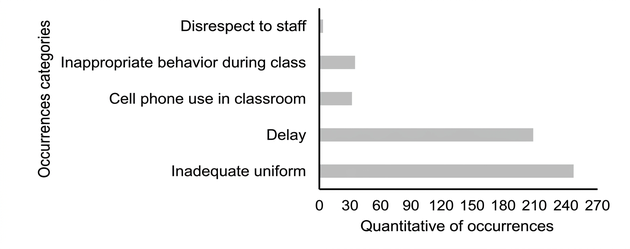
525 records of disciplinary occurrences were identified, categorized as inadequate uniform (247 records), lateness (208 occurrences), inappropriate classroom behavior (35), cell phone use during classes (32), and disrespect to staff (3). Figure 1 illustrates this distribution.
Figure 1. Quantitative of each group of occurrences
Source: Original research results
The qualitative analysis of occurrences of inadequate uniforms revealed that the majority of records referred to the use of sandals, pants with ripped details, and blouses with necklines, sleeveless, or of a different color than the institutional standard (white school shirt, black or blue jeans without details, and sneakers). Delays were often justified by parents not waking up on time, traffic, or difficulty with public transportation.
Inappropriate classroom behavior included excessive parallel conversations, confrontations with teachers, and inappropriate verbal manifestations, such as comments of a sexual, racist, or Nazi-related nature. Cell phone use in class was associated with communication with guardians about leaving school and access to social networks and electronic games.
The disrespect towards staff occurred outside the classroom, involving vexatious conduct when non-teaching staff attempted to guide students on post-break return protocols and corridor behavior.
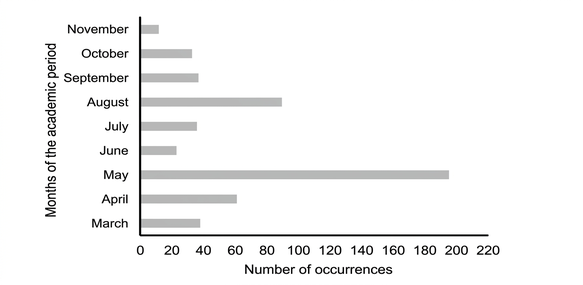
Comparing 2024 and 2025, there was a 42% increase in the total number of incident records. In 2025, 387 students (34% of the contingent) had their names linked to disciplinary incidents. The temporal distribution of incidents throughout the 2025 academic year indicated 38 records in March, 61 in April, 195 in May, 24 in June, 36 in July, 90 in August, 37 in September, 33 in October, and 12 in the last month analyzed. These data are detailed in Figure 2.
Figure 2. Variation in the number of occurrences per month during the academic period
Source: Original research results
The high incidence of occurrences in May can be explained by the prioritization of coordination, in the initial months (March and April), in adapting students to the school environment, focusing on academic routines, schedules, and uniform regulations. During this initial period, records were concentrated on more serious situations, such as disrespect to staff, inappropriate classroom behavior, improper use of mobile phones, and highly divergent uniforms.
Pedagogical reflections on disciplinary occurrences
The coordination of the preparatory course identified, through dialogues with the students, that part of the students were unaware of the institutional rules and showed low identification with the school environment. Many reported participating in the course due to the imposition of their guardians, without recognizing the relevance of the activities or requirements.
The lack of student involvement in the teaching-learning process, with a weakening of protagonism and sense of belonging, can contribute to an increase in indiscipline and conflicts (Santos & Queiroz, 2021). This view aligns with the conception of Parrat-Dayan (2008), who understands indiscipline as a phenomenon constructed in institutional interactions and influenced by students’ appropriation of norms. Thus, pedagogical practices that promote active participation and meaning tend to favor adherence to school rules.
Stimulating students’ interest in school activities is crucial for reducing indiscipline, although it is a complex challenge for teaching practice and school organization (Eccheli, 2008). In the current context, pedagogical practices must be reviewed to dialogue with the reality of the students, promoting dynamic and participatory methodologies that favor engagement and knowledge construction (Silva & Bueno, 2007).
The family’s role is fundamental in reducing disciplinary occurrences, requiring articulation between school and family for students’ academic and behavioral development. The absence of family support and overprotection can compromise the establishment of boundaries, leading to the transfer of unmet demands to the school environment (Oliveira, 2009).
In the coordination’s contacts with parents and guardians regarding incidents, a lack of knowledge of institutional rules was observed, along with a tendency to attribute responsibility to the institution. Common justifications included the use of mobile phones as a communication right and questions about warnings for inappropriate uniforms, alleging a lack of initial guidance.
The inadequate use of smartphones in class harms teaching-learning, interfering with students’ cognitive functions, such as attention, memory, language, and reasoning, making it difficult to focus on activities and compromising participation and understanding of content (Oliveira, 2025).
Federal Law No. 15.100/2025, in effect since January 13, 2025, regulates the use of personal electronic devices by basic education students, allowing it only for pedagogical or didactic purposes, under the guidance and mediation of education professionals, aiming for conscious and educational use of technology.
The school must assume a formative role in guiding the pedagogical use of technologies, directing screen time towards learning experiences that promote critical thinking and conscious use of digital resources. Family participation is fundamental to strengthening educational actions, and the institution should see technology as an ally to engage students in teaching-learning.
Current Practices of Pedagogical Coordination in Communication and Normative Guidance
The analysis of disciplinary occurrences revealed the need to strengthen the internal articulation between the pedagogical team, families, and students. The educational manager plays a crucial role in conflict mediation, promoting clear communication to improve school coexistence.
Currently, guidelines on schedules and uniforms are published in the registration notice, in February. On the first day of class, professors present the Student Handbook, which details students’ rights and duties.
During the first two months, information about schedules and uniforms is reinforced via social media and WhatsApp. Students who do not comply with the rules are sent to the auditorium for specific guidance on the same day.
After the initial adaptation period, the inspection team forwards the students to the pedagogical coordination for the application of written warnings. Parents and guardians are notified via WhatsApp and summoned to the institution in case of incidents.
The classes are predominantly expository, using digital presentations and video lectures from high school teachers. The tutor-professors act as mediators, assisting in the understanding of content, clarifying doubts, solving exercises, and organizing study materials.
The teaching material and the Student Handbook are accessed via the Google Classroom platform, with access provided on the first day of class.
Systematization of action plans
To reduce the occurrence rate by 2026, preventive action plans were developed, focusing on the initial months to avoid an increase in records after the period of stricter checks. The strategies were based on the identified focuses, addressing the insufficient understanding of parents and guardians regarding institutional rules and processes, and aiming to strengthen the family’s role in school monitoring.
To align students with the course proposal, its objectives and methodologies, and to encourage them to take the lead, two actions were outlined for the first day of class. It is essential to present the duties and rights of the students, according to the Student Handbook.
Previously, institutional guidance on the first day of class was superficial and concentrated on a single professor. As a first action, it is proposed to redistribute the guidance and explanations about the project throughout the entire first day of class, with each professor addressing a specific topic from the Student Handbook and methodology. This strategy aims to broaden student dialogue and understanding.
The second proposed action is the Time Capsule activity, which aims to stimulate students to reflect on their academic journey and project future perspectives. Students will record expectations, goals, and reflections on their school path, promoting autonomy, critical thinking, and medium-term planning.
To align the inspection team, responsible for monitoring the regulations, a meeting was held before the start of the academic period. This aimed to ensure that the team was confident about how to guide and hold students accountable.
Broad guidance to students from the beginning contributes to greater awareness and reduction of occurrences caused by ignorance of the rules.
As a final action, the creation of a physical warning form was implemented to clearly record the reason for the occurrence. The document is signed by the coordination and the student at the time of registration, and subsequently sent for the guardian’s signature, who is summoned in person.
This initiative aims to strengthen student awareness, as signing a formal document tends to generate a greater sense of responsibility and commitment to institutional norms.
In summary, the results indicated a significant increase in disciplinary occurrences, particularly in inadequate uniforms and lateness, and revealed that indiscipline is associated with students’ and guardians’ lack of knowledge of institutional rules, as well as low student identification with the school environment. Pedagogical reflections pointed to the need for more engaging practices and the importance of family-school partnerships. The proposed actions aim to strengthen communication, guidance, and awareness, seeking a more preventive and integrated approach to discipline management in the preparatory course.
4. Conclusion
This study sought to map the occurrences of indiscipline, understand its internal causes, and propose reduction strategies in a free preparatory course for public school students in Manaus. An expressive increase in disciplinary records was verified, with a higher incidence of cases related to improper use of uniforms and lateness. Inappropriate classroom behavior, cell phone use, and disrespect towards staff were also observed. Qualitative analysis indicated that indiscipline was associated with students’ and their guardians’ lack of knowledge of institutional rules, as well as students’ low identification with the school environment. Weaknesses in communicating the rules and the need for greater coordination between the institution and families were also identified, aspects that directly impact the understanding of established guidelines. In response to these findings, a structured action plan was developed to address the internal causes of indiscipline.
The proposed action plan aims to strengthen institutional communication, promote systematic guidance for students and guardians, align the inspection team, and formalize disciplinary processes, including the creation of a warning form. The main contribution of this work lies in offering a model of preventive and integrated intervention, which transcends the view of indiscipline as a merely individual problem, positioning it as a multifactorial phenomenon that requires the reorganization of institutional practices. However, the strategies presented represent a starting point for a continuous process of institutional improvement. It is suggested that future investigations evaluate the effectiveness of these actions over time and explore other factors that may influence the dynamics of school discipline, allowing for adjustments and deepening of coexistence management.
Bibliographic References
Brasil. 2025. Lei nº 15.100, de 13 de janeiro de 2025. Diário Oficial da União, Brasília, 14 jan. 2025. Seção 1, p. 3.
Carvalho, S.M. 2012. Indisciplina na escola: exemplo de um projeto integrado e sustentado de intervenção. In: 13º Colóquio de Psicologia e Educação, Lisboa, Portugal, 104–119.
Costa, G.; Paula, R.; Freitas, A.C.; Gicelmo, J.; Albuquerque, M.; Mary, L.; Sousa, S.; Rocha e Silva, M.F.; Paula, S.M. 2019. Indisciplina escolar e a relação professor-aluno: práticas a serem construídas significativamente. Revista de Administração 4: 81–91.
Dessen, Μ.Α.; Polonia, A.C. 2007. A família e a escola como contextos de desenvolvimento humano. Paidéia 17: 21-32.
Eccheli, S. D. 2008. A motivação como prevenção da indisciplina. Educar, 32: 199-213.
Gil, A. C. 2017. Como elaborar projetos de pesquisa. 6. ed. Atlas, São Paulo, SP, Brasil.
Houaiss, A.; Villar, M.; Franco, F.M.M. 2009. Dicionário Houaiss da língua portuguesa. Rio de Janeiro, RJ: Objetiva.
Oliveira, M. C. A. 2025. O dilema dos smartphones em sala de aula entre ferramentas de aprendizado e barreiras cognitivas. Revista Ibero-Americana de Humanidades, Ciências e Educação REASE 11(1): 1883-1893.
Oliveira, M.I. 2009. Fatores psico-sociais e pedagógicos da indisciplina: da infância à adolescência. Revista Semestral da Faculdade de Educação – UnB 12(25): 289-305.
Parrat-Dayan, S. 2008. Como enfrentar a indisciplina na escola. 2. ed. São Paulo, SP: Editora Contexto. Disponível em: . Acesso em: 28 set. 2025.
Pereira, C. B. D. 2020. A ferramenta 5W2H na análise da inclusão das pessoas com deficiência visual nas escolas municipais. Revista Educar Mais 4(3): 606-623.
Santana, A.C.A.; Silva, J.B.; Rodrigues, D.M.; Silva, L.G.; Pereira, M.N.; Santana, J.S.S.; Araújo, M.M.; Andrade, C. 2024. O papel da família na educação: construindo pontes entre escola e lar. Revista Políticas Públicas & Cidades 13(2): e1010.
Santos, R. B. R.; Queiroz, P. P. 2021. A complexa relação humana no espaço escolar: o que indisciplina, currículo e cultura têm a nos revelar. Revista Brasileira de Estudos Pedagógicos, Brasília, v. 102, n. 261, p. 339-356.
Silva, P. K. O.; Bueno, H. P. V. 2007. Reflexões sobre as práticas docentes frente aos desafios impostos pela indisciplina escolar. Revista Diálogos Interdisciplinares, p. 56-70.
Souza, A.L.A. 2021. A gestão para o controle da indisciplina escolar no século XXI. Revista de Ensino, Educação e Ciências Humanas 22(4): 475–481.
Tiollent, M. 2022. Metodologia da pesquisa-ação. 18. ed. São Paulo, SP: Cortez Editora. E-book. ISBN 9786555553055. Disponível em: . Acesso em: 5 out. 2025.
Videira, F.S.; Albuquerque, C. 2017. Gestão da indisciplina na dinâmica e organização escolar: estudo de alguns dos seus determinantes. Gestão e Desenvolvimento 25: 243–264.
Article originating from the Final Course Work of the Specialization in School Management of the MBA USP/Esalq
To learn more about the course, click here and access the MBX Academy platform