
School Management
September 09, 2026
Philosophy of the 5 Senses: Quality Management in Citizenship Education Classes
Ana Fabrícia Alves de Miranda; Tatiana Giselle Guimarães Lopes
DOI: 10.22167/2675-6528-202602126
Article derived from a Final Course Work (TCC), with content based on the student’s original work and adapted to the editorial format of the Revista E&S with the support of the ResumeAI tool, an artificial intelligence solution developed by the Pecege Institute for textual synthesis and organization.
Abstract
The implementation of the 5S philosophy was analyzed as a strategy to improve pedagogical management in citizenship training classes at a public school in Ceará. The qualitative research was designed as a single case study, using content analysis from the Bardin methodology. The corpus consisted of lesson plans, class records, classroom observation reports, and class council minutes. The results showed that the incorporation of the 5S principles contributed to the organization of the school environment, the improvement of classroom management, and the strengthening of attitudes related to co-responsibility, discipline, and collective coexistence. Greater student engagement, better use of pedagogical time, and improvement of the school climate were observed. The study highlighted the importance of intentional planning, the performance of school management, and the systematic monitoring of pedagogical practices as determining factors for the success of the intervention. Despite challenges related to teacher training and structural conditions, it was concluded that the adaptation of the 5S philosophy to the educational context represents a promising strategy for promoting the quality of education and the integral formation of students.
Keywords: School Climate; 5S Philosophy; Pedagogical Management; Educational Practices; Student Protagonism.
1. Introduction
The search for innovative strategies that promote the improvement of education quality has driven educators and managers to incorporate methodologies that, although not developed for the educational field, can foster an organized school environment, the development of attitudes of collective responsibility, and the integral formation of students. This movement is largely influenced by neoliberal perspectives in education, which value management practices originating from business models. Such practices focus on work organization, discipline, and the continuous improvement of teaching and learning processes (Libâneo et al., 2012).
Among the management methodologies that have been adapted to the educational context, the five senses (5S) philosophy stands out. It is based on the principles of use (Seiri), order (Seiton), cleaning (Seiso), standardization (Seiketsu), and self-discipline (Shitsuke). Originating in Japan after World War II, with the purpose of restructuring industrial society, the 5S philosophy goes beyond the physical sphere, contributing to the formation of the individual’s intellectual and social dimension (Campos et al., 2005; Gardas et al., 2015).
In the educational scenario, the application of 5S has demonstrated transformative potential in the quality of the school environment and teaching-learning processes, as evidenced by several publications (Gardas et al., 2015; Casagrande et al., 2020). In line with this innovative approach, the state public school network of Ceará has been implementing initiatives to improve pedagogical support and strengthen school retention. One example is the Project Professor Diretor de Turma (PPDT), from the Secretariat of Education of the State of Ceará, which aims to monitor students’ school progress, promote dialogue between school and family, and improve the school climate.
The PPDT, inspired by Portuguese educational experiences, was experimentally introduced in 2007 and officially established in 2008, gradually expanding until universalization in 2023 (Lima and Silva, 2014; Ceará, 2025). This initiative emerged during a period when Ceará faced a high dropout rate, with 16.4% of students dropping out in 2007, exceeding the national average. This meant that, out of every thousand enrolled students, 164 did not complete the third year of high school (Ceará, 2020).
In this context, the Professor Class Director (PDT) assumes a central role, offering students a workload focused on integral formation and the development of individuals capable of managing their ambitions. With the motto “Educate from the Perspective of De-massification”, the PDT is responsible for citizenship formation classes, concentrating on the socio-emotional development of students (Ceará, 2010). The project is fundamental for Ceará’s public school to meet the demands of current capitalism, which values cognitive skills and competencies useful for economic competitiveness, articulating with other educational modalities for the “knowledge society” (Libâneo et al., 2012; Paro, 2016).
The incorporation of pedagogical practices inspired by the philosophy of the five senses (5S) can, therefore, strengthen the actions developed in citizenship training classes, encouraging organization, care for collective spaces, and self-discipline. However, despite the potential of this approach, there is a scarcity of studies that systematically analyze the application of 5S principles in the educational environment and their contributions to the organization of pedagogical practices and the formation of values.
Given this gap, it becomes relevant to investigate how the 5S philosophy can contribute to the organization of pedagogical work and the strengthening of educational practices in citizenship formation classes. This research, by discussing the application of this methodology in the educational context, aims to contribute to the debate on innovative pedagogical management practices, broadening the understanding of the possibilities of articulation between quality management principles and educational processes focused on the integral formation of students (Lück, 2009). Thus, this study aimed to analyze the implementation process and indirectly investigate the impacts of applying the five senses (5S) philosophy on the classroom management quality of first-year high school students at a state school located in the municipality of Jaguaribe in Ceará.
2. Material and Methods
This research is characterized as a single case study, with a qualitative approach and based on documentary analysis, aiming to understand the implementation process of the five senses philosophy in the school context. The object of study was the project “Five Senses Philosophy: quality management in citizenship formation classes”, developed in two 1st-grade classes of high school in a state public school located in the municipality of Jaguaribe, Ceará. The choice of the 1st grade was due to the perspective of continuity and sustainability of practices throughout the students’ school journey. The researcher acted as a member of the institution’s pedagogical management team, configuring a situation of participant observation.
The qualitative approach and the case study were considered adequate for understanding complex phenomena and human interactions (Godoy, 1995; Yin, 2015).
The data collection procedures consisted of documentary research, analyzing administrative and pedagogical records produced in the context of the project’s implementation. The documents, considered relevant sources for qualitative investigation (Godoy, 1995), were analyzed with a focus on understanding the pedagogical interventions and the impacts of the 5S philosophy on classroom management. The documentary analysis was based on the Content Analysis proposed by Bardin (2016), encompassing the stages of pre-analysis, material exploration, results treatment, inference, and interpretation.
In the preliminary analysis, the inclusion criteria for the documents were: thematic relevance to the philosophy of the five senses and classroom management, temporal scope corresponding to the 4th bimestre of the 2025 school year, institutional origin, integrity, and authenticity of the records. The research corpus consisted of class records, teaching resources produced for project implementation and routine execution (lesson plans and support materials), minutes of class councils, and classroom observation reports. For data organization and interpretation, a documentary analysis matrix was developed, examining the documents in light of analytical categories related to project implementation, as shown in Table 1.
Table 1. Characterization of the research documentary corpus
| Document | Year | Contribution to Research |
|---|---|---|
| Lesson Plans | 2025 | Allows inferences to be made about the adequacy of actions and activities planned for the project’s implementation and success. |
| Class Records | 2025 | Document that allows for the verification of the fulfillment of the planned didactic sequence. |
| Observation Reports | 2025 | Crucial for understanding the dynamics of the classroom and how didactic practices can affect the project’s development. |
| Class Council Minutes | 2025 | Essential for interpreting the results, as it is foreseen in its structure a diagnostic synthesis of the class. |
Source: Original research data
The investigation sought to answer the following guiding questions: (1) How are the principles of the five senses (5S) philosophy incorporated into the planning and execution of pedagogical practices in citizenship training classes? (2) In what way does the performance of school management and pedagogical coordination contribute to the implementation and monitoring of these practices? (3) What challenges emerge in the process of implementing the 5S philosophy in the analyzed school context?
After a floating reading, the documents were categorized into planning, execution, and results, originating from the experiences of the 4th bimester of the 2025 academic year, in alignment with the logic of the five senses philosophy (Rocha et al., 2019).
Artificial Intelligence (AI) resources from the company OpenAI, Chatgpt, were used for the conference of bibliographic references, grammatical corrections, coherence, cohesion, and clarity, with the instruction not to alter content or add ideas/citations. The class records were selected from the “professor on-line” digital school diary platform of the Secretariat of Education of Ceará.
3. Results and Discussion
The implementation of the five senses philosophy (5S) in public schools in Ceará revealed contributions to pedagogical management and the civic education of students. The research findings indicate that the incorporation of 5S principles promoted the organization of the school environment, improved classroom management, and strengthened attitudes of co-responsibility, discipline, and collective coexistence. An increase in student engagement, better use of pedagogical time, and a notable improvement in the school climate were observed, evidencing the transformative potential of this approach in the educational context.
The educational institution investigated is a state high school that, in 2025, served 267 students, distributed between the main campus and an annex. The school offers regular high school education in the morning and afternoon shifts, with a total of ten classes. Its physical and pedagogical infrastructure, including well-equipped computer and science laboratories, multimedia resources, and a sports court, proved to be conducive to the development of the teaching-learning process, complemented by consistent pedagogical support and didactic materials.
The need to implement the project arose from weaknesses observed in daily school life, such as the presence of damaged chairs and tables, textbooks with signs of misuse, and students warned for non-compliance with institutional rules, especially regarding the use of uniforms. Frequent reports of wasted pedagogical time, resulting from inappropriate behavior and lack of self-discipline, reinforced the urgency. The 5S philosophy was therefore adopted as a strategy to reorganize spaces, strengthen co-responsibility, and build a school culture aligned with discipline and collective care.
The documentary analysis, which included lesson plans, class records, classroom observation reports, and class council minutes, was crucial for understanding the project’s implementation. The lesson plans allowed for inferences about the adequacy of actions, while the class records confirmed adherence to the didactic sequence. The observation reports were essential for understanding classroom dynamics and the impact of teaching practices, and the class council minutes offered a diagnostic synthesis of the class, revealing changes in the school climate and student engagement. Category – Planning Actions
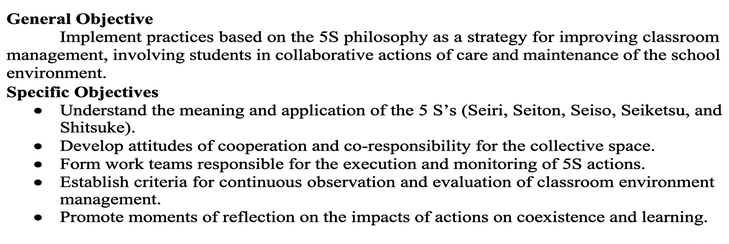
The lesson plans, which were the most relevant documents for the planning phase, structured a didactic sequence of eight classes in a hybrid format, with in-person and remote activities. This approach demonstrated intentional pedagogical planning, with clear objectives aimed at improving classroom management and promoting youth leadership. Educational intentionality, according to Pastoriza (2021), shifts the focus to practices that favor active participation and the collective construction of knowledge, avoiding improvisations that could lead to educational failures (Conceição et al., 2019).
Figure 1. Snippet from the objectives section of the lesson plan (1) for the didactic sequence for implementing the 5S methodology in citizenship training classes
Source: Researched School
The pedagogical proposal aligned with the 5S methodology was also manifested in the organization of students into teams, each responsible for one of the five senses: utilization, sorting, cleaning, standardization, and discipline. This structure reinforced co-responsibility and collaborative learning, intrinsic precepts to the 5S methodology and social co-responsibility. Furthermore, the proposed experiences contributed to the development of youth protagonism, with activities that promoted autonomy and self-regulation, considered fundamental for academic success (Souza and Lopes, 2021).
The remote activities were designed with creative proposals, using active methodologies, gamification, playfulness, and contextualization. A notable example was the activity in lesson plan 3, which proposed the production of videos by students to demonstrate how the knowledge of 5S transformed their routines. This initiative aimed to insert the principles of 5S into the daily lives of young people, encouraging reflection and the reproduction of these values in their homes, contributing to social enrichment, as highlighted by Gardas et al. (2015) and Casagrande et al. (2020).
Figure 2: Excerpt from the remote activity proposal of the lesson plan (3) of the didactic sequence for implementing the 5S methodology in citizenship training classes.

Source: Researched School
Despite detailed planning, the implementation of the 5S philosophy faces challenges, including structural issues and the need for continuous teacher training. Planning, although crucial for connecting theory and practice (Conceição et al., 2019), is often reduced to a bureaucratic completion of forms. Overcoming these obstacles is fundamental for the planned interventions to achieve their maximum effectiveness and promote lasting transformation in the school environment. Category – Execution of Planned Actions
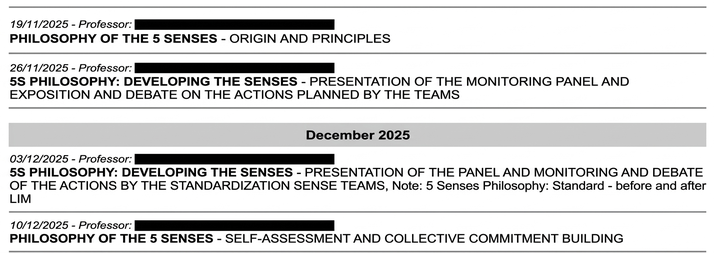
The class records, entered by the lead teachers on the “professor on-line” digital platform, were synthetic in nature, focusing on the class topic. However, these entries were important indicators of the fulfillment of the planned didactic sequence. The analysis demonstrated a clear coherence between the planning and the execution of pedagogical practices, confirming that the classes were developed in line with what had been proposed, which is a fundamental prerequisite for effective classroom management.
School planning, according to Libâneo (2016), should not be seen as a mere bureaucratic act, but as an essential stage of teaching practice that articulates disciplinary knowledge and the pedagogical-didactic process. The results of this research reinforce that well-structured planning is a guiding instrument for teaching action, contributing to the existence of a more organized class dynamic. Reflection on classroom records allows management and teachers to identify and overcome barriers that may prevent the realization of didactic actions.
Figure 3. Excerpt from the annual class registration report, generated from SIGE monitoring.
Source: Researched School
The classroom observation reports, analyzed as part of the project’s execution, proved relevant for the development of a reflective stance and for the insertion of productive feedback in school management (Franchi and Hobold, 2022). In accordance with the Guidelines for the Academic Year 2025, the school coordinator played an indispensable role in monitoring and implementing pedagogical interventions, articulating the team, management, and families, and seeking solutions for difficulties (Miranda, 2024).
The reports detailed the interaction between teachers and students, evidencing the clarity in the explanation of concepts, the understanding of the proposed activities, and the active participation of the students. Furthermore, they highlighted the positive impacts on classroom organization, on the interaction and harmony of collective coexistence, reinforcing the formative and pedagogical nature of the proposal. This continuous evaluation of pedagogical practice is essential for the teacher to critically reflect on their actions and improve their performance, as defended by Carvalho and David (2015) and Donald Schön’s concept of the reflective teacher. Category – Reported Results
The two class council minutes from the 4th bimester, analyzed in the research, revealed the impressions and discussions of the pedagogical and management team. School councils are important channels for democratic management, encouraging the participation of the school community and ensuring that the school fulfills its function of socializing knowledge with quality (Paro, 2016). The findings corroborate studies that advocate for participatory management and education for values as essential elements for the quality of the educational process and citizen formation.
The results pointed to positive changes in the school environment, including a more organized and clean classroom, students more concerned with the collective, correct use of textbooks and uniforms, quieter rooms, and better use of pedagogical time. There were no records of coexistence problems, indicating an improvement in the school climate. This transformation contributes to the promotion of an education that aims at the emancipation of subjects, allowing them to critically understand reality and act to transform it, instead of just adapting (Freire, 1996).
The implementation of the 5S philosophy, when articulated with intentional pedagogical planning and reflective practices, contributed significantly to classroom management and the integral development of students. The participatory action of school management directly influenced the organizational culture, promoting values, beliefs, and habits that resulted in a positive and stimulating school environment. School management must, therefore, observe and intervene in the regularities of daily life, ensuring that routines such as punctuality, cleanliness, and the use of materials serve the educational purpose (Lück, 2009).
In summary, the research demonstrated that the application of the 5S philosophy, integrated with intentional planning and accompanied by reflective practices, improved classroom management and the integral development of students. Actions based on co-responsibility, space organization, and active student participation favored a collaborative school climate and strengthened attitudes aligned with civic education. Despite structural and formative challenges, the analyzed experience offers promising paths for the incorporation of formative methodologies in the educational context, responding to the objective of analyzing the implementation of 5S for the improvement of pedagogical management.
4. Conclusion
This study analyzed the implementation of the five senses philosophy (5S) as a strategy to improve pedagogical management in citizenship training classes at a public school in Ceará. It was found that the incorporation of 5S principles contributed significantly to the organization of the school environment, enhancing classroom management and strengthening attitudes of co-responsibility, discipline, and collective coexistence among students. Greater student engagement, better use of pedagogical time, and a notable improvement in the school climate were observed. Documentary analysis showed that intentional pedagogical planning, participatory action by school management, and systematic monitoring of practices were determining factors for the success of the intervention, promoting a more collaborative and harmonious school environment, aligned with citizenship education.
The main contribution of this work lies in demonstrating that the adaptation of the 5S philosophy to the educational context represents a promising strategy for promoting the quality of education and the integral formation of students, offering pathways for innovative pedagogical management practices and for the development of essential societal values. However, it is recognized that the implementation faced challenges related to teacher training and the school’s structural conditions, which may limit the full effectiveness of the actions. Such limitations suggest the need for further research to deepen the understanding of the impacts of the 5S philosophy in different educational realities, exploring strategies to overcome the identified obstacles and consolidate the quality culture in the school environment, contributing to the debate on the articulation between quality management principles and educational processes.
Bibliographic References
Bardin, L. 2016. Análise de conteúdo. Edições 70, São Paulo, SP, Brasil.
Campos, R.; Oliveira, L.C.Q.D.; Silvestre, B.D.S.; Ferreira, A.D.S. 2005. A ferramenta 5S e suas implicações na gestão da qualidade total. Simpep – Simpósio de Engenharia de Produção (12): 685-692.
Carvalho, R.S.T.; David, A. 2015. Saberes docentes e o professor reflexivo: reflexões na prática escolar. Debates em Educação 7(13): 156-167.
Casagrande, C.; Novak, A.; Balzer, P.S.; Graziani, Á.P.; Ricardo, S.C. 2020. Aplicação dos 5 sensos em uma escola da região de Joinville-SC: uma proposta de intervenção para a cidadania. Brazilian Journal of Development 6(12): 101736-101748.
Ceará. 2010. Chamada pública de adesão ao projeto professor diretor de turma. Secretaria da Educação do Ceará, Fortaleza, CE, Brasil. Disponível em: https://www.seduc.ce.gov.br/wp-content/uploads/sites/37/2010/01/diretordeturma.pdf. Acesso em: 24 set. 2025.
Ceará. 2025. Diretrizes 2025. Secretaria da Educação do Ceará, Fortaleza, CE, Brasil. Disponível em: https://www.seduc.ce.gov.br/wp-content/uploads/sites/37/2025/01/diretrizes_2025.pdf. Acesso em: 10 set. 2025.
Conceição et al., 2019 [Referência completa não encontrada no documento original]
Franchi, G.O.O.M.; Hobold, M.S. 2022. As pesquisas sobre a sala de aula no campo da didática: as temáticas de pesquisa nos artigos científicos. Série-Estudos 27(59).
Freire, P. 1996. Pedagogia da autonomia: saberes necessários à prática educativa. Paz e Terra, São Paulo, SP, Brasil.
Gardas, J.B.; Lopes, S.R.; Silva, E.D.; Silva, E.D.N.; Schornobay, S.R. 2015. A gestão da qualidade pelo sistema 5 sensos e os benefícios advindos nos espaços escolares. Revista Científica Semana Acadêmica (74). Disponível em: https://semanaacademica.org.br/artigo/gestao-da-qualidade-pelo-sistema-5-sensos-e-os-beneficios-advindos-nos-espacos-escolares. Acesso em: 16 out. 2025.
Godoy, A.S. 1995. Pesquisa qualitativa: tipos fundamentais. Revista de Administração de Empresas 35(3): 20-29.
Libâneo, J.C.; Oliveira, J.F.; Toschi, M.S. 2012. Educação escolar: políticas, estrutura e organização. 10ed. Cortez, São Paulo, SP, Brasil.
Lima, V.B.; Silva, M.J.B. 2014. Professor diretor de turma: uma experiência educacional brasileira inspirada na educação portuguesa. Espaço do Currículo 7(2): 326-335.
Lück, H. 2009. Dimensões da gestão escolar e suas competências. 2ed. Positivo, Curitiba, PR, Brasil.
Miranda, M.S. 2024. A importância do coordenador pedagógico na articulação de projetos como estratégias na educação do campo. Letras e Educação: encontros e inovações (7).
Paro, V.H. 2016. Gestão democrática da escola pública. 4ed. Cortez, São Paulo, SP, Brasil.
Pastoriza, B.S. 2021. Ensaio sobre intencionalidade pedagógica e tradição: um tensionamento como princípio educativo. Acta Scientiarum. Education 44(1): e52706.
Rocha, L.S.; Santos, M.; Alencar, D.; Junior, M.F.; Rodriguez, I.L.R.; Nascimento, M.H.R. 2019. The 5S program in school spaces: a proposal for quality improvement. International Journal of Advanced Engineering Research and Science 6(7): 129-135.
Souza, P.H.S.; Lopes, L.A. 2021. Protagonismo estudantil: metodologias ativas e estratégias de aprendizagem. Anais do IX Salão de Iniciação Científica Júnior – Expo Ulbra.
Yin, R.K. 2015. Estudo de caso: planejamento e métodos. 5ed. Bookman, Porto Alegre, RS, Brasil.
Article originating from the Final Course Work of the Specialization in School Management of the MBA USP/Esalq
To learn more about the course, click here and access the MBX Academy platform