
Organizations
December 05, 2025
Diversity and inclusion: benefits for culture and climate in the implementation of affinity groups
Authors: Diogo Milhomens Lopes and Ana Luiza Terra Costa Mathias
DOI: 10.22167/2675-6528-2025022
E&S 2025, 6: e2025022
The study of diversity and inclusion in organizations gains relevance, especially considering the expansion of Environmental, Social, and Governance (ESG) practices. Within the scope of diversity, the focus is on building an organization that reflects, in terms of race, gender, sexual orientation, generations, and people with disabilities, among other categories, the plurality present in the society in which it is inserted. Regarding inclusion practices, the debate centers on the challenge of integrating groups historically excluded from opportunities, valuing their individual characteristics[1].
In conceptual terms, diversity corresponds to the plurality of physical, psychological, social, and emotional variations of human beings; inclusion in organizations concerns the appreciation of every person and the offering of the same opportunities[2]. Based on these definitions of diversity and inclusion, the reinforcement of the importance of these themes in actions related to the social practices of ESG is observed, especially when connected to the United Nations (UN) Agenda 2030 and to the agendas focused on reducing inequalities and developing gender equality[3].
Among different practices associated with the development of corporate diversity and inclusion, one of the most common is the creation of affinity groups, known internationally as Employee Resource Groups (ERGs). These groups originated from affirmative action policies, defined as policies for promoting equal opportunities – racial, gender, for people with disabilities, for LGBTQIAP+ people, among others – and are currently recognized as effective means to boost a company’s business and create a more inclusive environment[4].
ERGs are formed by people with common interests within organizations and meet periodically to define priority themes for actions and discussions related to diversity, equity, and inclusion[3].
Cox[5], one of the first authors to compile theories, research, and practices of diversity and inclusion, developed a model that explains the impact of diversity in organizations. According to this approach, a diverse environment drives positive individual results, which elevate organizational efficiency[5].
The stimulus to work with ESG-related social agendas also broadens the space for diversity and inclusion in discussions, especially when associated with the UN’s Sustainable Development Goals (SDGs) and organizations’ commitment to the 2030 Agenda, whose purpose is to create better conditions for the planet and people[3].
In Brazil, the themes of diversity and inclusion arrived in the corporate environment through multinational companies, mainly North American ones, in the 1990s. Since then, the agenda has expanded and begun to incorporate discussions associated with organizational climate, which has consolidated it as a vector for promoting a sense of belonging among employees generally classified as minorities[1].
Furthermore, groups can act as enhancers of business and results[1]. Research conducted by Cloverpope and published in an article in Forbes in 2017 by Erik Larson, one of its founders, indicates that diverse teams make better business decisions 87% of the time, with twice the speed compared to non-diverse teams[6].
Regarding the development of affinity groups (ERGs), Briscoe and Safford[7] highlight the complexity in defining them uniquely. Directly, these groups – formed by people connected by similarities – remain aligned with the company’s vision, values, mission, and strategic objectives[1]. Organized and normally linked to the human resources or diversity area, they are responsible for promoting actions focused on equity and inclusion, such as discussion circles, training, book clubs, and mentoring programs, among other initiatives.
The intention behind the creation of ERGs, according to Briscoe and Safford[7], lies on a spectrum composed of two extremes: on one side, the formation of groups motivated by employee interests seeking to align their beliefs with their work; on the other, creation driven by companies, as a strategy for employer branding and strengthening positive corporate results. As presented by Mota et al.[3], affinity groups play a relevant role in prioritizing themes and promoting advancements in organizations regarding diversity and inclusion policies.
When it comes to organizational culture and climate, it is necessary to adopt a critical stance to identify which practices should be maintained and to continuously review whether they still make sense, as defended by Lanzer[8]. The understanding of diversity and inclusion strategies, such as the implementation and development of affinity groups in companies, is increasingly becoming a vector for organizational development and business growth[9].
Given the definitions and potential benefits associated with the implementation of ERGs in organizations, the objective of this study is to investigate the perception of their participants through a questionnaire with quantitative and qualitative questions, covering the execution processes and results, with an emphasis on markers of gender, race, sexual orientation, and disability status in the organizational culture and climate of a Brazilian company.
This study presents a case study, defined by Yin[10] as an empirical investigation of a contemporary phenomenon in its real-world context, in which the boundaries between phenomenon and context are not clearly evident, conducted in a Brazilian company that recently implemented affinity groups. This organization has between 1000 and 5000 employees and has headquarters in several cities across three different regions of Brazil, in addition to remote workers.
The case study focused on the company employees’ experience with the foundation and development of affinity groups. The collected data were obtained through a form with open and closed questions, administered anonymously to employees participating in the ERGs.
The form, composed of a questionnaire with questions about motivations, objectives, gains, and perceptions – as presented in Table 1 – allows for more detailed data processing and includes the segments corresponding to the topics discussed in the groups. The construction of the form was based on market research investigating the theme of diversity and inclusion, such as Deloitte’s[14], and on studies previously applied in the company on the subject.
Regarding the application, the form was disseminated through the company’s official communication channels targeting affinity groups based on gender, race, LGBTQIAP+ individuals, and people with disabilities, with restrictions for participants within these groups. It remained available between May 3, 2024, and May 17, 2024, and received 81 responses from the 541 individuals registered in the affinity groups, although not all were active participants. The result represents a 15% participation rate and highlights a methodological limitation.
Table 1. Questions applied in the form about affinity groups
| Questions | Response options |
| Which affinity/dialogue group(s) are you part of? | Ethno-racial group, LGBTQIAP+ group, group of people with disabilities, gender equity group, inclusive education group |
| On a scale of 0 to 10, how likely are you to recommend a colleague to participate in the dialogue/affinity groups? | 0 to 10 |
| On a scale of 0 to 10, how much do you believe that participation in affinity groups contributes to your sense of belonging in the company? | 0 to 10 |
| On a scale of 0 to 10, how much do you believe that the actions of the affinity group can positively impact the company’s organizational culture and climate? | 0 to 10 |
| On a scale of 0 to 10, how satisfied are you with the development of the affinity group? | 0 to 10 |
| On a scale of 0 to 10, how much do you believe that participation in diversity initiatives contributes to you performing better in your activities? | 0 to 10 |
| In your opinion, are there challenges faced by groups today? If so, which ones? | Open answer |
| What evolutions do you believe could be implemented in the affinity group? | Open answer |
Source: Original survey data.
Furthermore, to compile some results, the Net Promoter Score (NPS) methodology was used, presented by Reichheld[12] in a Harvard article as an indicator that companies should pay attention to, as it translates satisfaction into practical loyalty and, consequently, into real growth. The NPS is calculated by the difference between the percentage of promoters – scores 9 and 10 on a scale between 0 and 10 – and the percentage of detractors – scores 0 to 6 on a scale between 0 and 10[11].
With the use of NPS, it is possible to classify affinity groups into NPS zones, a concept created by Track.co in 2013: enchantment zone (between 91 and 100) and excellence zone (between 76 and 90), both associated with a growth and loyalty engine that attracts new audiences; quality zone (between 51 and 75), which indicates stability but risk of commoditization; improvement zone (between 1 and 50) and critical zone (between – 100 and 0), which shows warning signs that the experience does not generate loyalty[13].
The procedure adopted followed the logic of content analysis proposed by Bardin[15], with an initial floating reading (pre-analysis), followed by grouping by similarity (material exploration) and, finally, interpretation of the findings into categories of promoting or offending factors (results treatment).
The company’s affinity groups were created in mid-2022, from the collaboration between a trainee and the diversity and inclusion team, who structured the governance and launched the first groups throughout the year.
Regarding the governance model, responsibility for the ERGs is shared among three different groups. The first is the Human and Organizational Development (DHO) team, responsible for leading the strategic front and planning diversity and inclusion actions for the company, as well as informing the other groups about these points. The second group is formed by ambassador leaders, volunteer employees who operationalize actions and act as leaders of each dialogue group. Finally, there are the ambassadors, who connect with or support the groups’ agendas and are responsible for multiplying actions and disseminating knowledge.
The groups initiated in 2022 were: inclusive education (focused on disseminating and sharing educational practices that promote the inclusion of all people in the learning process), people with disabilities, LGBQIAP+ people, and ethnic-racial groups. In parallel, a female leadership mentoring program was structured for the gender perspective. Initially, the groups gathered an average of 20 to 30 participants each. In 2022, the focus was on structuring the groups and holding monthly meetings to discuss relevant topics for each of them.
In 2023, the groups expanded, with the participation of internal and external guest people for interactions with participants and the company, marked by the creation of Diversity Week, aimed at broadening the theme to all employees. In 2024, the groups continue to grow, with 541 people registered and now include the gender front.
The affinity group meetings occur monthly, and the agendas are generally defined by the ambassador leaders. There is ample openness for these leaders to receive suggestions and contributions. The activities include discussions on specific topics, analysis of books and films, debates with reference people in the subjects, among others.
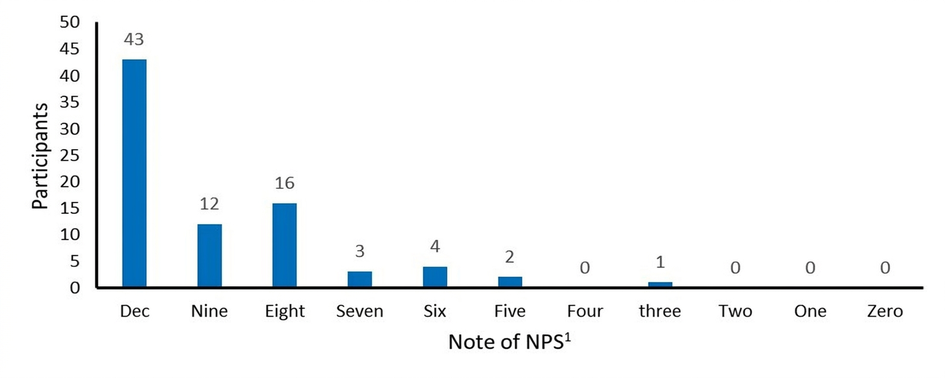
In a compilation of 81 responses, it is observed that participants in affinity groups show positive sentiment towards them. The NPS score was 60, which positions the groups in the quality zone. Furthermore, 92% of respondents were classified as promoters, extremely satisfied, loyal, and enthusiastic participants with the ERGs, or as passives, satisfied but indifferent participants; not dissatisfied, but without demonstration of active loyalty[12], which indicates a strong convergence of positive perceptions on the topic. The overall average score was 8.94, as shown in Figure 1.
Source: Original research results.
Note. ¹NPS: Net Promoter Score.
This evidence finds support in Douglas[9], who, when analyzing affinity groups, demonstrates how the perception of belonging and shared value acts as a catalyst for engagement and loyalty. Thus, it is possible to infer that the qualitative factors identified as promoters are directly related to the strengthening of this organizational bond.
Despite the positive results in several questions, as presented in Table 1, which reinforce the role of affinity groups in improving business performance by increasing engagement and a sense of belonging among employees, one of the survey data presented a negative highlight. When asked how safe they feel to express their opinions, they gave an average score of 7.69, which is 1.25 points below the score related to the promotion of affinity groups, with 38% of people classified as passive.
This result dialogues with the analysis of Douglas[9], who recognizes affinity groups as catalysts for engagement, but emphasizes that their maximum potential is reached when their learnings extend to the organizational environment as a whole. Therefore, although groups are valued and recommended, the opportunity remains to strengthen diversity and inclusion more broadly and systemically in the company.
Table 1. Compiled averages for the closed questions rated from 0 to 10 in the form
| Questions | Average of the 81 responses | Standard deviation |
| On a scale of 0 to 10, how likely are you to recommend a colleague to participate in the dialogue/affinity groups? | 8,94 | 1,48 |
| On a scale of 0 to 10, how much do you feel that the existence of a diversity front in the company contributes to you having greater motivation to remain in it? | 8,78 | 1,89 |
| On a scale of 0 to 10, how much do you believe that the actions of the affinity group can positively impact the company’s organizational culture and climate? | 8,77 | 1,74 |
| On a scale of 0 to 10, how much do you believe that participation in affinity groups contributes to your sense of belonging in the company? | 8,56 | 1,72 |
| On a scale of 0 to 10, how much do you believe that participation in diversity initiatives contributes to you performing better in your activities? | 8,16 | 2,00 |
| On a scale of 0 to 10, how much more welcomed and belonging to the company do you feel since you started participating in diversity initiatives? | 8,10 | 2,15 |
| On a scale of 0 to 10, how satisfied are you with the development of the affinity group? | 7,99 | 1,91 |
| On a scale of 0 to 10, how safe do you feel expressing your opinion in different situations? | 7,69 | 2,08 |
Regarding the standard deviation, considerable variation is observed among the scores provided by the participants, with the NPS score showing the smallest deviation, illustrated by the distribution in Figure 1. This result aligns with Cox[5], who argues that organizational diversity requires acknowledging that different groups experience culture in distinct ways, which explains the presence of divergent perceptions even in spaces like ERGs. Similarly, Nayani[4] reinforces that ERGs achieve their transformative potential when organizations integrate their practices into strategy and offer consistent support, which prevents perception discrepancies from limiting their effectiveness.
Overall, the results of the questions directed to the participants of the affinity groups demonstrated that engagement and sense of belonging to the company were strengthened by the ERGs. Despite this, relevant points for improvement emerged to be considered in the next steps, synthesized in Table 2 based on the main aspects mentioned in the answer to the question: “What developments do you believe could be implemented in the affinity group?”.
Table 2. Main points raised as evolutions for affinity groups
| Greater leadership involvement and support: presence and active encouragement of leadership and internal policies |
| Implementation of practical and effective projects: development of concrete projects and implementation of diversity policies |
| Actions beyond affinity groups: broadening discussions to other levels in the company and topics being addressed more routinely |
| Visibility and formalization of groups: groups driven by high leadership and formalization of groups as an integral part of the company’s organizational structure |
| Employee engagement and participation: incentive for greater employee participation and involving more affinity group representatives in the company’s strategic decisions |
In qualitative questions, when asked about what developments could strengthen the diversity and inclusion front, many people pointed out as the main area for improvement the need to transform the themes discussed in the groups into more practical actions within the company. This perception also clarifies the difference between the results of the two questions presented in the previous paragraphs.
In Table 4, it is possible to verify how the means are presented in the different affinity groups and how the differences between these scores can lead to reflections and conclusions, including with connection to the standard deviation values presented in Table 2.
One point observed in this data is that the questions with the highest deviation – “On a scale of 0 to 10, how much do you feel more welcomed and belonging to the company since you started participating in diversity initiatives?” and “On a scale of 0 to 10, how safe do you feel expressing your opinion in different situations?” – show significant discrepancies between groups.
Table 2. Compilation of averages for the closed questions rated from 0 to 10 on the form by each dialogue group
| Questions | Inclusive education (21 answers) | LGBTQIAP+ (22 responses) | Gender equity (27 responses) | People with disabilities (13 responses) | Ethnic-racial (36 responses) |
| On a scale of zero to ten, how much do you believe that participation in affinity groups contributes to your sense of belonging in the company? | 8,47 | 8,64 | 8,51 | 8,85 | 8,53 |
| On a scale of 0 to 10, how likely would you be to recommend a colleague to participate in the dialogue/affinity groups? | 8,80 | 8,82 | 8,96 | 9,23 | 8,83 |
| On a scale of 0 to 10, how much do you feel that the existence of a diversity front in the company contributes to you having greater motivation to remain in it? | 8,52 | 8,82 | 8,52 | 8,85 | 9,00 |
| On a scale of 0 to 10, how much do you believe that the actions of the affinity group can positively impact the company’s organizational culture and climate? | 9,00 | 8,55 | 8,44 | 8,92 | 8,83 |
| On a scale of 0 to 10, how much do you believe that participation in diversity initiatives contributes to you performing better in your activities? | 8,23 | 8,18 | 8,11 | 8,77 | 7,81 |
When analyzing the questions with the highest standard deviation, it is possible to perceive that both present discrepancies related to the different groups. Regarding the first one, the Inclusive Education group distances itself considerably from the pattern observed in the other groups. In relation to the second one, an average variation of 0.3 points is observed between the groups.
When comparing the responses by group, the expected improvement points brought up in the last open-ended question remain in the pattern of the overall analysis, suggesting that the needs for the next steps are of a broad organizational nature, not restricted to a specific group or segment.
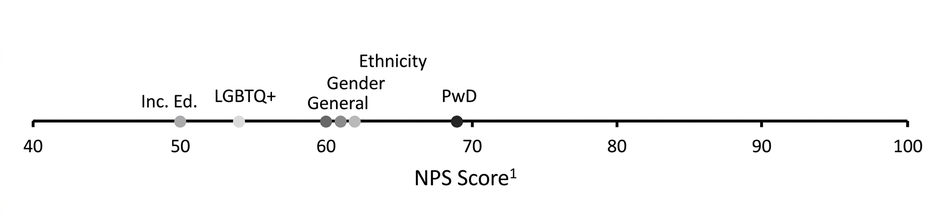
In Figure 2, the compilation of the NPS score distribution for all affinity groups (ERGs) can be observed, with only one group below the quality zone – Inclusive Education – and all others within the quality zone, and the People with Disabilities group achieving the highest score.
Source: Original survey results.
Note. ¹NPS: Net Promoter Score.
The results obtained in the research can be related to the diversity, equity, and inclusion practices observed in other companies. In a survey conducted by Deloitte (2023), with 355 respondents from different organizations, 94% state that diversity and inclusion practices improve the quality of the workforce and 96% consider that such practices promote a more welcoming environment in companies[14]. These data reinforce the relevance of the topic in the corporate context.
These results also corroborate the findings presented, in which the average score for the question “On a scale of 0 to 10, how much do you believe that participation in diversity initiatives contributes to your better performance in your activities?” was 8.16; and for the question “On a scale of 0 to 10, how much do you believe that affinity group actions can positively impact the company’s organizational culture and climate?”, 8.77 – values that indicate good audience adherence and satisfaction with the topics addressed[14].
Still based on the research conducted by Deloitte[14], seven out of ten companies already have at least one affinity group structured, and three is the average number of groups per organization. Compared to the analyzed company, the scenario appears more evolved, with five structured groups, even in the face of development challenges. In general, both the positive points and the challenges faced in the implementation and development of ERGs and other diversity, equity, and inclusion practices in the analyzed organization are aligned with the national scenario presented by Deloitte.
It can be inferred that the practices of affinity groups strengthen engagement and the sense of belonging in the company in general. Despite this, there are still many relevant areas for improvement and development, especially regarding the expansion of these practices beyond the groups, in order to promote the transformation of the organization into an increasingly diverse and inclusive environment.
As a point of attention, the engagement of collaborating people with affinity groups still presents several aspects for improvement, mainly regarding adherence to form completion, which had the participation of only 15% of the members. This low engagement is aligned with the main demands pointed out in the qualitative questions and reinforces the team’s difficulty in fully engaging with diversity practices in the company.
Furthermore, it is important to reinforce the ERGs’ vision for the company, given that the perception among different groups – and even within them – presents significant discrepancy. Work focused on increasing the visibility of affinity groups and encouraging leadership and other employees to engage with the issue can act as a relevant vector for equalizing these perceptions, as suggested by the group participants in their proposals for future improvements.
REFERENCES
[1] Amato, L. (coord). 2022. Diversidade e inclusão em suas dimensões. 1ed. São Paulo, SP: Literature Books International.
[2] Sodré, M. 2006. Diversidade e diferença. Sevilla: Revista Científica de Información y Comunicación. 3: 5-15. https://idus.us.es/items/23ee3b38-c431-4fcd-8826-07f69f1811f0.
[3] Mota, R., Ignarra, C., Leite Lemos, J., Schneider, M., Gioffi, S. 2022.Diversidade, Equidade e Inclusão: tornar simples o que parece complexo. 1ed. São Paulo, SP: Editora Haikai.
[4] Nayani, F. 2022. The power of employee resource groups: how people create authentic change. 1ed. São Francisco, Califórnia: Berrett-Koehler Publishers.
[5] Cox T. 1994. Cultural diversity in organizations: theory, research and practice. Reprint ed. São Francisco, Califórnia: Berrett-Koehler Publishers.
[6] Larson, E. 2017. New Research: Diversity + Inclusion = Better Decision Making at Work. Forbes. Disponível em: https://www.forbes.com/sites/eriklarson/2017/09/21/new-research-diversity-inclusion-better-decision-making-at-work/?sh=3ee422ac4cbf. Acesso em: 19 mar. 2024.
[7] Briscoe, F.; Safford, S. 2010. Employee Affinity Groups: their evolution from social movements vehicle to employer strategies.Perspectives on work. 14(1): 42-45. https://sciencespo.hal.science/hal-01052900v1.
[8] Lanzer, F. 2017. Clima e cultura organizacional: Entender, manter e mudar. 2ed. Amstelveen, Holanda: Createspace Independent Publishing Plataform.
[9] Douglas, P.H. 2008. Affinity Groups: Catalyst for Effective Organizations. Wiley InterScience. 34(4). https://doi.org/10.1002/ert.20171
[10] Yin, R. 2001. Estudo de caso: planejamento e métodos. 2ed. Porto Alegre, RS: Bookman.
[11] Duarte, T. 2023. Net Promoter Score: entenda o que é o NPS e como implementar esta métrica na sua empresa! Track.co. Disponível em: https://track.co/blog/net-promoter-score/#:~:text=Defini%C3%A7%C3%A3o%20e%20conceito%20do%20NPS,Cliente%2C%20%C3%A9%20o%20NPS%20Transacional. Acesso em: 24 jun. 2024.
[12] Reichheld, F. 2003. The One Number You Need to Grow. Harvard Business Review. Disponível em: https://hbr.org/2003/12/the-one-number-you-need-to-grow. Acesso em: 24 jun. 2024.
[13] Reichheld, F. 2021. Winning on Purpose: The Unbeatable Strategy of Loving Customers. 1ed. Cambridge, Massachusetts: Harvard Business Review Press.
[14] Deloitte. 2023. Diversidade, Equidade e Inclusão nas Organizações. Disponível em: https://img04.en25.com/Web/DeloitteToucheTohmatsuAuditoresIndepende/%7B9fa61913-bbc8-4740-aa67-43b4d368c772%7D_Diversidade__Equidade_e_Inclus%c3%a3o_2023.pdf?utm_campaign=ins-122023-pesquisas-diversidade-download&utm_medium=email&utm_source=Eloqua&idcmp=br%3A2em%3A3cc%3A4elqbr%3A5gen%3A6oth. Acesso em: 3 out. 2024.
[15] Bardin, L. 1977. Análise de Conteúdo. Lisboa, Portugal: Edições 70.
COMO CITAR
Lopes, D.M.; Mathias, A.L.T.C. Diversidade e inclusão: benefícios para a cultura e para o clima na implementação de grupos de afinidade. Revista E&S. 2025; 6: e2025022.
ABOUT THE AUTHORS
 Diogo Milhomens Lopes – Business Management Specialist. Project Coordinator II at Arco Educação. Rua Martim Afonso, nº 1543, Bigorrilho, 80730-030, Curitiba, Paraná, Brazil.
Ana Luiza Terra Costa Mathias – Ph.D. in Administration. Supervising Professor. Rua Cezira Giovanoni Moretti, 580, Santa Rosa, 13414-157, Piracicaba, São Paulo, Brazil.