
Edição Temática - Gp 2026
November 27, 2026
Training and Development: the Importance of Theoretical Training in a Young Apprentice Program
André Luiz Gomes da Silva; Orjana de Oliveira Pacheco Rossi
DOI: 10.22167/2675-6528-202603734
Article derived from a Final Course Work (TCC), with content based on the student’s original work and adapted to the editorial format of the E&S Magazine with the support of the ResumeAI tool, an artificial intelligence solution developed by Instituto Pecege for textual synthesis and organization.
Summary
The study investigated how theoretical training, articulated with professional practice in the Jovem Aprendiz program, influenced the development of young people in an inland city in Bahia. The main objective was to understand, from the perspective of the instructors responsible for theoretical training, the relevance of this stage in the professionalization process. A qualitative approach was adopted, with a descriptive and participatory design. A semi-structured online questionnaire was applied, and the data were treated through content analysis, complemented by a bibliographic review in indexed databases. The results indicated that the instructors considered theoretical training fundamental for broadening knowledge, developing critical thinking, and strengthening technical and behavioral skills, such as communication, teamwork, and responsibility, which are essential for professional practice. Its contribution to social inclusion and the expansion of apprentices’ social mobility prospects was also highlighted. Although needs for greater methodological dynamism and better adaptation of content to the market were pointed out, the perception prevailed that the integration between theory and practice is indispensable for training critical, autonomous individuals capable of facing personal and professional challenges. It was concluded that theoretical training constitutes a pillar of apprenticeship programs, functioning not only as preparation for work but also as a mechanism for citizenship and social transformation.
Keywords: Professional skills; Social inclusion; Social mobility; Public policies; Critical thinking.
1. Introduction
The concept of sustainability encompasses the economic, environmental, and social dimensions. Public policies play a crucial role in enabling organizations’ advancement in these dimensions, especially in the economic and social spheres. They facilitate access to the labor market and professional training for groups in society facing barriers, such as young people in situations of social vulnerability.
In this scenario, studies such as Costa and Montanhara (2021) emphasize that the right to work is a fundamental principle of human dignity. For this right to be universal, the implementation of governmental policies that correct existing inequalities is imperative. Law nº 10.097/2000, known as the Young Apprentice Law (Brazil, 2000), exemplifies such a policy, allowing organizations to act as agents of economic and social transformation.
The Young Apprentice Law (Brazil, 2000) establishes the opportunity for practical and theoretical learning, promoting the insertion of young people aged fourteen to 24 into the job market, without disregarding formal educational training. Partner companies sign contracts with institutions that are responsible for theoretical training, aiming for comprehensive education. In the field of People Management, training and development have a strategic character in organizations, according to Wanzeler et al. (2018), highlighting the relevance of understanding the importance of theoretical training in the professionalization process of these young people.
Theoretical training is, therefore, an essential component of apprenticeship programs. Its focus transcends the mere offering of employment and income, seeking to empower young people to become qualified professionals, with greater chances of success in their careers. The integral formation of critical subjects is achieved through the articulation between theoretical training and practical activities developed in organizations (Brasil, 2000). Apprenticeship programs, based on the Young Apprentice Law, can be implemented in various types of organizations, public or private, with the purpose of offering training that positively impacts the professional lives of young people, many of them in situations of social vulnerability.
This strategic approach to theoretical training in learning programs goes beyond a tool for labor market insertion, acting as a mechanism for emancipation and social mobility. Based on this context, this study analyzes how theoretical training, articulated with professional practice within the scope of the Young Apprentice Program, impacts the professional development of young people in a municipality in the interior of Bahia. Specifically, it seeks to understand the perceptions of the instructors responsible for theoretical training, identify the technical and behavioral competencies valued in the training process, and relate theoretical training to the formation of critical subjects and the social inclusion of participants.
2. Material and Methods
The present study adopted a qualitative approach, with a descriptive and participatory design. The objective was to understand, in depth, the instructors’ perceptions of the theoretical training in Young Apprentice programs.
For data collection, a semi-structured questionnaire was used, developed specifically for this research, as no previously validated instruments were identified that encompassed the investigated variables. The instrument was made available online through the “Google Forms” platform, a strategy that, according to Castro and Oliveira (2022), is valued in qualitative research for balancing structure and flexibility, allowing for the collection of rich and contextualized data.
The target population comprised instructors responsible for theoretical training in partner organizations of the Jovem Aprendiz program, located in a city in the interior of the state of Bahia. The sample consisted of ten respondents, all instructors who directly engage in the theoretical training of young apprentices in the surveyed municipality. The limited number of participants stems from the universe of professionals existing in this role in the city, but the sample is considered representative of the local reality, as it includes professionals with experience in this type of training.
For the analysis of the collected data, content analysis was employed, as proposed by Bardin (2011), aiming to identify emerging categories from the participants’ responses.
Additionally, the research was supported by a literature review to theoretically sustain the study. A survey of recent publications in indexed databases, such as “Scielo” and CAPES Periodicals, was conducted, focusing on public policies, training and development, and social inclusion (Sousa et al., 2021). This integrated approach between empirical data collection and theoretical foundation sought to ensure that the study was grounded in consistent evidence.
3. Results and Discussion
The research sought to analyze the influence of theoretical training, as a tool for training and development in Young Apprentice programs in the city of Feira de Santana, Bahia, on the development of young people, from the instructors’ perception. The semi-structured questionnaire, used to collect data, was divided into five sections, addressing the respondents’ profile, aspects of theoretical training and professional preparation, technical and behavioral skills developed, critical training and social inclusion, and final considerations.
Among the ten participating instructors, 60% were female, 30% male, and 10% other genders. The predominant age group (40%) was 25 to 34 years old, followed by 30% between 35 and 44 years old, and 30% between 45 and 54 years old. Regarding academic background, 60% had pedagogy as their main area, 30% other areas related to education, and 10% administration. The majority (80%) had prior experience in education. As for the time spent in theoretical training of young apprentices, 50% had less than one year, 20% from one to two years, 20% more than five years, and 10% between three and five years. The predominant mode of operation was in-person (80%), with 10% hybrid and 10% online.
Instructors perceive theoretical training as a fundamental pillar for the professional preparation of young apprentices. It broadens knowledge, develops critical thinking, and provides a solid foundation of skills and competencies for the job market. Furthermore, theoretical training favors the association between theory and practice, contributes to personal and professional growth, and acts as a space for welcoming and listening, preparing young people for challenges with safety, responsibility, and social awareness.
Regarding the adequacy of theoretical training for the needs of the labor market, 70% of instructors fully agree that it meets the needs, while 30% partially agree. Justifications for partial agreement included the need for more dynamic and interactive classes, the lack of alignment between content and the reality of young people’s work, and a lack of communication. These perceptions indicate opportunities for improvement so that theoretical training prepares young people more effectively for market demands.
The articulation between theoretical training and professional practice was evaluated as very well articulated by 60% of participants, partially articulated by 30%, and poorly articulated by 10%. This articulation is considered essential for significant training that meets the expectations of the job market.
Technical and Behavioral Competencies
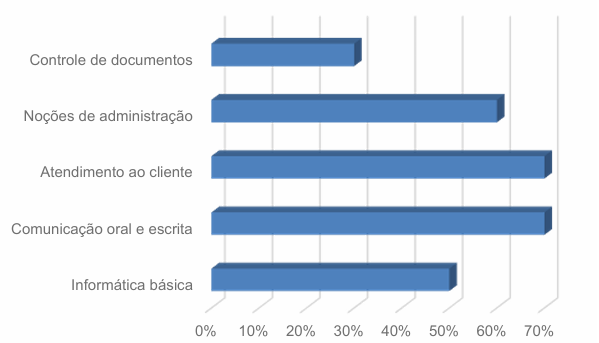
The most developed technical skills during the training, according to the instructors’ perception, are oral and written communication and customer service, both indicated by 70% of respondents. Other technical skills mentioned include basic computer literacy, notions of administration, and document control. Figure 1 illustrates the frequency of these mentions.
Figure 1. Technical skills most developed by young people during de-suckering
Source: Original research results
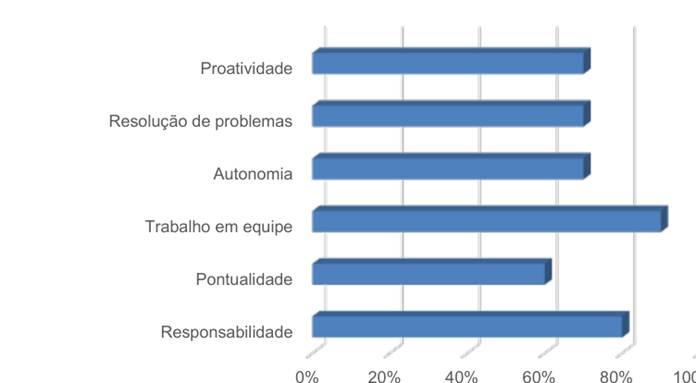
Regarding behavioral competencies, teamwork (90%) and responsibility (80%) were the most highlighted by instructors as evident after the young people’s training process. Proactivity, problem-solving, autonomy, and punctuality were also mentioned. Figure 2 shows the distribution of these competencies.
Figure 2. Most evident behavioral competencies after the youth training process
Source: Original research results
Instructors reported significant behavioral changes in young apprentices, such as greater responsibility with deadlines and activities, increased class participation, more collaborative attitudes, and respect in interpersonal relationships. Progress was also observed in communication, commitment, and the development of a professional demeanor. The theoretical-practical training promoted self-confidence, proactivity, awareness of rights, and better teamwork. Some young people, who started the program without life prospects, were transformed and subsequently hired as permanent employees, aligning with the principles advocated by the Young Apprentice Law (Brazil, 2000) and by Wanzeler et al. (2018) regarding comprehensive and strategic training.
Critical Training and Social Inclusion
The majority of respondents (80%) consider that the program contributes greatly to the social inclusion of young people, while 20% assess that it contributes moderately. Instructors justify this contribution by the insertion of young people into the job market, strengthening of professional potential, improvement of economic condition and self-esteem. The program also offers qualification, keeps young people away from crime, and promotes participation in collective environments, stimulating socialization. There were mentions of rescuing young people in vulnerable situations, creating support networks, and the perceived evolution throughout the training. However, limitations were pointed out, such as the need for better adaptation of teaching materials and methodologies more focused on social inclusion.
All instructors agree that theoretical training contributes to the development of critical thinking in young learners. This contribution is manifested in the broadening of worldview, stimulation of reflection on different realities, and assistance in questioning, analyzing, and proposing solutions for everyday situations, both personal and professional. Theory exposes young people to concepts and contexts that go beyond practice, encouraging debate, argumentation, and analysis of causes and consequences. The effectiveness of this contribution depends, in part, on the instructor’s performance in creating conditions for the development of the criticality necessary for entry and permanence in the world of work.
Regarding social mobility and the expansion of future prospects for young people, 90% of instructors agree that the program favors these aspects. Social mobility, according to Freitas (2021), refers to the possibility for individuals to improve their life position in terms of well-being, education, income, and occupation, compared to that of their families of origin. Only 10% of respondents believe that the program only partially favors these aspects, with one participant justifying their answer by the difficulty of allocating young people near home, which indicates an interpretation of the question as urban mobility and not social mobility.
In the final considerations, participants expressed satisfaction in observing the evolution of young people, who arrive insecure and with little prospect for the future, but develop self-esteem, autonomy, and see new professional and personal possibilities throughout their training. Theoretical training, combined with active monitoring and listening, is seen as fundamental to awakening this potential. However, frustration was also mentioned when perceiving the disinterest of some.
The analysis showed that theoretical training in the Jovem Aprendiz program plays a central role in building more qualified professional trajectories for young people in situations of social vulnerability. This finding confirms that the articulation between theory and practice not only fills training gaps but also drives the construction of strategic human capital in organizations (Wanzeler et al., 2018). Instructors recognize the importance of theoretical training for the development of essential skills for young people’s entry and retention in the labor market, which dialogues with the literature that advocates for the need for critical training and the expansion of social mobility (Freitas, 2021; Leal and Alberto, 2021).
Theoretical training favors the acquisition of technical knowledge and stimulates the development of critical thinking, autonomy, and responsibility, elements highlighted as differentials in the professional performance of apprentices. This reinforces the understanding that the program functions as a mechanism for citizen training (Leal and Alberto, 2021). The training process contributes to broadening life perspectives, strengthening self-esteem and autonomy, allowing young people to overcome historical barriers linked to their youth, race/color, social class, and place of origin. These findings converge with studies that recognize professional training programs as instruments for promoting equity and citizenship (Souza et al., 2020; Bezerra et al., 2022).
A limitation of the study is the restricted number of participants, which prevents the generalization of findings to other contexts. However, the data provide relevant subsidies for reflection on the improvement of public learning policies and the strengthening of training and development strategies for young people in situations of social vulnerability. The strengthening of public learning policies requires continuous investments in innovative methodologies capable of articulating the demands of the world of work with integral human development. Thus, theoretical training must be treated as a structuring element of the learning program, ensuring that the training process is technical, critical, and inclusive (Wanzeler et al., 2018; Silva, 2023).
4. Conclusion
This study sought to understand the relevance of theoretical training in the professionalization process of young apprentices in a municipality in the interior of Bahia, from the instructors’ perspective. It was found that theoretical training is considered a fundamental pillar, expanding knowledge and developing critical thinking in young people. The instructors identified the strengthening of technical skills, such as oral and written communication and customer service, and behavioral skills, highlighting teamwork and responsibility. It was observed that the training process promoted significant changes in the apprentices’ behavior, including greater self-confidence, proactivity, and a more developed professional attitude. The articulation between theory and professional practice was evaluated as essential for meaningful training, contributing to social inclusion and broadening the social mobility prospects of the participants, by enabling them to face personal and professional challenges with greater autonomy and awareness.
Despite the relevant findings, the study presented the limitation of a restricted number of participants, ten instructors from a single city, which prevents the generalization of the results to other contexts. However, the data provide important subsidies to improve public learning policies and training and development strategies aimed at young people in situations of social vulnerability. It is suggested that future research expand the number of respondents, include different locations, and explore the perceptions of other involved actors, such as the young apprentices themselves and organizational managers. Theoretical training, therefore, emerges as a structuring element of apprenticeship programs, functioning as a robust mechanism for citizenship and social transformation, in addition to preparing for the job market.
Bibliographic References
Bardin, L. 2011. Análise de conteúdo. Edições 70, São Paulo, SP, Brasil.
Bezerra, F. W. C. 2022. Gestão da diversidade nas organizações: uma breve revisão bibliográfica. Research, Society and Development 11(11): 1-12.
Brasil. 2000. Lei nº 10.097, de 19 de dezembro de 2000. Altera dispositivos da Consolidação das Leis do Trabalho – CLT, aprovada pelo Decreto-Lei nº 5.452, de 1º de maio de 1943. Diário Oficial da União, Brasília, 20 dez. 2000. Seção 1, p. 1.
Castro, E.; Oliveira, U. T. V. 2022. A entrevista semiestruturada na pesquisa qualitativa-interpretativa: um guia de análise processual. Entretextos 22(3): 25-45.
Costa, D. A.; Montanhara, R. 2021. Políticas públicas de juventude e inclusão produtiva: uma análise da aprendizagem profissional. Revista Brasileira de Políticas Públicas 11(2): 114-132.
Freitas, A. A. 2021. Bem-estar e estratificação social no Brasil contemporâneo. Revista Brasileira de Sociologia 9(22): 196-221.
Leal, N. S. B., Alberto, M. F. P. 2021. Políticas de acolhimento e juventude: a problemática de inserção na formação profissional. Psicologia: Ciência e Profissão 41: 1-16.
Silva, J. H. 2023. Trajetórias de trabalho: empregos precários e inserções provisórias. Pro-Posições 34: 1-31.
Souza, M. A. et al. 2021. Pesquisa bibliográfica: fundamentos e aplicações. Revista Científica Multidisciplinar Núcleo do Conhecimento 2(30): 50–65
Souza, A. C. S. et al. 2020. O valor da diversidade nas organizações: um mero discurso ou uma experiência efetiva. Revista Valore 5: 371-383.
Wanzeler, R. et al. 2018. Gestão de pessoas: visão estratégica sobre treinamento e desenvolvimento no contexto das organizações do século XXI. Revista de Administração e Negócios da Amazônia 10(2): 67-84.
Article originating from the Final Course Work of the Specialization in People Management of the MBA USP/Esalq
To learn more about the course, click here and access the MBX Academy platform