
Edição Temática - Gp 2026
November 27, 2026
Generation Z and the Corporate Environment: Perspectives and People Management Practices by Leaderships
Andressa Alves dos Reis; Adriana Villanova de Almeida
DOI: 10.22167/2675-6528-202602363
Article derived from a Final Course Work (TCC), with content based on the student’s original work and adapted to the editorial format of the E&S Magazine with the support of the ResumeAI tool, an artificial intelligence solution developed by Instituto Pecege for textual synthesis and organization.
Summary
Generation Z, with its socio-cultural experiences, influences behaviors and expectations in the workplace. The study aimed to map the characteristics attributed to these professionals and identify how leadership adapted their management practices to promote motivation and retention. A descriptive and qualitative survey was conducted, through a case study in a private company in the corporate food sector in the interior of São Paulo. Semi-structured interviews were carried out with 11 leaders from different administrative areas of the organization. The results indicated that leaders recognized Generation Z as technological, with a desire for challenges and innovation, and attentive to social issues, but also pointed out challenges such as instability and immediacy. Adaptations in management practices included closeness, transparency, active listening, constant feedback, and recognition. Remuneration and benefits were identified as determining factors for the motivation and retention of these professionals. It was concluded that the alignment between leadership styles and the expectations of Generation Z can significantly contribute to building a more attractive and productive work environment, favoring talent retention.
Keywords: Generation Z; Generations; People Management; Leadership; Talent Retention.
1. Introduction
People born in the same historical period tend to develop similar behaviors, values, and preferences, influenced by experiences lived over time (Lirio et al., 2020). In this context, Generation Z, which includes individuals born from 1995 onwards, shares cultural and social experiences that shape their attitudes, distinguishing them from preceding generations.
It is important to emphasize that the chronological division by generations serves as a reference and a potential delimitation, given that each generation was formed in a world scenario with specific socio-historical influences (Oliveira, Piccini and Bitencourt, 2012). However, it is fundamental to consider that youth is not a homogeneous group, and elements such as social class, historical context, shared experiences, and intergenerational relationships also play a role in shaping its characteristics (Colet and Mozzato, 2019).
The era in which Generation Z grew up was marked by profound technological transformations, economic and social crises, as well as an increase in environmental activism and social movements. This environment contributed to the formation of an adaptable, dynamic, and globally aware generation (Pauli et al., 2020).
Generation Z is the first to be born fully connected to digital media, often being called “digital natives” (Lanier, 2017). These individuals, also known as “zappers”, demonstrate an ability to handle information quickly and selectively, adapting to sudden changes at an accelerated pace compared to previous generations (Iorgulescu, 2016).
In the workplace, Generation Z seeks flexibility, openness to dialogue, and continuous opportunities for growth and development (Barhate; Dirani, 2021). Work-life balance is an essential value, and these professionals seek companies that share their values, offer meaningful work, and a positive impact on society (Pandita, 2021). They tend to change jobs more frequently, especially when their current job does not meet their expectations for rapid growth, purpose, or quality of life (Iorgulescu, 2016).
The entry of this generation into the labor market makes it crucial for organizations to understand their characteristics and values, in order to adjust their people management policies to attract and retain these professionals (Rocha, 2022). Furthermore, understanding generational differences is essential to promote effective collective interaction and integrated actions in the corporate environment, with leadership playing a central role in this process, adapting their management styles to create more satisfactory and productive environments (Colet and Mozzato, 2019; Soares; Almeida, 2022).
The alignment of leadership practices with Generation Z values is a key factor for attracting and retaining talent in a competitive job market (Maloni et al., 2019). Based on these considerations, the present study seeks to investigate whether leadership is indeed attentive to the particularities of this generation so that their management practices favor the well-being and development of their professionals in the workplace, and consequently organizational success. The main objective of this work, therefore, is to map the main characteristics that leadership attributes to Generation Z, including behaviors and expectations, and how they adapt their management practices to promote a work environment that favors the engagement, satisfaction, and retention of professionals of this generation.
2. Material and Methods
This work is characterized as descriptive in nature, with a qualitative approach, using a single case study, with the application of a semi-structured interview (Minayo, 2012).
Interviews were conducted with 11 managers from the administrative area of a private company in the corporate food sector, headquartered in the interior of São Paulo. The organization has more than 90 operational units distributed throughout Brazil and its administrative center has more than 65 professionals, of which more than 60% belong to Generation Z.
The target population was selected through a survey of all leaders in the company’s administrative center, covering the Baby Boomers, X, Y, and Z generations, and those responsible for the Accounting/Tax, Human Resources, Facilities, Finance, People Management, Marketing, PCP, Quality, Supply, and IT departments.
The work was submitted and evaluated by the Research Ethics Committee (CEP) – CAAE 85500924.6.0000.9927. Participants signed the Consent Agreements (TCLEs) before the interviews, which took place in person in reserved company rooms, with audio recording.
The interviews were guided by an 8-question script (Appendix A), based on Colet and Mozzato (2019). The instrument was pre-tested by 3 people in February 2025 to verify the clarity of the questions. The final data collection was carried out in March 2025.
Table 1 presents the profile of the 11 interviewees.
Table 1. Characterization of the interviewed leaders
| Denomination | Generation | Age | Area of Operation |
| Interviewee A | Baby Boomer | 69 years | Quality |
| Interviewee B | X | 46 years | Human Resources Department |
| Interviewee C | Y | 43 years | Accounting/Tax |
| Interviewee D | Y | 40 years | Supplies |
| Interviewee E | Y | 39 years | Financial |
| Interviewee F | Y | 37 years | PCP |
| Interviewee G | Y | 34 years | IT |
| Interviewee H | Y | 31 years | People Management |
| Interviewee I | Z | 28 years | PCP |
| Interviewee J | Z | 28 years | Installations |
| Interviewee K | Z | 26 years | Marketing |
Source: Original research data
After the interviews, the data were transcribed and organized with Microsoft Word software. The analysis followed the chronological poles of Bardin’s (2011) content analysis: a) pre-analysis, with preparation and organization of the material; b) material exploration, with analysis of the interviews in light of the bibliography; and c) treatment of results, inference and interpretation, to systematize and interpret the data.
3. Results and Discussion
This section presents and discusses the data obtained through semi-structured interviews with leaders about Generation Z, exploring their perceptions of this generation’s characteristics, expectations, and motivations in the workplace, and the management practices adopted to address their challenges and demands.
Characterization of Generation Z
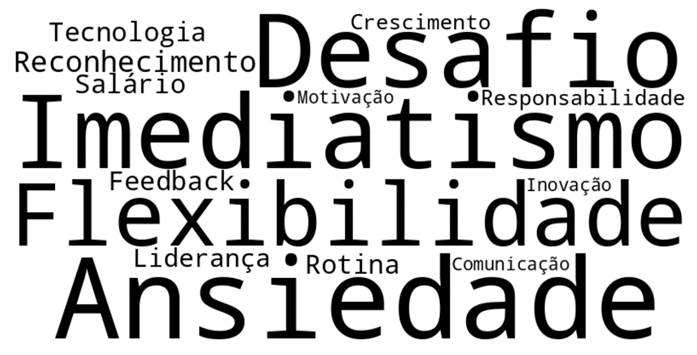
The interviewed leaders demonstrated an understanding of the main characteristics of Generation Z aligned with the literature, which describes them as digital natives, valuing autonomy and flexibility, seeking work-life balance, and expecting rapid professional growth and development (Matta et al., 2024; Iorgulescu, 2016; Chillakuri and Mahanandia, 2018; Melo et al., 2019; Rodrigues et al., 2021; Bispo et al., 2022). Figure 1 illustrates the most cited words by leaders to describe this generation.
Figure 1. Word cloud
Source: Original research results
Among the most mentioned characteristics, anxiety and immediacy stood out. Most leaders perceived that Generation Z seeks short-term results and achievements, with little patience for longer processes. The term “anxiety” was used 22 times by 7 leaders, and “immediacy” 20 times by 6 interviewees. Excessive self-confidence and lack of patience to learn the phases of a process, generating frustration, were also pointed out, corroborating Novaes (2016).
Some interviewees related these characteristics to the accelerated social context, marked by rapid technological advancement and the fast consumption of content on social media. This ease of adaptation to new tools, however, can be accompanied by excessive dependence on the internet and mobile devices, resulting in distraction and loss of focus, as observed by interviewees A and B and confirmed by Hermes (2017).
Generation Z also seeks new challenges, innovation, and meaningful experiences, not settling for monotonous or impactless activities, which can hinder engagement in complex and time-consuming tasks, as pointed out by interviewees E and G, and aligned with Santos et al. (2019). The ease of change, in pursuit of quality of life and alignment with personal values, was another relevant trait, with participant A highlighting the absence of attachment to the job or company, which is consistent with Pauli et al. (2020).
Expectations and Motivations of Generation Z at work
Leaders perceive that Generation Z is motivated by recognition, professional development opportunities, fair compensation, benefits, and effective communication (Santos et al., 2019). There is an almost unanimous expectation of rapid growth and high salaries, without necessarily a consistent career path of experience, and a tendency to change jobs more naturally and frequently, unlike previous generations, as observed by respondents B, H, I, and K, and by Pauli et al. (2020).
This generation prioritizes experiences aligned with their values and interests, especially quality of life, seeking healthy, flexible work environments with a balance between personal and professional life, as summarized by interviewees H and K. Recognition, both financial and for the appreciation of contributions, and constant feedback are essential for motivation, as exemplified by D, G, J, and K, and evidenced by Santos et al. (2019).
Generation Z professionals tend to engage more with companies whose values align with theirs and where they feel their actions have a relevant impact, seeking a sense of purpose, as reinforced by interviewee K and corroborated by Deloitte (2024). Transparent communication about the motivations behind activities, career plans, and flexibility are crucial, as pointed out by B, D, E, H, and J, and by Lanier (2017). The organizational climate, with respect, transparency, active listening, safety, closeness, and support, is fundamental to motivating this generation, with a close relationship with leadership being an essential aspect (Comora, 2023).
Demotivation and the search for new opportunities arise when Generation Z faces repetitive routines, lack of challenges, absence of recognition, or opportunities for rapid growth. Salary and benefits were identified by most leaders as the most determining factors for demotivation and the intention to leave the company, in line with Lima et al. (2022).
Role and Practices of Leadership
All respondents recognize the decisive role of leadership in creating a favorable work environment and the need to adapt their management practices to the particularities of each individual or generation, according to Matta et al. (2024). Despite their self-confident stance regarding positions and salaries, Generation Z may be insecure in decision-making, constantly seeking feedback, recognition, and validation, as pointed out by F, J, and K. The influence of social media on self-esteem and the pursuit of approval was also mentioned, corroborating Comin, Soares, and Mombelli (2024).
The excessive use of mobile devices during work was a pointed challenge, impacting focus and performance, according to Zivnuska et al. (2019). Leadership seeks to guide conscious use, without prohibiting it. Other challenges include anxious posture, demand for immediate responses, perception of lack of commitment, and difficulty in receiving criticism.
To deal with these characteristics, respondents believe that Generation Z professionals expect updated leadership, with technical knowledge, that brings innovations and seeks improvements in working conditions. The majority understand that close leadership, with transparency, clear communication, understanding, support, attention, and flexibility, in addition to defining career plans and offering challenges, is essential. Such strategies are consistent with the actions suggested by Colet and Mozzato (2019) to attract and retain these professionals.
Leaders seek to be attentive to the needs of Generation Z and adapt their practices, but also recognize the importance of establishing boundaries to encourage professional development, given that the relationship must be a two-way street. Managing professionals from different generations in the same work environment is a challenge, but efficiently utilizing the strengths of each generation can create competitive advantages and strengthen the environment, as highlighted by Hermes (2017).
The study revealed that leadership recognizes the specific characteristics of Generation Z, such as immediacy and anxiety, and the need to adapt management practices to create a more receptive work environment. Actions such as recognition, constant feedback, active listening, and transparency were reported. Intergenerational coexistence can be enriching when mediated by management that is aware of differences and committed to valuing the potential of each group, highlighting the importance of knowing the team and adapting practices to individual singularities and expectations, considering other social segments. The results confirm trends observed in previous research and contribute to the understanding that considering the expectations of Generation Z is essential for effective People Management strategies, promoting a healthy and productive organizational environment, and fostering talent retention.
4. Conclusion
The present study aimed to map the characteristics attributed to Generation Z by leadership and identify how their management practices were adapted to promote motivation and retention of these professionals. It was found that leadership recognizes Generation Z as technological, with a strong desire for challenges and innovation, and attentive to social issues. However, it was also identified that this generation exhibits traits such as instability, immediacy, and anxiety, in addition to a pursuit of rapid growth and high remuneration. In response to these particularities, it was observed that leadership adapted their management practices, adopting approaches that include proximity, transparency, active listening, constant feedback, and recognition. Remuneration and benefits were pointed out as crucial factors for the motivation and retention of these professionals. The study’s main contribution lies in highlighting that the alignment between leadership styles and the expectations of Generation Z is fundamental for building a more attractive and productive work environment, favoring talent retention and the achievement of organizational objectives.
Although the study confirms trends observed in previous research and reinforces the importance of understanding Generation Z’s expectations for effective people management strategies, it is important to consider its limitations. The research focused on a single organization and had a limited number of respondents, which prevents the generalization of results. For future studies, it is suggested to expand the sample and explore different sectors and organizational contexts. Such an approach can deepen the knowledge about effective people management practices across generations and their impacts on individuals and organizational outcomes, strengthening intergenerational coexistence in the corporate environment.
Bibliographic References
COLET, D. S.; MOZZATO, A. R. Nativos digitais: características atribuídas por gestores à geração Z. Desenvolve – Revista de gestão do Unilasalle, Rio Grande do Sul, 8(2), 5-40, 2019.
LIRIO, A. B.; GALLON, S.; COSTA, C. Percepções da qualidade de vida no trabalho nas diferentes gerações. Gestão & Regionalidade, v. 36, n. 107, p. 201-220, 2020. Disponível em: https://seer.uscs.edu.br/index.php/revista_gestao/article/view/5398. Acesso em: 17 out. 2024.
OLIVEIRA, S. R.; PICCININI, V. C.; BITENCOURT, B. M. Juventudes, gerações e trabalho: é possível falar em geração y no Brasil? Revista Organização e Sociedade, Salvador, v. 19, n. 62, p. 551-558, 2012. Disponível em: http://www.scielo.br/scielo.php?script=sci_arttext&pid=S1984-92302012000300010. Acesso em: 28 mar. 2025.
Article originating from the Final Course Work of the Specialization in People Management of the MBA USP/Esalq
To learn more about the course, click here and access the MBX Academy platform