
Edição Temática - Gp 2026
November 27, 2026
Emotional Intelligence in People Management: Trends Revealed by a Bibliometric Approach
Lorrane Pereira Miranda; Bárbara Helena de Oliveira Santos
DOI: 10.22167/2675-6528-202603674
Article derived from a Final Course Work (TCC), with content based on the student’s original work and adapted to the editorial format of the E&S Magazine with the support of the ResumeAI tool, an artificial intelligence solution developed by Instituto Pecege for textual synthesis and organization.
Summary
Emotional intelligence has consolidated itself as a crucial skill for organizational success and employee well-being in people management. The study aimed to analyze the trends and panoramas of research on emotional intelligence in people management, using a bibliometric approach to map the current state of the field and its scientific productions. The methodology employed quantitative analysis of 117 scientific articles, selected from a total of 405 from the Web of Science database, published between 2000 and 2024, using the terms “Emotional intelligence” AND “Human resource”. Relevant works and authors were identified; the temporal panorama of publications and citations, the frequency of topics, and the citation network were analyzed. The results revealed a significant increase in the relevance of the topic over the years, with a peak in publications in 2019 and citations in 2016. The analysis mapped the current state of the field, highlighted the main academic contributions, and identified influential authors and works, providing a comprehensive overview of the trends and scenarios that guide research, contributing to the advancement of the understanding and application of emotional intelligence in people management, aiming for a more efficient and healthy work environment.
Keywords: Organizational environment; Personal development; Human resource management; Emotional skills; Scientific productions.
1. Introduction
Emotional Intelligence has a positive and significant impact on the performance of people management professionals, aiming at empowering individuals to manage their emotions, reactions, and externalizations. This results in more effective communication processes and better conflict management. Professionals who develop these skills become more confident and resilient, capable of managing frustrations and learning from negative outcomes in the organizational environment (Siqueira, 2023).
People Management, according to Chiavenato (2014), constitutes a strategic set of integrated policies and practices that aim to generate synergistic and multiplier effects for organizations and their collaborators. This approach is not restricted to an administrative function, but acts as a strategic component capable of promoting a harmonious organizational environment, increasing motivation and engagement, and consequently, improving the overall performance of the organization.
Emotional Intelligence has been arousing growing interest in recent decades, both in the field of psychology and in interdisciplinary areas. Goleman (1995), one of the pioneers in the study of this theme, defines emotional intelligence as the ability to identify one’s own feelings and those of others, motivating and managing emotions in oneself and in relationships. This competence goes beyond simple recognition, encompassing the ability to understand and influence the emotions of others, becoming a key factor for the effectiveness of people management in organizations.
However, individuals who face difficulties in effectively managing their emotions may experience a state of emotional overload, accompanied by difficulties in tolerating these emotions. This challenge can result in experiences such as depersonalization, derealization, and even emotional numbing, which have a direct impact on quality of life and social relationships. Such emotional difficulties can increase the propensity for the establishment of unhealthy interpersonal relationships, intensifying the cycle of emotional and social difficulties faced by the individual (Leahy, Tirch, and Napolitano, 2013).
Given the importance of Emotional Intelligence in people management, a deeper understanding of the trends shaping its academic and practical development becomes fundamental. As organizations seek to strengthen talent management and leadership, it is essential to identify how this field has evolved in terms of scientific contributions and global collaborations.
In this context, a bibliometric approach emerges as an essential tool for mapping and interpreting the trends of Emotional Intelligence in people management. This methodology, which uses quantitative methods, allows for the analysis of the evolution of scientific production, identification of the main authors, institutions, and knowledge flows, as well as highlighting the most investigated themes and areas still little explored (Vanti, 2002; Wolfram, 2017).
This study is justified by providing a data-driven quantitative overview, assisting in strategic decision-making in both academic and business spheres, and demonstrating how Emotional Intelligence is consolidated as a key competence in people management. Thus, the main objective of this study was to identify and analyze the main research trends and landscapes on Emotional Intelligence applied to people management, using a bibliometric approach to map and explore the current state of the field of study, identifying the main academic contributions, the most influential authors and works, as well as trends and scenarios in research.
2. Material and Methods
To understand and explore the landscape of scientific production on Emotional Intelligence in people management, a quantitative bibliometric analysis was performed. This methodology, according to Wolfram (2017), uses statistical and mathematical methods to evaluate scientific productivity. The objective was to measure and analyze indicators of scientific productivity and impact, such as the number of publications, citations, collaboration networks among authors, journals, and countries. The bibliometric analysis involved the collection and review of published articles, seeking to identify patterns, trends, and characteristics of the studies based on statistical elements, including citation frequency, main authors and institutions involved, and the temporal evolution of the research (VERBEEK et al., 2002; LEITE FILHO E SIQUEIRA, 2007).
The database used was Web of Science (WoS), selected for its volume of records in Humanities and Social Sciences. The search was conducted in April 2024, using the advanced search tool with the keyword combination (“Emotional intelligence” AND “Human resource”).
The initial search returned 405 articles, of which 117 were classified in the area of administration and business and selected for analysis. The information returned covered the period from 2000 to 2024.
The articles were analyzed with the aid of the software Bibliometrix and Microsoft Excel. Bibliometrix was used for the construction of bibliometric maps of authors, journals based on cocitation data, and keywords based on co-occurrence data. Microsoft Excel was used for the generation of tables and graphs, aiming to systematize the field of study.
Specifically, the research sought to: (i) identify the main works and authors; (ii) analyze the temporal panorama of publications and citations; (iii) perform frequency analysis of the most recurrent topics; and (iv) map the citation network between studies.
3. Results and Discussion
The research was conducted on the Web of Science database, using the terms “Emotional intelligence” and “Human resource”. This search resulted in 405 articles, of which 117 were classified in the area of administration and business and were used for the analysis. The information returned covers the period from 2000 to 2024, with no specific temporal delimitation in the search.
Emotional Intelligence, initially developed by John Mayer and Peter Salovey in the 1990s, gained wide popularity with the publication of Daniel Goleman’s book “Emotional Intelligence” in 1995, with a revised edition in 1997 that included contributions from Reuven Bar-On. Goleman (2011) defines emotional intelligence as a set of skills that facilitate problem-solving, motivate the individual, and promote well-being by controlling impulses and contributing to personal growth. This competence goes beyond recognizing and controlling one’s own emotions, encompassing the ability to understand and influence the emotions of others, being crucial for personal and professional success, as well as for building healthy and effective relationships.
Emotional Intelligence has been increasingly recognized as a fundamental element for effectiveness in people management. Leaders and managers who develop these skills are capable of recognizing and dealing with their own emotions, as well as understanding and responding appropriately to the emotions of their team members. This promotes effective communication, constructive conflict resolution, and a positive organizational climate, contributing to success and satisfaction in the workplace. The theory of Emotional Intelligence has evolved to encompass emotional self-awareness, self-management, social awareness, and relationship skills, being applied in various areas such as education, leadership, team management, and mental health.
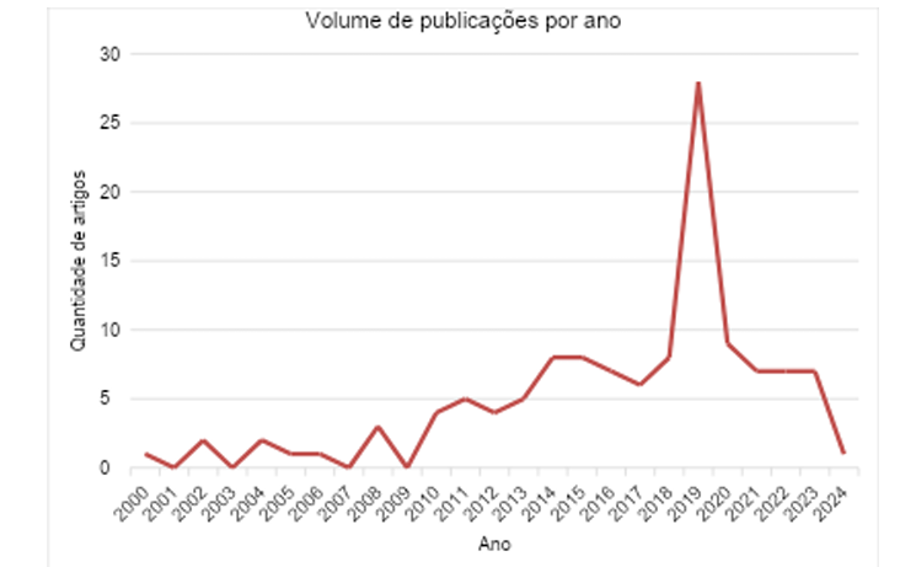
The analysis of the distribution of articles by publication year, presented in Figure 1, revealed that the first records on Emotional Intelligence in people management date back to 2000. A growth trend in the number of publications was observed from 2014 onwards, with a peak in 2019. This progressive increase reflects a growing attention and interest from researchers in the intersection between Emotional Intelligence and people management, highlighting the continuous relevance of the field of study in the academic and scientific community.
Figure 1. Temporal evolution of the volume of publications per year
Source: Original research results
This rise of the topic may indicate a response to contemporary demands and challenges in the organizational context, where Emotional Intelligence has become crucial for the effective development of organizations and the well-being of employees. Emotionally balanced individuals not only understand and identify their feelings but also manage them effectively, achieving greater personal and professional success. This capacity for emotional self-management allows for better handling of challenges, conscious decision-making, and maintaining healthy and productive relationships (Ferreira, 2017), improving communication and persuasion.
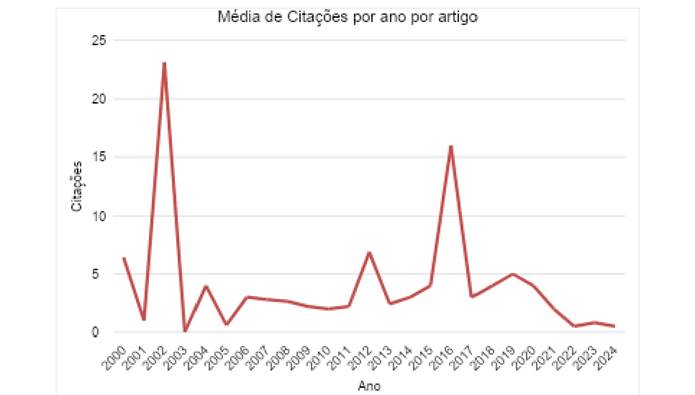
The analysis of citations, as shown in Figure 2, revealed a pattern of gradual increase starting in 2002, reaching an average of 25 citations per article. This growth suggests increasing recognition and interest from the scientific community in the topics addressed. However, after a peak in 2016, there was a decrease in citations, which may be related to the dynamics of academic research, such as the natural transformation of interests and study focuses.
Figure 2. Evolution of the number of citations per year
Source: Original research results
The publication of articles on Emotional Intelligence is fundamental for academic and practical advancement, disseminating new discoveries, theories, and methodologies. This practice contributes to the creation of a dialogue between academics, professionals, and policymakers, facilitating the exchange of ideas and collaboration. Professionals with emotional balance tend to make more appropriate decisions, manage emotions and conflicts effectively, and foster cooperation, contributing to productivity (Silva, 2016).
Table 1 presents the ten journals with the highest number of publications on Emotional Intelligence in people management, revealing the distribution of research among different scientific journals and countries.
Table 1. Main journals with the highest number of publications on emotional intelligence in people management
| # | Journals | QUANTITY | COUNTRY | SJR | TABLE OF CONTENTS |
| 1° | International Journal Of Human Resource Management | 10 | United Kingdom | 1,07 | 154 |
| 2° | Sa Journal Of Human Resource Management | 7 | South Africa | 0,27 | 14 |
| 3rd | Asia Pacific Journal Of Human Resources | 5 | Australia | 0,4 | 36 |
| 4° | Human Resource Development Quarterly | 4 | United States | 0,67 | 81 |
| 5° | Human Resource Development Review | 4 | United States | 0,73 | 75 |
| 6° | Human Resource Management Review | 4 | Netherlands | 2,14 | 213 |
| 7° | African Journal Of Business Management | 3 | Nigeria | 0,25 | 18 |
| 8° | Quality-Access To Success | 3 | Romania | 0,2 | 10 |
| 9° | Academy Of Management Executive | 2 | United States | 0,16 | 19 |
| 10° | Benchmarking-An International Journal | 2 | Switzerland | 0,36 | 35 |
Source: Original research results
The International Journal Of Human Resource Management (United Kingdom) led with 10 articles, standing out as a significant platform for disseminating research in the field. In second place, the Sa Journal Of Human Resource Management (South Africa) published 7 articles, evidencing regional engagement. The Asia Pacific Journal Of Human Resources (Australia), with 5 articles, reflects the interest of the Asia-Pacific region. Journals from the United States, such as Human Resource Development Quarterly and Human Resource Development Review, each with 4 articles, emphasize the country’s leadership in knowledge production. The Human Resource Management Review (Netherlands), also with 4 articles, contributes to geographical diversity. Other journals such as African Journal Of Business Management (Nigeria), Quality-Access To Success (Romania), Academy Of Management Executive (USA), and Benchmarking-An International Journal (Switzerland) also play important roles in disseminating knowledge in regional and global contexts. This diversity of journals and countries illustrates the multifaceted and global nature of studies, highlighting the importance of interdisciplinary dialogue and collaboration.
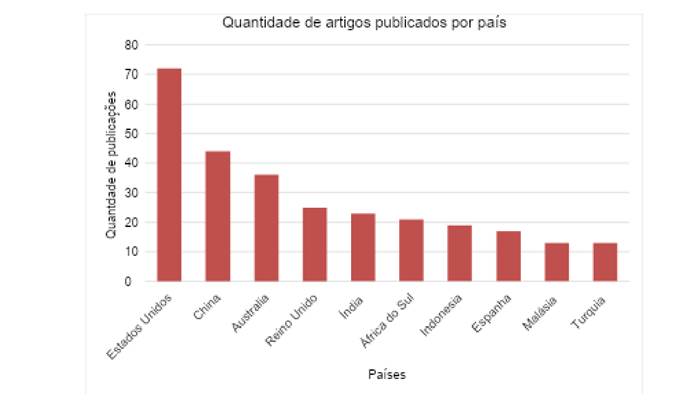
The analysis of Figure 3, which shows the number of articles published by country, offers an understanding of the engagement and interest of nations in the field of Emotional Intelligence in people management.
Figure 3. Number of articles published by country
Source: Original research results
The United States leads in the number of published articles, demonstrating strong commitment and leadership in research. China also stands out with a significant volume, reflecting growing interest and investment. Australia ranks among the main contributors, indicating engagement in the production and dissemination of knowledge. The United Kingdom, although with fewer publications than the leaders, maintains a relevant participation, evidencing a robust academic environment. The involvement of other countries demonstrates the interest and contribution of different regions, enriching the overall understanding of the topic with their perspectives and contexts.
The analysis of the main authors who published on Emotional Intelligence in people management revealed a dispersed distribution. Table 2 highlights the authors with the highest volume of publications.
Table 2. Most prolific authors
| # | AUTHORS | QUANTITIES |
| 1° | Meisler G | 3 |
| 2° | Cruz Deniz-Deniz M | 2 |
| 3° | Dulewicz V | 2 |
| 4° | Haricharan Sj | 2 |
| 5° | Higgs M | 2 |
| 6° | Jena Lk | 2 |
| 7° | Luu Trong Tuan Ltt | 2 |
| 8° | Ravlin Ec | 2 |
| 9° | Singh Sk | 2 |
| 10° | Thory K | 2 |
Source: Original research results
Meisler G. stood out with 3 publications, indicating consistent engagement. Other authors such as Cruz Deniz-Deniz M., Dulewicz V., Haricharan Sj., Higgs M., Jena LK., Luu Trong Tuan Ltt, Ravlin Ec, Singh Sk, and Thory K. contributed 2 publications each. This diversity of authors reflects the breadth and complexity of the research, suggesting dynamic collaboration and exchange of ideas. The production and publication of articles are fundamental to the advancement of academic careers and scientific recognition, opening doors for collaborations and funding. The continuity of the explored themes contributes to a solid research line, enhances writing and critical thinking skills, and enriches the academic and scientific field.
Table 3 details the authors’ production by year, including frequency, total citations (TC), and average citations per year (TCpY). This data allows for the evaluation of the authors’ contribution and the recognition of their publications over time.
Table 3. Authors’ production by year
| AUTHOR | YEAR | FREQUENCY | TC (Total citations) | TCpY (Total citations per year) |
| Dulewicz V | 2004 | 1 | 88 | 4.190 |
| Higgs M | 2004 | 1 | 88 | 4.190 |
| Meisler G | 2013 | 1 | 33 | 2.750 |
| Thory K | 2013 | 1 | 8 | 0.667 |
| Dulewicz V | 2014 | 1 | 21 | 1.909 |
| Higgs M | 2014 | 1 | 21 | 1.909 |
| Luu Trong Tuan Ltt | 2015 | 1 | 8 | 0.800 |
| Ravlin Ec | 2015 | 1 | 125 | 12.500 |
| Luu Trong Tuan Ltt | 2016 | 1 | 22 | 2.444 |
| Thory K | 2016 | 1 | 1 | 0.111 |
| Ravlin Ec | 2017 | 1 | 11 | 1.375 |
| Jena Lk | 2018 | 1 | 26 | 3.714 |
| Jena Lk | 2019 | 1 | 60 | 10.000 |
| Haricharan Sj | 2022 | 1 | 2 | 0.667 |
| Haricharan Sj | 2023 | 1 | 0 | 0.000 |
| Meisler G | 2014 | 2 | 110 | 10.000 |
| Cruz Deniz-Deniz M | 2019 | 2 | 23 | 3.833 |
| Singh Sk | 2019 | 2 | 168 | 28.000 |
Source: Original research results
The table illustrates the progress of scientific production and the relevance of each author’s work in the area of Emotional Intelligence applied to people management, allowing for the identification of influential researchers and how research has been developing. The importance of the authors’ production over the years is highlighted, with periods of great impact and relevance, as well as years with lower production that still contributed to the advancement of knowledge. Each publication and citation reflects the recognition and influence of the research in the academic context.
Table 4 presents the main organizations that have published the most studies on Emotional Intelligence in people management, identifying the institutions that stand out in the research and dissemination of these topics.
Table 4. Main organizations researching emotional intelligence in people management
| # | ORGANIZATIONS | QUANTITIES |
| 1° | Griffith University | 7 |
| 2° | University of Haifa | 7 |
| 3° | La Trobe University | 5 |
| 4° | Stellenbosch University | 5 |
| 5° | Texas A&M University | 5 |
| 6° | University of Queensland | 5 |
| 7° | Coventry University | 4 |
| 8° | Hong Kong Baptist University | 4 |
| 9° | ISCTE – University Institute of Lisbon | 4 |
| 10° | University of Cape Town | 4 |
Source: Original research results
The table reveals which universities and research centers lead article production, helping to understand the main research centers and their contributions to the advancement of knowledge. These organizations play an important role in expanding and deepening the understanding of topics, indicating centers of excellence and contributing to academic debate and the development of new practices. The presence of these institutions highlights the fundamental role of universities in creating new knowledge, promoting discussions, and developing useful practices in the organizational environment and personal life, revealing their commitment to innovation and academic quality.
Figure 3 presents the network of keywords with the highest number of occurrences among the analyzed articles. 835 keywords were identified, with the terms “emotional intelligence”, “leadership”, “human resource”, “emotional performance”, and “training” being the most used in scientific productions. These terms, which were also part of the search keywords, reinforce the validity of the obtained data.
Figure 3. Keyword network

Source: Original research results
According to Nobre (2019), the term “emotional intelligence” derives from the Latin “inter” (between) and “legere” (to choose or elect), indicating the ability to make the best choice in emotional situations. Developing emotional intelligence implies consciously and intentionally recognizing and managing one’s own emotions and those of others, using emotional skills to resolve situations effectively. This approach enhances the ability to make informed decisions, strengthens interpersonal and problem-solving skills, promoting more empathetic and collaborative relationships. Thus, emotional intelligence contributes to a more balanced and efficient social environment, where well-managed emotions are fundamental for interactions and personal growth.
The results of this bibliometric study can be applied in people management to direct investigations and strategies in a more informed and effective way, aligning practices with the contemporary needs of the organizational environment. The identification of the most relevant aspects of Emotional Intelligence can assist organizations in creating specific training programs, ensuring that employees develop emotional skills that improve the organizational climate and teamwork. By recognizing and dealing with emotions appropriately, it is possible to improve communication and collaboration, promoting a more harmonious and productive environment.
The bibliometric study on Emotional Intelligence in people management provided a detailed overview of the trends and characteristics of academic research. It was possible to identify the main works, authors, most cited articles, journals with the highest impact, and leading institutions. This data helped to understand the evolution of the field over the years, although Figure 1 indicated a drop in the volume of publications from 2020 onwards. The progress in publications and citations points to a significant increase in interest in the topic, especially during periods of social and organizational transformations, with a growing emphasis on the mental health and well-being of employees.
Figure 2 showed a stabilization in the evolution of the number of citations from 2020 onwards, but also fluctuations that suggest cycles of popularity and decline, possibly linked to changes in research focus or the emergence of new topics such as leadership, diversity, and inclusion. The frequency analysis of topics and the identification of the most cited authors validate the relevance of Emotional Intelligence in people management, providing a valuable resource for academics and professionals, allowing for a deeper understanding and improvement of practices in a dynamic and demanding environment. The identification of citation relationships and key journals empowers managers to implement evidence-based strategies, improving communication, conflict resolution, and the emotional well-being of teams. The results guide future research and practices, highlighting Emotional Intelligence in leadership as a vital area, as leaders shape emotional behavior in organizations and affect decisions, conflict management, organizational culture, and team engagement. In practice, this study offers a comprehensive overview for human resources professionals and managers, allowing them to base their decisions on concrete evidence to create an organizational environment that favors employees’ mental health, improves team cohesion, and drives organizational performance.
4. Conclusion
The study aimed to analyze the trends and panoramas of research on emotional intelligence in people management, using a bibliometric approach to map the current state of the field and its scientific productions. A significant increase in the relevance of the topic over the years was verified, with the first publication records dating back to 2000 and a peak in 2019, although a drop in volume was observed from 2020 onwards. Citation analysis revealed a gradual growth until a peak in 2016, followed by stabilization and fluctuations in subsequent years. The journals with the highest impact were identified, such as the International Journal Of Human Resource Management, and the leading countries in scientific production, with emphasis on the United States and China. The most prolific authors were also mapped, such as Meisler G., and the organizations that contributed most to the advancement of knowledge, such as Griffith University. The terms “emotional intelligence”, “leadership”, and “human resource” were the most recurrent keywords, reinforcing the centrality of these concepts in the field.
The study’s main contribution lies in providing a comprehensive, data-driven overview of the academic landscape of Emotional Intelligence in people management. This overview empowers academics and professionals to guide investigations and strategies more effectively, aligning practices with the contemporary needs of the organizational environment. The results highlight the importance of Emotional Intelligence for effective communication, conflict resolution, and fostering a positive organizational climate and employee well-being. Observed fluctuations in publications and citations suggest cycles of popularity and the emergence of new research focuses, such as leadership, diversity, and inclusion. For future studies, it is suggested to investigate the integration of Emotional Intelligence into leadership development programs, analyze different leadership styles and training effectiveness, and examine its impact on team formation and the building of healthy interpersonal relationships, essential for innovation and organizational performance.
Bibliographic References
Chiavenato, I. (2014). Gestão de pessoas: o novo papel dos recursos humanos nas organizações. 4. ed. Barueri, SP: Manole.
Ferreira, J. R. M. (2017). A relevância da inteligência emocional na comunicação de líderes para o desenvolvimento e engajamento dos empregados. Comunicação com líderes e empregados, vol. 3 Faculdade Cásper Líbero. Disponível em: <https://static.casperlibero.edu.br/uploads/2017/09/3-A-releva%CC%82ncia-da-intelige%CC%82ncia-emocional-na-comunicac%CC%A7a%CC%83o-de-li%CC%81deres.pdf .> Acesso em: 21 abr. 2024.
Goleman, D. (1995). Inteligência emocional: por que pode ser mais importante que o QI. Livros Pequenos.
Goleman, D. (2011). Inteligência emocional: a teoria revolucionária que redefine o que é ser inteligente. 2 ed. Rio de Janeiro: Objetiva.
Leahy, R.; Tirdch, D.; Napolitano, L. (2013) Regulação Emocional em Psicoterapia. São Paulo: Artmed.
Leite Filho, G. A.; Siqueira, R. L. (2007). Revista Contabilidade e Finanças USP: uma análise bibliométrica de 1999 a 2006. Revista de Informação Contábil, Recife, v. 1, n. 2, p. 102-119.
Nobre, F. O. (2019). Inteligência emocional no ambiente de trabalho e suas relações com a saúde: Revisão de Literatura. Disponível em: <https://lume.ufrgs.br/handle/10183/234630.> Acesso em: 21 abr. 2024.
Silva, E. W. (2016). Inteligência emocional e sua importância nas lideranças e no trabalho. Inovarse. Disponível em: <http://www.atenas.edu.br/uniatenas/assets/files/spic/monography/LIDERANCA_NAS_ORGANIZACOES_A_IMPORTANCIA_DA_INTELIGENCIA_EMOCIONAL_NA_LIDERANCA_E_DESEMPENHO_DE_EQUIPES.pdf . > Acesso em: 02 mai. 2024.
Siqueira, S. (2023). Inteligência emocional no trabalho: 8 formas de o RH contribuir. 11 out. 2023. Disponível em: <https://blog.solides.com.br/inteligencia-emocional-no-trabalho/.> Acesso em: 1 nov. 2023.
Vanti, N. A. P. (2002). Pesquisa bibliométrica: análise quantitativa da produção científica. Ciência da Informação, 31(2), 149-162.
Verbeek, A. et al. (2002). Measuring progress and evolution in science and technology – I: The multiple uses of bibliometrics indicators. International Journal of Management Reviews, Liverpool, v. 4, n. 2, p. 179-211.
Wolfram, D. (2017). Bibliometrics research in the era of big data: challenges and opportunities. Bibliometria e Cientometria no Brasil: infraestrutura para avaliação da pesquisa científica na Era do Big Data, 91-101.
Article originating from the Final Course Work of the Specialization in People Management of the MBA USP/Esalq
To learn more about the course, click here and access the MBX Academy platform